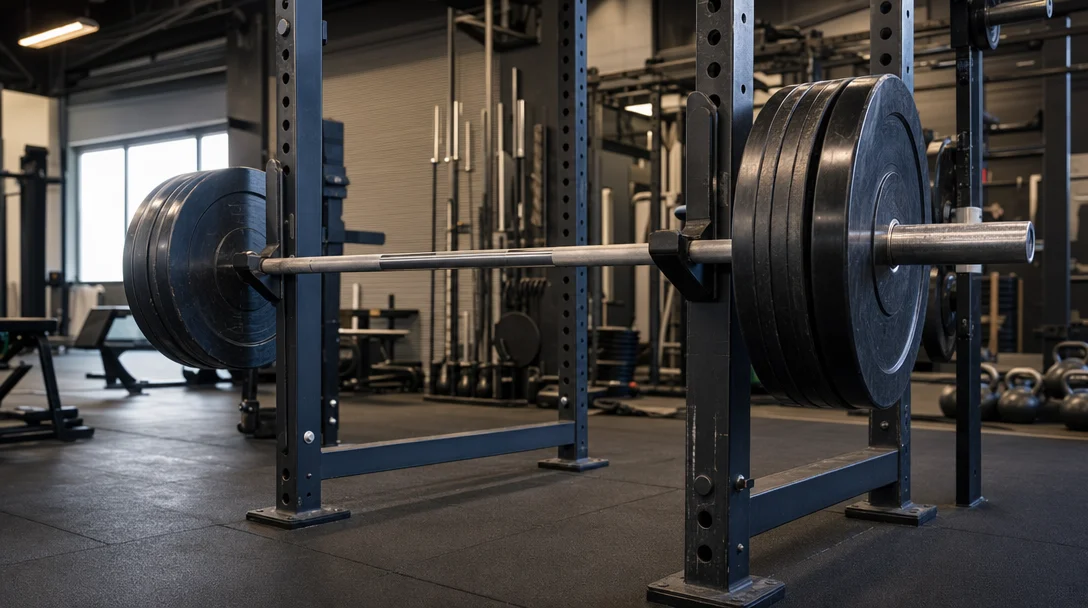
Monday Strength — StrongLifts 5×5 Workout B, Session 6
Session 6 of StrongLifts 5×5 Workout B: Back Squat 5×5 @ 70 lb, Overhead Press 5×5 @ 55 lb, Deadlift 1×5 @ 105 lb — each +5 lb from May 25. Full warmup ramp tables, 6 video demos, rest guidance, 3-level scaling, and a confirmed Hal Higdon Week 3 running preview.
Today is Workout B, Session 6 — the 4th time through the B rotation. Three lifts: Back Squat, Overhead Press (OHP), and Deadlift, always in that order. 1 Every weight is up 5 lb from the last Workout B on May 25: Squat 70 lb, OHP 55 lb, Deadlift 105 lb. 1
Session specs
| Field | Detail |
|---|---|
| Program | StrongLifts 5×5 |
| Session | Workout B — Session 6 (4th Workout B) |
| Date | Monday, June 2, 2026 |
| Lifts | Back Squat / Overhead Press / Deadlift |
| Total working sets | 11 sets (5+5+1) |
| Estimated time | 45–60 min |
| Equipment | Barbell, squat rack, weight plates |
Warm-up (~5–8 min)
Lift-specific warmup sets are the real warmup — general cardio alone does not prepare the joints and muscles for barbell work. 2 If you want a brief pre-bar routine to raise body temperature, run through this in under 5 minutes:
- 2 min light movement: jumping jacks or jog in place
- Joint mobility: ankle circles (10 each direction), leg swings (10 forward/back + 10 side-to-side per leg), hip circles (10 each direction), arm circles (10 each direction)
- Bodyweight activation: 5–8 slow bodyweight squats, 5–8 glute bridges
Then move straight into the empty-bar warmup sets below. Do not do anything intense enough to fatigue your legs before the Squat working sets. 2
Exercise 1: Back Squat — 5×5 @ 70 lb
Squat goes first because it is the most technically demanding and physically taxing lift of the session. 1 Getting it done while fresh is the point.
Warmup ramp (no rest between warmup sets; add plates and go): 2
| Set | Reps | Weight | Notes |
|---|---|---|---|
| Warmup 1 | 5 | 45 lb (empty bar) | |
| Warmup 2 | 5 | 45 lb (empty bar) | |
| Working 1–5 | 5 each | 70 lb | Rest ~3 min between working sets |
Plate math: 70 lb = 45 lb bar + 12.5 lb per side (one 10 lb + one 2.5 lb plate per side, or similar).
Key form cues (low-bar back squat):
- Bar rests on rear deltoids (the muscle shelf just below the back of the shoulder), not on top of the traps
- Feet shoulder-width apart, toes turned out roughly 30°
- Breath: big belly breath at the top, hold it through the entire rep (Valsalva maneuver), exhale only after you stand back up
- Descent: break hips and knees at the same time, keep chest up, lower until the hip crease drops just below the top of the knee
- Ascent: drive through the heels, keep knees tracking over the toes — do not let them cave inward
Video demos:
콘텐츠 카드를 불러오는 중…
Alan Thrall's low-bar squat tutorial (18 min, 1.36M views). 3
콘텐츠 카드를 불러오는 중…
Jeff Nippard's science-based squat breakdown (5.25M views) — good for checking the hip depth standard if you're unsure whether you're hitting parallel. 4
Exercise 2: Overhead Press — 5×5 @ 55 lb
OHP is programmed second so the legs get a break from the Squat load before the Deadlift. 1 Today's 55 lb is +5 lb from the 50 lb pressed on May 25. 1
Warmup ramp (no rest between warmup sets): 2
| Set | Reps | Weight | Notes |
|---|---|---|---|
| Warmup 1 | 5 | 45 lb (empty bar) | |
| Warmup 2 | 5 | 45 lb (empty bar) | |
| Working 1–5 | 5 each | 55 lb | Rest ~3 min between working sets |
Plate math: 55 lb = 45 lb bar + 5 lb per side (one 5 lb plate per side).
Key form cues:
- Bar starts on the front delts and clavicles, hands just outside shoulder-width, elbows slightly forward
- Before pressing, take a full breath; hold it through the press
- Drive the bar straight up — tuck your chin and move your head back slightly to clear the bar on the way up, then push the head back through once the bar passes the forehead
- At the top: arms locked out, shoulders shrugged up toward the ears, bar directly over the mid-foot when viewed from the side
- Common mistake to avoid: leaning back excessively turns the press into a partial incline press, which shifts the load away from the shoulders
Video demos:
콘텐츠 카드를 불러오는 중…
Mark Rippetoe's overhead press instruction (Art of Manliness) — the definitive Starting Strength/StrongLifts teaching method. 5
콘텐츠 카드를 불러오는 중…
Alan Thrall's OHP tutorial (1.19M views) — a clean, straightforward walkthrough if you prefer a quicker reference. 6
Exercise 3: Deadlift — 1×5 @ 105 lb
The Deadlift is one single working set of 5 reps — not 5×5. 1 After two exercises already done at full effort, one heavy top set is the correct load. Today's 105 lb is +5 lb from the 100 lb pulled on May 25. 1
Deadlift warmup must start at 65 lb minimum, because the bar needs to rest on the floor between reps — an empty 45 lb bar sits too low to maintain proper pulling posture. 2
Warmup ramp: 2
| Set | Reps | Weight | Notes |
|---|---|---|---|
| Warmup 1 | 5 | 65 lb (bar + 10 lb/side) | No rest after — load immediately |
| Working set | 5 | 105 lb | Rest ~3 min before this set |
Plate math: 105 lb = 45 lb bar + 30 lb per side (one 25 lb + one 5 lb plate per side).
Key form cues:
- Bar sits over mid-foot (roughly 1 inch from the shins), feet hip-width apart
- Grip just outside the legs — double overhand is fine at 105 lb
- Before pulling: take the slack out of the bar first (you'll hear a small click as it tightens against the plates), then push the floor away with your legs rather than yanking with your back
- Keep the bar in contact with the shins and thighs on the way up — bar drift away from the body is the most common inefficiency at this weight
- Lockout: hips and knees finish at the same time, standing tall at the top; no hyperextension of the lower back
- Lower under control, reset breath at the floor between each rep
Video demos:
콘텐츠 카드를 불러오는 중…
Alan Thrall's 2022 deadlift setup tutorial — updated technique walk-through covering the floor-to-lockout sequence. 7
콘텐츠 카드를 불러오는 중…
Jeremy Ethier's beginner-friendly deadlift breakdown (4.15M views) — useful if this is one of your first sessions pulling from the floor. 8
Rest intervals
All rest times are between working sets only. Warmup sets need no rest — rack the bar, change the plates, and go. 2
| Condition | Rest |
|---|---|
| Set felt manageable | ~1–2 min |
| Standard effort | ~3 min |
| Set was very hard, form was breaking | Up to 5 min |
If a set is so hard that 5 min of rest still does not restore enough for the next set, note it — that is a signal to monitor as the weight increases over coming sessions. 1
Scaling table
| Level | Back Squat | Overhead Press | Deadlift |
|---|---|---|---|
| Beginner | Drop to 50–55 lb; focus on reaching hip-crease-below-knee depth before adding weight; video-check form each session | Drop to 45 lb (empty bar); prioritize lockout and bar path over load; add 2.5 lb per session rather than 5 lb | Drop to 75–85 lb; use double overhand grip; film a set from the side to verify bar stays close to body |
| Intermediate | Follow today's 70 lb as prescribed; if any set fails, repeat 70 lb next Workout B rather than deloading | Follow 55 lb as prescribed; if rep 5 grinds on set 4 or 5, hold at 55 lb next session | Follow 105 lb top set; if the set felt smooth, add 5 lb next Workout B |
| Advanced | Add belt for sets 4–5 at this weight if low-back fatigue accumulates; explore pause squats on warmup sets to reinforce bottom position | Experiment with a slight widening of hand position if shoulder impingement is an issue at narrow grip; add 2.5 lb micro-plates if 5 lb jumps cause stalls | Start experimenting with mixed grip (one hand supinated) if grip is the limiting factor at this weight range |
Progression rule
Add 5 lb to each lift next time you perform it — provided every rep of every prescribed set was completed. 1 Lifts progress independently: a failed OHP set does not affect whether Squat or Deadlift weight goes up. If a set comes up short, repeat the same weight at the next session rather than adding weight. 1
If today goes clean, the next Workout A on Wednesday projects to: Squat 75 lb / Bench Press 60 lb / Barbell Row 80 lb. 1
Cool-down (~5–8 min)
Two to three minutes of light walking first to let the heart rate drop, then static stretches. Hold each stretch 20–30 seconds; no bouncing. 2
- Quad stretch: standing, heel pulled to glute, each leg
- Hamstring stretch: seated forward fold or standing toe touch
- Hip flexor stretch: half-kneeling lunge, each side — priority after heavy squats
- Glute stretch: figure-4 stretch seated or lying down (also called pigeon-prep), each side
- Lat/shoulder stretch: cross-body arm pull across the chest, each arm
- Chest opener: hands interlaced behind the back, lift the arms, gentle shoulder retraction
Finish with 5 slow belly breaths: 4-second inhale, 6-second exhale. 2
Week 3 running preview
Running picks back up tomorrow. Here is the confirmed Hal Higdon Novice 5K Week 3 schedule: 9
| Day | Date | Session |
|---|---|---|
| Tuesday | June 3 | 2.0 mi easy run |
| Thursday | June 5 | 1.5 mi easy run |
| Saturday | June 7 | 2.0 mi easy run |
| Sunday | June 8 | 40 min walk |
Tuesday's 2.0-mile run is the longest single session in the program so far — up from 1.75 mi last Tuesday. Thursday holds at 1.5 mi, the same distance as last week; Saturday also hits 2.0 mi, matching Tuesday. Pace stays conversational throughout: if you can speak a sentence comfortably while running, the effort is right. 9
참고 출처
- 1StrongLifts 5×5 Workout Program: Quick Start Guide
- 2StrongLifts Warmup Calculator
- 3Alan Thrall — How To Squat: Low Bar
- 4Jeff Nippard — The Perfect Squat
- 5Mark Rippetoe / Art of Manliness — Overhead Press
- 6Alan Thrall — Overhead Press
- 7Alan Thrall — Deadlift Setup (2022)
- 8Jeremy Ethier — How To Deadlift
- 9Hal Higdon — Novice 5K Training Program
이 콘텐츠를 둘러싼 관점이나 맥락을 계속 보강해 보세요.