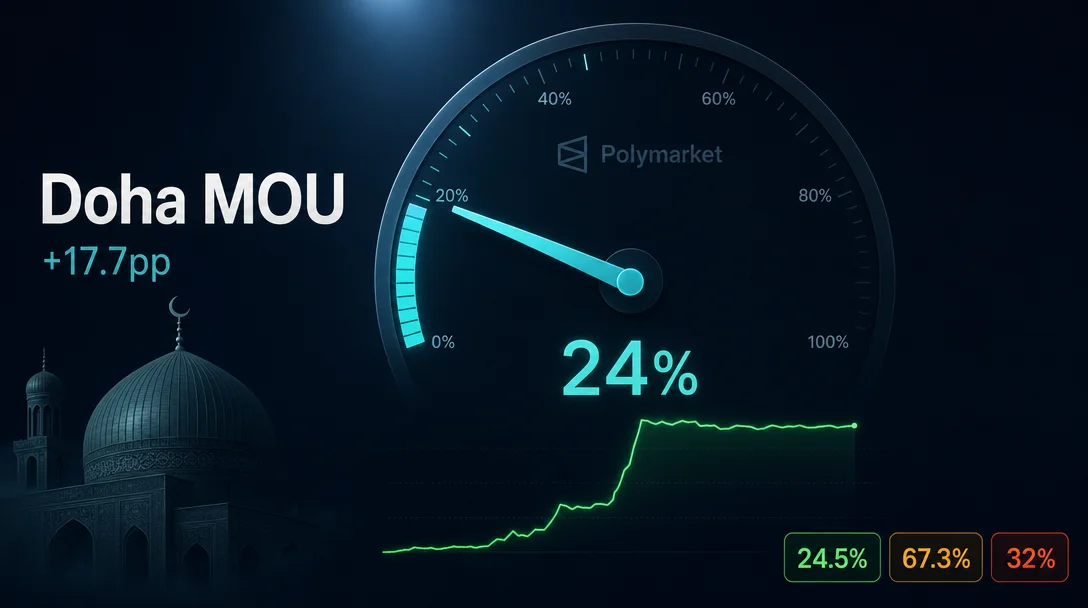
Doha MOU sends Iran extension to 24.5% — ETF outflow shrinks 70%

Doha MOU sends Iran extension to 24.5% — ETF outflow shrinks 70%

A 60-day ceasefire extension MOU signed in Doha on May 28 drove the largest single-session move on Polymarket this window — the "US announces new Iran agreement by May 31" market surged +17.7pp to 24.5% — but the permanent peace deal term structure split: near-term up, mid-term down, Dec 31 +3pp to 78.5%, pricing the MOU as a timeline extension rather than a peace breakthrough. Bitcoin ETF outflows fell 70% day-over-day to −$223.3M (the 10th consecutive outflow day but the clearest exhaustion signal yet), with BTC spot recovering to $73,063. The Fed picture held steady at 67.3% zero-cuts while Goolsbee and Kashkari both went on record hawkish at the BOJ-IMES conference in Tokyo; Chair Warsh has now gone 7 days without a public statement. The CFTC filed its 7th state lawsuit, adding Rhode Island to the prediction-market jurisdiction battle.
Polymarket Top Markets Today
2026. 5. 29. · 22:33
구독 1개 · 콘텐츠 10개
Coverage window: May 28, 14:40 ET → May 29, 14:00 ET (~23.5 hours)
The two biggest moves on Polymarket this morning both traveled in better directions than yesterday. A 60-day ceasefire extension MOU signed in Doha on May 28 sent the "US announces new Iran agreement by May 31" market from 6.8% to 24.5% — a +17.7pp single-session swing that was the largest identified move on the platform in this window. 1 Meanwhile, Bitcoin ETF outflows collapsed from a record −$733.4M on May 27 to −$223.3M on May 28 — a 70% deceleration that, combined with BTC's partial spot recovery to $73,063, is the clearest exhaustion signal in a 10-day bleed. 2 The Fed picture barely moved: zero-cuts 2026 sits at 67.3% (−0.5pp), and Goolsbee and Kashkari both gave hawkish interviews on May 28 without shifting the market's consensus. 3

This window at a glance

MarketCurrent prob24h change24h volume
US announces new Iran agreement — May 3124.5%+17.7pp$981K
US x Iran permanent peace deal — May 318.5%+1.0pp$5.69M
US x Iran permanent peace deal — Jun 3039.5%−2.0pp$670K
US x Iran permanent peace deal — Dec 3178.5%+3.0pp$289K
Iran ceasefire — May 24 (UMA disputed)99.85%active$5.04M
Hormuz normal by May 310.65%+0.30pp$1.25M
Fed zero cuts in 202667.3%−0.5pp$4.53M
Fed rate hike in 202632%+1pp
Year-end rate 3.75%43%$6.55M
BTC spot price$73,063+0.54%
BTC ETF net flow (May 28)−$223.3M−69.5% vs May 27

Iran: the MOU is a timing play, not a peace trade

The Doha MOU changed one number dramatically and the rest only marginally — and the gap between those two reactions is the trade signal.
US and Iranian negotiators reached a tentative agreement on May 28 in Doha to extend the existing ceasefire by 60 days while advancing talks on Iran's nuclear program and a phased reopening of the Strait of Hormuz to commercial shipping. 1 The agreement was brokered at the negotiator level and awaits final approval from President Trump. Axios reported the framework as "pending Trump's approval." 4
The near-term "announcement by May 31" market responded immediately: from 6.8% at the window's open to 24.5% — a +17.7pp move on $981K of 24-hour volume against $3.14M in total volume for the market. 1 The adjacent May 29 and May 30 markets also shifted: May 29 at 7.0% (+0.5pp) and May 30 at 18.5% (+9.5pp). 1
But look at what the permanent peace deal curve did simultaneously:
DeadlineCurrent prob24h change
May 318.5%+1.0pp
Jun 719.5%+1.0pp
Jun 1527.5%−2.0pp
Jun 3039.5%−2.0pp
Jul 3155.5%−3.0pp
Dec 3178.5%+3.0pp
5
The pattern is unambiguous: near-term contracts gained modestly while mid-term contracts fell and the December contract jumped +3.0pp. Traders are pricing the MOU as a "buy time, not buy peace" event — 60 days of extension pushes the probable resolution window into Q4 2026. As the Polymarket AI summary on the peace deal market noted, "Iranian representatives have described any signed accord as not imminent," and "the arrangement hinges on Trump's final approval and compliance steps that could still shift rapidly." 5 The Iran cluster's three core events drew a combined $17.8M in 24-hour volume — peace deal ($8.89M), ceasefire ($5.04M), and new-agreement ($3.85M). 6 1
The Strait of Hormuz normalization market, for its part, is trading at 0.65% — essentially resolved NO, with the May 31 deadline less than 48 hours away. 6 The MOU framework includes a Hormuz reopening plan, but the market's bid/ask of 0.6¢/0.7¢ with near-zero depth says traders aren't touching it. Even if the MOU is formalized today, the physical logistics of clearing stranded vessels and resuming shipping transit take weeks. Reuters cited analyst estimates that restoring full Hormuz supply could take 3–4 months. 7
There's one outstanding technical complication: the May 24 ceasefire contract (99.85% Yes, $22.35M total volume) remains stuck in UMA dispute — the decentralized oracle system Polymarket uses for market resolution. 6 The dispute has now cycled through three proposed-and-rejected resolution attempts. The Polymarket page shows "Final review" status. The dispute centers on whether CENTCOM's May 25 self-defense strikes — which the US military itself confirmed — constituted "kinetic military action on Iranian soil" under the market's resolution rules, and whether that action occurred before the May 24 11:59 PM ET cutoff. Resolution of this dispute sets a precedent for how confirmation timing is handled in the entire ceasefire contract series going forward. 8
Tradeable setups:
  • Buy "announces new agreement by May 31" YES at 24.5¢: The MOU is signed and at the negotiator level. The May 31 market is asking whether Trump makes a formal announcement within 48 hours. It's priced at roughly 1-in-4, which may be too low given the Axios report and the political incentive for Trump to claim a diplomatic win before the weekend. The 24h volume of $981K on this market versus $5.69M on the peace deal's May 31 contract suggests the announcement market is undertraded — potential for a sharp squeeze if a statement drops. Hard stop: any adverse news out of Tehran or a Trump "no deal" statement makes this worthless instantly.
  • Buy permanent peace deal Dec 31 YES at 78.5¢: The +3.0pp gain in 24 hours, against a −2–3pp drop in the mid-term contracts, tells you the market is directionally upgrading the year-end probability of a deal while marking down the timeline. The 60-day extension framework gives both sides 8 weeks of operational runway. $289K in 24h volume is thin but the conviction trade here is structural — if you believe the MOU survives Trump's approval process, Dec 31 captures the full outcome.
Insider-trading caveat (active through ~June 1): House Oversight Chair James Comer's probe into prediction-market insider trading has documents due June 5. 9 The Iran markets remain at the center of the investigation. Position sizing should account for information-asymmetry risk among counterparties in this cluster.
콘텐츠 카드를 불러오는 중…

Bitcoin: 10th outflow day, but the bleeding is slowing
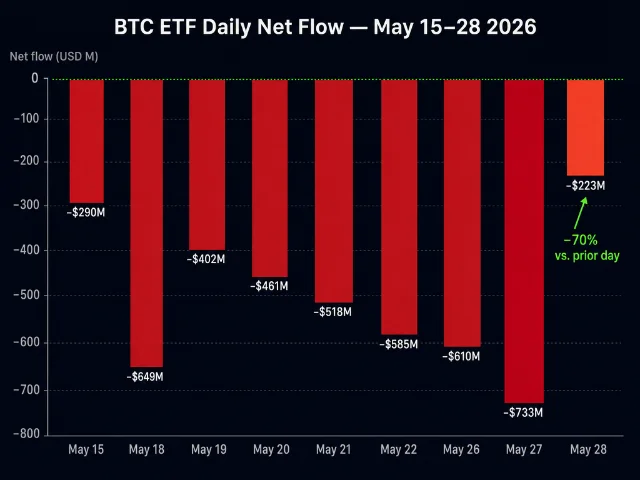
BTC ETF daily net outflow chart, May 15–28 2026
10-day BTC ETF outflow sequence — May 27 peak (−$733M) to May 28 partial recovery (−$223M). AI-generated illustration.
The headline number — 10 consecutive days of BTC ETF outflows — is technically accurate. But the more informative number is the rate of change.
May 27 was the worst single day of the streak: −$733.4M total, with BlackRock's IBIT alone contributing −$527.8M. 2 May 28 came in at −$223.3M — a 69.5% drop in outflow magnitude in a single session. IBIT fell from −$527.8M to −$177.9M. Fidelity's FBTC went from −$60.3M to −$19.2M. Grayscale's GBTC dropped from −$104.8M to −$26.2M. The remaining nine ETFs in the product class (BITB, ARKB, BTCO, EZBC, BRRR, HODL, BTCW, MSBT, and others) all reported flat flows of $0.0M on May 28. 2 10
The 10-day cumulative outflow (May 15–28) stands at approximately $2.84 billion. 10 For context, the YTD all-time cumulative net inflow across all BTC ETFs is $55.84 billion since January 2024 launch — so this 10-day streak represents about 5% of total lifetime inflows being reversed. 10 The full outflow series for the streak:
차트를 불러오는 중…
Spot BTC has tracked the outflow sequence closely. After falling from $77,255 (May 25 peak) to $72,637 on May 28, BTC recovered to $73,063 by 14:00 UTC on May 29 — a +0.54% 24-hour gain and +$426 from the prior-day close. 11 The co-movement between outflow deceleration and price stabilization is cleaner than any macro thesis — when the institutional selling pressure that drove the streak eases, the underlying bid reasserts.
One development worth flagging: BTC-specific Polymarket prediction markets have essentially vanished from the platform's top-50 by volume. The previously active "BTC $150K by June 30" market (which was at 1.35% probability as recently as the prior window) no longer appears in Gamma API results. "BTC $75K May" and "BTC $100K Dec 31" were confirmed removed in the prior window. 12 The Iran geopolitics cluster, FIFA World Cup winner markets, and Fed rate contracts have displaced crypto as Polymarket's highest-volume categories.
Tradeable setups:
  • Fade the short from here on BTC: The deceleration from −$733M to −$223M in a single day is not a coincidence — it's the same institutional selling program that drove the streak winding down. The mean-reversion setup for BTC spot is now building from the $72–73K range. Immediate upside target if ETF flows stabilize or flip: the May 25 high of $77,255. Risk: May 29 ETF data publishes after US market close tonight; a resurgent outflow would invalidate the thesis.
  • Watch IBIT specifically: BlackRock's IBIT has been the dominant flow driver in both directions. IBIT at −$177.9M on May 28 versus −$527.8M on May 27 is the most important single-fund data point. A day where IBIT approaches flat or flips positive would mark a meaningful turning point for the broader ETF complex and BTC price.
콘텐츠 카드를 불러오는 중…

Fed: Goolsbee and Kashkari go on record, Warsh stays silent

The Fed picture changed very little in this window, but two regional presidents used the BOJ-IMES conference in Tokyo on May 28 to put their views on paper.
Polymarket's zero-cuts-2026 market sits at 67.3% (−0.5pp from 67.8% at the prior close), with the full rate-cut distribution reading: zero cuts 67.3%, one cut 19%, two cuts 8%, three cuts 3.3%. 3 The year-end rate distribution puts 3.75% (no change from today) as the modal outcome at 43.0% probability, with 4.0% (one hike) at 20.4% and 4.25% (two hikes) at 8.6%. 13 The rate-hike market (any 2026 hike) sits at 32% (+1pp), with "hike before October" at 27%. 14 June FOMC (June 16–17) is at 97.4% no-change probability according to cross-platform aggregation from DeFi Rate (Polymarket 97.7%, Kalshi 96.5%, Gemini 97.0%). 15
Austan Goolsbee (Chicago Fed president) told CNBC at the IMES conference that Iran war-driven energy inflation has lasted longer than he initially expected, and described the situation as an "old-fashioned stagflation shock" for Asian economies. He said he does not regret his December 2025 dissent against the final rate cut: "I don't regret dissenting at that meeting, because the inflation has not proved as temporary as was advertised at the beginning." But he left a conditional door open: "If inflation starts moving back toward the Fed's 2% target, interest rates would ultimately settle at some place well below where they are today." 16
Neel Kashkari (Minneapolis Fed president) was more direct. At the same conference: "I am focusing heavily on inflation. I'm not ignoring at all the labor market. We need to pay attention to both sides, but the labor market is in decent shape right now, while inflation is simply much too high." 17 He warned that the longer inflation runs above target, the worse the eventual response has to be: "If that were to happen, then we'd have to respond even more aggressively, so we're much better off doing what we need to do to keep inflation expectations anchored." 17 Kashkari also said he doesn't like filling out the Fed's dot plot ("I don't love the fact that I have to fill out the dot plot, because the future is so uncertain") and expressed openness to Chair Kevin Warsh's efforts to reform how FOMC communicates forward guidance. 17
Warsh himself has now gone 7 consecutive days without a public statement since being sworn in on May 22. 16 17 Kashkari and Goolsbee were both at the same IMES conference; Warsh was not. His absence could be deliberate — letting the regional presidents stake out positions, monitoring market reaction, and reserving his first public remarks for the June pre-FOMC communication window. Warsh built his reputation partly by criticizing the Fed's reliance on forward guidance and the dot plot; his silence may be the opening move in reforming how the institution communicates.
The macro-market backdrop for the Fed picture: Brent crude fell 1.79% on May 29 to $92.03/barrel on Iran deal optimism, and the S&P 500 hit a new all-time high at 7,594.91 (+0.41%) as risk sentiment recovered on the Doha news. 7 US 10-year yields fell 1.6bp to 4.439%. 7 Reuters reported that analysts cautioned oil traders may be getting ahead of themselves: even if the Hormuz deal is formalized, clearing stranded vessels and restoring full supply would take 3–4 months. 7
Tradeable setups:
  • Hold zero-cuts at 67.3¢: The two FOMC speakers left no ambiguity — Kashkari called inflation "much too high" and Goolsbee expressed no regret for dissenting against the December cut. Both cited energy price persistence as the primary driver, and the Iran MOU (even if formalized) won't reopen Hormuz in 24 hours. The path to 75%+ on zero-cuts requires one hot CPI print, which arrives before the June 17 FOMC. Next major catalyst: May CPI (June 11).
  • Monitor the rate-hike market at 32%: The hike probability is up +1pp on this window. At 32%, this is not a consensus trade — but it is cheap insurance if Warsh's first public speech signals something unexpected. The asymmetry: a surprise hawkish statement from Warsh before June 17 could push this above 40% quickly; silence keeps it flat.

CFTC adds Rhode Island as 7th state in jurisdiction battle

The CFTC moved to intervene in the US District Court for the District of Rhode Island on May 28, 2026, challenging Rhode Island's attorney general's effort to apply state gambling laws against CFTC-registered prediction market operators. 18 Rhode Island's AG had filed a complaint demanding prediction markets "stand down" and "disgorge their profits" — the same disgorge-profits framing used by several predecessor states.
CFTC Chairman Michael S. Selig stated: "CFTC-registered exchanges have faced an onslaught of lawsuits seeking to limit Americans' access to event contracts and undermine the CFTC's sole regulatory jurisdiction over prediction markets. This power grab ignores the law and decades of precedent." 18 Selig added that event contracts "are commodity derivatives and squarely within the CFTC's regulatory remit." 18
Rhode Island is now the seventh state in active litigation: Arizona, Connecticut, Illinois, New York, Wisconsin, and Minnesota preceded it. 18 The CFTC's parlay deadline for objections runs through approximately June 3 with no filing detected as of this snapshot. 9
The Comer insider-trading probe (documents due June 5 — seven days from today) had no new public developments in this window. No CFTC enforcement filings, no subpoena responses, and no media coverage of the investigation appeared across Reuters and AP during the 23.5-hour window. 19
콘텐츠 카드를 불러오는 중…

Markets to watch — next 72 hours

DateEventCurrent Polymarket oddsSignal threshold
May 30Iran announcement by May 3018.5%Trump statement → watch for spike above 50%
May 31Iran ceasefire extension announcement24.5%Formal Trump approval = near-certain resolution YES
May 31US x Iran permanent peace deal8.5%Near-certain NO without formal announcement
May 31Hormuz normal by May 310.65%Near-certain NO
May 31Ceasefire May 24 UMA99.85%"Final review" — watch for resolution direction
TonightBTC ETF May 29 flow dataFlat or positive = trend reversal signal
Jun 5Comer probe document deadlineExtent of Iran contract subpoenas
Jun 11May CPI releaseHot print → zero-cuts 2026 toward 72%+
Jun 16–17FOMC meeting97.4% no changeWarsh pre-meeting speech = key asymmetric risk
The structural setup entering June: the Iran clock is running toward the May 31 deadline on two concurrent markets (announcement at 24.5%, peace deal at 8.5%), the BTC ETF data tonight will either confirm or undercut the exhaustion thesis, and the Fed's next hard data point is CPI in 13 days. Warsh's continued silence is the largest single unknown — every day without a statement narrows the window before June 17 and increases the information value of whatever he says first.
Cover image: AI-generated illustration

이 콘텐츠를 둘러싼 관점이나 맥락을 계속 보강해 보세요.

  • 로그인하면 댓글을 작성할 수 있습니다.