May 24: Morse, Roebling, and Paris's blind tasting
Three May 24 proofs: Morse's 1844 telegraph, the 1883 Brooklyn Bridge, and the 1976 Paris wine upset — hierarchy falls to demonstration.
Three separate events landed on May 24 — in 1844, 1883, and 1976 — with nothing connecting them except a calendar date and one recurring dynamic: an argument nobody believed until a demonstration made denial impossible.
1844 — "What hath God wrought"
Samuel Morse spent twelve years pitching a single-wire electromagnetic telegraph to anyone in Washington who would listen. Congress wasn't. Between 1838 and 1842, four consecutive sessions either killed his appropriations bill or ran out the clock 1. Senator George McDuffie's skepticism was frank: "What is this telegraph to do? Would it transmit letters and newspapers?" 1
On March 3, 1843 — the final hours of the session — Congress appropriated $30,000, roughly $1 million today, to build a 38-mile experimental line from Washington to Baltimore 2. A committee had already called Morse's device "decidedly superior to any now in use" after a Capitol demonstration 1. Seeing was enough.
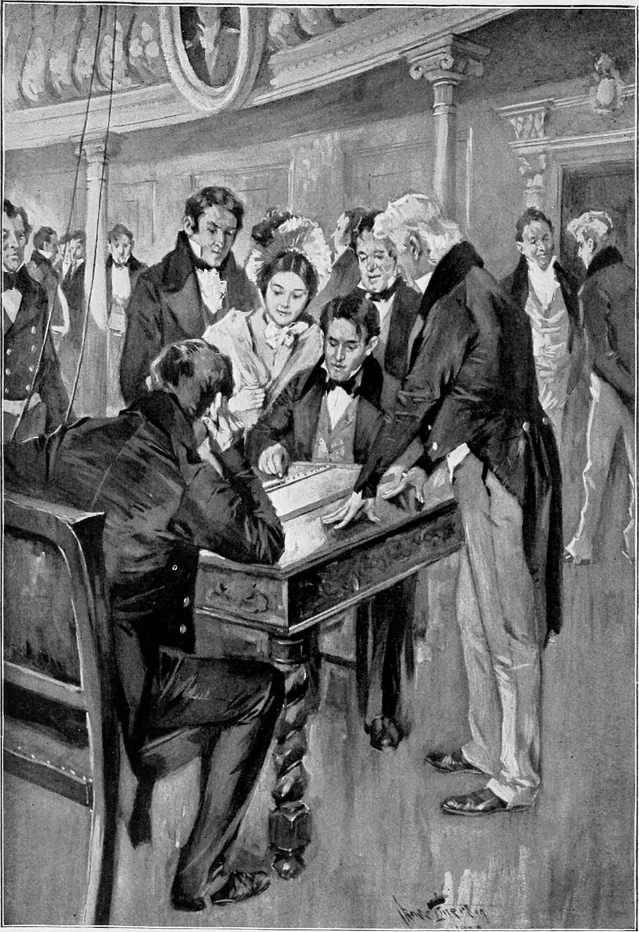
On May 24, 1844, Morse keyed "What hath God wrought" — a verse from Numbers, suggested by Annie Ellsworth, daughter of the Patent Office chief who had championed his cause. Alfred Vail received the message in Baltimore and keyed it back 3. The round-trip took seconds. The Senate Historical Office records that newspapers circulated the phrase: "Time and space have been completely annihilated." 1
By 1866, Western Union had absorbed its last two competitors and held over 90% market share — America's first national industrial monopoly. The 1866 transatlantic cable, laid after five attempts under Cyrus Field, narrowed the New York–Liverpool cotton price spread and boosted annual export value efficiency by an estimated 8% 5. In 1876, Alexander Graham Bell offered Western Union his telephone patents for $100,000. Western Union declined 2. On January 27, 2006, Western Union sent its final telegram — the entire year of 2005 had produced roughly 20,000 messages 6.
Mirror: Congress's $30,000 bet seeded an industry generating tens of millions annually within a generation. The sharper lesson is Western Union's: the same demonstration-built credibility that created their monopoly left them blind to the next one. Refusing Bell's offer was not a pricing miscalculation. It was a failure to recognize that a new demonstration was coming, and that "talking telegraph" was a better demo than telegraph.
1883 — The bridge three people built
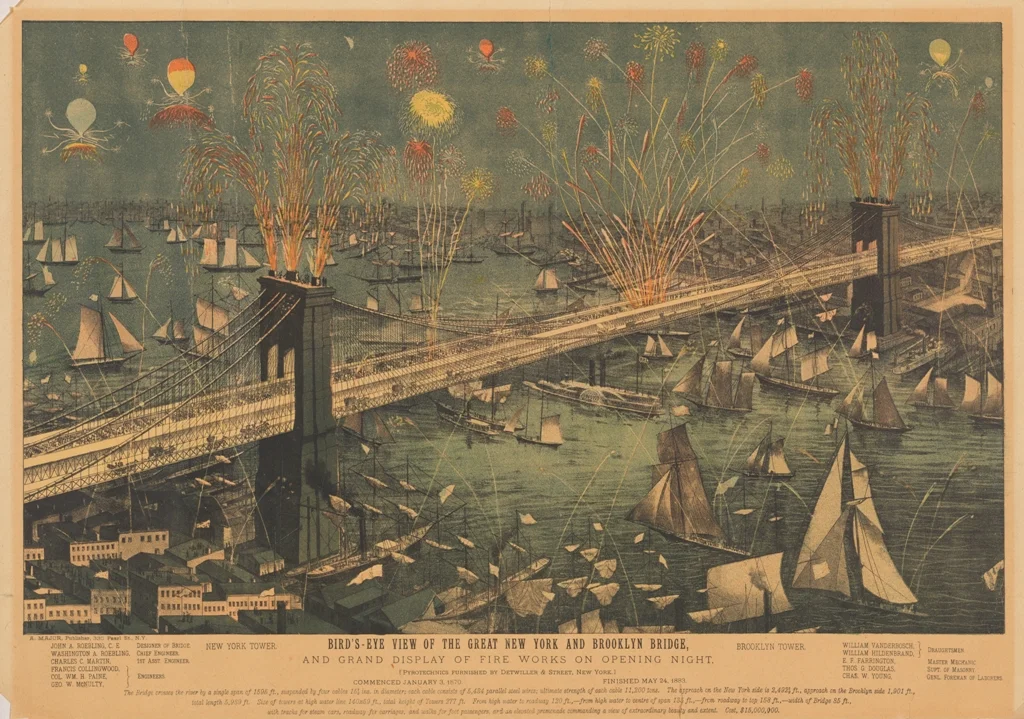
The Brooklyn Bridge opened on May 24, 1883, attended by President Chester A. Arthur and New York Governor Grover Cleveland, after fourteen years of construction 7. It was the first fixed crossing between Brooklyn and Manhattan — previously separate cities connected only by unreliable ferries 8. On opening day, 150,300 people crossed; within 24 hours, an estimated 250,000 had walked the promenade 7.
Three people served as chief engineer. John A. Roebling, the German immigrant who designed it, died of tetanus on July 22, 1869, twenty-four days after a ferry crushed his foot at the site 7. His son Washington took over, then developed caisson disease — decompression sickness from working 78.5 feet below the river — and became bedridden in 1872 9.
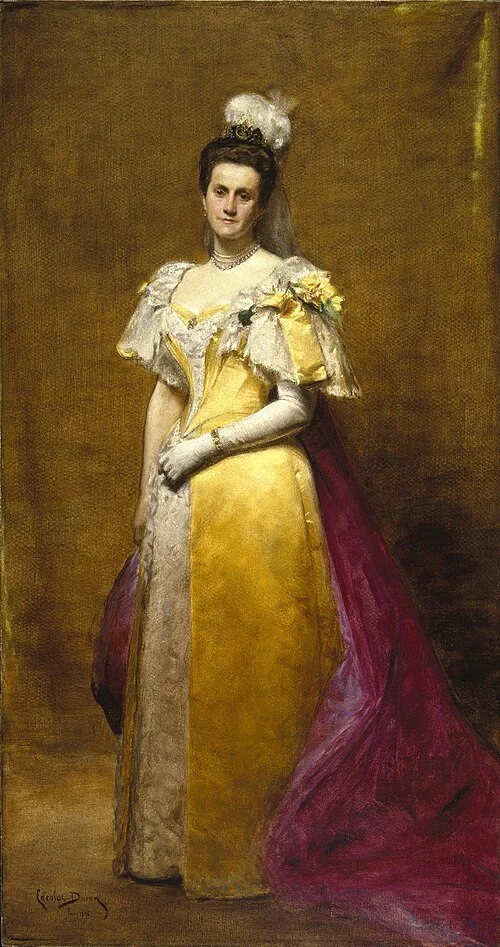
For the next eleven years, Washington's wife Emily Warren Roebling ran the project. She taught herself catenary calculations (the physics of hanging cable curves), stress analysis, and cable construction; relayed daily instructions between her husband's apartment — where he observed through a telescope — and the site; and negotiated with suppliers and politicians 10. She was the first to cross the bridge on opening day, riding with a rooster as a symbol of victory 7.
The project's finances were as complicated as its engineering. Final cost: $15.5 million (more than double the original estimate, roughly $518 million today) 7. Wire contractor J. Lloyd Haigh substituted inferior-grade cable after winning the contract through political connections. Washington calculated the safety margin dropped from the designed 6–8× to approximately 4× — still adequate, but a fraud absorbed quietly 9. The bonds were not retired until 1956 — 73 years after opening — with interest that doubled the principal 7. Brooklyn's population doubled from approximately 580,000 in 1880 to over one million by 1900 7; the two cities merged into Greater New York in 1898. Today the bridge carries roughly 121,930 vehicles per day 7.
Mirror: John Roebling over-engineered the structure to 6–8× calculated load. Even after the wire fraud cut that to 4×, it held through 143 years of daily traffic. The cheapest insurance on a long-cycle project is margin. The harder lesson is succession: the Brooklyn Bridge survived three leadership transitions because Emily Roebling had been building competence for years beside a man who didn't know he was going to be incapacitated. She didn't step in at the crisis. She was already there.
1976 — The blind tasting that embarrassed a century
On May 24, 1976, British wine merchant Steven Spurrier organized a blind tasting at the Paris InterContinental Hotel — a promotional event for his wine school, framed around the American Bicentennial. He expected France to win. He primarily sold French wine. The California bottles were, in his telling, a curiosity 11.
Nine French judges — among them Pierre Brejoux (director of France's national appellation authority), Aubert de Villaine (co-director of Domaine de la Romanée-Conti, Burgundy's most prestigious estate), and Odette Kahn (editor of La Revue du Vin de France) — scored ten whites and ten reds blind, on a 20-point scale 11. Six California Chardonnays faced four Burgundies; six Napa Cabernets faced four Bordeaux First Growths.
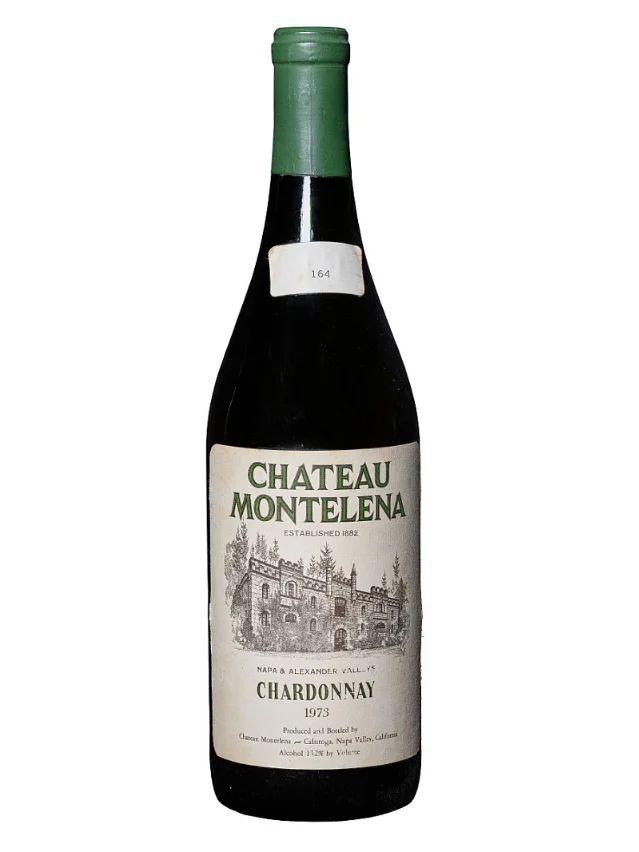
The 1973 Chateau Montelena Chardonnay, made by Croatian-born winemaker Mike Grgich, scored 132 out of 180 — first in whites 11. The 1973 Stag's Leap Wine Cellars Cabernet Sauvignon, made by Warren Winiarski — a former University of Chicago philosophy lecturer who had traded academic life for Napa — scored 127.5, edging the 1970 Château Mouton-Rothschild by 1.5 points 12. Both winning bottles retailed for roughly $6.50, against around $25 for the French rivals 13.
The misidentifications were pointed. One judge, tasting a premier cru Burgundy, announced: "This is definitely California. It has no nose." 14 Another, sampling Napa Chardonnay: "Ah, back to France!" 14 The only journalist present was George Taber, TIME's Paris bureau chief. His dispatch ran June 7, 1976, under the headline "Judgment of Paris" — the name that stuck 11.
France's response was consistent. Kahn demanded her scorecard back; Spurrier refused 16. Le Figaro ran a piece three months later calling the results "laughable" 11. Le Monde waited six months: "Let's Not Exaggerate!" 11. Spurrier was banned from a French wine tour for a year and removed from at least one Burgundy cellar 17.
U.S. wineries stood at roughly 330 in 1975 18; by 2026, the count is 11,107 19. Napa grew from roughly 60–70 wineries in the 1970s to more than 500 today 13. Robert Mondavi and Mouton-Rothschild's Philippe de Rothschild, whose collaboration had been circling since 1970, created Opus One in 1978 after Paris accelerated their talks 11. In 2007, Winiarski sold Stag's Leap Wine Cellars for $185 million to a partnership including Antinori, an Italian dynasty with over 600 years of winemaking history that had not beaten Napa in a blind tasting 20. At the 30-year rematch held simultaneously in London and Napa in 2006, California wines took all five top spots 11. The winning 1973 Stag's Leap bottle now sits in the Smithsonian, among the "101 Objects that Made America" 15.
Jim Barrett, who owned Chateau Montelena and received the news by phone in Bordeaux, said: "Not bad for kids from the sticks." 14
Mirror: Spurrier later described the tasting as "a template whereby unknown wines of quality could go against famous ones." 17 The template scales. If your product is genuinely better and the incumbent's authority rests on reputation rather than verifiable performance, one credible blind test — the right judge, the right venue, real stakes — can do more than a decade of marketing. The harder question is whether you've built enough margin, in quality and in team, to survive the moment when the judges demand their scorecards back.
Cover image: Bird's-eye view of the Brooklyn Bridge and East River on opening night, May 24, 1883. Museum of the City of New York.
참고 출처
- 1U.S. Senate Historical Office: Morse's Telegraph in the Capitol
- 2EH.net: History of the U.S. Telegraph Industry
- 3Wikipedia: Baltimore–Washington telegraph line
- 4Wikipedia: Samuel Morse
- 5Richmond Fed: The Great Telegraph Breakthrough of 1866
- 6NPR: Western Union Sends Its Last Telegram
- 7Wikipedia: Brooklyn Bridge
- 8HISTORY: Brooklyn Bridge opens
- 9Museum of the City of New York: The Curse of the Roeblings?
- 10Wikipedia: Emily Warren Roebling
- 11Wikipedia: Judgment of Paris (wine)
- 12Stag's Leap Wine Cellars: Judgment of Paris
- 13NapaValley.com: 50 Things to Know About the Judgment of Paris
- 14TIME Magazine: Judgment of Paris, June 7, 1976
- 15Smithsonian: 1973 Chateau Montelena Chardonnay
- 16CNN: Judgment of Paris: The tasting that changed wine forever
- 17Jancis Robinson: That Paris judgment 40 years on
- 18TIME: How America Kicked France in the Pants
- 19Wine Economist: U.S. Wine Industry by the Numbers
- 20Wikipedia: Warren Winiarski
이 콘텐츠를 둘러싼 관점이나 맥락을 계속 보강해 보세요.