Geopolitics Daily Brief — June 9, 2026
Five stories at 08:00 UTC: Iran-Israel attacks halt after Trump-Netanyahu call as Hormuz deal talks resume; Pentagon blacklists Alibaba, BYD and Baidu as military companies in widest-ever CMIC expansion; Ukraine's long-range strikes force Russia off the Kinburn Spit while Kremlin rejects European peace plan; China deploys coast guard east of Taiwan after Japan-Philippines maritime deal; Kospi rebounds 5%+ after Monday's 8.3% crash, semiconductors recover, bonds face Hormuz-or-growth inflection.

Five stories at 08:00 UTC. Iran and Israel stepped back from full-scale war after Trump called Netanyahu; the US blacklisted Alibaba, BYD and Baidu as military companies; Russia rejected every peace proposal while Ukraine destroyed oil infrastructure deep inside Russian territory; China sailed coast guard ships east of Taiwan following a Japan-Philippines maritime deal; and bond markets are flashing a warning investors should not ignore.
1. Iran-Israel ceasefire holds — for now — as Trump claims nuclear deal is "days away"
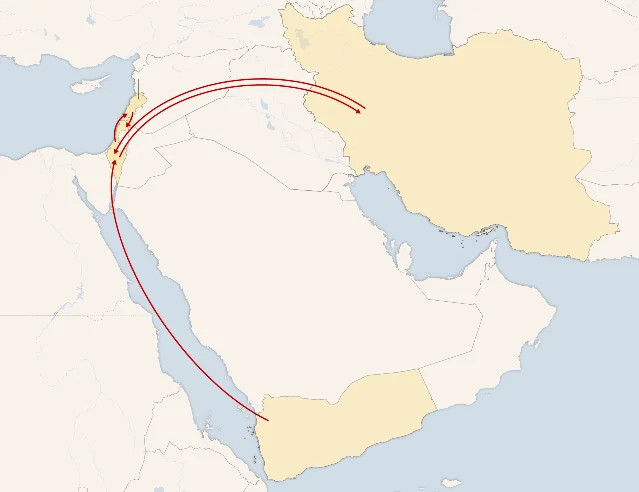
Iran and Israel exchanged their most intense fire in months over the weekend before both sides halted operations on Monday after a direct call between President Trump and Prime Minister Netanyahu. Israel struck Hezbollah targets on the outskirts of Beirut on Sunday; Iran responded with waves of ballistic missiles; Israel launched two rounds of airstrikes on Monday, hitting military sites and Iran's Mahshahr petrochemical complex, before Netanyahu ordered a halt. 1
Trump told Netanyahu that Washington and Tehran were "within days" of a breakthrough on a framework for long-term nuclear talks. A White House official said the US blockade of the Strait of Hormuz remains in effect; Iran is demanding release of frozen assets, and Washington wants Hormuz mines removed before any financial concessions. 1 Iran's parliament speaker Mohammad Bagher Ghalibaf said publicly that Trump's comments on the memo of understanding contradicted what had been agreed, signalling Tehran's continued distrust.
Israel said its schools would reopen Tuesday but Israeli Defence Minister Israel Katz warned Israel was still ready to strike Beirut if it saw fit. Lebanon's President Aoun accused Iran of "using Lebanon as a bargaining chip." Meanwhile the Houthis declared a naval blockade of Israel and fired a missile intercepted near Eilat. CENTCOM confirmed disabling the Palau-flagged tanker Marivexx in the Gulf of Oman after it tried to reach an Iranian port, the seventh vessel disabled since April 13. Gaza's Kerem Shalom and Rafah crossings were closed Sunday after Iranian strikes and are set to reopen gradually from Tuesday, according to Israel's COGAT. 1
Market and supply-chain impact. Brent spiked 5.4% to $98.08 during the exchange before falling back to around $94.70 once Iran signalled the military operation was over. 2 The Strait of Hormuz — through which roughly 20% of the world's daily oil and gas moves — remains blockaded. Morgan Stanley's fixed income research head said that if oil reaches $130–$150 per barrel, yield markets would start pricing in a growth shock rather than an inflation shock. 3 Insurance premiums on tanker routes through the Gulf of Oman remain elevated.
2. Pentagon blacklists Alibaba, BYD and Baidu as "Chinese military companies"
The US Department of Defence published a Federal Register notice designating Alibaba, Baidu, BYD, Nio, WuXi AppTec, Unitree, TP-Link, JA Solar, Trina Solar, BOE Technology Group, CALB, EVE Energy, Hesai and RoboSense as "Chinese military companies" under Section 1260H of the National Defence Authorisation Act, with the listing formally effective Wednesday. 4 The designation does not trigger automatic sanctions but complicates access to US capital markets and federal contracts. Alibaba called it baseless and said it would take "all available legal action."
The breadth of the list — spanning EVs, AI, batteries, solar, lidar, display panels, biotech, and robotics — makes it the widest single expansion of the CMIC blacklist and is widely read as targeting sectors central to the US-China technology contest rather than entities with direct military roles.
Market and supply-chain impact. The listing pushes US institutional investors managing portfolios with CMIC-restricted mandates to reassess positions across Chinese consumer tech, clean energy and semiconductor supply chains simultaneously. BYD and Nio shares in Hong Kong fell in early trade on Monday. Procurement managers sourcing EV batteries (CALB, EVE Energy) or lidar sensors (Hesai, RoboSense) will need to assess whether their US government-related contracts create compliance exposure. The simultaneous coverage of solar (JA Solar, Trina Solar) adds to the cost pressure on US utility-scale renewables projects that depend on Chinese panels.
3. Russia abandons Kinburn Spit as Ukraine's long-range strike campaign deepens
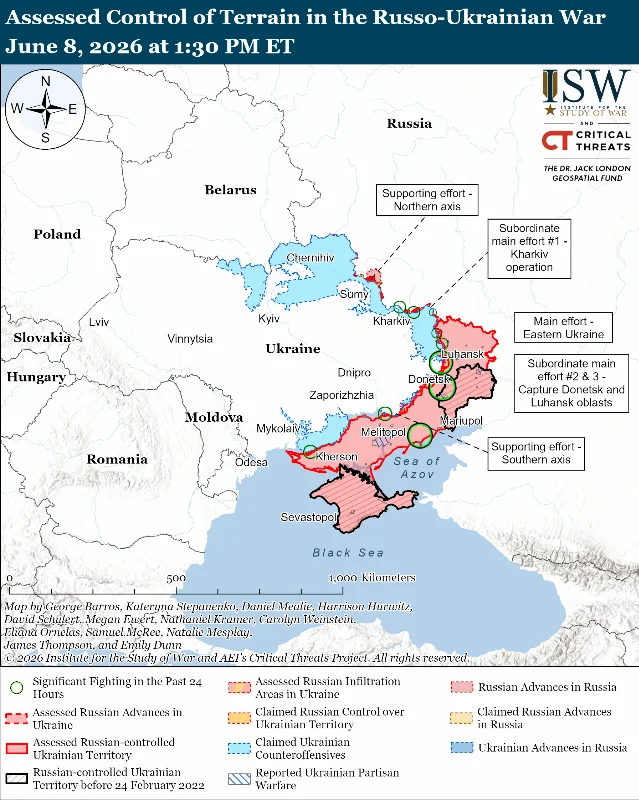
The Russian 337th Airborne Regiment has begun withdrawing from the Kinburn Spit in Mykolaiv Oblast after Ukraine's intermediate-range strike campaign cut food, fuel and ammunition deliveries to forces there, according to Ukrainian partisan group Atesh reporting cited in ISW's June 8 assessment. 5 Simultaneously, Ukraine struck the Grushovaya oil terminal near Novorossiysk (part of Russia's main southern oil export pipeline), an oil depot in Crimea's Hvardiiske, and a linear production station feeding the Volgograd refinery, all confirmed by geolocated footage and NASA FIRMS heat data.
The Kremlin flatly rejected a joint UK-France-Germany-Ukraine proposal issued June 7 calling for an immediate ceasefire and frontline freeze. Foreign Minister Lavrov invoked alleged "understandings" from the August 2025 Alaska Summit to portray Russia as a willing negotiator, a framing ISW assessed as false. 5 Zelensky confirmed he met Russian oligarch Roman Abramovich in Kyiv as Putin's back-channel intermediary, but Putin rejected the offer of direct leader talks. Russian Duma defence officials said the European proposals are "unacceptable" and that Moscow's goal requires reaching Ukraine's "western borders."
NATO French jets downed a drone over Latvia for the first time after Russian electronic warfare diverted it into Latvian airspace — the second such incident near NATO borders in a week after a Ukrainian USV entered Romanian territorial waters on June 5. Russia launched 155 drones against Ukraine overnight. 5
Market and supply-chain impact. Ukraine's deepening strike campaign against Russia's Novorossiysk export terminal and Crimea rail lines is progressively reducing Russian crude-export capacity from the Black Sea. Gasoline rationing is in effect in occupied Crimea (20-litre QR-code limits at TES stations). European defence procurement: France's counter-drone startup Alta Ares raised €50 million on June 9, a concrete data point in the accelerating European counter-UAS market. 3
4. China conducts second "special maritime law enforcement operation" east of Taiwan
China's Coast Guard deployed six cutters and patrol vessels east of Taiwan's Luzon Strait in its second "special maritime law enforcement operation" in the area, triggered by Japan and the Philippines beginning maritime boundary discussions in waters east of Taiwan. 6 Taiwan's Defence Ministry called the operation a "provocative act" and said its military would closely coordinate with its own coast guard. 7
In the 24 hours to 06:00 Tuesday, Taiwan tracked one PLA helicopter entering its southeastern ADIZ, six naval vessels, and nine official ships — 15 vessels in total. Taiwan deployed aircraft, naval units and coastal missile batteries to monitor activity. For the month of June so far, Taiwan has logged 93 PLA aircraft sorties and 112 ship detections. 7 The operations continue the grey-zone pattern running since September 2020, with Beijing using coast guard patrols — rather than PLA Navy warships — in what is legally Taiwan's surrounding waters to establish jurisdictional precedent without triggering a direct military threshold.
Market and supply-chain impact. The Luzon Strait channel east of Taiwan carries critical undersea data cables linking Japan, the Philippines, and the broader Pacific. Elevated PLA and coast guard presence near the strait raises the perceived risk premium for telecoms and financial infrastructure in the region. TSMC, which fabricates advanced chips 200 km from the PLA helicopter's ADIZ entry point, continued normal operations; but the modal escalation — coast guard east of the island, not just through the Strait — is a new vector for institutional risk teams.
5. Markets: semiconductor rebound, Kospi recovery, bonds at a crossroads
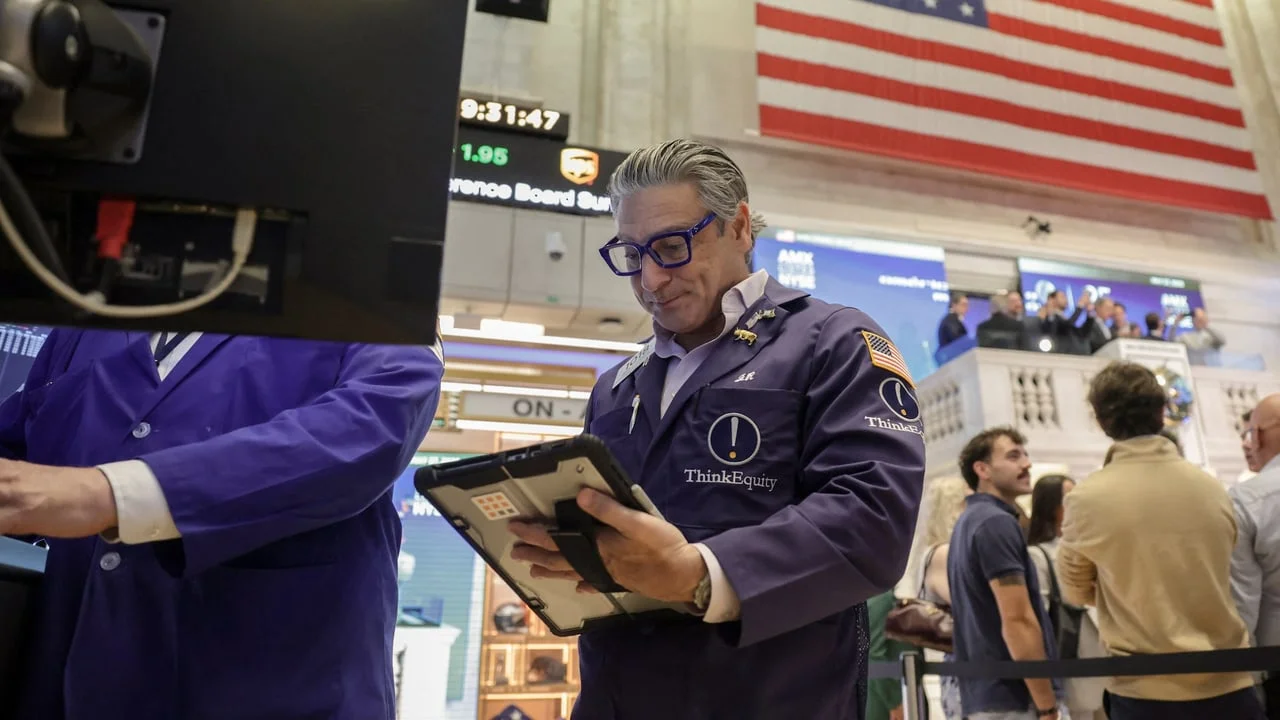
Asian equity markets are staging a recovery Tuesday morning after Monday's sharp selloff. Kospi futures were up more than 5% and Nikkei futures up more than 2% as Middle East tensions eased and US chip stocks rebounded. 2 The Kospi fell 8.3% on Monday — its largest single-day drop since March — as investors unwound crowded AI and semiconductor positions; Samsung and SK Hynix were the largest drags. The semiconductor selloff was itself triggered by the Nasdaq's worst session since April 2025 on Friday, after Broadcom's AI chip revenue guidance miss.
On Wall Street Monday, the Philadelphia Semiconductor Index jumped 5.6% — its best day since the selloff — led by Intel, which surged 11.2% on a reported order from Alphabet for over 3 million TPUs, and Micron, up 9.9%. 2
The deeper structural story is in bonds. Ten-year US Treasury yields are at 4.556%, with 30-year Treasuries above 5%. JPMorgan raised its year-end 10-year yield forecast to 4.70%, citing a resilient labour market. ECB markets are pricing in 25bps of tightening on Thursday with ~70bps total for 2026. Since the Iran war began in late February, 10-year Treasuries have delivered –1.5% (–5.4% annualised) and German Bunds –2.4% (–8.7% annualised), compared with 39% annualised returns for the S&P 500. Global fund managers are at their most underweight in bonds since June 2022. 3
PIMCO's Konstantin Veit said bonds "look very attractive" globally, including in Europe and Japan. The inflection point depends on Hormuz: if the strait reopens, rate-hike bets unwind and bonds rally; if the closure persists long enough to threaten growth, bonds reclaim safe-haven status. T. Rowe Price's Yoram Lustig put the semiconductor supply-chain risk plainly: "If you have a geopolitical event that will impact the production of semiconductors, that's going to impact massively financial markets." 3
Sources: New York Times (Iran-Israel live), South China Morning Post (Pentagon blacklist), ISW/Critical Threats (Russia-Ukraine), Taiwan News (PLA tracking), Reuters (bonds/markets), Saxo Bank APAC Research (Asia markets).
참고 출처
- 1New York Times live updates
- 2Saxo Asia Market Quick Take 9 June 2026
- 3Reuters — Investors spy tipping point for bonds
- 4South China Morning Post
- 5ISW/Critical Threats, Russian Offensive Campaign Assessment June 8 2026
- 6Reuters — Taiwan says China Coast Guard patrols provocative
- 7Taiwan News — Taiwan tracks 15 Chinese ships
이 콘텐츠를 둘러싼 관점이나 맥락을 계속 보강해 보세요.