Forty years of almost losing them: the ruby slippers’ unlikely path to the Smithsonian
Made in 1938, forgotten in an MGM basement, and nearly stolen forever — how Dorothy’s ruby slippers reached the Smithsonian.
Forty years of almost losing them: the ruby slippers' unlikely path to the Smithsonian
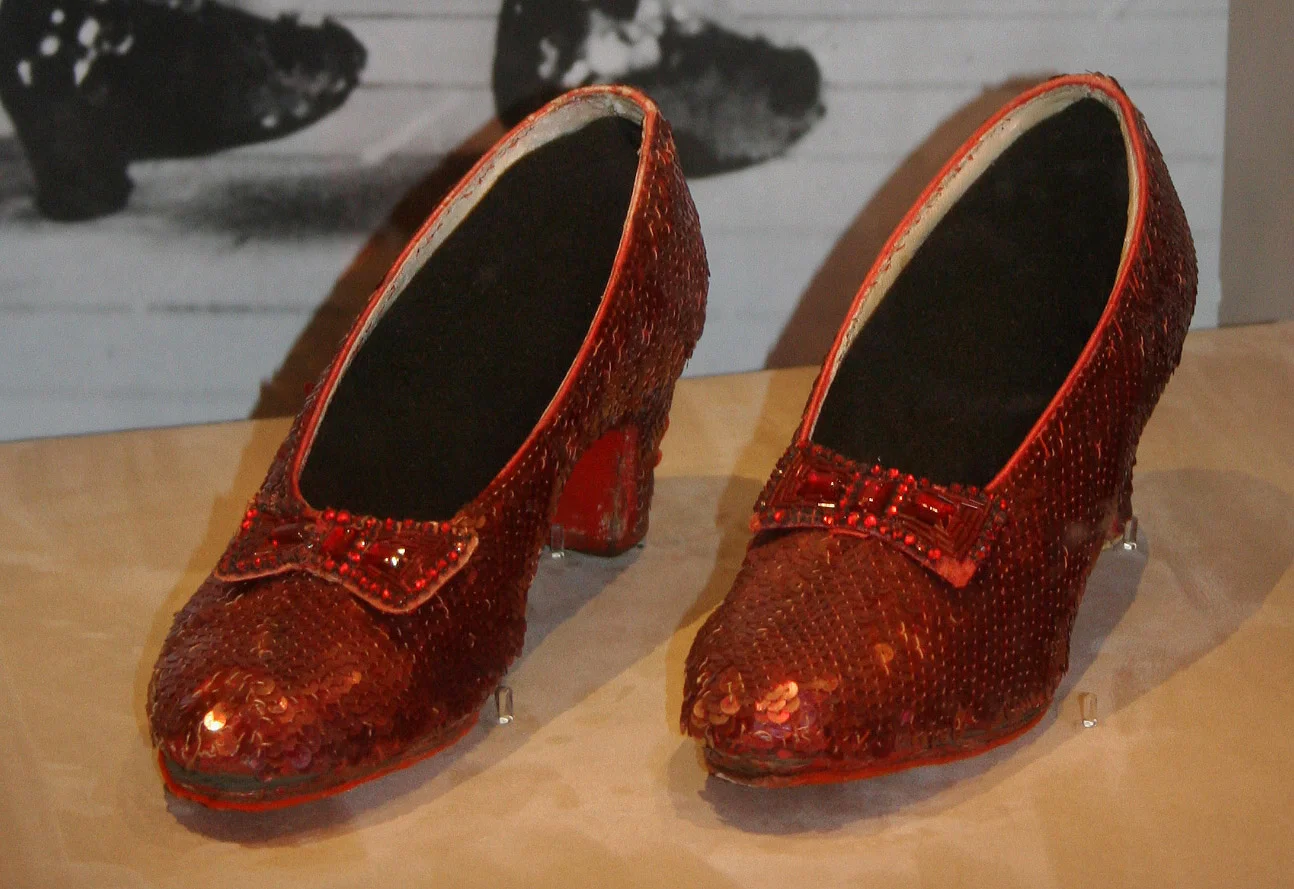
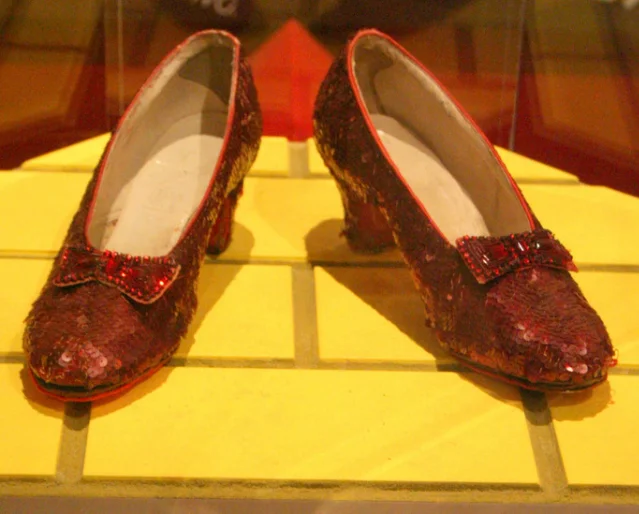
Walk into the popular culture galleries of the National Museum of American History in Washington, D.C., and a pair of shoes stops you. They sit inside a climate-controlled case under carefully calibrated lights — low enough to protect the glass, bright enough to make the sequins ignite. The color is not quite the fire-engine red you remember from the film. It is deeper, more aubergine than scarlet, closer to burgundy wine than ruby. Under the right angle of the light, each of the roughly 2,300 glass sequins per shoe catches and scatters the beam separately, so the whole surface shimmers as if it is breathing. 1
These are Dorothy's ruby slippers, accession number nmah_445196. They were made in Los Angeles in 1938 or early 1939, worn by Judy Garland on a soundstage in Culver City, stored in an MGM basement for three decades, sold at an auction for $15,000, held by an anonymous donor for nine years, and donated to the Smithsonian, which has been guarding them ever since. 1 2 They are, by the measure of the December 2024 auction market, the single most valuable category of film memorabilia in the world. 1 The story of how they ended up behind that glass — and how they nearly didn't — runs from a novelist's Kansas farmhouse to a Hollywood wardrobe cage to a Minnesota jewel thief who thought the sequins were real rubies.
Silver shoes and a color revolution
The ruby slippers should have been silver. In L. Frank Baum's original 1900 novel The Wonderful Wizard of Oz, Dorothy's magical footwear is made of silver, enchanted by the Wicked Witch of the East, and powerful enough to carry her home to Kansas. 3 For the first thirty-nine years of the story's life, across theatrical productions and the 1925 silent film, the shoes remained silver whenever they were shown at all.
In 1938, when MGM began adapting the book, a screenwriter named Noel Langley proposed the change that would transform a literary plot device into a visual icon. His reasoning was purely technological. The studio had committed to filming in three-strip Technicolor — a process that could render vivid, saturated reds on screen with an almost supernatural intensity. Silver would read on film as a flat, cold grey. Ruby red would glow. 3 1 Smithsonian magazine's Jesse Rhodes, writing in January 2009, described the color change as not cosmetic but essential — it turned functional footwear into "one of the most recognizable objects in movie history." 1
The decision had one technical wrinkle. Bright red sequins, tested under Technicolor's color temperature, appeared orange on screen. The actual sequins sewn onto every surviving pair are a deeper, darker burgundy that reads as true ruby red only under the specific lighting conditions of the film. 1 It is a reminder that the shoes were always a performance object — engineered to look a certain way under camera, not in a museum case. The slippers on display today look, to our eyes, slightly darker than Dorothy's shoes on the screen. That discrepancy is built into the design.
Gilbert Adrian and the butterfly bow
The man responsible for translating Langley's color suggestion into actual footwear was Gilbert Adrian (1903–1959), MGM's chief costume designer from 1928 to 1941. Adrian had designed costumes for over 250 films during Hollywood's Golden Age — Camille, Marie Antoinette, The Women — but The Wizard of Oz was, in retrospect, the assignment that generated his most durable legacy. 1
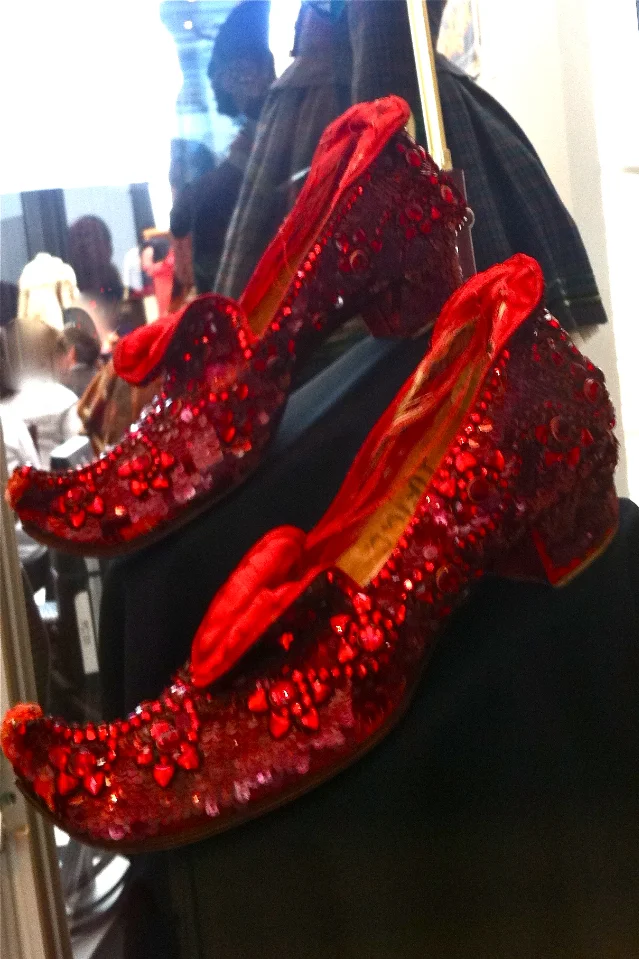
His first attempt was theatrical to the point of parody. The so-called "Arabian test pair" featured curled, upturned toes, an elaborate jeweled heel, and decorative flourishes that looked more like a Scheherazade prop than a Kansas girl's shoe. The producers rejected the design immediately. They wanted something that preserved Dorothy's farm-girl innocence while still reading as magical. 1
The approved design was Adrian's second attempt: a simple pump silhouette from the Innes Shoe Company of Los Angeles — inexpensive white silk pumps, the standard-issue base used for female costumes across the studio — dyed red and covered in hand-sewn sequined organza overlays. 1 Two weeks before filming began, Adrian added a crucial final touch: butterfly-shaped red leather bows applied to the toe of each shoe. Each Art Deco-inspired bow was three to four inches wide, centered on three large rectangular red-glass jewels and outlined in rows of dark red bugle beads and faceted red glass rhinestones set in silver-toned metal settings. 1
The materials analysis conducted during the Smithsonian's 2016–18 conservation confirmed what Rhys Thomas had documented in the Los Angeles Times in March 1988: the sequins are genuine glass, not early plastic. 1 Glass sequins are heavier and more reflective than plastic, which is why they catch the light the way they do — and why they have proven so fragile in the decades since. Each right shoe bears an embossed gold or silver stamp inside, the Innes Shoe Company maker's mark. 1
How many pairs, and who made them
Producer Mervyn LeRoy, looking back on the production years later, gave the vaguest of tallies: "We must have had five or ten pairs of those shoes." 1 A wardrobe woman on the production gave a more specific count: six identical pairs, plus the rejected Arabian prototype. The author Rhys Thomas, whose 1989 book The Ruby Slippers of Oz remains the primary documentary study, attributed the fabrication to Joe Napoli of the Western Costume Company. However he assigns that role cautiously — the evidence is incomplete and the pairs were likely assembled over time as the need arose during shooting, rather than all at once. 1
Five pairs are known to have survived into the present. They are:
- "The People's Shoes" — the NMAH Smithsonian pair, mismatched sizes 5C and 5BC, donated anonymously in 1979. Orange felt glued to the soles for sound deadening during dance sequences. The pair considered most likely to have been worn by Garland during the Yellow Brick Road scenes. 1
- The Michael Shaw pair — stolen from the Judy Garland Museum in Grand Rapids, Minnesota in 2005 and recovered by the FBI in 2018. Sold at Heritage Auctions on December 7, 2024 for $28 million ($32.5 million with buyer's premium), a record for any piece of film memorabilia, drawing over 800 bidders. 1
- The close-up pair (sometimes called the "Witch's Shoes") — the best-preserved surviving pair, inscribed "#7 Judy Garland" in the lining, with characteristic circular heel-click scuff marks on the soles. Acquired by the Academy Museum of Motion Pictures in 2012 with assistance from Leonardo DiCaprio and Steven Spielberg. 1
- The Arabian test pair — Adrian's rejected curled-toe design, owned by actress Debbie Reynolds, sold at auction in June 2011 for $510,000. 1
- The stunt-double pair — lining inscribed "Double," likely made for Bobbie Koshay, Garland's stunt double, size 6B. Owned by Hollywood memorabilia dealer David Elkouby. 1
All surviving working pairs share one construction detail that the NMAH pair exemplifies: orange felt glued to the leather soles. The felt was applied to deaden the sound of Garland's feet on the Yellow Brick Road set floor, which was a hard surface that would have registered clearly on the production's early sound recording equipment. 1 Dr. Brent Glass, then director of the National Museum of American History, confirmed the NMAH pair's role on Oprah Winfrey's program on January 23, 2008: "they were worn by Judy Garland during her dance routines on the Yellow Brick Road because there's felt on the bottom of these slippers." 1
The slippers fit Judy Garland badly. All surviving pairs measure between size 5 and 6, ranging from B to D widths. Garland's actual foot was reportedly closer to size 6½. She wore the slippers only when her feet were visible on camera. In the apple-throwing orchard scene, sharp-eyed viewers can catch her wearing plain black shoes instead. 1
Kent Warner and the MGM basement
In early 1970, MGM was in financial trouble. The studio that had produced The Wizard of Oz, Singin' in the Rain, and Ben-Hur was hemorrhaging money, and the new management's solution was blunt: liquidate the archive. In February and March of that year, MGM held a massive sale of props, costumes, and set pieces accumulated over four decades. 1
A costumer named Kent Warner was assigned to help catalog the items for auction. Working in the basement of MGM's wardrobe building, Warner found what had been forgotten for over thirty years: multiple pairs of ruby slippers from The Wizard of Oz, sitting in storage as if the studio had never noticed they existed. 1
Warner already supplemented his income by selling studio memorabilia privately, and he understood immediately what he had found. One pair was chosen as the auction's centerpiece and heavily promoted in the catalog. It sold for $15,000 — roughly $120,000 in 2025 purchasing power — to a lawyer acting on behalf of an unidentified client. 1
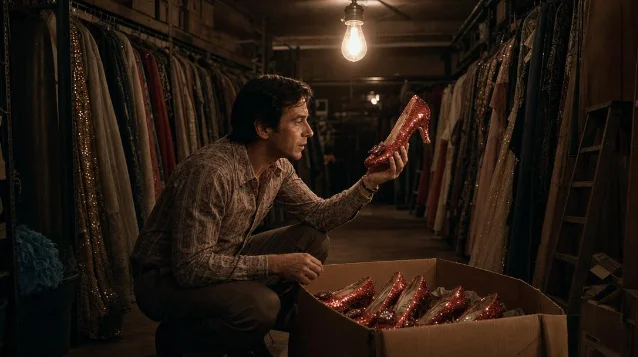
Warner kept for himself the best-condition pair — the close-up "Witch's Shoes" with the "#7 Judy Garland" inscription — which he later sold through Christie's East in 1981 for $12,000. That pair eventually changed hands for $165,000 before reaching the Academy Museum. Warner sold another pair to collector Michael Shaw, and the Arabian test pair to Debbie Reynolds. 1
The New York Times's Larry Rohter, writing in May 1990, observed that for decades movie studios had treated old props and costumes as trash. Warner was among the first to recognize and profit from their cultural value. The 1970 MGM auction is now regarded as the founding moment of the Hollywood memorabilia industry — the point at which the market understood that what a studio considered surplus inventory, the public considered irreplaceable history. 1
Warner died in 1984, never seeing just how valuable his discovery would prove.
An anonymous gift
The lawyer who bought the auction pair in 1970 was acting on behalf of a client who has never been identified. For nine years, the slippers passed through private hands — held quietly, out of public view. Then, in 1979, an anonymous donor gave them to the Smithsonian Institution's National Museum of American History. 1 2 The donor insisted on complete anonymity, and the Smithsonian has honored that condition; the identity has never been publicly disclosed.
The acquisition was not merely a donation. It was a declaration. Museum historians note that bringing Judy Garland's screen-worn shoes into the permanent collection of a federal Smithsonian museum validated, for the first time at an institutional level, the idea that film costumes and popular culture artifacts deserve the same rigorous museological attention as presidential portraits and revolutionary-era documents. The slippers entered the museum's Division of Cultural and Community Life, within the Popular Culture collections, and have been on near-continuous public display ever since. 1
Dwight Blocker Bowers, curator at the Smithsonian's Lemelson Center, would later frame their significance precisely: the ruby slippers represent "Inventing an American Icon." They are not, he argued, merely movie props. They are artifacts that define how Americans understand their own cultural heritage — objects that carry the entire weight of the 1939 film's emotional mythology, condensed into a pair of shoes that a seventeen-year-old actress found too tight to wear for more than a few minutes at a stretch. 1
The NMAH pair carries one more secret that only came to light decades later. The left shoe (size 5C) and the right shoe (size 5BC) are not actually a matched pair — they were mixed up at some point before or during the 1970 auction. The true mate of the NMAH left shoe is the right shoe of the pair that Michael Shaw would eventually own. 1 The shoes have been mismatched in a Smithsonian display case for over forty years, and almost no one knew.
Conservation crisis
By 2016, the slippers were deteriorating visibly. The glass sequins — which had always been more fragile than they looked, their coating subject to environmental stress — were flaking and loosening. Threads were failing. The silk faille base was degrading. The Smithsonian faced a familiar institutional dilemma: a beloved object in a federal collection, under pressure, with insufficient dedicated funding to address it. 1
The museum's response was unusual. In October 2016, the National Museum of American History launched a Kickstarter campaign — "Keep Them Ruby," later "Save the Ruby Slippers" — seeking $300,000 for conservation and research. For a federally funded museum to turn to public crowdfunding was a striking step, reflecting both the constraints on federal arts budgets and the particular emotional charge that these objects carry. 1
The campaign exceeded its goal. Thousands of individual donors contributed, generating national media coverage across NPR, Smithsonian Magazine, and major news outlets. The public response confirmed what museum staff had long observed: that visitors often become visibly emotional standing in front of the display case. The slippers function, in Bowers's phrase, as secular relics — objects for which people make pilgrimages. 1
The conservation work that followed included stabilizing the loose sequins and failing threads, conducting a detailed materials analysis that confirmed the sequins are genuine glass (not early-generation plastic, as some had assumed), and constructing a specialized climate-controlled display case with regulated humidity, temperature, and light levels. The slippers were removed from display during treatment and reinstalled in their new environmentally controlled case in 2018. 1
The great ruby slipper theft
On the night of August 27–28, 2005, a pair of ruby slippers owned by collector Michael Shaw was stolen from the Judy Garland Museum in Grand Rapids, Minnesota, where they were on temporary loan. The thief smashed a display case and took only the slippers, leaving behind other valuable Oz memorabilia. A single red sequin was found at the scene. There were no fingerprints. 1
The case went cold for thirteen years. In 2015, an anonymous donor offered a $1 million reward for information leading to the slippers' return. In 2018, the FBI recovered them in an undercover sting operation in Minneapolis. 1
In March 2023, a federal grand jury indicted Terry Jon Martin, a Minnesota man with a prior history of jewel theft. Martin pleaded guilty and was sentenced to time served in January 2024 — he was terminally ill and in hospice care. His stated motive had a wry, terrible logic to it: he believed the large jewels set into the butterfly bows were genuine gemstones. He planned to pry them out and sell them. When he discovered they were worthless glass — exactly what they had always been — he claimed to have disposed of the shoes. 1
The recovered pair was authenticated by Smithsonian conservators, who could compare the glass sequin composition against the documented materials of the NMAH pair. Michael Shaw regained possession and consigned them to Heritage Auctions. On December 7, 2024, the Shaw pair sold for $28 million ($32.5 million with buyer's premium), setting a record for any piece of film memorabilia in history — nearly seven times the $4.6 million previously paid for Marilyn Monroe's "subway dress." Over 800 bidders competed, including the Judy Garland Museum itself, which tried and failed to buy the shoes back. 1
What the shoes carry
The Smithsonian's pair — the "People's Shoes," mismatched, donated anonymously, never sold again — now sits in its controlled-environment case while the replica auction pair makes headlines. Salman Rushdie, in his 1994 short story "At the Auction of the Ruby Slippers" (published in East, West), imagined bidders hoping that the shoes' magic would grant personal and political liberation in "a destitute world." The story is a fiction, but the impulse it describes is real: the slippers function as containers for meaning that overflows any reasonable accounting of what they are — dyed silk, glass, leather, bugle beads. 1
Scholarly interpretations multiply. One reading sees the slippers as a symbol of American technological modernism — Technicolor as industrial art, the studio system as a factory of aspiration. Another locates in them the anxiety of the Depression era: Dorothy's Kansas is drought-stricken, her family struggling, and the shoes that carry her home speak directly to the experience of a generation of Dust Bowl migrants for whom "home" was simultaneously lost and longed for. 1 The 2009 film Night at the Museum: Battle of the Smithsonian placed the slippers among the museum's living exhibits; the Harry Winston jewelry company made a three-million-dollar diamond-and-ruby tribute pair in 1989 to mark the film's fiftieth anniversary. 1 None of these gestures quite explains what happens to visitors when they stand in front of the real ones.
The shoes were made to be consumed by a camera. They were designed to look a specific way under specific lights at a specific color temperature that no longer exists in any working studio. They were found in a basement. They were sold for fifteen thousand dollars by a lawyer who would not say who hired him. They were given away by a donor who would not say who they were. They deteriorated for decades in a glass case, and strangers on the internet sent money to save them. One pair was stolen by a man who wanted the jewels and found there were no jewels.
The ruby slippers at the Smithsonian are, among other things, a record of every hand they passed through to get there — and a reminder that the objects we call icons are usually just objects that survived.
Cover image: Dorothy's ruby slippers at the National Museum of American History. Photo by Smithsonian Institution, Wikimedia Commons (CC0 / public domain).
이 콘텐츠를 둘러싼 관점이나 맥락을 계속 보강해 보세요.