1/4

每日一花
brownsun
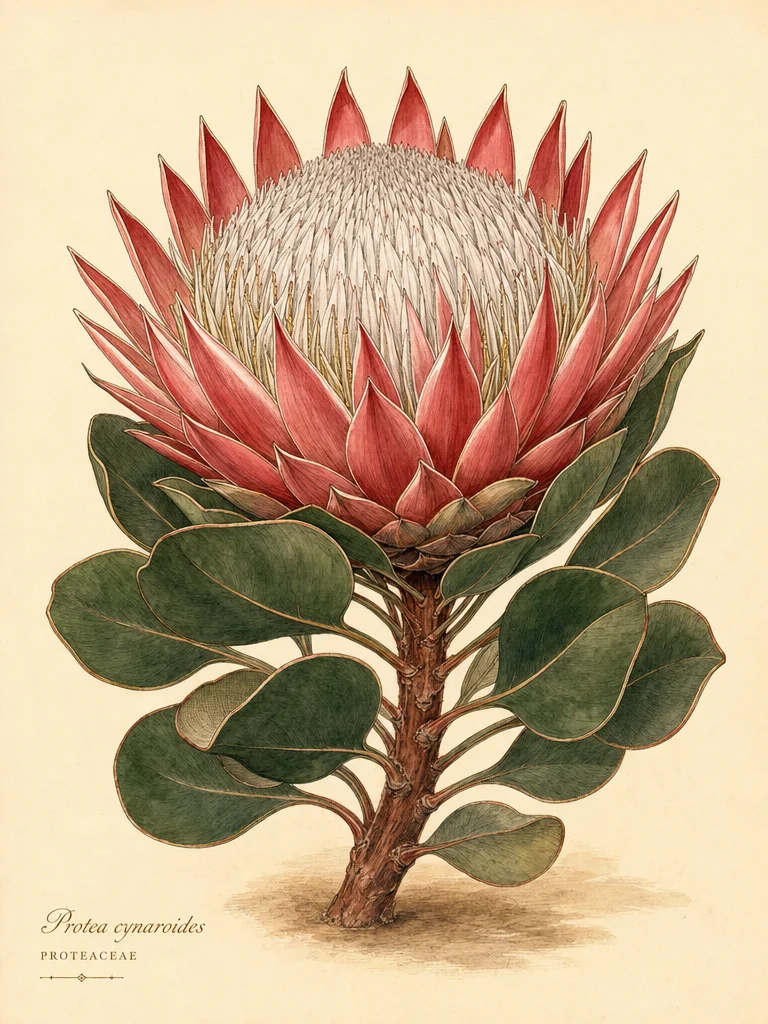
Protea cynaroides — the "flower" that is actually two hundred flowers, and survives by burning
A complete botanical profile of the King Protea: South Africa's national flower, whose massive dinner-plate-sized bloom is not a single flower but a capitulum of up to 200 individual florets ringed by modified leaves. The plant belongs to one of the world's oldest flowering-plant families (Proteaceae, ~95–120 million years old, Gondwanan in origin) and survives repeated fynbos wildfires via a dense underground lignotuber that sprouts anew within weeks of a burn.
2026. 6. 1. · 08:08
갤러리
Protea cynaroides (King Protea) · Family: Proteaceae
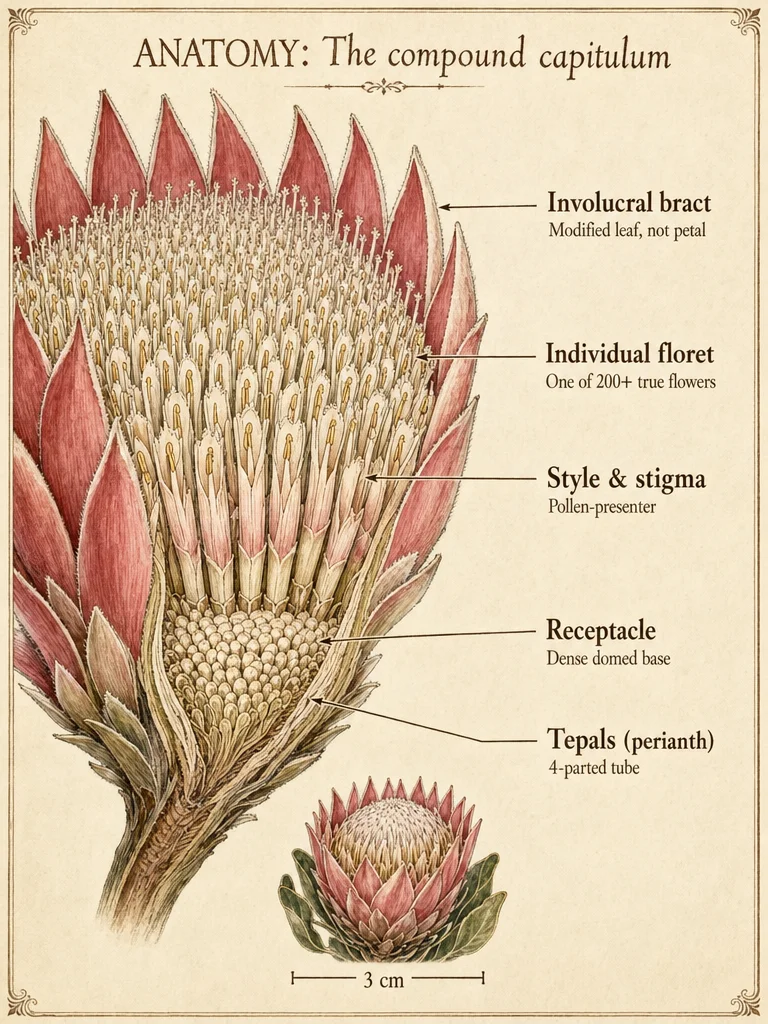
What you see when a King Protea is in bloom is not a single flower. That showy structure — sometimes the size of a dinner plate, 12 to 30 centimetres across, ringed with stiff pointed bracts in shades from pale cream to deep crimson — is a capitulum: a condensed flower head packed with up to 200 individual tubular florets, each one a complete flower with its own tepals, style, and stamens. The bracts that look like petals are modified leaves. The actual petals are the narrow tubes inside. It is, in botanical terms, more closely related to a sunflower's head than to any true single-petalled bloom — just orders of magnitude more dramatic.
The species
Scientific name: Protea cynaroides (L.) L.
Common names: King Protea, King Sugar Bush
Family: Proteaceae
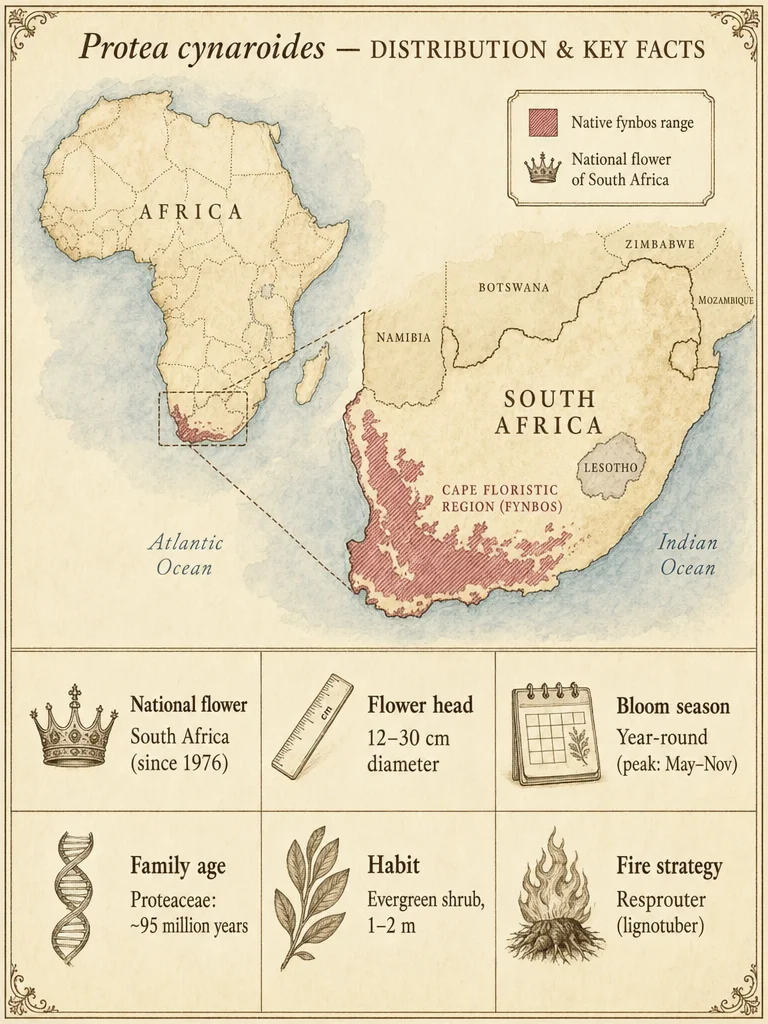
Native range: Cape Floristic Region, South Africa — concentrated in the southwestern and southern Cape, from the Cederberg Mountains to the Langeberg Range, generally below 1,500 m altitude
The species epithet cynaroides means "resembling Cynara" — the artichoke genus — because Linnaeus thought the flower head looked like an artichoke thistle. He was not wrong.
Habitat and growing conditions
King Protea is endemic to the fynbos biome: the ancient, extraordinarily species-rich heathland that covers the Cape Floristic Region. Fynbos soils are nutrient-poor, often acidic, and sandy. King Protea thrives in precisely these conditions — it is adapted to low phosphorus levels that would stunt most other plants.
Altitude range: sea level to about 1,500 m. Rainfall: 250–2,000 mm annually, predominantly winter-falling. The plant grows as an upright evergreen shrub, typically 0.5–2 m tall, with thick leathery leaves and a stout woody stem.
The bloom
Unusually for a large showy inflorescence, P. cynaroides blooms year-round, with a peak from May to November. Individual plants carry multiple stems, each capable of producing a flower head. Bract colour varies from white to pale pink, through salmon and deep rose, to intense crimson — partly reflecting ecotype variation, partly individual genetics.
Pollination is primarily by Cape sugarbirds (Promerops cafer) and Orange-breasted sunbirds (Anthobaphes violacea), which probe the florets for nectar and carry pollen on their faces and chests to the next plant. The capitulum's shape, orientation, and sturdy receptacle base are well-matched to a bird landing and gripping while feeding.
The fire adaptation: one of the most studied in botany
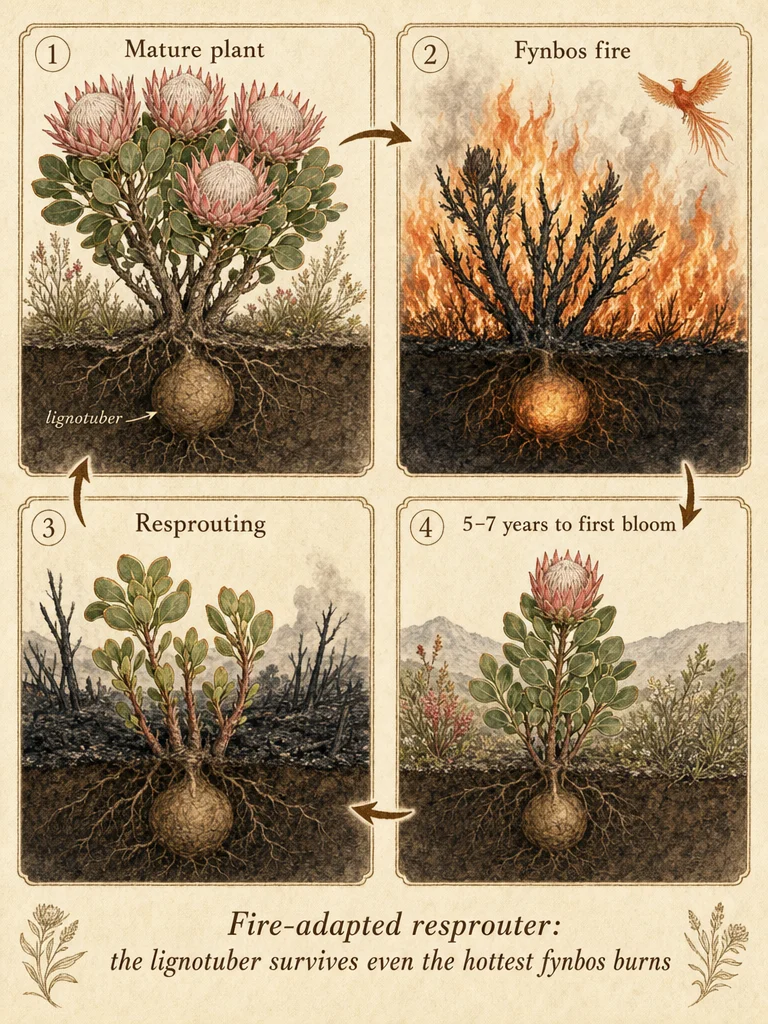
The fynbos burns. Periodic fire is not a disaster for this ecosystem — it is a requirement. Accumulated dead biomass, seed-germination triggers, and nutrient cycling all depend on fire returning every 5–40 years. Protea cynaroides has evolved accordingly.
Beneath the soil, the plant maintains a lignotuber: a dense, starchy, woody swelling packed with dormant buds and carbohydrate reserves. When fire sweeps through and kills every stem above ground, the lignotuber survives. Within weeks, vigorous new shoots emerge from the surviving tissue. A mature plant can resprout to flowering size in 5–7 years after a burn — considerably faster than growing from seed.
This "resprouter" strategy contrasts with "seeders" (plants that die in a fire but whose seeds are triggered to germinate by heat or smoke). P. cynaroides bets on individual survival across multiple fire cycles. Because the lignotuber can live for decades, old plants in unburned patches accumulate extensive underground reserves — one reason why artificially fire-suppressed fynbos tends to see King Protea populations age out and decline.
An ancient family
Proteaceae, the family P. cynaroides belongs to, traces its origin to when Africa, South America, Australia, and Antarctica were still joined as Gondwana, roughly 95–120 million years ago. The family's present distribution — rich in southern Africa and Australia, with representatives in South America and the Pacific — maps almost exactly onto the old Gondwanan landmasses. King Protea is not just a South African flower; it is a living fragment of supercontinent biogeography.
Human significance
Protea cynaroides has been South Africa's national flower since 1976. The South African national cricket team is nicknamed "The Proteas." The country's leading domestic one-day cricket competition is also named for the flower.
As a cut flower and garden specimen, King Protea is grown commercially in South Africa, California, Australia, New Zealand, and Israel. The flower heads dry well, keeping their shape and most of their colour, which has made them a staple of dried-flower arrangements globally.
Medicinal use: fynbos communities have historically used Protea leaf preparations as cough and throat remedies, though this is not a primary modern use.
The one fact worth remembering
What looks like a single grand flower is really two hundred flowers sharing one stage — and the whole structure, from the underground lignotuber to the bird-shaped landing pad of bracts, is engineered not just to reproduce but to survive the next fire and do it again.
Issue 12 · 每日一花 · June 1, 2026
댓글