The 18-year-old who nearly swept tennis history — and lost it all to a cement truck
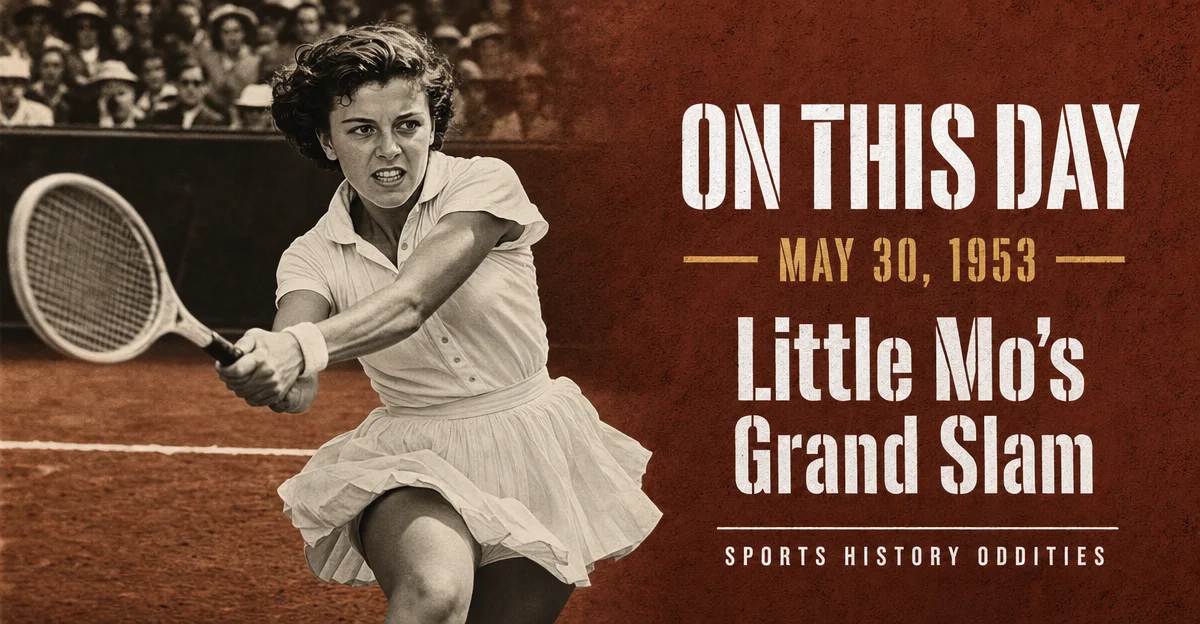
On May 30, 1953, 18-year-old Maureen "Little Mo" Connolly won the French Championships to start the first women's calendar-year Grand Slam — losing just one set all season. Fourteen months later, a concrete mixer truck ended her career at 19.

On the morning of Saturday, May 30, 1953, Maureen Connolly walked onto the clay courts of Stade Roland-Garros in Paris knowing exactly what was on the line. She was 18 years old, ranked world No. 1, and already the reigning champion at Wimbledon and the U.S. National Championships. Now she was two sets away from the French title — and, though nobody said it out loud quite yet, two sets away from something no woman in tennis history had ever done. 1
Her opponent was Doris Hart — the defending French champion (she'd won in 1950 and 1952), seeded second, 28 years old, and every inch a legitimate threat. 2
Connolly beat her 6–2, 6–4. It wasn't close.
A name from a battleship
To understand why this mattered, you have to understand where the nickname came from.
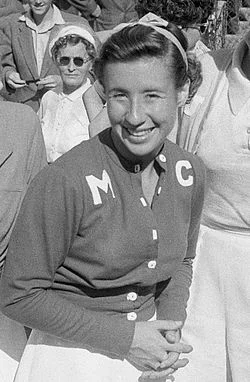
When Connolly was 11 years old, a San Diego sportswriter named Nelson Fisher watched her bludgeon balls from the baseline and reached for the obvious naval metaphor. He called her "Little Mo" — a reference to the USS Missouri, the battleship known as "Big Mo." The comparison: that much firepower packed into that small a frame. She stood 5 feet 4 inches tall. 3
The name stuck — because it was accurate. Connolly's game had almost no finesse in the strategic sense. She didn't come to the net much. She stayed back and hit the ball so hard that her opponents simply couldn't cope. New York Times tennis correspondent Allison Danzig — himself later inducted into the Tennis Hall of Fame — put it plainly: "Maureen, with her perfect timing, fluency, balance and confidence, has developed the most overpowering stroke of its kind the game has known." 4
She won the U.S. National Championships at 16, becoming the youngest champion at that event at the time. She won Wimbledon at 17. By the time she arrived in Paris at 18, she had hired Australian Davis Cup captain Harry Hopman as her coach specifically for this season — her first year entering all four Grand Slam tournaments. 1
One set. That's it.
Here is the absurd part of what happened in 1953.
Connolly won all four Grand Slam tournaments that year: the Australian Championships in January, the French in May, Wimbledon in July, and the U.S. National Championships in September. She became the first woman in tennis history to complete a calendar-year Grand Slam — and only the second player ever to do so, after Don Budge achieved it in the men's draw in 1938. 5
Across those four events — dozens of matches, hundreds of games — she lost one set.
One. In the third round of the French Championships against French player Susan Chatrier (the 8th seed), Connolly dropped the first set 3–6. She then won 6–2, 6–2 and the rest of the tournament without dropping another. 6
The four Grand Slam finals that year looked like this:
| Grand Slam | Final opponent | Score |
|---|---|---|
| Australian Championships | Julie Sampson | 6–3, 6–2 |
| French Championships | Doris Hart | 6–2, 6–4 |
| Wimbledon | Doris Hart | 8–6, 7–5 |
| U.S. National Championships | Doris Hart | 6–2, 6–4 |
Hart played Connolly in three of four Grand Slam finals that year and lost all three. The Associated Press named Connolly Female Athlete of the Year for the third consecutive year — 1951, 1952, and 1953. 1 She was 18 years old.
In her 1957 autobiography Forehand Drive, she described the psychology behind that record with startling candor:
"I have always believed greatness on a tennis court was my destiny, a dark destiny, at times, where the court became my secret jungle and I a lonely, fear-stricken hunter. I was a strange little girl armed with hate, fear, and a Golden Racket."
That is not how most athletes write about their teenage dominance. It is, however, the kind of self-portrait that explains how someone loses one set in four Grand Slams. 1
The cement truck
Connolly won the French Championships again in 1954. She defended her Wimbledon title in 1954. In the last nine Grand Slam tournaments she ever played, she won all nine. Her winning streak in Grand Slam singles matches at some point reached 50 consecutive wins. 3
She had planned to turn professional after the 1954 U.S. National Championships. The money would finally be there. The career trajectory was pointing toward a decade of dominance.
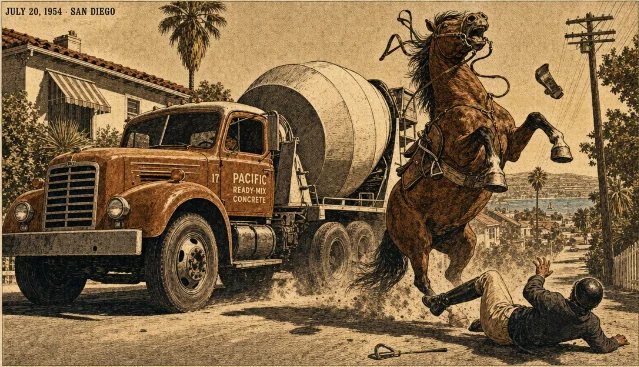
Then, on July 20, 1954 — two weeks after her third consecutive Wimbledon title — Connolly went horseback riding near her home in San Diego. The horse was named Colonel Merryboy, a thoroughbred a neighbor had given her after the 1952 European tour. A concrete mixer truck rumbled past on the road. The truck startled the horse. Colonel Merryboy reared up and pinned Connolly between himself and the truck.
She suffered a compound fracture to her right fibula, with severe muscle and tendon damage. She was 19 years old.
In the hospital, before the doctors had finished their assessment, Connolly already knew. "I knew immediately I'd never play again," she said. 3
She was right. She officially retired in February 1955 — not from injury sustained in a match, not from a rival pushing her out, but from a concrete mixer truck and a frightened horse on an afternoon ride. She sued the trucking company and eventually won a $95,000 verdict, upheld by the California Supreme Court in 1957. 1
When she announced her retirement, Connolly managed a line that felt both gracious and slightly heartbreaking: "Tennis is a wonderful game and I leave it with no regrets. I've had a full life with lots of travel and I've met lots of wonderful people. Now I'm going to be a little housewife. It's a new career and I'm awfully happy with it." 4
She married Norman Brinker, a member of the 1952 U.S. Olympic equestrian team (the irony of the sport is its own footnote), settled in Dallas, and founded the Maureen Connolly Brinker Foundation to develop junior tennis in Texas. She was inducted into the International Tennis Hall of Fame in 1968 — while she was still alive, one of the earliest inductees. 3
She died of ovarian cancer on June 21, 1969. She was 34. 4
What the record actually means
The calendar-year Grand Slam is among the rarest individual achievements in tennis — and Connolly's 1953 sweep stands out even within that company. Winning all four majors while dropping just one set is a mark that has not been matched since.
The Tennis Hall of Fame's own assessment is worth repeating: many tennis historians believe that if Connolly had continued playing, she would likely be regarded as the greatest women's tennis player ever. 3 That is a comparison reserved for players with decades-long careers. She had three and a half years at the top.
The trivia version of this story — young prodigy wins Grand Slam, career ended by horse — is genuinely, darkly strange. But the actual version is stranger. She dropped one set. In four Grand Slams. At 18 years old. Then walked onto a clay court in Paris on May 30, 1953, and put down her final French Open title 6–2, 6–4 in about an hour.
A year later she was done.
🔑 Mirror: The standard sports lesson here would be "appreciate greatness while you have it." But Connolly's own framing — "no regrets," a "full life" — suggests a different angle: the records don't need a long career to be permanent. One extraordinary year is enough for history. Nobody's touched that one-set mark in 73 years.
Cover image: AI-generated editorial illustration
이 콘텐츠를 둘러싼 관점이나 맥락을 계속 보강해 보세요.