What Founders Are Thinking About This Week
Issue #1 of a weekly digest covering five founder-authored long-form essays published May 5–12, 2026 — from compute distribution justice and AI's judgement gap to engineering culture in the age of AI agents. Closes with a synthesis of four cross-essay tensions.
Issue #1 · May 5–12, 2026
This week's five founder essays arrive at AI from five different angles — and in doing so, they accidentally sketch a single picture. Two founders think AI is fundamentally about distribution: who gets power, who gets access, who gets left behind. Two think it's about coordination: whether AI answers your questions or actually runs your business. One thinks it's about culture: whether the code your agents produce reflects what you actually stand for. Together, they suggest AI has moved from "will this work?" to "what does this do to us?"
Here's what they wrote, and why you should read them.
Eric Weiner: the homestead problem of compute
Published: May 10 · Who Gets the Compute? 1
Who he is: Eric Weiner is the solo founder of Trovable.ai, an anti-algorithm social media platform he built entirely with AI assistance — in three months, for $3,500. 2 The essay was submitted to Dwarkesh Patel's "Big Questions About AI" contest.
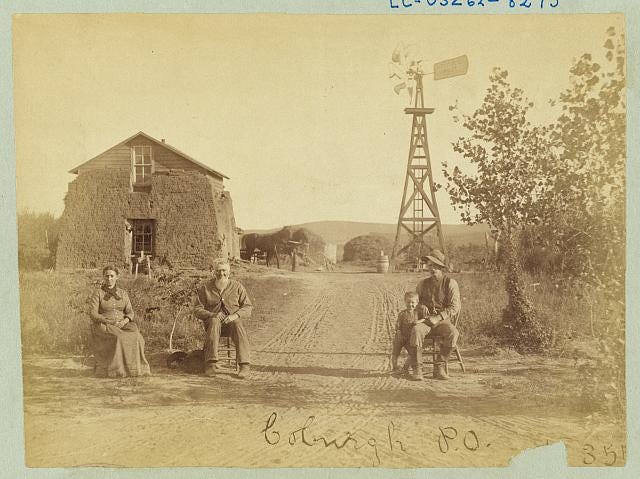
The argument: Weiner opens with a historical pattern that most AI optimists prefer to skip. The Homestead Act of 1862 distributed 160-acre land grants to millions of Americans — and still failed, because land came without the complements: credit, water infrastructure, insurance. The internet made the same mistake. Broadband rolled out broadly; the attention economy concentrated in a handful of platforms. Both times, the primary resource was shared while the power over it was not.
AI, Weiner argues, is about to repeat the pattern — unless the distribution is designed differently. His proposal: the American Technological Consortium, a trillion-dollar fund by 2028, with dollar-for-dollar federal matching, that delivers compute to the 10 million Americans in the lowest-income zip codes by year three. Not as a reward for merit. As a diagnostic program, like building roads.
"Land was distributed broadly, but power — the water and credit — was concentrated by few." 1
"Access was distributed broadly, but power — platforms and data — was concentrated by few." 1
The historical echo is deliberate. He lines them up like exhibits.
The ATC would come with radical transparency requirements: a public ledger within 30 days, minority voting rights for frontier labs, rotating board seats, and a prohibition on self-dealing. The point is to design against entrenchment from the start, not patch it later.
"On day one, I would convene the other AI labs and the federal government to create the American Technological Consortium: a trillion-dollar fund by 2028, with dollar-for-dollar federal matching, to ensure those most at risk can cross." 1
Why read it: Most AI-governance writing argues from abstraction. Weiner argues from history, and his case studies are better chosen than most. The "primary resource without complements" frame applies to any distribution scheme — public, private, or philanthropic. Even if the ATC never becomes policy, the historical pattern is a useful diagnostic for any founder thinking about access and adoption curves.
Matt Hopkins: the judgement gap
Published: May 8 · The judgement gap: why AI advice helps the best entrepreneurs and hurts the rest 3
Who he is: Matt Hopkins is the founder of Vertical Leap, a search engine marketing firm he started in 2001, which grew to 50+ employees and £3.6M in sales. He also founded an online estate agency and a B2B/B2C confectionery business, both successfully exited. 4 Based in the UK.
The argument: Hopkins anchors the whole piece on a single piece of evidence — a 2026 MIT Sloan Management Review field study in Kenya. Hundreds of small-business owners were given WhatsApp access to GPT-4 as a business adviser. The result: AI raised profits for some and lowered them for others. The deciding variable wasn't industry or literacy level. It was business judgement — specifically, the ability to recognize when advice was wrong.
This is what Hopkins calls the "judgement gap." AI makes advice cheap and fluent. It does not make the ability to evaluate advice any cheaper. The people who already had strong business intuition used AI to move faster. The people who lacked it trusted advice they shouldn't have.
"When advice is cheap and fluent, the ability to evaluate it becomes the premium skill — and the people who already have that ability pull further ahead." 3
The distinction Hopkins draws is between well-defined tasks and management decisions. For the first kind — drafting emails, generating options, writing copy — AI helps most the people who are least skilled. For the second kind — pricing, hiring, positioning — the context is invisible to the model, and the answer depends entirely on whether the human can evaluate it.
"A plausible answer and a good answer look identical on the page. The difference shows up six weeks later in the numbers." 3
He closes with a five-step practical kit: form your own answer before asking AI; ask what the model doesn't know; run a pre-mortem; get a human sanity-check; keep a small decision log.
"These are the habits that turn AI from a voice you defer to into a tool you use well." 3
Why read it: The Kenya study is the most rigorous evidence yet that AI advice has asymmetric effects by capability level — and Hopkins's analysis of why is cleaner than the original research summary. The five-step kit is practical enough to apply immediately. If you're giving AI access to junior team members or first-time employees, this essay is the briefing.
Duncan Grazier: betting against cognitive overhead
Published: May 5 · The Builder's Bet: Why I'm Building Aqen.ai 5
Who he is: Previously Chief AI Officer at BuildOps (a $1B field service software unicorn), before that scaled Weedmaps from 30 to 300+ engineers through IPO, and ShopKeep through a $550M acquisition. This week, he started his first company. 5

The argument: Grazier spent 15 years building inside other people's companies. He watched the same pattern repeat: the actual work of building a company (formation, finance, hiring, brand, GTM, compliance) runs as a constant background process, leaking attention from the actual product. He calls this the "cognitive overhead tax." Most technical founders accept it as the price of entry.
His bet is that AI has changed that calculus. Not because AI answers questions better, but because it's now capable of coordinating across business functions: decomposing goals into steps, holding context across weeks, managing execution across legal, finance, ops, marketing, and product simultaneously. That's the premise behind Aqen.ai, which he describes as a cofounder who's built it all before.
"I've spent 15+ years building things inside other people's companies. This week I started building one of my own." 5
"At some point the observation curdled into an obligation. If I actually believe what I've been writing, the honest move is to go build the thing." 5
The essay is explicitly a public commitment as much as an explanation. Grazier also launched Grazier Ventures as a holding company for future ventures built on AI leverage. The theory: if Aqen works, it collapses years of accumulated "how the world works" knowledge that currently separate a technical builder with an idea from a functioning business.
"Not advice. Not a chat window. Coordinated execution against your actual goals, with a shared memory that every teammate — human or AI — reads from and writes to." 5
Why read it: This is one of the cleaner operator-to-founder essays in a while. Grazier isn't theorizing — he's explaining what he saw over 15 years of scaling and what it made him believe. The "cognitive overhead tax" framing is precise and transferable. Read it alongside Hopkins: Grazier is betting AI can handle the management decisions Hopkins says require human judgement. They might both be right about different layers of the stack.
Benn Stancil: the revolution will be ticketed
Published: May 8 · The revolution will be ticketed 6
Who he is: Co-founder and former CTO of Mode Analytics (a SQL-first business analytics platform), acquired by ThoughtSpot in June 2023. Writes at benn.substack.com. 6
The argument: Stancil's opening provocation: AI companies keep telling us they're building the future of work. But they can't actually do the last mile. The real architects are the internal teams across a million enterprises who decide which AI outputs go into which workflows.
He points to recent layoff announcements at Block (50% workforce reduction), Coinbase (14%), and Cloudflare (1,100+ employees), all citing AI as the driver. The language is nearly identical across all three companies: "intelligence at the core, people on the edge," "player-coaches replacing traditional managers." They sound written by the same consultant. But Stancil's read is that the uniformity doesn't reflect AI company influence — it reflects the enterprise implementation layer: the IT teams deciding what gets automated and what doesn't. 6
"Bold entrepreneurs and ambitious artificial intelligence startups are all gas. They do not follow the rules... IT is the brakes." 6
The historical parallel he draws is the personal computer era. Microsoft built Windows. But the modern corporation wasn't built by Microsoft — it was built by a million IT teams using Windows to automate their specific operations over two decades. AI is following the same shape.
"One way to read all of this is that AI is reinventing Block, Coinbase, and Cloudflare. But the other, more literal way to see it is that Block, Coinbase, and Cloudflare are reinventing Block, Coinbase, and Cloudflare." 6
He ends on the question that matters:
"If you are a bold entrepreneur who wants to change the world with ambitious artificial intelligence technologies, are you building the cathedral, or are they?" 6
Why read it: This is the essay that pushes back on the ambient assumption that AI companies are in control of what AI becomes. If Stancil is right, the most strategically important people in AI adoption are enterprise architects nobody talks about. For early-stage founders building tools for companies, this is the market landscape you're actually in.
Noah Brier: your agents need an onboarding document
Published: May 8 · The Culture of AI Engineering 7
Who he is: Co-founder of Percolate (a content marketing platform) in 2011, which grew to 100+ people before being acquired. Now co-founder of Alephic, an AI consultancy. 7
The argument: The dominant metaphor for AI-powered software development is a factory: more inputs, faster outputs, consistent product. Brier thinks this is wrong, and the right metaphor is sitting in plain sight. The best analogy for building something people actually want isn't Henry Ford's assembly line — it's Andy Warhol's Factory, where everything depended on a shared creative vision that only worked when everyone understood what they were doing and why.
"If the hardest problem is making something people want, then the process of building software looks a lot more like Andy Warhol's factory than Henry Ford's." 7
His central observation: AI agents generate correct code that feels written by a stranger. Technically functional, stylistically alien — ignoring obvious abstractions and norms that are present in the existing codebase.
"The code works, but it often feels written by someone most definitely not you — ignoring obvious abstractions and stylistic norms that are present in the codebase." 7
This isn't a quality problem. It's a culture problem. Brier's answer draws on something he learned running Percolate: culture is how your company makes decisions when you're not there. He proposes a "pace layers" framework, borrowed from the writer Stewart Brand, where different parts of the system move at different speeds — standards and architecture change slowly; specs and plans move faster; individual code changes fastest. The slow layers constrain the fast ones, which is exactly how culture works.
The practical implication: build onboarding documents and training materials for your AI agents, just as you would for a new engineer. The culture document you write to ship better code is the same document that trains your agents.
Why read it: Brier is one of the few people applying organizational management insights to agent management without it feeling forced. If you're running a team where agents are already producing production code, this is the framework for deciding what to standardize and what to let the agents freestyle. The "pace layers" model travels well outside software engineering.
Four tensions running through the week
These essays don't argue with each other directly, but they press on the same pressure points.
Governance vs. autonomy. Weiner wants centralized, federally matched compute distribution to prevent concentration. On the other side, the solo-founder moment (illustrated by stories like Weiner's own $3,500 Trovable.ai build) suggests the empowerment is already happening from the bottom up. Both can be true simultaneously — but they require different policy responses and different product bets.
Judgement vs. coordination. Hopkins's Kenya study shows AI advice backfires without business judgement. Grazier is betting that AI can handle coordination across business functions — the kind of task that requires exactly the institutional knowledge Hopkins says is invisible to models. The reconciliation may be temporal: early-stage founders who lack judgement will be hurt; experienced operators like Grazier who have it will be multiplied.
Architects vs. plumbers. Stancil's essay asks whether AI companies or internal enterprise teams decide what AI becomes. Brier answers the same question from inside a team: what makes the difference is whether the culture of a specific organization transfers to its agents. If Brier is right, the real AI leverage isn't compute or models — it's organizational clarity.
Factory vs. studio. The "software factory" assumption runs through almost all AI-productivity discourse. Brier's critique of it isn't romantic nostalgia for artisanal craft — it's a practical point. Code is not widgets. The goal is something people want. Optimizing for throughput without a shared understanding of what "good" means produces stylistically alien, contextually broken output at higher volume.
None of these tensions resolves cleanly. Most founders are operating inside at least two of them right now, whether they've named them or not.
이 콘텐츠를 둘러싼 관점이나 맥락을 계속 보강해 보세요.