Zurbarán's Debut in Britain, Raphael's First in America — May 2026's Best Museum Shows
40+ new exhibitions opening this month across London, New York, Paris, and Asia-Pacific — rated for whether they're worth a flight, with the Met's first Raphael retrospective and Tate's triple London breakthrough leading the field.
May 2026 arrives with an embarrassment of riches. London alone stacks three separate five-star shows at the same time — a statistical anomaly that hasn't happened in living critical memory. New York runs the first comprehensive Raphael exhibition ever mounted on American soil alongside a Duchamp retrospective that nobody has attempted in decades. Paris puts Michelangelo and Rodin in the same room, for the first time in history. Tokyo reunites Irish-held Japanese scrolls with their homeland audience. And Sydney hands the Archibald Prize — Australia's most prestigious annual portrait competition — to Richard Lewer for its 105th edition.
For readers who travel for art, this is the month to act. The ratings below reflect genuine critical consensus, not promotional copy: ★★★★★ means the flight cost is justified; ★★★★ means it's worth restructuring a trip for.
London — three five-star shows at once
No European city matches London's May card. The National Gallery, Tate Britain (twice), and the British Museum are all running blockbuster-tier shows simultaneously, with two of them opening this month.
Zurbarán ★★★★★
National Gallery, London · May 2 – Aug 23 · £20–£22 (under-18s free; Pay What You Wish Fridays from May 22)
Francisco de Zurbarán (1598–1664) is Spanish Baroque's great under-exposed master — a painter whose monastery commissions kept his work locked behind convent walls for most of his career. This is the first major UK exhibition dedicated to him, and over 50 works spanning his full arc show why The Sunday Times called it "one of the greatest shows I've ever seen." 1
The headline works justify the hyperbole. Still Life with Lemons, Oranges and a Rose (1633) — his only signed and dated still life — travels from California. Agnus Dei (c.1635–40), the lamb whose resigned gaze has unsettled viewers for four centuries, comes from the Prado. The Crucifixion (1627) arrives from the Art Institute of Chicago. The show was organized jointly with the Louvre and the Art Institute of Chicago, which explains the quality of the loans. The Guardian, The Times, The Standard, The Observer, and the New York Times all placed the show in their respective five-star or "exquisite" tier. 1
Located in the Sainsbury Wing. Book ahead; timed entry in operation.
James McNeill Whistler ★★★★★
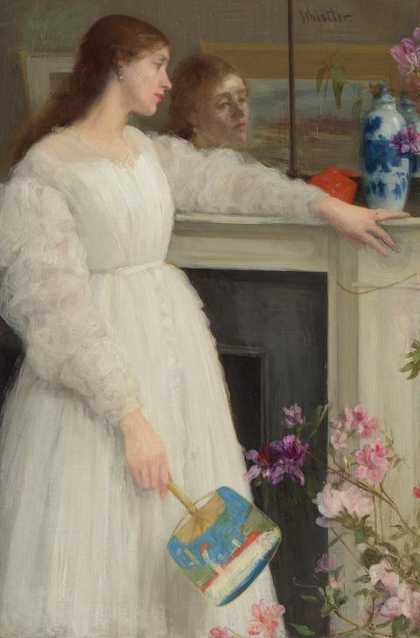
Tate Britain, London · May 21 – Sep 27 · £24 (free for Tate Members)
The last major European retrospective of James McNeill Whistler took place thirty years ago. This new survey at Tate Britain corrects that long gap: over 150 works span his teens in St. Petersburg through late self-portraits, and — critically — Arrangement in Grey and Black No. 1, better known as "Whistler's Mother," travels on loan from the Musée d'Orsay. 2
The show frames Whistler as two things simultaneously: a boldly experimental formalist who was treating painting as abstract tonal arrangement decades before anyone used that vocabulary, and a cosmopolitan provocateur who disrupted Victorian conventions through lawsuits, aphorisms, and carefully staged self-presentation. Symphony in White, No. 2: The Little White Girl and Wapping (on loan from the National Gallery of Art, Washington) anchor the early rooms. A two-day exhibition conference runs June 18–19; a Lunder Institute conference on May 25 explores Whistler's reception beyond Europe. 2
Members' Private View on May 20; general opening May 21.
Image from: Tate Britain: James McNeill Whistler
Hurvin Anderson ★★★★★
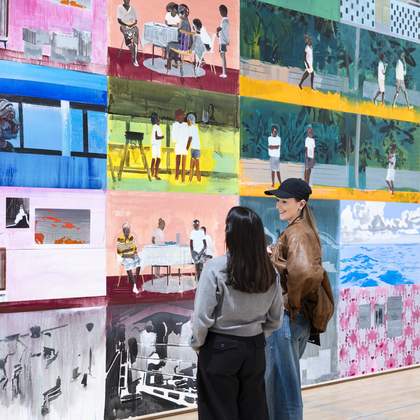
Tate Britain, London · Mar 26 – Aug 23 · £18 (free for Tate Members)
Anderson, born in the UK to Jamaican parents, has spent decades making paintings that look deceptively cheerful — aquamarine pools, barbershop interiors, Caribbean landscapes — and are in fact meticulous examinations of belonging, diaspora, and the unreliability of memory. His first major solo exhibition brings together over 80 paintings and includes never-before-seen new work alongside pieces from his student years. 3
The Guardian awarded five stars, writing "this haunted, hazy, beautiful show is like stumbling through someone's memories." Time Out matched it with another five stars: "big, energetic, happy paintings which are just as enjoyable to stand in front of as one can imagine they were to make." The Independent said Anderson is "one of Britain's most significant painters." Late opening on May 15 until 22:00. 3
Image from: Tate Britain: Hurvin Anderson
Hawaiʻi: a kingdom crossing oceans ★★★★★
British Museum, London · Jan 15 – May 25 · From £16 (Members and under-16s free; timed entry, advance booking strongly recommended)
This closes at the end of May — the last call. Created over several years in collaboration with Native Hawaiian artists, practitioners, and scholars, the exhibition commemorates King Liholiho and Queen Kamāmalu's 1824 journey to Britain (both died of measles in London; the British government's handling of the episode remains a live grievance) and displays one of the largest Hawaiian collections outside the islands themselves. 4
Feathered cloaks (ʻahu ʻula), carved wooden deities (kiʻi akua), shark-toothed weapons, and new commissions by Kānaka ʻŌiwi (Native Hawaiian) artists occupy the same rooms. The Guardian called it "an epic thriller of an exhibition." The Times: "a dazzling display of royal razzmatazz." Free Māori fashion show "Matakite: Prophecy, This Is." on May 15. Online event on Hawaiian featherwork conservation on May 21. Book now; the final days will sell out. 4
Catherine Opie: To Be Seen ★★★★
National Portrait Gallery, London · Mar 5 – May 31 · £19.50–£21.50 (Pay What You Can Saturday evenings)
Also closing at the end of May: the first major UK museum show for American photographer Catherine Opie (b. 1961), curated with the artist. Spanning 30 years from Being and Having (1991) through Baroque-style portraits of fellow artists, the show reaches across 7 rooms on 3 floors, placing Opie's photographs in deliberate dialogue with the NPG permanent collection. 5
A newly commissioned portrait of Sir Elton John, David Furnish, and their children hangs in Room 30. Opie on the show: "Throughout the galleries I've created these different conversations and interventions. How do we create dialogues with our past and representation?" The Guardian and The Independent each gave four stars. Queer photography masterclass with Sunil Gupta and Charan Singh on May 23; Evening Late on May 29 (free). 5
A National Portrait (Es Devlin) — free
National Portrait Gallery, London · May 14 – Oct 27 · Free
Es Devlin, the stage designer behind some of the most ambitious theatrical productions of the last two decades, launches a participatory digital portrait project on May 14. The public collectively draws a national portrait; Devlin hosts a free in-gallery drawing event on opening day. An online step-by-step drawing class runs alongside the physical installation. 6
Paris — sculpture, light, and the pioneers they ignored
Four major Paris institutions are running simultaneously in May, with two new shows opening mid-month. The Grand Palais is currently the operating venue for Centre Pompidou programming while Pompidou undergoes renovation.
Michelangelo/Rodin: Living Bodies ★★★★
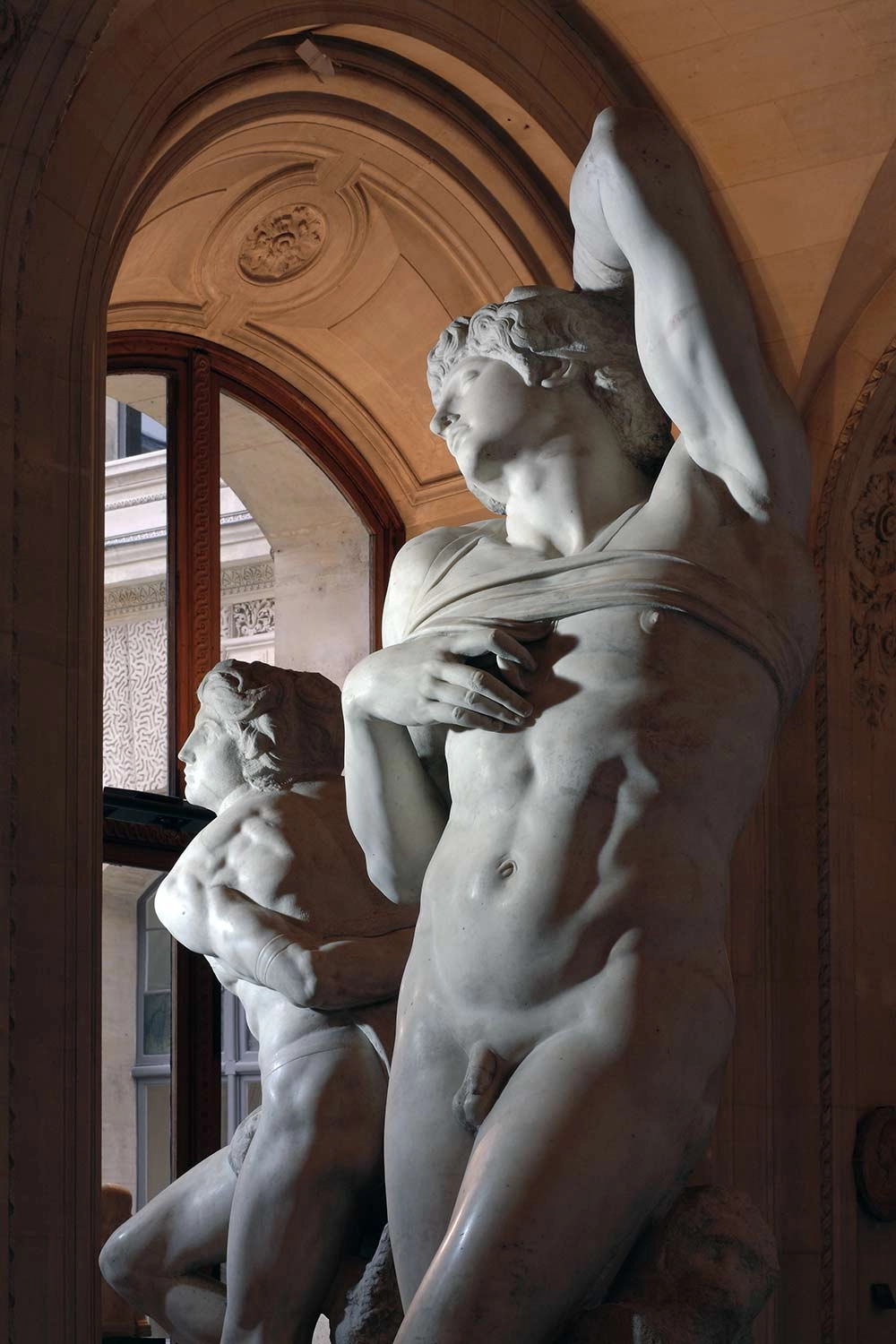
Musée du Louvre, Paris · Apr 15 – Jul 20 · Included with museum admission (€22 EU residents / €32 non-EU; timed entry required)
The first exhibition ever to bring Michelangelo and Rodin into direct dialogue spans over 200 works — marble, bronze, plaster, terracotta, cast, and a body of preparatory drawings — organized across five thematic sections in the Louvre's premier Hall Napoléon. Key loans include Rodin's Adam, L'Âge d'airain, and Jean d'Aire nu, set alongside Michelangelo's Esclave rebelle and Esclave mourant from the Louvre's own collection. 7
Jean-Marie Wynants in Le Soir awarded four stars, noting that the rotunda opening alone justifies the visit — and that the show, rather than staging a clash of titans, reveals how much the two sculptors shared: "Loin d'opposer les deux sculpteurs, l'exposition met en évidence leurs préoccupations communes." The curators frame the entire exhibition around a single proposition: both artists "perceived the body as animated by an intense inner life." Jason Farago in the New York Times found exactly that — "the living spirit in stone." 8 A free mobile app (michelangerodin.louvre.fr) accompanies the show in English and French.
Hilma af Klint: Pioneer of Abstraction ★★★★
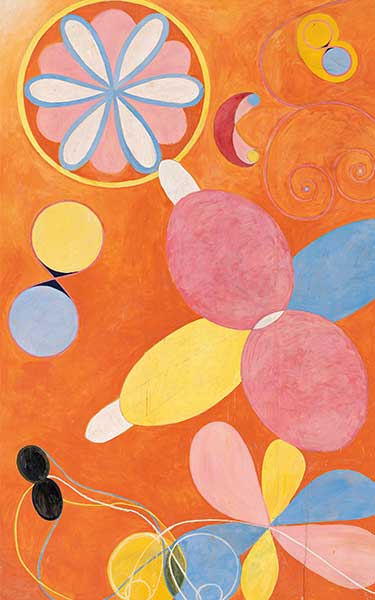
Grand Palais (co-produced by Centre Pompidou), Paris · May 6 – Aug 30 · €15 full / €12 reduced
The first major monographic exhibition devoted to Hilma af Klint (1862–1944) in France focuses on the Paintings for the Temple cycle (1906–1915), including the monumental series The Ten Largest — paintings made years before Kandinsky and Malevich created the works that earned them the title of abstraction's inventors. Centre Pompidou states the problem plainly: af Klint "résolument en avance sur les grands courants du 20e siècle... a bouleversé la chronologie de l'art moderne." 9
She painted in secrecy. She stipulated in her will that her works remain sealed for 20 years after her death. Her first public showing came only in 1986, at LACMA's "The Spiritual in Art." ArtMajeur summarizes what the exhibition makes visible: "She painted abstract art before Kandinsky, but history long ignored her because she was a woman, because she was a mystic, and because she refused to exhibit during her lifetime." 10
Sponsored by Chanel. Located in Galeries 8, entrance Square Jean Perrin, open Fridays until 10pm.
Image from: Centre Pompidou: Hilma af Klint
Matisse, 1941–1954: The Final Years ★★★★
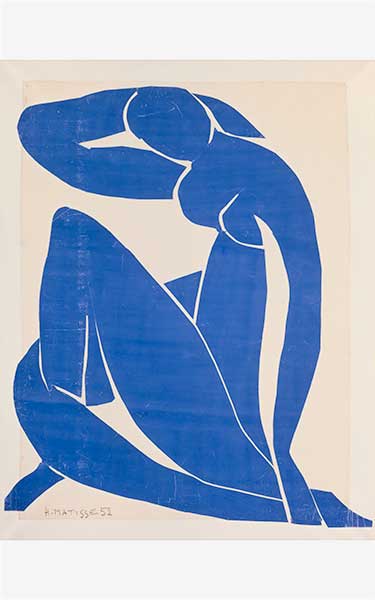
Grand Palais (Centre Pompidou), Paris · Mar 24 – Jul 26 · €19 full / €16 reduced
Matisse wrote near the end of his life: "I had so completely prepared for my exit from life that it feels as though I am living a second life." The work from that second life — gouache cut-outs, Jazz album pages, stained-glass cartoons, textile designs, the monumental La Tristesse du roi — fills 180 works spanning his final thirteen years when, largely bedridden, he reinvented his own vocabulary yet again. Centre Pompidou describes works of "unprecedented freshness and vitality" from an artist who "had never varied his techniques and media so much" as he approached 80. 11
A special performance, Jazz Matisse, with Philippe Katerine and Adrien Soleiman took place May 12. Time Out Paris lists this among the absolute must-sees of the month. The Blue Nudes series and La Gerbe are among the large-scale works drawn from both Pompidou's collection and international loans; some are shown together for the first time.
Image from: Centre Pompidou: Matisse, 1941–1954
Renoir and Love: A Joyful Modernity ★★★★
Musée d'Orsay, Paris · Mar 17 – Jul 19 · €16 full / €13 reduced (€12 Thursday evenings)
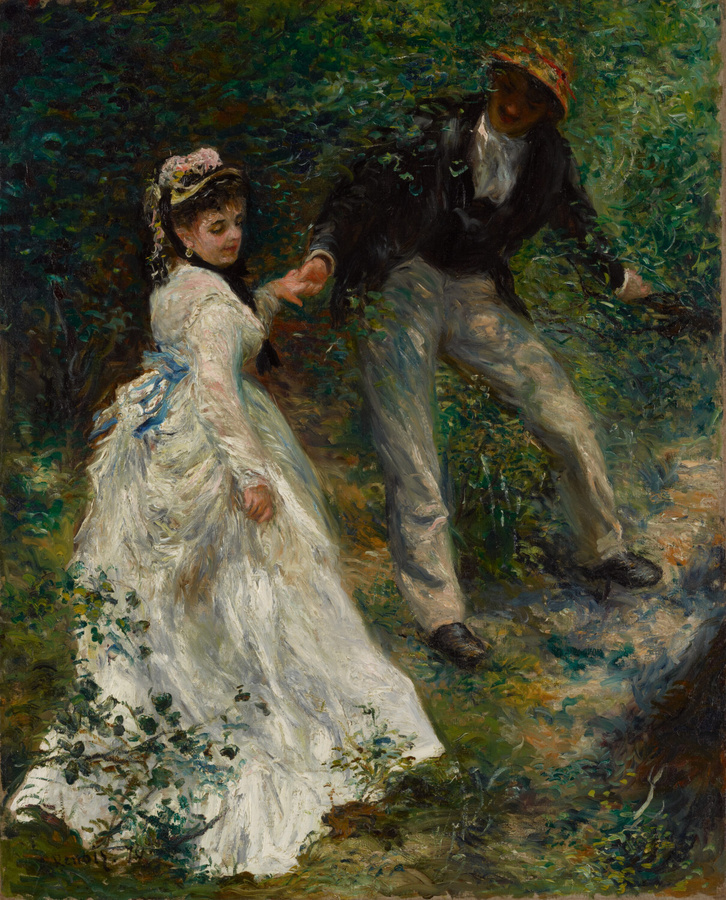
The first major Renoir retrospective in Paris since 1985 co-organized with the National Gallery London and the Museum of Fine Arts Boston — which is why it can assemble Bal du moulin de la Galette (1876), La Promenade (1870), and Le Déjeuner des canotiers (1881) in the same building. The show's curators frame Renoir not as a painter of easy happiness but as one whose surfaces concealed a deliberate refusal to look at the darker aspects of modernity — poverty, alcoholism, the dynamics of male desire. Curator Paul Perrin describes the aim as giving "a new perspective on paintings that are so well-known that it has become difficult to perceive how radical they are." 12
Libération included the show among its ten best exhibitions currently on in Paris; Culturefirst.fr called it "exceptionnelle." A symposium "Revoir Renoir" is scheduled for May 29. Timed entry; booking strongly recommended. 12
Youssef Nabil: To Dream Again
Musée d'Orsay, Paris · May 19 – Sep 13 · Standard museum admission (€16 full / €13 reduced)
A Franco-Egyptian photographer and filmmaker (b. 1972) becomes the first contemporary artist to exhibit in the Musée d'Orsay's Orientalist galleries — a gallery context that is itself a statement about who gets to represent the Mediterranean and on what terms. 13
Nabil's characteristic hand-colored silver gelatin prints — an old technique evoking the golden age of Egyptian cinema — are placed in dialogue with Puvis de Chavannes, Odilon Redon, and the Symbolist collection. His The Dream (2021) hangs beside Puvis's Le Rêve; Redon's Sleep of Caliban provides the title's source: Caliban's monologue from The Tempest, the words of a colonized voice dreaming of freedom. Part of the Mediterranean Season 2026 and the Bicentennial of Photography 2026–2027.
Primordial Water: Lessons from Mesopotamia
Musée du Louvre, Paris · May 20 – Mar 15, 2027 · Included with museum admission
An unusual show built entirely from the Louvre's own Oriental Antiquities collection — approximately 100 works in the main room, plus a gallery trail connecting Richelieu to Sully wings. The arc runs nearly 8,000 years, from Central Asian prehistory to the Mediterranean edge, tracing how the civilizations of the Tigris and Euphrates managed, ritualized, and mythologized water as a resource that was simultaneously a source of life and a driver of conflict. The curators explicitly connect ancient water politics to contemporary questions of climate and drought. 14
New York — Raphael, Duchamp, and the grit of the street
New York runs three different institutional registers simultaneously in May: the scholarly blockbuster at the Met, the canonical conceptual at MoMA, and the unmediated street-level at MoMA PS1. A good week in the city covers all three.
Raphael: Sublime Poetry ★★★★★
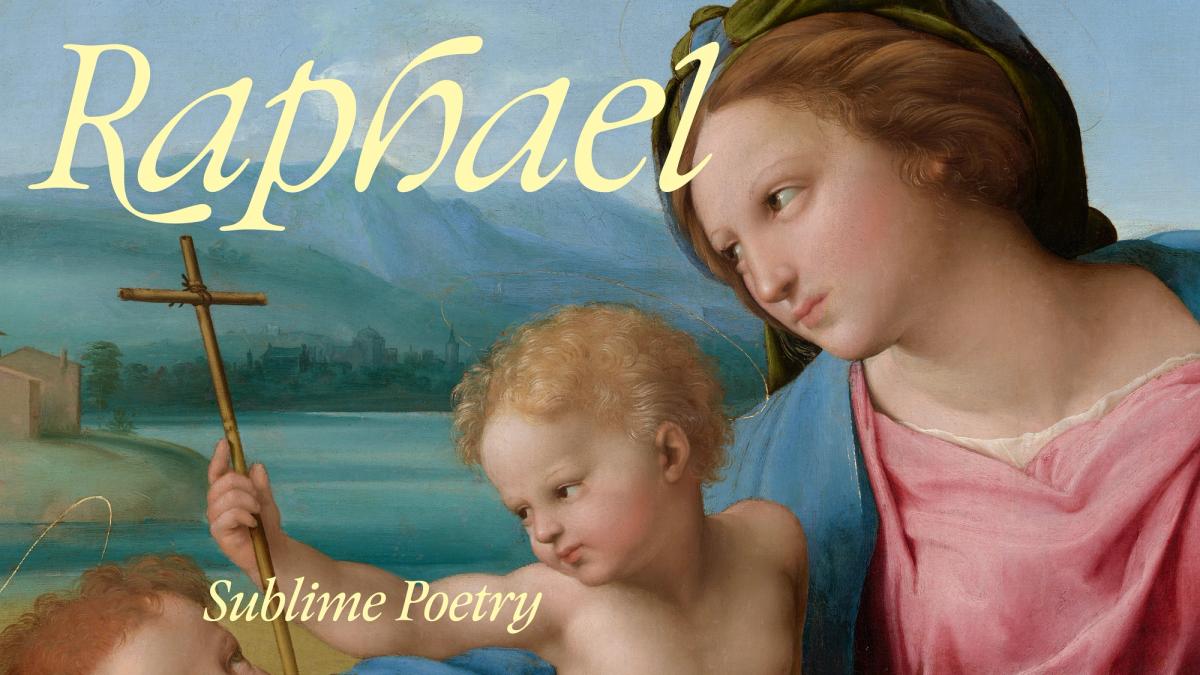
The Metropolitan Museum of Art, New York · Mar 29 – Jun 28
The first comprehensive Raphael (Raffaello di Giovanni Santi, 1483–1520) exhibition ever mounted in the United States — eight years in development under Met curator Carmen C. Bambach. Over 170 works by the artist, 237 pieces total including contextual loans: preparatory drawings, Vatican tapestry cartoons, society portraits, and three Sistine Chapel tapestries designed by Raphael himself, displayed together for the first time in an American venue. 15
Jackson Arn in The New Yorker argued that Raphael's greatest gifts are compositional rather than surface-level — "his greatest talents are, in a way, invisible. A brilliant composition isn't as tangible as a single body rippling with muscle or the sfumato of an earlobe; it's an interrelation of parts." The portrait room is the one to linger in: "an hour concentrated with the portraits is worth more than an hour spread thinly across the rest of the exhibition." Sebastian Smee in the Washington Post called it "a magnificent, thorough, scholarly treatment... a balm for the soul." 16
The show also examines Raphael's relationship with women — the first Western artist documented to have used nude female models — through the Madonna and Child series and five society portraits in a central octagonal chamber. Closes June 28. Buy tickets now.
Marcel Duchamp ★★★★
Museum of Modern Art (MoMA), New York · Through Aug 22
The first major North American survey of Marcel Duchamp (1887–1968) in decades, curated by Ann Temkin, Michelle Kuo, and Matthew Affron. Covers the full career — readymades, Rotoreliefs, Fountain, Large Glass — alongside less familiar works. Hilton Als in The New Yorker examined "how the shape-shifting artist radicalized art itself." 17
The Observer called it "an expansive survey that invites visitors to reconsider Duchamp's work on renewed terms." Cultured Magazine described "a brilliant and appropriately bewildering exhibition." The Financial Times offered a dissent worth noting: "makes up for the sparseness of substance with an abundance of examples — a plethora of bottle racks." Both views are defensible; the show rewards patience more than it rewards breadth.
Greater New York 2026 ★★★★★ (free)
MoMA PS1, Long Island City, New York · Apr 16 – Aug 17 · Free admission
The sixth edition of this quinquennial survey — which MoMA PS1 has run since 2000, every five years, covering artists living and working in New York — coincides with PS1's 50th anniversary. Over 50 artists, 150+ works, more than half of them without gallery representation. Hrag Vartanian, editor-at-large at Hyperallergic, wrote that it was "far better than the Whitney Biennial, which felt like work made for conventional art galleries that had strayed into museum space." He praised a show "as multicultural and multidimensional as the city itself" with curation that captured "not the out-of-towner's New York with its glossy surfaces, but the gritty New York that's always in the process of formation." 18 19
Lisa Yin Zhang in the same publication caught a different register: "work pinned or pasted directly on the walls, a defiantly handmade quality... I'd rather a work try, and fail, than be too afraid to be seen trying in the first place. This is New York, now — a work in progress." Performance program runs across three Saturdays in May and June. Take the 7 train to Court Square, then walk.
Carol Bove at the Guggenheim ★★★★
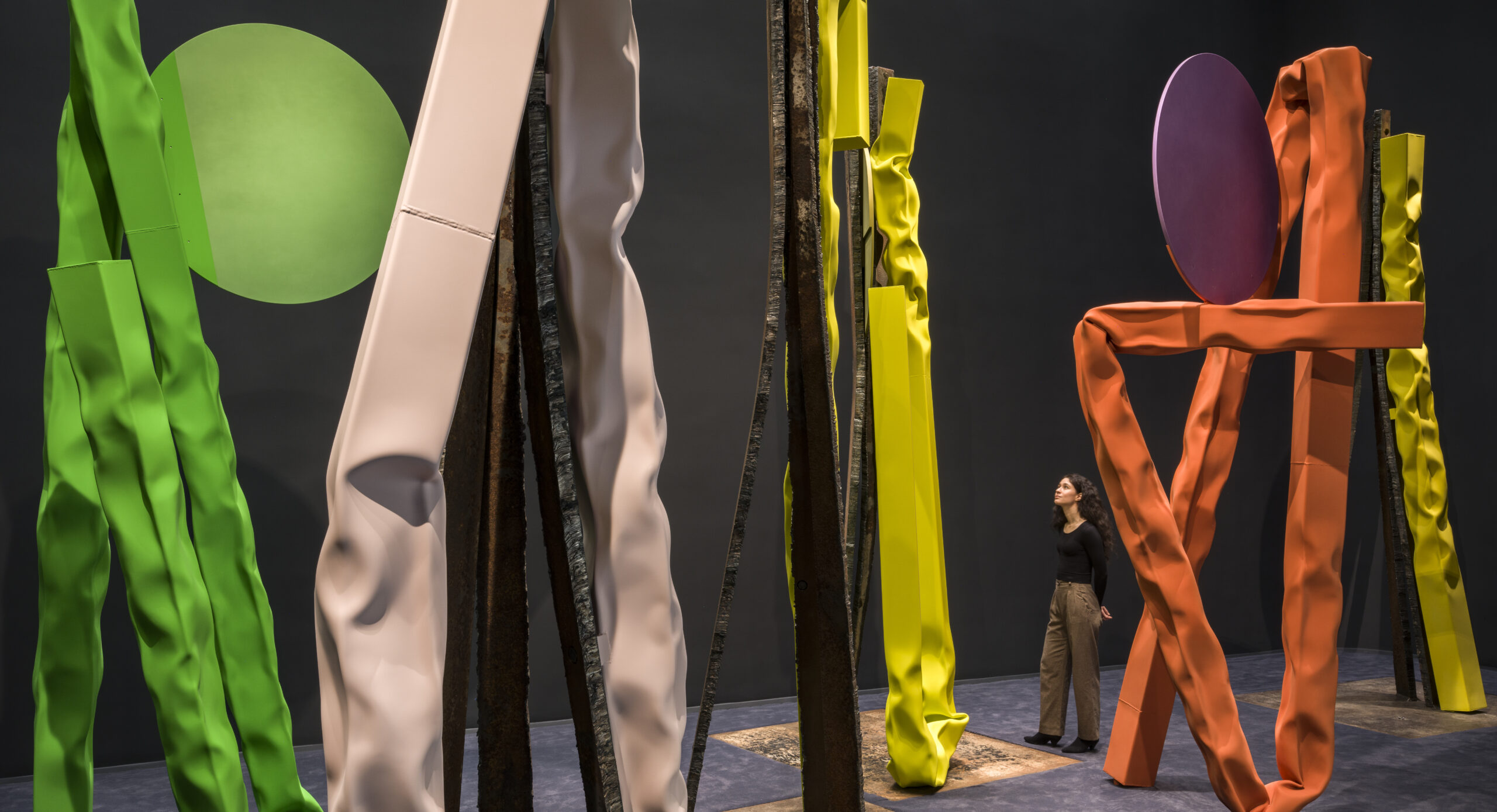
Solomon R. Guggenheim Museum, New York · Mar 5 – Aug 2
The first museum survey of Carol Bove (b. 1971, Geneva) fills the entire Frank Lloyd Wright spiral rotunda with 25 years of work — book assemblages, paper collages, towering steel sculptures in bright industrial colors. The most genuinely surprising element: a diamond-shaped cutout in the ramp wall that reveals a mural Joan Miró made with ceramist Josep Llorens Artigas, built into the structure in the 1960s and unseen by the public for decades. 20
Bove approaches the Frank Lloyd Wright building "as a sculpture in its own right, subtly activating its distinctive geometries and open sight lines, which allow works to remain visually connected across levels." The exhibition also incorporates a tactile library of studio materials, artist-made chess tables, and built-in seating — an unusual investment in the museum as lived space. A two-volume catalogue with die-cut slipcase, each copy unique through a hand-cut element by the artist, is available.
Image from: Solomon R. Guggenheim Museum: Carol Bove
Frida and Diego: The Last Dream
Museum of Modern Art (MoMA), New York · Through Sep 12
Organized by MoMA's Beverly Adams in collaboration with Jon Bausor, with a particular formal innovation: the Metropolitan Opera is staging its own Frida and Diego: The Last Dream production (Gabriela Lena Frank / Nilo Cruz, May 14 – June 5) as an experimental collaboration with the museum. Self-portraits, paintings, and archival materials from both Kahlo and Rivera appear alongside documentation of the operatic production. 17
Europe — Bilbao, Berlin, Amsterdam, Vienna, Madrid
The continent's second tier this month is anything but: a Jasper Johns retrospective in Bilbao, a Cassirer/Impressionism show in Berlin that pulls Manet to Van Gogh into the same argument, and a participatory installation in Hamburg that used 400,000 wooden cubes.
Jasper Johns: Night Driver ★★★★
Guggenheim Museum Bilbao · May 29 – Oct 12
A seven-decade retrospective of Jasper Johns (b. 1930), one of the most consequential figures in postwar American art, with approximately 100 works drawn from public and private collections worldwide. The arc runs from the flags and targets of the 1950s — which redefined the relationship between image, object, and sign — through his latest work. Opens May 29. 21
Cassirer and the Breakthrough of Impressionism ★★★★
Alte Nationalgalerie, SMB, Berlin · May 22 – Sep 27
Paul Cassirer (1871–1926) ran the Berlin gallery that introduced German audiences to French Impressionism and Post-Impressionism — Degas, Cézanne, Manet, Monet, Renoir, Van Gogh — at a time when German state institutions were still hostile to the movement. More than 100 works from major European collections reconstruct that campaign, alongside Cassirer's championing of the Berlin Secession, Edvard Munch, Ernst Barlach, and Paula Modersohn-Becker. A strong argument for the gallery owner as the unacknowledged co-creator of modern art's canon. 22
CHANEL Commission: Lina Lapelytė — We Make Years Out of Hours ★★★★
Hamburger Bahnhof – Nationalgalerie der Gegenwart, Berlin · May 1 – Jan 10, 2027
Lithuanian artist Lina Lapelytė (b. 1984) fills Hamburger Bahnhof's 2,500 m² Historic Hall with 400,000 wooden spruce and pine cubes, each 10×10×10 cm. Twelve performers and visitors build and reshape wooden structures together daily (Tuesdays, Thursdays, Saturdays, Sundays, 2–5pm). A composed soundtrack features field recordings by Peter Cusack; a libretto draws from 15 international poets including Khalil Gibran, Etel Adnan, Forugh Farrochzad, Ocean Vuong, and Ilya Kaminski. 23
The second edition of the CHANEL Commission; part of Hamburger Bahnhof's 30th anniversary programme. When the installation closes, the 400,000 cubes will become a permanent public artwork in Eisenhüttenstadt in 2027.
Felix Gonzalez-Torres: Sweet Revenge
Museo Reina Sofía, Madrid · May 27 – Oct 12
A retrospective of Felix Gonzalez-Torres (1957–1996), the Cuban-American conceptual artist whose candy spills, billboard works, and stacked paper piles transformed everyday materials into meditations on love, loss, AIDS, and mortality. The title nods to his best-known candy installation, "Untitled" (Revenge), 1991 — blue-wrapped candies in an ever-replenished pile that visitors are invited to take, depleting and restoring the work simultaneously. 24
Gonzalez-Torres died of AIDS-related illness at 38; his work remains one of the most emotionally precise bodies of art to emerge from that decade.
Metamorphoses @ Rijksmuseum Amsterdam
Rijksmuseum, Amsterdam · Feb 6 – May 25 · Museum admission applies
Over 80 masterpieces inspired by Ovid's Metamorphoses — the ancient poem about transformation, gods, and mortals that has generated more subsequent art than almost any other single text. Titian, Caravaggio, and Rodin sit alongside contemporary video installations. Closing May 25; the Concertgebouw Orchestra chamber music performance on May 17 may be the final significant programming event before closure. 25
Anni Albers: Constructing Textiles
Lower Belvedere, Vienna · Apr 30 – Aug 16
A dedicated survey of Anni Albers (1899–1994), Bauhaus-trained textile artist and wife of Josef Albers. Where her husband made squares of pure color, she made structures: weavings that followed a construction logic as rigorous as any architectural drawing, transforming the loom into a modernist medium. This is a corrective to her long relegation to the shadow of her husband's reputation. 26
Asia-Pacific — Tokyo, Beijing, Sydney, Melbourne
Divine Steeds @ Palace Museum Beijing ★★★★★
The Palace Museum (故宫博物院), Beijing · Apr 22 – Jun 21 · Included with Palace Museum entry (off-peak ¥40); advance reservation required via the Palace Museum WeChat mini-program
The thematic focus — 55 works of horse-themed calligraphy and painting from the Palace Museum's collection — sounds narrow until you look at what "the horse" meant in Chinese political and military history. Among the 20 National Level-1 Cultural Relics and 28 first-time-exhibited works, the centerpiece is Li Gonglin's (李公麟) Copy of Wei Yan's Pasturing Horses — a Northern Song dynasty handscroll depicting 1,247 horses and 142 herders, created when Li was in his 30s–40s and last exhibited 11 years ago. Curator Ma Shunping (马顺平) notes Li later developed rheumatism that prevented him from holding a brush; the work shows a younger hand inventing rather than copying, incorporating innovations over the Tang originals. 27
Also on first-time display: a Tang dynasty Hundred Horses scroll (《百马图》) depicting 95 horses on an ancient farm, including the detail of a monkey kept in the stable — a traditional practice believed to prevent equine disease, and the origin of Sun Wukong's title Bima Wen (弼马温, literally "horse disease preventor"). An unusual piece of administrative documentary realism from a period that usually depicted emperors on horseback. Reserve a week in advance at 20:00 through the WeChat mini-program; slots fill quickly.
The Maeda Legacy @ Tokyo National Museum ★★★★
Tokyo National Museum (東京国立博物館), Heiseikan, Tokyo · Apr 14 – Jun 7 · ¥2,300 adults / ¥1,300 university / ¥900 high school / free under junior high
The centenary exhibition of the Maeda Ikutokukai Foundation, founded in 1926 by the 16th head of the Kaga Maeda family — one of the most powerful daimyo houses of the Edo period, ruling the Hokuriku region from Kanazawa with an economy second only to the Tokugawa shogunate. The treasures assembled here reflect that wealth: lacquerware, paintings, calligraphy, ceramics, and the exhibition's visual anchor, a set of Gusoku armor with gilt scales and white lacing from the Azuchi-Momoyama period (16th century), designated an Important Cultural Property. 28
Organized jointly with NHK, NHK Promotions, and The Yomiuri Shimbun. Related exhibition "The ABCs of Antique Textiles: Prized Pieces Passed Down by the Maeda Clan" continues at Toyokan through July 12. Extended Friday/Saturday evening hours until 20:00.
A Treasure Trove from Ireland @ Tokyo National Museum ★★★★
Tokyo National Museum (東京国立博物館), Honkan Rooms D & E, Tokyo · Apr 27 – Jul 20 · Free with TNM Collection admission (¥1,000)
Twenty-five Japanese narrative paintings from the Chester Beatty in Dublin — one of Europe's finest collections of Japanese manuscript art, assembled by mining magnate Sir Alfred Chester Beatty after a single 1917 visit to Japan. The items rarely leave Ireland. Five thematic sections trace court romances, tales of the supernatural, and scenic landscapes; the centerpiece is the Scrolls of Song of Lasting Sorrow by Kano Sansetsu (Edo period, 17th century), based on the Tang dynasty poem about Emperor Xuanzong and Yang Guifei. 29
Also notable: Itō Jakuchū's On a Riverboat Journey (c.1767) and the Yoshitsune's Invasion of Hell scroll. Ireland House opened in Tokyo in 2025, partly as context for exactly this kind of cultural exchange.
Archibald Prize 2026 @ AGNSW Sydney ★★★★
Art Gallery of New South Wales, Sydney · May 9 – Aug 16 · Adult A$30 (weekdays) / A$32 (weekends and holidays); under-12s free
Australia's most famous art prize, in its 105th year. Richard Lewer won the Archibald Prize 2026; Del Kathryn Barton judged the Sulman Prize. The Archibald has always functioned as a social document as much as an art competition — portrait subjects reflect who the country considers worth commemorating in a given year. 30
ANZ People's Choice voting is open to visitors; the winner receives A$2,000. Multilingual guided tours: Mandarin (Sundays 1pm from May 17), Korean (Wednesdays 1pm from May 27), Japanese (Saturdays 11am from June 6). Young Archie 2026 — work by artists aged 5–18 — runs free in Kaldor Hall. Archie Party on June 26 (7–11pm).
25th Biennale of Sydney: Rememory (closing June 14)
Art Gallery of New South Wales, Sydney · Mar 14 – Jun 14 · Free
The world's fifth-oldest contemporary art biennale, curated this edition by Hoor Al Qasimi, takes its theme from a Toni Morrison coinage: "Rememory as in recollecting and remembering as in reassembling the members of the body, the family, the population of the past." Sixteen artists at AGNSW — including Abdul Abdullah, Chang En Man (Paiwan Nation, Taiwan), Kapwani Kiwanga, Ngurrara Artists from the Great Sandy Desert, and Palestinian-French photographer Taysir Batniji — work through migration, exile, First Nations continuity, and the politics of forgetting. 31
Closing June 14; the final month. Also presented at White Bay Power Station and Campbelltown Arts Centre. Drop-in drawing workshops run through May 20.
MOTHER: Stories from the NGV Collection
National Gallery of Victoria (NGV Australia), Melbourne · Mar 27 – Jul 12 · Free
Over 200 works across the full arc of art history — Correggio's Madonna and Child (c.1514–15), Rembrandt, Goya, David Hockney, Tracey Emin, Patricia Piccinini, and Djerrkŋu Yunupiŋu — organized around motherhood as one of the oldest and most contested themes in visual art. The curatorial framing is deliberately expansive: private transformation, intergenerational trauma, mythological iconography, and the relationship between motherhood, nature, and First Nations concepts of Country. 32
Free, daily 10am–5pm. Exhibition tours and a family activity trail available. Panel event with The Wheeler Centre on June 27.
Also in May
Exhibitions with solid merit and documented openings, worth the visit if you're in these cities:
- Renoir Drawings @ Musée d'Orsay, Paris (through Jul 5): The first exhibition ever dedicated to Renoir's graphic work — approximately 100 drawings, pastels, and watercolors with special attention to sanguine technique. Co-organized with the Morgan Library & Museum, New York. 33
- Brancusi @ Neue Nationalgalerie, Berlin (through Aug 9): Major retrospective of Constantin Brancusi (1876–1957) in Mies van der Rohe's iconic glass-and-steel building. 34
- Ruth Asawa @ Guggenheim Bilbao (through Sep 13): Retrospective of Japanese-American sculptor Ruth Asawa (1926–2013), known for looped-wire hanging sculptures that challenge the boundary between drawing and three-dimensional form. Studied under Josef Albers at Black Mountain College. 21
- Dumile Feni: African Guernica @ Reina Sofía, Madrid (through Sep 22): South African resistance artist Dumile Feni's monumental drawing in deliberate dialogue with Picasso's Guernica, which hangs in the same museum. 24
- Manet & Morisot @ Cleveland Museum of Art (through Jul 5): Focused examination of the relationship between Édouard Manet and Berthe Morisot, two artists whose creative and personal entanglement shaped Impressionism's inner logic. 35
- Matisse's Femme au chapeau @ SFMOMA, San Francisco (opens May 16, through Sep 13): Restages the 1905 Salon d'Automne debut of Femme au chapeau — the painting that ignited Fauvism and scandalized Paris — alongside the greatest number of works from that original display assembled in over a century. Exclusive to SFMOMA. Surcharged admission ($10 weekdays / $12 weekends). 36
- Slow Burn: Women and Photography @ Te Papa, Wellington (ongoing through 2026): Major survey of photography by women and non-binary artists in Aotearoa New Zealand from the 1960s to today. Four thematic galleries. Free with museum entry. 37
- Mānawatia a Matariki @ Te Papa, Wellington (through Jul 19): Interactive celebration of the Māori New Year on the museum's working marae. Three themes: celebration, remembrance, aspiration. Free, all ages. 38
Cover image: Michelangelo's Rebellious Slave and Dying Slave, Musée du Louvre. Image from Musée du Louvre: Michelangelo Rodin — Living Bodies
참고 출처
- 1National Gallery: Zurbarán
- 2Tate Britain: James McNeill Whistler
- 3Tate Britain: Hurvin Anderson
- 4British Museum: Hawaiʻi — a kingdom crossing oceans
- 5National Portrait Gallery: Catherine Opie — To Be Seen
- 6National Portrait Gallery: A National Portrait
- 7Musée du Louvre: Michelangelo Rodin — Living Bodies
- 8Le Soir: Michel-Ange et Rodin au Louvre
- 9Centre Pompidou: Hilma af Klint
- 10ArtMajeur Magazine: The unmissable exhibitions of May 2026
- 11Centre Pompidou: Matisse, 1941–1954
- 12Musée d'Orsay: Renoir and Love — A Joyful Modernity
- 13Musée d'Orsay: Youssef Nabil — To Dream Again
- 14Sortiraparis: Primordial Water at the Louvre
- 15The Metropolitan Museum of Art: Raphael — Sublime Poetry
- 16The New Yorker: Was Raphael the Runt of the Renaissance?
- 17MoMA: Duchamp
- 18MoMA PS1: Greater New York 2026
- 19Hyperallergic: MoMA PS1's "Greater New York" is gritty, stunning, and gutting
- 20Solomon R. Guggenheim Museum: Carol Bove
- 21Guggenheim Museum Bilbao: Exhibitions
- 22Kunsti Radar: 61 art exhibitions around Europe opening in May 2026
- 23SMB Berlin: CHANEL Commission: Lina Lapelytė
- 24Museo Reina Sofía: Exhibitions
- 25Amsterdam Spotted: Van Gogh, Rijksmuseum & Stedelijk Museum — Exhibitions 2026
- 26Belvedere: Current Exhibitions
- 27The Palace Museum: Exhibitions
- 28Tokyo National Museum: The Maeda Legacy
- 29Tokyo National Museum: A Treasure Trove from Ireland
- 30Art Gallery of New South Wales: Archibald, Wynne and Sulman Prizes 2026
- 31Art Gallery of New South Wales: 25th Biennale of Sydney
- 32National Gallery of Victoria: MOTHER
- 33Musée d'Orsay: Renoir Drawings
- 34SMB Berlin: Brancusi
- 35Cleveland Museum of Art: Exhibitions
- 36SFMOMA: Matisse's Femme au chapeau: A Modern Scandal
- 37Te Papa: Slow Burn — Women and Photography
- 38Te Papa: Mānawatia a Matariki
이 콘텐츠를 둘러싼 관점이나 맥락을 계속 보강해 보세요.