

The boardroom coup that wasn't: Renault, Nissan, and the Ghosn affair

The boardroom coup that wasn't: Renault, Nissan, and the Ghosn affair

In November 2018, Japanese prosecutors arrested Carlos Ghosn — simultaneous chairman of Renault and Nissan — at Tokyo's Haneda Airport, triggering the most consequential governance crisis in modern automotive history. The case reveals three intersecting failures: a board structure that delegated compensation authority to the CEO himself, an equity architecture that encoded inequality into the Alliance's legal foundation, and a Japanese criminal system whose 99%-plus conviction rate made the arrest the functional equivalent of a sentence. It took five years and a complete equity restructuring to resolve.

Business Negotiation Classics: One Case a Day
2026. 6. 5. · 21:33
구독 1개 · 콘텐츠 18개
On the afternoon of November 19, 2018, Carlos Ghosn — chairman of both Renault and Nissan, one of the most celebrated auto executives alive — landed at Tokyo's Haneda Airport on a private jet. Japanese prosecutors were waiting on the tarmac. He was arrested before he could clear the gate. 1
That evening, Nissan CEO Hiroto Saikawa held a press conference in Yokohama that lasted until midnight. He declared that Ghosn's conduct "cannot be tolerated by the company" and announced Ghosn would be removed as chairman. 2 What followed — 108 days of pre-trial detention, four arrests, a spectacular escape inside an audio equipment box, and a governance crisis that took five years and a complete restructuring of the Alliance to resolve — is one of the most instructive cases in modern corporate history.
The case has everything a business school professor could want: a charismatic founder CEO who accumulated unchecked power, a structurally asymmetric alliance the French state used as an instrument of industrial policy, a Japanese boardroom rebellion executed with precision, and a legal system whose 99%-plus conviction rate made the outcome of a trial nearly irrelevant. What it illuminates most clearly is not the drama of one man's fall, but the structural conditions that made it possible — and the five-year negotiation that finally corrected them.

The parties, their leverage, and what they actually wanted

Renault (France)Nissan (Japan)French government
Stated objectiveStable Alliance, Ghosn-led integrationOperational independence, governance reformProtect French industrial employment; maintain Alliance stability
Hidden preferenceFull Renault-Nissan merger, consolidating controlRemove Ghosn, neutralize merger threat, rebalance equity structureDouble voting rights under the Florange Law; Renault as industrial vehicle for state policy
BATNAWalk away from full merger; retain 43.4% Nissan stake; accept governance reformsTrigger 25% clause in December 2015 pact, eliminating Renault's voting rights in NissanSell back stake to 15%, retaining double voting rights; accept Ghosn's removal
Leverage43.4% voting stake in Nissan; Nissan's 15% Renault stake was non-voting 3Larger revenues, more profitable — and a secret plea-bargain deal with Tokyo prosecutors 4Renault's single largest shareholder at 15% with 17.8% voting rights 3
Hidden asymmetryRenault's legal control over Nissan was real; its operational control was fictive. The 2015 stabilization agreement had already bound Renault "never to oppose the Nissan board" 3Nissan knew Ghosn's compensation scheme was vulnerable; the Japanese criminal system's 99%+ conviction rate made a plea-bargain arrest nearly irreversible 1Macron's 2015 intervention was designed for domestic political consumption; the Elysée received no advance notice of Ghosn's arrest — the Japanese side had stopped trusting French government intentions entirely 3

How the structural fault lines formed (1999–2018)

The Renault-Nissan Alliance was born in crisis. In March 1999, Nissan was technically insolvent — $19 billion in debt, losing money on most of its models, its supplier relationships a mess of cross-shareholdings that entrenched costs. 5 Renault paid $3.5 billion for a 36.6% equity stake — rising to 43.4% by 2001 — while Nissan took a reciprocal 15% stake in Renault. The catch: Nissan's Renault shares carried no voting rights under French cross-shareholding rules. 6 Renault held all the theoretical power. Nissan, once it recovered, held all the operational size.
Ghosn's turnaround of Nissan — nine cross-functional teams, the Nissan Revival Plan, a return to profitability in fiscal year 2001 — made him a global management celebrity. 7 By 2006, he held simultaneous CEO and chairmanships at both companies. Professor Tim Hubbard (University of Notre Dame) later observed: "There's too much power in this case. The board of directors of each of those companies is embedded with [Ghosn], and over 20 years he's been involved in all three of these companies." 8 Nissan's board meetings averaged under 30 minutes. 9
The first structural rupture came not from Ghosn but from Emmanuel Macron. In April 2015, then Economy Minister Macron ordered a surprise €1.2 billion government purchase of an additional 4.73% of Renault stock — executed through put/call options with Deutsche Bank — specifically to defeat Resolution 12 at Renault's shareholder meeting. 3 Resolution 12 would have blocked the Florange Law's automatic doubling of voting rights for long-term shareholders. The government defeated the opt-out: France's voting rights in Renault hit approximately 28%, while Nissan's 15% stake remained at zero.
Nissan's response was swift and formal. On September 3, 2015, Saikawa sent a note to Renault's board warning that the governance of Renault had been "significantly impacted" and threatening to trigger the exit clause in the Restated Alliance Master Agreement (RAMA). 3 Under RAMA, if Nissan reached 25% ownership of Renault, Renault would lose its Nissan voting rights — effectively terminating French control.
The December 2015 "stabilization" deal resolved the immediate standoff but created new vulnerabilities. Renault pledged never to oppose the Nissan board at shareholder meetings and capped France's voting rights at 17.9-20% for non-strategic decisions. Loïc Dessaint of proxy advisory firm Proxinvest called the deal "nothing less than the abandonment of Renault's rights over its main asset." 3 A former French government official conceded in 2018: "The terminology, the phrases and vocabulary we're hearing today are much the same as in 2015. We didn't believe Ghosn when he presented the Japanese position, but in fact it was no invention." 3
Renault-Nissan-Mitsubishi Alliance logo — the three-brand partnership covered nearly 200 countries and sold 10.6 million vehicles in 2017
Alliance visual identity at its peak. 6
By early 2018, the underlying fault had widened further. Ghosn was pushing to make the Alliance "irreversible" — and exploring a full Renault-Nissan merger, backed by the French government's urging, despite "strong reservations at the Japanese firm." 10 Macron's merger ambition "raised hackles in Japan months before the Nissan whistleblower probe that led to Ghosn's arrest." 3 Nissan was larger and more profitable than Renault. The idea of being absorbed into a company it had arguably saved — under French sovereign supervision — was unacceptable.

The internal investigation and the trap (March–November 2018)

Nissan's response was not a spontaneous governance intervention. Starting around March 2018, a small circle of executives — led by Senior Vice President Hari Nada and internal auditor Hidetoshi Imazu — began building a case against Ghosn. In May 2018, an internal scenario chart mapped out his removal. On June 16, Imazu visited Tokyo prosecutors with files on Ghosn. By August, Nada and compensation director Toshiaki Ohnuma had entered a plea-bargain agreement — a mechanism only recently introduced to Japanese law — in exchange for immunity from prosecution. 4
The investigation engaged Latham & Watkins as external counsel. Nissan's then-General Counsel Ravinder Passi later wrote a formal letter to the board flagging that the arrangement created a serious conflict of interest: Latham had previously advised both Nissan and Ghosn on how to structure the very compensation arrangements now under investigation, and Nada — one of the executives most deeply involved in those arrangements — was directing the probe. Passi wrote that these matters "create substantive concerns, and that these issues will come to a head in due course and create exposure and risk for the company." 11
On November 18, 2018 — one day before the arrest — Nada's internal memo noted that Ghosn's removal would "fundamentally change alliance governance." 4 The arrest was structured for maximum institutional effect: Ghosn was brought back to Japan on the premise of a routine board meeting, arrested at Haneda in the evening, and Saikawa announced the dismissal before the night was over. Passi later described it bluntly: "When you lie to someone, to get them back into a particular jurisdiction, so that you can have them arrested in a very public manner, that says a lot about what's going on." 4
What was the compensation case, precisely? From 2004, Nissan's board had delegated to Ghosn the authority to set individual director compensation levels — including his own. 12 From 2009 until his arrest, Ghosn, with help from Kelly and subordinates, concealed more than $90 million in compensation from public disclosure — primarily through secret deferred-pay contracts — and took steps to inflate his future retirement allowance by more than $50 million, bringing total undisclosed amounts above $140 million. 12 Separate allegations involved the personal use of company-owned properties in Beirut and Rio de Janeiro, approximately $750,000 in payments to his sister through fictitious consulting contracts, and the transfer of a 1.85-billion-yen foreign-exchange loss onto Nissan's books during the 2008 financial crisis. 13
Ravinder Passi, reflecting on how the board had allowed it to happen, was direct: "If you were given the opportunity to set your own pay, what would you do? That's human nature. Those directors — when they needed to do their jobs, they weren't there. They were amateurs doing director work." 9

108 days, four arrests, and the escape

After his first arrest on November 19, Ghosn was denied bail twice. On December 10, a second indictment re-opened his detention clock. On December 21, a third arrest — for allegedly transferring a personal $16.6 million currency swap loss onto Nissan's books — blocked his release again. 1
The Japanese system — where bail is rarely granted to defendants who deny guilt, where attorneys are not permitted to be present during interrogations, and where the conviction rate exceeds 99% — drew sharp international criticism. Ghosn's French legal team filed a complaint with the United Nations on March 4, 2019. 1 His defense attorney Junichiro Hironaka, known as "The Razor" for his record in difficult cases, filed a third bail application — the first two having been rejected — and on March 5, 2019, it was granted. Bail was set at ¥1 billion (approximately $9 million), with 24-hour camera surveillance, no internet access, and a ban on international travel. 14 Ghosn had been in detention for 108 days.
On April 4, 2019 — one week after Ghosn announced he intended to hold a press conference — he was arrested a fourth time, on charges related to $5 million in payments routed to an Omani dealership and ultimately, Ghosn alleged, for his personal benefit. 15 He was re-bailed on April 25 under even stricter house arrest — including a four-month prohibition on contact with his wife Carole.
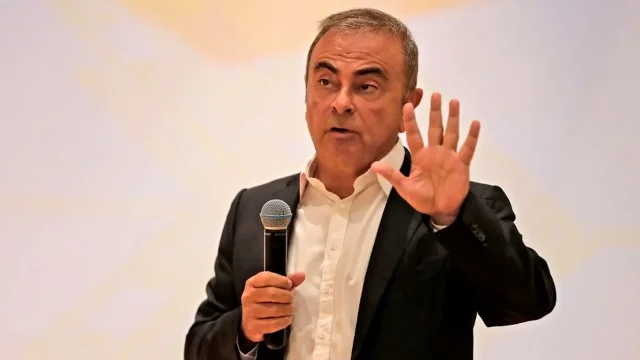
Carlos Ghosn at his first press conference in Beirut, January 8, 2020, after fleeing Japan
Ghosn at his Beirut press conference, January 2020, after fleeing Japan. 16
By December 2019, Ghosn had concluded that a fair trial in Japan was not possible. Japan's conviction rate and the pattern of serial re-arrests had left him with what he framed as two options: "You're going to die in Japan or you're going to have to get out." 16 On December 29, he walked out of his Tokyo apartment in jeans and sneakers, met two men at a nearby hotel, took the Shinkansen to Osaka, and — in the early hours of December 30 — was loaded into a large audio equipment case that was boarded as cargo onto a Bombardier private jet to Istanbul. A connecting flight took him to Beirut. Lebanon has no extradition treaty with Japan. 16
At his press conference in Beirut on January 8, 2020, Ghosn declared: "I did not escape justice. I fled injustice and political persecution." 1 He named Saikawa and Nada directly, calling their actions a "plot and treason" designed to block the Renault-Nissan merger. 1
The U.S. Securities and Exchange Commission filed settled fraud charges in September 2019. Nissan paid a $15 million civil penalty; Ghosn paid $1 million and accepted a ten-year bar from serving as an officer or director of any public company; Kelly paid $100,000 with a five-year bar. All three settled without admitting or denying the SEC's findings. 17 Separately, a French criminal investigation escalated to the investigating magistrate level in February 2020, covering the 2016 Versailles wedding (organized under a Renault sponsorship agreement) and Oman dealership payments. 18
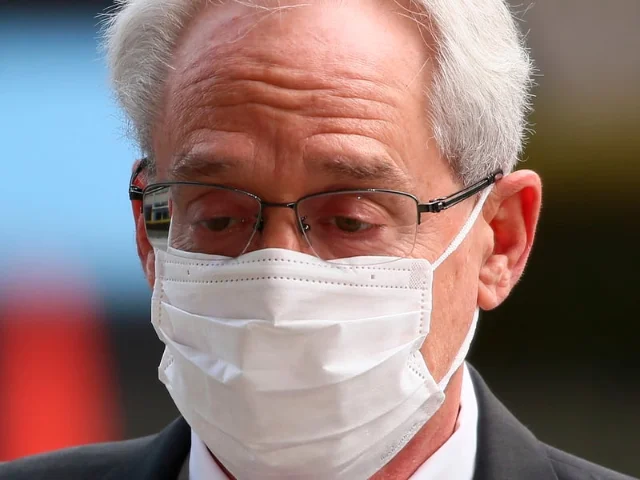
Greg Kelly, Ghosn's former HR director who was arrested the same day, stayed in Japan and stood trial. In March 2022, Tokyo District Court Judge Kenji Shimotsu found Kelly guilty on one of the eight years charged, giving a six-month suspended sentence — a result Kelly called shocking. The judge described Ghosn's management of Nissan as a "dictatorship" and observed: "The dysfunctional governance of the company allowed Ghosn to act in his own self interest." 19
Greg Kelly walking into Tokyo District Court on verdict day, March 3, 2022
Greg Kelly arrives at Tokyo District Court for the verdict, March 3, 2022. 19

Five years to fix the architecture (2019–2023)

The Alliance did not collapse. What it did was spend five years rewriting the terms of coexistence.
In March 2019, Renault and Nissan signed a Memorandum of Understanding creating a new Alliance Operating Board — four members, decisions by consensus, chaired by Renault's newly appointed chairman Jean-Dominique Senard (a former Michelin CEO brought in expressly to rebuild trust). 20 All governing decisions that had previously rested with one person now required agreement between the three companies' CEOs.
In May 2020, the Alliance announced a leader-follower production model: Nissan leads China, North America, and Japan; Renault leads Europe, Russia, and Latin America; Mitsubishi leads ASEAN and Oceania. Investment reductions for fully shared vehicles were projected at up to 40%. 21 The model converted a personal-authority Alliance into an operational one.
The structural correction came in January 2023. Renault agreed to reduce its Nissan stake from 43.4% to 15%, placing 28.4% of Nissan shares into a French trust that would vote neutrally. In exchange, Nissan gained the right to vote with its 15% Renault stake for the first time — ending 24 years of one-way power. 22 Nissan also committed to investing up to 15% in Ampere, Renault's EV subsidiary. The New Alliance Agreement came into force on November 8, 2023. 22
Nissan CEO Makoto Uchida said the deal put both companies on an "equal footing." 22 Renault CEO Luca de Meo described it as entering "a new era of the Alliance with a pragmatic and business-oriented approach." 22 The language is deliberately measured. The price of preserving the Alliance was Renault surrendering the equity architecture it had held since 1999.
링크 미리보기를 불러오는 중…

Frameworks you can use

The board capture trap

The governance failure here was not that Ghosn was dishonest. It was that the board structure gave him the tools to behave dishonestly without consequence for nearly a decade. From 2004, Nissan delegated to Ghosn the authority to set his own compensation. 17 He also chaired the boards that were nominally overseeing him. HBR's podcast analysis of the case identified three failure points: Renault's founding CEO Louis Schweitzer allowed Ghosn to become dual CEO of both companies; neither Nissan nor Renault's boards enforced accountability; and the financial press failed to investigate Ghosn's compensation for years after it became publicly visible. 9
Schweitzer later said: "You cannot part-time manage two companies 10,000 kilometers apart." 9 That observation arrived 15 years too late to be useful.
Application: Any deal that places one executive — or one company — in simultaneous control of multiple governance structures should trigger immediate board architecture review. The red flags here were identifiable in 2006: Ghosn had chairmanships and CEO titles at two Fortune 500 companies simultaneously, no independent directors, board meetings under 30 minutes, and self-determined compensation. Any one of those conditions warrants scrutiny. All four together should end a board's passivity. Establish the oversight mechanism before the problem, not after.

The asymmetric alliance and the equity trap

The Renault-Nissan structure encoded an inherent contradiction: equal-partnership language wrapped around unequal legal control. Nissan generated more revenue and profit than Renault, yet Renault held a 43.4% voting stake while Nissan's reciprocal 15% carried zero votes. For the first decade, this asymmetry was masked by shared growth and Ghosn's personal authority. Once Nissan recovered and Ghosn became identified with French merger ambitions, the asymmetry became an existential grievance.
The lesson is not that equity asymmetry is always fatal — many alliances survive unequal structures. The lesson is that asymmetry requires corresponding constraints on the stronger party's exercise of that power. Renault's failure was not having 43.4%; it was using that stake as a platform for French state industrial policy (the Florange Law intervention of 2015) rather than purely commercial partnership. Once a state actor starts weaponizing equity for non-commercial purposes, the counterparty's trust in the equity arrangement collapses — and the path to resolution runs through equity restructuring, not governance procedures.
Application: When structuring a cross-border alliance, map how domestic political actors in each jurisdiction might interact with the equity structure. A government shareholder in one party is not simply a passive investor — it has sovereign interests that may diverge sharply from the commercial logic of the alliance. Either price that risk into the initial structure (separate classes of voting rights, capped government voting power, put options triggered by political-purpose voting) or accept that the equity structure may need to be renegotiated when political incentives change.

"Hostage justice" and jurisdiction as leverage

Japan's criminal justice system was not a neutral backdrop. Its specific features — extended pre-charge detention (up to 22 days per charge), no right to counsel during interrogation, bail routinely denied for defendants who deny guilt, conviction rate above 99% — turned Ghosn's arrest into a near-irreversible fait accompli regardless of what any trial might ultimately find. 23 Defense attorney Hironaka called the practice "hostage justice" — a description that became widely used in international legal commentary on the case. 23
Senator Bill Hagerty (R-Tennessee), commenting on Kelly's three-plus years in Japan before verdict, said: "What should have been a corporate boardroom discussion landed in the Tokyo prosecutors office." 19
The strategic implication is two-directional. On the offensive side, Nissan's leadership understood that directing a whistleblower into the Japanese criminal system — rather than a civil or regulatory proceeding — maximized the consequence for Ghosn while minimizing Nissan's ongoing exposure. On the defensive side, any executive who operates simultaneously across multiple jurisdictions should understand that the least favorable criminal jurisdiction — not the most favorable — will determine their actual exposure if things go wrong. Ghosn held French, Brazilian, and Lebanese nationality but was arrested in Japan. His only legal exit, in his own assessment, was physical.
Application: In any international deal, governance dispute, or regulatory investigation, identify at the outset which jurisdiction your counterparty might use to litigate or escalate. Parties that operate in Japan, for example, face very different bail, interrogation, and pre-trial detention rules than in France, the UK, or the US. Build that asymmetry into your risk assessment. Do not assume the jurisdiction with the best commercial relationship is the one where a dispute will ultimately be resolved.

The "project of projects" model: why alliances fail when the founding compact dissolves

Academic research on the Renault-Nissan Alliance by Ayache and Dumez (2025), drawing on interviews with Alliance managers after the 2018 crisis, found that the Alliance survived not because of accumulated relationship capital — the standard explanation — but because both parties could articulate a shared future. The researchers described this as a "project of projects" structure: the Alliance was not a single contract but an ongoing relationship defined by a succession of joint undertakings, each of which projected the relationship into the next phase. 24
What eroded the Alliance was not Ghosn's individual misconduct but the collapse of a shared future. By 2018, Renault and the French government were projecting a merger that Nissan did not want. Nissan was projecting an independent operating future that Renault had formally pledged not to oppose. These futures were incompatible. Ghosn was the mechanism through which the incompatibility became a crisis — but the underlying divergence had been building since at least 2015.
Mikami, Ikegami, and Bird (2022) reached a complementary conclusion in their theory of equity-trust for cross-national alliances: the Renault-Nissan case shows that when one party perceives persistent unfairness in the distribution of benefits and decision-making power — distributive and procedural injustice — the trust underpinning an alliance erodes faster than any formal contract can repair. 25 The 2023 equity restructuring was not simply a governance fix. It was the corrective measure that restored the perception of fairness on which the relationship depends.
Application: In long-duration alliances or joint ventures, model not just the current equity and governance structure but each party's likely five-year projection of the relationship. When parties are projecting materially different futures, governance-level agreements will not prevent conflict — they will only determine how the conflict is fought. A shared future must be re-negotiated actively; it does not self-renew.

What to remember

  • Self-dealing requires board architecture that permits it. Ghosn did not seize compensation authority covertly — Nissan's board delegated it to him in 2004. The $140 million in undisclosed or improperly structured compensation was the logical endpoint of a governance design that placed one person simultaneously in the roles of executor, supervisor, and auditor of his own pay. If your board cannot answer the question "who sets the CEO's compensation independently of the CEO?" — that is the problem, not a symptom of it.
  • Equity asymmetry is only stable when the stronger party exercises restraint. For a decade, France's dominant Renault stake was manageable because Ghosn ran both companies and both sides trusted the informal equilibrium. The moment a government actor (Macron in 2015) used the equity structure for domestic political purposes, the trust collapsed. The eventual fix required Renault to give up 28 percentage points of Nissan shares. The cost of the 2015 "raid" — measured in equity given up, five years of crisis management, and $30+ million in SEC and criminal penalties — was vastly higher than any domestic political benefit justified.
  • Jurisdiction determines consequence more than any contract clause. Ghosn's situation — in which a 99%+ conviction rate turned an arrest into a career-ending event before any trial — illustrates that the jurisdiction in which a dispute escalates will often matter more than the underlying merits. International executives, deal-makers, and alliance managers should model worst-case jurisdictional exposure as a distinct risk variable, separate from the substantive legal question.
  • A shared future is the operating capital of an alliance. When Renault and Nissan stopped projecting the same future — one side projecting merger, the other projecting independence — the Alliance entered existential crisis. The 2023 restructuring did not just rebalance equity; it created a new shared project (EV investment via Ampere, the leader-follower model) that gave both sides a reason to project the relationship forward. Alliances that lack an active shared roadmap eventually collapse under the weight of diverging interests, regardless of contractual architecture.
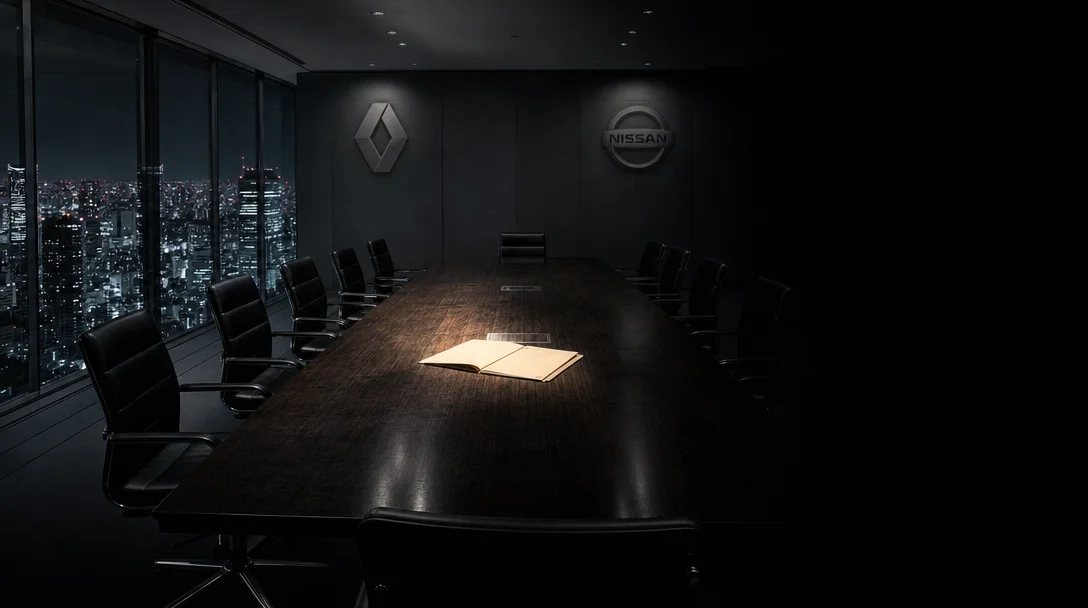
Cover image: AI-generated editorial illustration for this case study.

참고 출처

  1. 1Wikipedia: Carlos Ghosn
  2. 2CNBC: Nissan board votes to remove Carlos Ghosn as chairman
  3. 3Reuters: Seeds of Renault-Nissan crisis sown in Macron's 'raid'
  4. 4BBC News: The downfall of Nissan's Carlos Ghosn: An insider's view
  5. 5HBR: Saving the business without losing the company
  6. 6Wikipedia: Renault-Nissan-Mitsubishi Alliance
  7. 7Thunderbird International Business Review: The global leadership of Carlos Ghosn at Nissan
  8. 8Knowledge at Wharton: Pay, power and politics: Where did Carlos Ghosn go wrong?
  9. 9HBR IdeaCast Episodes 800-806: The rise and fall of Carlos Ghosn
  10. 10CNBC: Mitsubishi Motors ousts Ghosn as chairman
  11. 11Wall Street Journal: Nissan lawyers flag possible conflicts of interest in Ghosn probe
  12. 12SEC Press Release 2019-183
  13. 13Nissan Motor Co., Ltd. — TSE investigation filing, September 2019
  14. 14BBC News: Ex-Nissan boss granted bail by Tokyo court
  15. 15CNBC: Ex-Nissan chairman Ghosn indicted on aggravated breach of trust charge
  16. 16BBC News: Ex-Nissan boss Carlos Ghosn — how I escaped Japan in a box
  17. 17SEC: Charges against Nissan, Ghosn, and Kelly for concealing compensation
  18. 18RFI: France steps up probe into Ghosn's Versailles wedding
  19. 19Courthouse News/AP: Ex-Nissan US exec Kelly gets suspended sentence
  20. 20Nissan Global Newsroom: Alliance Operating Board announcement
  21. 21InsideEVs: Renault-Nissan-Mitsubishi Alliance leader-follower model
  22. 22Nissan Global Newsroom: November 2023 completion announcement
  23. 23Japan Forward: Carlos Ghosn arrested for the 4th time
  24. 24M@n@gement Journal: Renault-Nissan as a Project of Projects
  25. 25Journal of World Business: Opportunism and trust in cross-national lateral collaboration

이 콘텐츠를 둘러싼 관점이나 맥락을 계속 보강해 보세요.

  • 로그인하면 댓글을 작성할 수 있습니다.