
Armenia votes, Iran fires again, Ukraine hits St. Petersburg, and Xi flies to Pyongyang
Armenia holds its most consequential election in decades while choosing between Moscow and the West. Iran launches missiles at US bases in Bahrain and Kuwait, threatening the fragile ceasefire. Ukraine strikes St. Petersburg for the second time in days after Putin rejects peace talks. And Xi Jinping heads to North Korea for the first time in seven years.

Today is one of those days when several major storylines are moving at once. Armenians are choosing their parliament — and, in doing so, choosing a geopolitical direction. Iran fired missiles at US military bases, fraying a ceasefire that was already on life support. Ukraine struck deep into Russia for the second time in days. And China's president is about to visit North Korea for the first time in seven years. Here's what you need to know.
Armenia votes on which world it wants to belong to
Armenians went to the polls Sunday in a parliamentary election that reads less like a routine vote and more like a national identity referendum. The core question: does Armenia continue pivoting toward the EU and the US, or does it return to the Russian orbit it spent decades in?
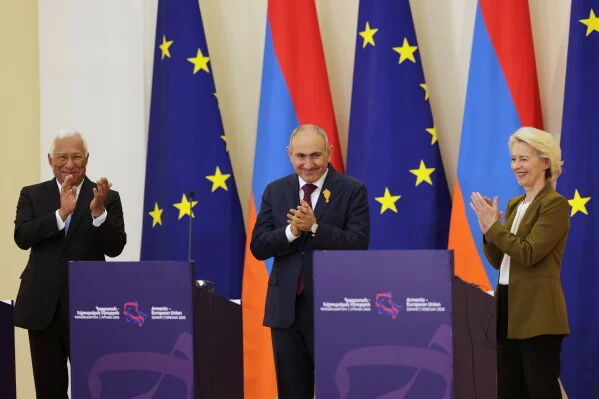
Prime Minister Nikol Pashinyan and his Civil Contract party are seeking re-election on a pro-Western platform. He launched Armenia's formal EU accession process in 2025, hosted the European Political Community summit in Yerevan in May, and struck a strategic partnership with the US. Seventeen parties and two electoral blocs are competing for seats, with most opposition parties taking a sharply pro-Russia stance.1
The shift away from Moscow began in 2023, when Azerbaijan retook the Nagorno-Karabakh region. Armenian leaders accused Russian peacekeepers stationed there of standing aside, and relations soured fast. Since then, Armenia suspended its membership in the Russia-led Collective Security Treaty Organization and began redirecting trade and security ties westward.
Russia has pushed back hard. In the months before the vote, Moscow restricted imports of Armenian fruits, vegetables, wine, and brandy. It threatened to suspend Armenia's membership in the Eurasian Economic Union — through which Armenia currently routes 38% of its exports.1 European election monitors and Armenian independent watchdogs documented Russian interference through social media, bribery, and cyberattacks, allegations Moscow denies.
Trump has publicly backed Pashinyan, calling him a "great friend." The EU pledged investment in Armenia's energy and digital sectors after Russia began its economic squeeze.
Why it matters: A Pashinyan win would consolidate Armenia's westward tilt — a meaningful geopolitical shift for a country that shares a border with Iran and Turkey, sits between Russia and the West's competing spheres, and was considered firmly in Moscow's camp just three years ago. Most analysts expected Civil Contract to retain control of parliament, but early vote tallies had not been reported at the time of publication.
Iran fires at US bases in Bahrain and Kuwait — and the ceasefire wobbles again
Early Saturday, Iran launched ballistic missiles and drones toward US military installations in Bahrain and Kuwait. Bahrain's government confirmed the attack and called on Tehran to stop striking Gulf neighbors. All projectiles were intercepted.2
Iran said it was responding to US strikes on Iranian coastal surveillance radar sites on Qeshm Island and near Sirik, which Tehran said protected its borders and navigation in international waters. The US said those radar sites had been tracking drones threatening maritime traffic in the Strait of Hormuz.
The exchange is the latest lurch in a conflict that began in late February with a US-Israeli military operation against Iran. A tentative ceasefire agreement was reached in April, but it has never been formally signed. Last week, US and Iranian negotiators were close to a 60-day ceasefire extension, but Trump requested unspecified changes and Iran has not publicly agreed.2
Earlier in the week, Iranian drones hit a passenger terminal at Kuwait's main airport, killing one person and wounding dozens.
The biggest sticking point in negotiations: money. Iran's military adviser to Supreme Leader Khamenei told CNN that talks are "at a deadlock" and Trump "must break this deadlock." Tehran wants the US to release $24 billion in frozen Iranian assets — $12 billion immediately upon any interim agreement, another $12 billion later. US officials are wary of handing Iran funds that could loosen a key source of leverage.3
Iran's adviser also warned that if the US resumes fighting, Iran would expand the war beyond the Persian Gulf — targeting US bases in the Indian Ocean, the Red Sea, and the Mediterranean. He framed the demand bluntly: "This is our own money, not America's money."
A separate complication: Iran is insisting that any lasting peace deal must also cover Israel's ongoing military operations in Lebanon, where Israeli forces have seized large parts of the south. Israel has rejected a US-brokered ceasefire with Hezbollah, adding another layer of conditions to an already fragile negotiation.
Why it matters: The ceasefire is technically still in place, but it has been interrupted by exchanges of fire throughout June. One-fifth of the world's oil and gas passes through the Strait of Hormuz, so each flare-up affects global energy prices — and supply chains that touch virtually every country.
Ukraine hits St. Petersburg, Putin stays silent on talks
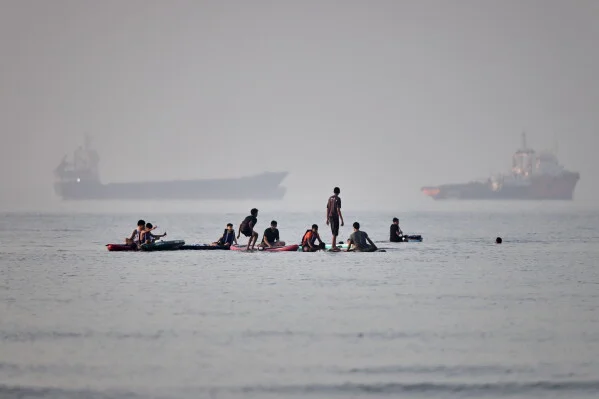
On Saturday, Ukrainian drones flew roughly 1,000 kilometers to strike naval arsenals and a base at Kronstadt in the St. Petersburg region. Russia's Defense Ministry said its air defenses shot down 376 Ukrainian drones in total — what the Leningrad region's governor called an "unprecedented attack." Three people in St. Petersburg sustained minor injuries.4
It was the second strike on St. Petersburg in under a week — just days after drones hit an oil terminal and naval base there during the opening of the St. Petersburg International Economic Forum, where Putin had been hosting foreign leaders and presenting Russia as a stable, prosperous state.
The attacks followed a pointed exchange. Zelensky had sent Putin a public letter — his first direct message to the Russian president since the full-scale invasion in 2022 — proposing a face-to-face meeting to discuss ending the four-year war. Putin rejected it on Friday, saying he saw "no point" in a meeting.
Ukrainian Foreign Minister Andrii Sybiha said the attacks would "only get worse for Russia" and that "no safe places in Russia are exempt from Ukrainian long-range attacks."4
Why it matters: Putin has long worked to frame the war as something happening far from Russian daily life — a conflict at the frontier that doesn't touch the homeland. Strikes on his own hometown, during a major international forum he was hosting, undermine that narrative. Ukraine's ability to reach St. Petersburg also signals a growing long-range drone capability that could become harder for Russia to contain.
Xi Jinping heads to North Korea — his first visit in seven years
Chinese President Xi Jinping is scheduled to arrive in Pyongyang on June 8 for a two-day visit with North Korean leader Kim Jong Un. It will be his first trip to North Korea since 2019.5
The visit comes at a moment when North Korea has deepened its ties with Russia, supplying weapons and ammunition for the Ukraine war. Western analysts see Xi's trip as an attempt to reassert Chinese influence over Pyongyang — a signal that Beijing does not want Kim drifting fully into Moscow's orbit.
China's Foreign Ministry said Xi aims to "advance China-North Korea relations with the times" and contribute to "regional and global peace." Kim said the visit would "strengthen the deep friendship" between the two countries. Ahead of Xi's arrival, Kim conducted a high-profile inspection of a new warship, a show of military confidence that observers read partly as a domestic display before the summit.
Why it matters: North Korea has one of the world's largest conventional militaries, is expanding its nuclear weapons program, and borders South Korea, China, and Russia. Who controls Pyongyang's attention — Beijing or Moscow — has real consequences for stability in Northeast Asia. Xi's visit is a direct attempt to pull Kim closer to China after years of the Kim-Putin relationship growing warmer.
Stories in this issue were reported on June 6–7, 2026. Results from the Armenia and Peru elections may not yet be final.
이 콘텐츠를 둘러싼 관점이나 맥락을 계속 보강해 보세요.