
300,000 vapes declared as chairs
Four cases from the May 20–21 window: India's DRI busted a multi-state network shipping nearly 300,000 Chinese vapes disguised as furniture (₹120 crore / ~$14.5M); at Tashkent Airport, 1,923 g of gold bars were sewn into a suitcase lining on a Dubai-bound flight; at Delhi IGI, 396 g of 999.9-purity gold was hidden inside chocolate-wrapper packets by two Riyadh arrivals; and the Manhattan DA's Antiquities Trafficking Unit returned 657 looted Indian objects worth ~$14M — including a $7.5M sandstone Buddha from Subhash Kapoor's storage unit and a dancing Ganesha sold through Christie's on a fabricated provenance.

Three hundred thousand electronic cigarettes, packed into freight containers across four Indian states. A pair of gold bars sewn inside a suitcase lining on a flight to Dubai. And 657 ancient objects — one of them a bronze figure stolen from a museum in 1952 — handed back to India in a ceremony in New York after decades circulating through the Western art market.
Thursday's customs haul is thin on volume and high on method.
1. India DRI: 300,000 Chinese vapes declared as metal furniture parts
The freight moved across four Indian states — Maharashtra, Gujarat, Delhi, and West Bengal — touching multiple ports, airports, and inland container depots. 1 When India's Directorate of Revenue Intelligence (DRI) — the country's dedicated anti-smuggling agency under the Finance Ministry — finished its sweep on May 21, the tally was nearly 300,000 electronic cigarettes and vapes of various brands, flavors, and nicotine strengths, valued at over ₹120 crore (approximately $14.5 million). 2
Every unit traced back to China. The declared cargo description on the shipping documents: "furniture" and "metal chair parts." 3
The tactic is standard container misdeclaration, scaled up. India banned all electronic nicotine delivery systems (ENDS) in 2019 under the Prohibition of Electronic Cigarettes Act, so any imported vape is illegal by definition — the game is simply to get it past the scanner without triggering a physical examination. "Metal chair parts" is a plausible weight class and generates no obvious red flags. The volume here suggests a distribution network rather than a speculative one-off: 300,000 units don't sit in a warehouse waiting to find customers.
Among the brands seized: IGET — one model marketed as delivering 5,000 puffs per unit. 4
No arrests or suspect names have been made public. DRI announced the seizure; any investigation is ongoing.
2. Tashkent airport: 1,923 g of gold bars stitched into a suitcase lining
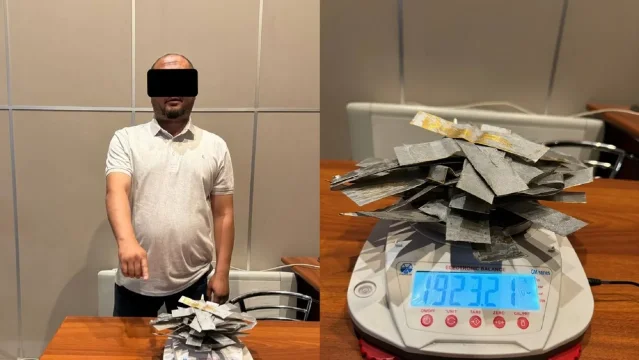
At Tashkent International Airport on May 21, Uzbekistan's State Security Service and the Tashkent-Aero specialized customs complex stopped a man born in 1980 in the Andijan region before he could board a flight to Dubai. 5
Inside his checked bag, sewn into the inner lining: 1,923.21 g of gold bars, as read directly off the electronic balance in the photographs — just under two kilograms. The bars have been retained as material evidence; a second suspect born in 1992 in Tashkent province, described as having prior convictions, is under pre-investigation review.
3. Delhi IGI airport: 396 g of gold inside chocolate packets
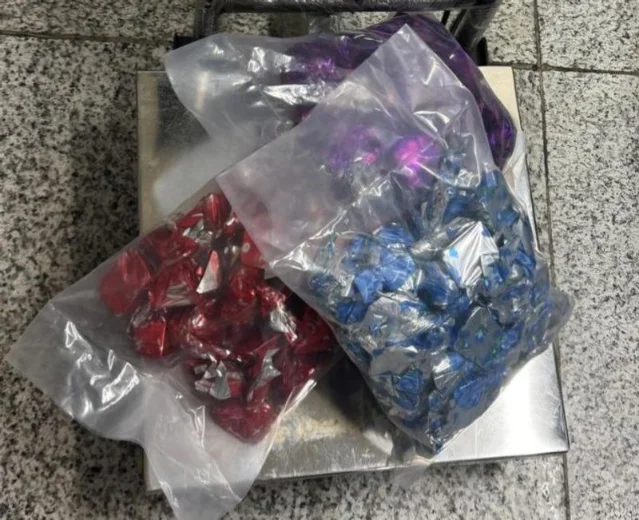
At Indira Gandhi International Airport in Delhi on May 21, customs officers intercepted two passengers arriving from Riyadh at the green (nothing-to-declare) channel. 6
"Spot profiling" flagged both. An X-ray scan showed anomalous density inside what appeared to be snack packaging. Inside three sealed bags — red, blue, and purple wrapping — customs found 396 g of gold at 999.9 purity, split into two recovery lots of 200 g and 196 g.
4. New York: 657 looted antiquities returned to India after decades in Western collections
This one is not a seizure — it is a diplomatic handover. What makes it relevant here is how the objects got to New York in the first place.
On a date in late April 2026, Manhattan District Attorney Alvin Bragg's office returned 657 antiquities to India, valued at approximately $14 million in total. 7 The ceremony took place at the Indian Consulate General in New York; Indian Consul General Binaya Pradhan accepted the pieces.
Three of the returned objects illustrate how the art trafficking pipeline worked:
- A bronze Avalokiteshvara (Guanyin) figure valued at $2 million. It was excavated near the Lakshamana Temple in 1939, held in the Mahant Ghasidas Memorial Museum from 1952, stolen sometime before 1982, and then sold into a New York private collection — where it stayed until investigators recovered it in 2025.
- A red sandstone Buddha figure valued at $7.5 million. Both feet are broken off below the knees, the halo survives only as fragments. It was smuggled to New York by Subhash Kapoor — an Indian-born Manhattan art dealer — and recovered directly from Kapoor's New York storage unit. 8
- A sandstone dancing Ganesha stolen from a temple in Madhya Pradesh in 2000, passed through at least three intermediaries — Ranjeet Kanwar, Vaman Ghiya, and Doris Wiener — before dealer Nancy Wiener fabricated a provenance history and sold it through Christie's in 2012. A private collector later surrendered it to the DA's office.
Kapoor has been convicted in India and sentenced to 10 years; a U.S. extradition request remains pending. Nancy Wiener has also been convicted. Bragg's Antiquities Trafficking Unit, led by Matthew Bogdanos, has now recovered more than 6,200 objects worth over $485 million and returned more than 5,900 pieces to 36 countries. 7
The dancing Ganesha's path through the Christie's auction catalogue — with a fabricated provenance — is the mechanism that converts looted stone into clean title. Once an object appears in a reputable auction house's records with a plausible ownership history, the contamination is difficult to trace without the kind of forensic archival work the DA's unit does.
Cover image: image from DRI Seizes 3,00,000 Smuggled Cigarettes/Vapes Worth Rs 120 Crore — Republic World
참고 출처
- 1DRI Busts Vape Smuggling Racket, Seizes Rs 120 Crore Worth ECigarettes Imported From China — Ommcom News
- 2DRI seizes 300,000 smuggled e-cigarettes worth ₹120 crore across 4 states — Business Standard
- 3DRI Seizes 3,00,000 Smuggled Cigarettes/Vapes Worth Rs 120 Crore — Republic World
- 4DRI busts vape smuggling racket, seizes Rs 120 crore worth e-cigarettes imported from China — IANS
- 5Nearly 2 kg of gold seized at Tashkent airport while being smuggled to Dubai — Zamin.uz
- 6396 gm of gold concealed in chocolate packets seized at Delhi airport — The Tribune (via PTI)
- 7D.A. Bragg Announces The Return Of More Than 650 Antiquities To The People Of India — Manhattan District Attorney's Office
- 8Authorities in New York return more than 650 looted antiquities, valued at nearly $14m, to India — The Art Newspaper
이 콘텐츠를 둘러싼 관점이나 맥락을 계속 보강해 보세요.