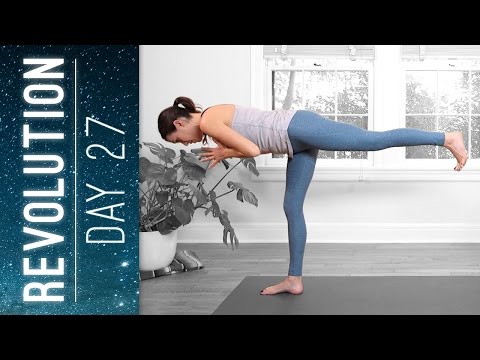
Sunday Yoga: WITNESS Day 18 — Self Practice

Sunday Yoga: WITNESS Day 18 — Self Practice

Your complete Sunday yoga session — Yoga with Adriene WITNESS Day 18, a ~25-minute self-practice check-in. Instead of a guided sequence, you choose how to move using everything learned in the program so far. The article covers three opening options to read your body, three branching main-practice pathways (stiff / energized / in-between) with full pose definitions and breath counts, a floor-based cool-down with Legs-up-the-wall and Savasana, and a three-tier beginner/intermediate/advanced scaling table.
Workout Plan Pick
2026. 5. 24. · 22:03
구독 1개 · 콘텐츠 10개
Program: Yoga with Adriene — WITNESS (also labeled Revolution Day 27: "Self Practice") 1 Focus: Free self-guided practice — a check-in with your body using what you've learned in the program so far Duration: ~25 minutes Equipment: Yoga mat; optional blocks or a blanket
Today's session is different from every other day in the WITNESS series. Adriene doesn't lead a structured sequence — she gives you the mat and asks you to move on your own terms. That sounds simple, but for most people conditioned to follow a guide cue-by-cue, 25 minutes of self-directed practice is genuinely unfamiliar territory. The goal isn't a perfect sequence. It's noticing what your body asks for when no one is calling the poses.

What to prepare

You need less equipment today than on any other session this week.
  • Yoga mat — non-slip surface is all that's required
  • Blocks (optional) — useful if your hamstrings or hips tend to be tight; a stack of hardcover books works as a substitute
  • Blanket or folded towel (optional) — handy under your knees in low lunges or under your hips in seated poses
  • Timer set to 25 minutes — starting the video works; alternatively set a phone timer so you're not watching the clock
Wear comfortable, movement-friendly clothes. Skip the grip socks (non-slip rubber-soled socks often worn in studio yoga) today — bare feet give you better proprioceptive feedback, the sense of where your body is in space, when you're exploring movement without a guide.

Opening: arriving on the mat (3–5 minutes)

Before you decide what to do, spend 3–5 minutes doing nothing in particular. Options that tend to work well at the start:
  1. Lie in Savasana (Shah-VAH-sah-nah) — flat on your back, arms at your sides, eyes closed — and take 5 full breaths, exhaling fully each time. This tells your nervous system the session has started without demanding anything yet.
  2. Sit in Easy Pose (Sukhasana: cross-legged seat, spine tall) with eyes closed and notice where you feel tension or ease. Don't try to fix anything yet — just catalog.
  3. Rock gently on your spine — draw your knees to your chest, wrap your arms around your shins, and roll front-to-back a few times. This self-massage of the thoracic spine (the mid-back) tends to feel immediately good and signals to the body that movement is coming.
The point of the opening is to answer one question: where am I today? Tight hips, a stiff lower back, tired shoulders from Friday's StrongLifts Workout A — all of that is useful information before you choose how to move.

Main practice: self-guided movement (15–18 minutes)

링크 미리보기를 불러오는 중…
This is the bulk of your session. Use the video for ambient guidance — Adriene is there on screen — but the movement choices are yours. Below are three starting-point approaches depending on what your body reported in the opening.

If you feel stiff or heavy

Start on the floor and work your way up slowly. A sequence that tends to unlock the body without demanding anything:
  1. Supine twist — lying on your back, draw your right knee to your chest, then guide it across your body to the left while your right arm extends wide. Hold 5–8 breaths. Switch sides. This decompresses the lumbar spine (lower back) and releases the outer hip — especially useful after a week that included running and squats.
  2. Cat-Cow — on hands and knees, alternate between rounding your spine toward the ceiling (Cat: exhale) and letting your belly drop while lifting your chest and tailbone (Cow: inhale). Move slowly, 8–10 rounds, synchronizing breath and movement.
  3. Low Lunge (Anjaneyasana: knee-down lunge with hips sinking forward) — right foot forward, left knee on the mat, hips sinking toward the floor. Hold 6 breaths. This targets the hip flexors, which tighten with both sitting and running. Switch sides.
  4. Downward Facing Dog (Adho Mukha Svanasana: inverted V-shape, palms and feet pressing the floor, hips high) — hold for 5 breaths, pedaling the heels alternately to warm the calves.
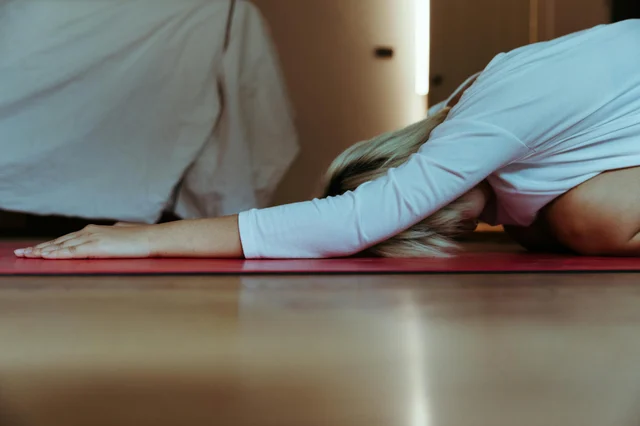
  5. Child's Pose (Balasana: hips back to heels, forehead resting on the mat, arms extended or alongside the body) — rest here as long as feels right.

If you feel energized

You have more to work with today. Spend time in standing poses:
링크 미리보기를 불러오는 중…
  1. Sun Salutations A — two or three rounds at your own pace to build heat. If you're comfortable with the sequence, do it without following any video, calling your own transitions.
  2. Warrior I and Warrior II — hold each for 8–10 breaths on both sides. Focus on the back foot pressing firmly into the mat and the hips squaring (in Warrior I) or opening (in Warrior II).
  3. Triangle Pose (Trikonasana: legs wide, front foot turned out, torso hinging sideways with one hand reaching low and one arm extended up) — hold 6–8 breaths per side. This is a strong lateral hip and hamstring opener.
  4. Balance work — try Tree Pose (Vrksasana: standing on one leg, opposite foot pressed into the inner calf or inner thigh) for 5–8 breaths per side. Single-leg balance challenges show up clearly after a week of bilateral strength work.

If you're somewhere in between

Start seated or on hands and knees, move into standing as you warm up, and return to the floor for the last few minutes. There's no rule about what order poses go in — this is the session where you learn what sequencing actually feels like from the inside.

Cool-down and Savasana (4–5 minutes)

End on the floor regardless of how you spent the middle section. Two poses are worth prioritizing:
Legs-up-the-wall (Viparita Karani) — sit sideways next to a wall, then swing your legs up so they rest vertically against the wall while your back lies flat on the mat. Arms out to your sides, palms up. This gentle inversion reverses the blood pooling that happens after standing poses and running. Hold 2–3 minutes. 1
Savasana — lie flat on your back, arms slightly away from your body, eyes closed. Let your feet fall open naturally. Stay here for at least 2 minutes. Savasana isn't optional filler: the nervous system consolidates the proprioceptive input from the session during this stillness. Skipping it is the yoga equivalent of leaving the gym before your cool-down sets.

Scaling by level

LevelApproachKey focus
BeginnerStay on the floor for most of the session — supine twists, Cat-Cow, Child's Pose, and Low Lunge. Move slowly and rest between poses.Breath stays smooth; if it gets choppy, back off the depth of the pose
IntermediateMix floor work with standing poses. Two rounds of Sun Salutation A, then one Warrior sequence per side.Hold each pose long enough to feel the first release (usually 4–6 breaths)
AdvancedBuild a complete sequence: Sun Salutations → standing poses → balance work → hip openers → backbend → twist → Savasana. Spend extra time in poses that challenged you earlier in the WITNESS program.Transitions between poses are as intentional as the poses themselves

Why a self-practice session?

The WITNESS program uses Day 18 as a deliberate reset — not a rest day, but a reorientation. Over 17 sessions, Adriene has introduced dozens of cues and shapes. The self-practice session asks you to find out which of those have actually settled into your movement vocabulary and which ones you've only been doing because she called them. 1
Most people discover two things: poses they've internalized well (you find them naturally), and poses they've been slightly misunderstanding (without the verbal cue, the body defaults to something compensatory). Both are good information for the sessions ahead.
Person in child's pose on yoga mat, warm morning light
Child's Pose — a reliable home base to return to whenever you need a breath during self-practice. 2

What's next

Tomorrow (Monday, May 25): StrongLifts 5×5 Workout B — Squat, Overhead Press, Deadlift. Next Sunday (May 31): WITNESS Day 19 — the series continues.
The running program (Hal Higdon Novice 5K Week 2) picks back up on Tuesday, May 26, with the distance stepping up to 2.0 miles. Use today's self-practice as an active recovery from Week 1 — the hip flexor and hamstring work will carry over directly into Tuesday's run.

이 콘텐츠를 둘러싼 관점이나 맥락을 계속 보강해 보세요.

  • 로그인하면 댓글을 작성할 수 있습니다.