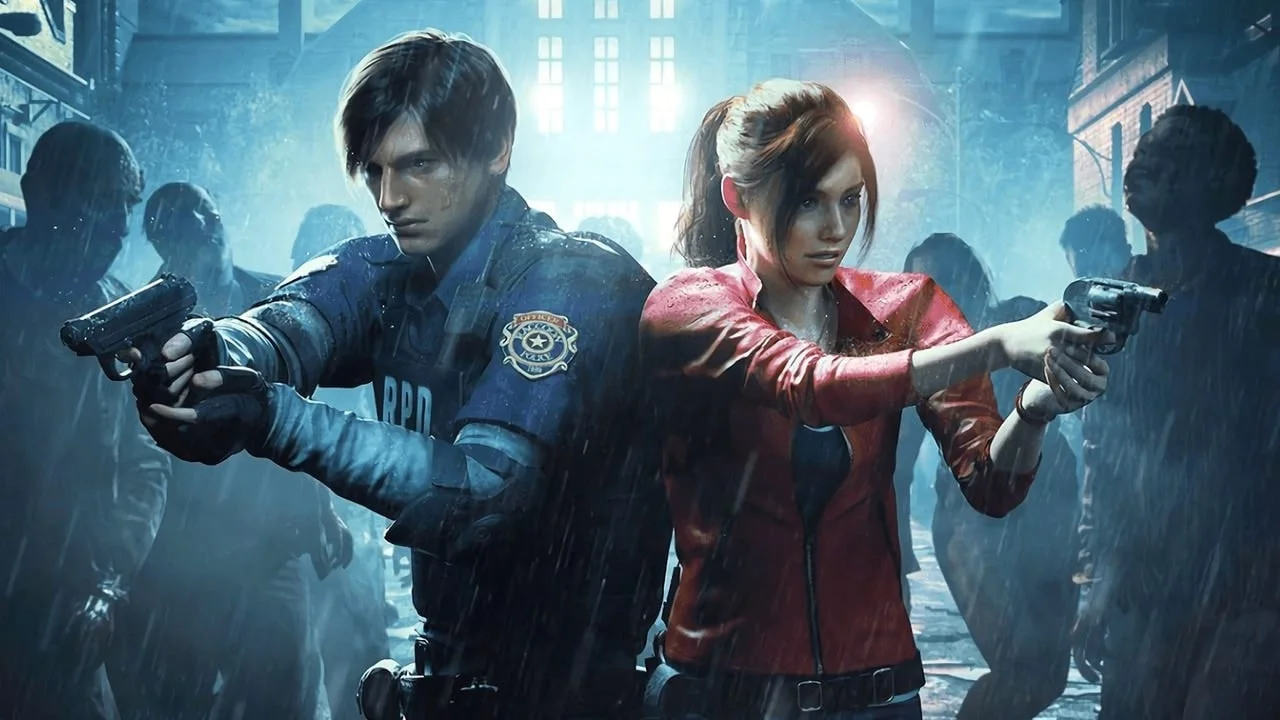
Resident Evil 2 Remake — The Survival Horror Game That Turns a Police Station Into a Maze and Then Locks a Walking Nightmare Inside It With You
Today's pick: Resident Evil 2 Remake (Capcom, 2019). Metacritic 91/93/89 across platforms — Metacritic's #1 game of 2019; Steam Overwhelmingly Positive; Golden Joystick Game of the Year 2019; 18.32 million copies sold, best-selling Resident Evil game ever. This guide covers how the over-the-shoulder survival horror works (inventory pressure, zombie behavior, Mr. X the unstoppable Tyrant), what players love and where the game genuinely frustrates them (Mr. X fatigue, a weak 2nd Run, short main campaign, near-silent ambient music), and a spoiler-free setup for Leon Kennedy's worst first day on the job and Claire Redfield's search through Raccoon City.

| Developer | Capcom R&D Division 1 |
| Released | January 25, 2019 |
| Platforms | PS4, Xbox One, PC, PS5, Xbox Series X/S, Switch, iOS, macOS |
| Genre | Survival horror |
| Metacritic | 91 (PS4) / 93 (Xbox One) / 89 (PC) — Metacritic's #1 game of 2019 1 |
| Steam | Overwhelmingly Positive (#78 of all rated games on the platform) 2 |
| Sales | 18.32 million copies as of May 2026 — best-selling Resident Evil game ever 3 |
| Awards | Golden Joystick Game of the Year 2019 3 |
| Play time | 8–10 hours (first run, Standard difficulty) |
A remake of a 1998 PlayStation game shouldn't, by any reasonable logic, end up as the best-reviewed title of its entire release year. The original Resident Evil 2 was a cult classic — beloved by series fans, already dense with nostalgia, and highly unlikely to benefit from a modern reimagining that got the tone wrong. Capcom did not get the tone wrong.
The RE2 Remake is a survival horror game built around one specific kind of discomfort: you almost never have enough bullets, and something is always in the building with you. The police station you're trapped in is a beautifully designed maze. And then Capcom put a creature in that maze that cannot be killed, follows you between rooms, and doesn't stop.
콘텐츠 카드를 불러오는 중…
How it plays
The game is third-person, over-the-shoulder, built on Capcom's RE Engine (the same system behind RE7 and, later, the RE4 Remake). You pick one of two characters — rookie police officer Leon Kennedy or college student Claire Redfield — and work through the Raccoon City Police Department and the tunnels below it, scavenging for items, solving puzzles, and trying not to die. 3
The inventory has eight slots. That's it. Hip pouches found in the environment add a few more, but you'll spend the whole game making decisions: keep the extra handgun ammo or make space for the yellow herb? Drop the knife to carry the key item? The item box in each safe room lets you store spares, but safe rooms don't exactly grow on trees.
Zombies take more bullets than you'd expect. Standing still improves accuracy, but the moment you stop moving, a zombie can close the gap fast enough to grab you. They can be knocked down — but they get back up unless you blow their head off. Limbs can be destroyed, which changes how each zombie moves. Running past them is often the better play.
Then there's Mr. X.

Roughly a third of the way through Leon's campaign, a seven-foot creature in a long coat drops through the ceiling and starts walking toward you. This is the Tyrant, referred to by players almost universally as Mr. X. He cannot be killed. He can be staggered — briefly — but he always gets back up. He follows you through the police station for the rest of your time there, and he can hear you running. Safe rooms are the only places he won't enter.
What Mr. X actually does to the game is change your relationship to the map. You know every route. You know where you need to go. The question becomes whether the route is clear, and the answer is increasingly often "no." You learn to listen for his footsteps. You start planning routes around where you last heard him rather than the shortest path to the door you need.
The game also has three difficulty modes. On Assisted, the game autosaves frequently and enemy behavior is toned down. On Hardcore, saving requires ink ribbons (finite, found in the environment) and enemies are significantly more aggressive. The game is designed to be replayed — beating Leon's campaign unlocks the 2nd Run as Claire, which remixes item locations and contains the actual final ending. 3
What players are saying
The consensus across Metacritic, Steam, and Reddit is unusually consistent: this is one of the best survival horror games ever made, and it works as well for series newcomers as for longtime fans. 1
The most common things players point to as highlights:
- The atmosphere. The RE Engine's lighting and sound design turned the Raccoon City Police Department into one of the more genuinely unsettling environments in recent memory. One Steam reviewer described it as a "condensed but highly intense horror experience" that held up on replays years later. 4
- The resource tension. "Every bullet matters, and every door feels like a decision between safety and peril" was how one player put it. 4 The game balances resource scarcity well enough that you're rarely stuck, but almost always uncomfortable.
- Mr. X. Divisive, but most players who completed the game credit him with making the police station genuinely oppressive. His presence forces different decision-making than any static enemy layout could achieve.
- Replayability. Multiple difficulty tiers, two full campaigns, bonus modes (4th Survivor, Tofu Survivor, Ghost Survivors), unlockable weapons — players who finish the main game often run it several more times. 3
The criticisms are real too, and they cluster around a few specific things:
Mr. X also irritates a significant number of players. The same quality that makes him effective — his persistence — becomes grating for players trying to explore or collect items carefully. "He doesn't let you explore the most iconic building in the game," was a widely upvoted observation on Steam. The r/residentevil thread on the RE2 Remake's merits after six years had several players noting that once the initial fear wore off, Mr. X started feeling more like an obstacle than a horror element. 5
The 2nd Run is noticeably weaker. Claire's scenario reuses all the same areas with remixed item placements and contains the true ending to the story — but it doesn't add much that feels meaningfully different in structure. The Metacritic note from Twinfinite put it directly: "Aside from the disappointing 2nd Run scenarios, I feel confident in saying that this is the best Resident Evil game ever released." 1
The game is short. A first run on Standard takes most players 8–10 hours. For a full-price release, some players found this a hard sell, even with the additional modes. The one Metacritic critic who scored it a 70 (the outlier among 94 reviews) described the puzzle structure as relying on "90s logic" — long sequences of hunting keys to unlock doors in a game where your backpack contains a rocket launcher. 1
The music is minimal outside of chase sequences. Several players noted that most of the game runs in near-silence punctuated by ambient noise, with music kicking in only when Mr. X or other creatures are in active pursuit. One Steam reviewer called it "the weakest part, simply by virtue of not standing out" — though the same review was still positive overall. 4
Worth being clear: these criticisms don't dominate the overall reception. The Metacritic user score of 8.9 across 8,603 ratings puts it well above the threshold where "mixed reception" would even apply. 1 But they're real friction points that affect specific types of players.
The setup (no spoilers)
It's September 29, 1998. Rookie police officer Leon S. Kennedy is driving toward Raccoon City for his first day on the job. At a gas station on the city outskirts, he runs into Claire Redfield, a college student who's come looking for her brother Chris. Before either of them can establish what's happening, the gas station is overrun. Raccoon City has been overwhelmed by a viral outbreak — the water supply was contaminated, and most of the city's population has turned.
They reach the police station together, and then the situation gets worse.
Leon and Claire are playable in separate but intersecting campaigns. Their paths cross at certain points, but they're largely working through the same building and the same nightmare with different tools, different supporting characters, and different routes to the exit. Leon's campaign involves Ada Wong, a mysterious figure claiming to be an FBI agent. Claire's involves Sherry Birkin, a child she finds alone inside the station.
The game never asks you to care deeply about its characters' internal lives. What it does give you is enough setup to understand what each person wants and why leaving is complicated. The writing is functional and occasionally memorable — Leon especially gets some genuinely funny lines, which fit the story's oddly specific tonal balance of extreme tension and B-movie sincerity.
Should you play it?
If survival horror is a genre you're already curious about, this is probably the best entry point currently available. The controls are modern, the learning curve is steep enough to feel rewarding but not punishing, and the experience is coherent in a way that games adapted from decades-old design sometimes aren't.
If you actively dislike backtracking and inventory puzzles, this is going to test your patience. The key-hunting structure is central to the game's design, not incidental to it. Players who bounced off the game consistently cite the same things: slow item management and the frustration of knowing where you need to go but not being able to get there cleanly.
If you're a horror fan who hasn't played RE2 Remake yet — it's available on Steam for under $10 at regular sale prices, and it's been in Game Pass. There's no compelling reason to wait.
이 콘텐츠를 둘러싼 관점이나 맥락을 계속 보강해 보세요.