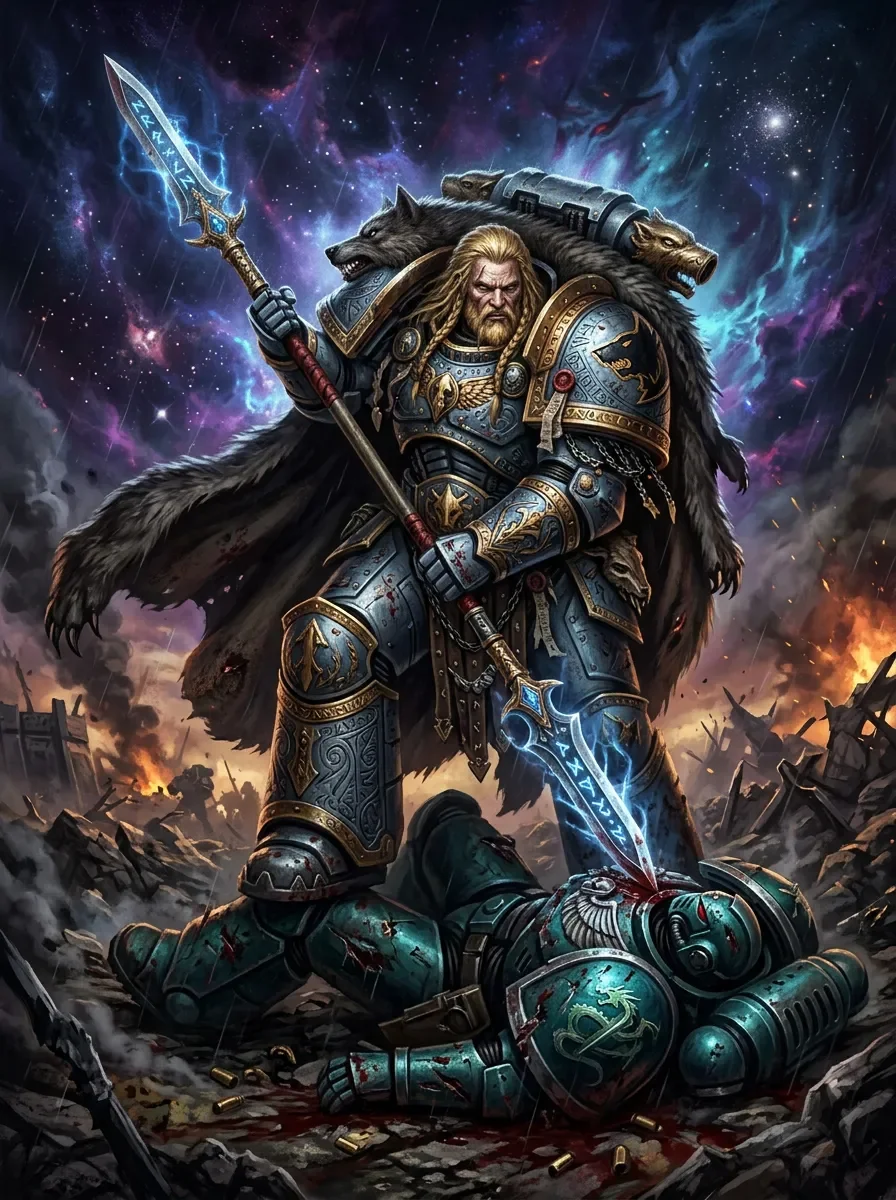
Leman Russ, Part II: The Weight of Ash
Part II of the Leman Russ arc — from the desperate siege in the Alaxxes Nebula where Bjorn pulled his Primarch back from despair and Dark Angels rescued the pack from Alpha Legion encirclement, through the Space Wolves' late arrival at a Terra already broken, Russ's clash with Valdor over the Emperor's fate and the underground fight with Lion El'Jonson, the Codex Astartes dispute and the failed Wolf Brothers Chapter, to Bjorn's naming as first Great Wolf — and Russ's final feast at the Fang, his promise of the Wolftime, and his disappearance into the Eye of Terror.
The Heresy is over. Horus is dead. The Emperor is enthroned in agony on the Golden Throne. And Leman Russ — the Wolf King, the Emperor's Executioner, the man who burned Prospero — must figure out what to do with the rest of his very long life.
Part I ended in the dust of Tizca: the Thousand Sons' city razed, Magnus broken, and Russ beginning the slow, awful recognition that he had been used. Horus had fed the Space Wolves a manipulated order and pointed them at a brother. The guilt of that would never fully leave him. But there was no time to sit with it. The Alpha Legion was already waiting in the dark.
Trapped in the Alaxxes Nebula
The Space Wolves emerged from Prospero battered. They had fought a psychic legion on their home ground, taken casualties they had not anticipated, and now their Primarch was in a state of something close to despair — not grief, which Russ understood, but doubt, which he did not. The doubt was about purpose. About what it meant to be the Emperor's Executioner when the Emperor's orders could apparently be fabricated by a traitor Warmaster.
Horus had planned for this. The Alpha Legion, one of the most operationally sophisticated forces in the galaxy, was dispatched to intercept the Space Wolves before they could reach Terra. The ambush caught Russ's fleet in the Alaxxes Nebula in 007.M31, and suddenly the Sons of Fenris found themselves surrounded, besieged, and burning through ammunition they could not replace.1
Russ sent word to Jaghatai Khan of the White Scars, whose fleet was operating in the same region. Horus had already moved against that too. The Warhawk received a counter-message claiming that Russ himself had turned traitor, that the attack on Prospero had been an act of rebellion rather than execution of orders. Jaghatai Khan, a cautious and methodical commander even at speed, chose to investigate rather than commit — he turned for Prospero to see the evidence himself. Russ got no relief.
What followed in the nebula was a slow strangulation. First Captain Gunnar Gunnhilt assumed tactical command while Russ wrestled with his crisis of identity, and it was Bjorn — young then, sullen and sharp-tongued, the warrior who had already saved Kasper Hawser's life and brawled with Thousand Sons sorcerers at Nikaea — who finally cut through the Primarch's paralysis. Bjorn confronted Russ directly, told him that blind service to the Emperor as an instrument of punishment was a mistake, and that the Space Wolves needed their Primarch to be something more than a weapon in someone else's hand. It was, by any measure, an extraordinary conversation between a line warrior and the being who had effectively birthed him. Russ listened.2
The breakout came at enormous cost. Gunnhilt drove his ship Ragnarok in a suicide run against the Alpha Legion vessel Delta, destroying it — and himself — to tear open a gap in the encirclement. The Alpha Legion closed again regardless. But somewhere in that desperate fighting, with the Space Wolves throwing themselves at a trap that should have killed them all, a rescue arrived from an unexpected direction.
A Dark Angels fortress-monastery, Chimaera, had picked up the distress signal. The contingent aboard — loyal to Luther rather than Lion El'Jonson, and utterly unaware that the Heresy was even happening — assessed the situation and reached their own conclusion: the Space Wolves were clearly the loyalist force here. They intervened, broke the Alpha Legion attack, and pulled Russ's battered fleet free. In the aftermath, Russ told them about Horus, about Terra, about everything. The Dark Angels promptly reversed course for Caliban to deal with their own internal crisis.
Russ set a heading for Terra. He was too late.
Leman Russ leads the Sixth Legion in the field 3
Arriving after the fire
The Space Wolves, along with Dark Angels elements under Corswain and the remnants of other late-arriving loyalist fleets, reached the Sol System after the Siege of Terra had already ended. Sanguinius was dead. Horus was dead. The Emperor was broken beyond recovery, interred in the device that would sustain his corpse for ten thousand years.4
There is something almost unbearable about this in the record. Leman Russ had spent the entire Heresy reacting to manipulations — sent to Prospero on a falsified order, ambushed in the Alaxxes Nebula as a consequence, and now arriving to find that the war was over and the Emperor was gone. He had not been at the Siege. His Legion had spent its capacity on a burning city and a trap in a nebula while Terra bled.
Russ's grief at the Emperor's condition was reportedly public and raw. He clashed verbally with Constantin Valdor, Captain-General of the Adeptus Custodes, when Valdor made a statement to the effect that the Emperor had foreseen and accepted this outcome — that it was all, in some sense, planned. Russ did not accept this. The idea that the Emperor had orchestrated his own entombment on the Golden Throne ran directly against everything Russ understood about his father. Whether Russ was right or wrong matters less than what the confrontation reveals: this was a Primarch who had always operated on loyalty rather than theology, and he was now being asked to understand the Emperor's defeat as a form of divine strategy.
There was also the matter of Lion El'Jonson. The two had a history — the brawl on Dulan over a dead tyrant's throne during the Great Crusade, covered in Part I, which had ended without resolution. In the aftermath of the Siege, beneath the Imperial Palace, they fought again. The circumstances of what they argued about are not fully recorded. What is recorded is that the confrontation was violent enough that witnesses reported Russ was stabbed with the Lion Sword and came close to death. And then, shortly afterward, both Primarchs emerged in public, neither visibly wounded, the old rancor apparently settled. Whatever passed between them underground stays underground.5
The Codex Astartes and the war Russ refused to fight twice
Roboute Guilliman, who had arrived at Terra as commander of the relief force, moved with characteristic urgency to prevent the Imperium from collapsing under the weight of its own victory. The Heresy had left the surviving Space Marine Legions as dangerously large forces with no formal structure to prevent another traitor Primarch from using one as a private army. Guilliman's solution was the Codex Astartes: break every Legion into smaller Chapters of roughly a thousand warriors, each operating independently with its own supply chain, its own gene-seed record, and no single commander capable of deploying more than a Chapter's worth of power without Inquisitorial oversight.
Leman Russ hated this.
He and Rogal Dorn stood together against the Codex, for different reasons. Dorn's objection was a matter of military doctrine — he thought Guilliman was wrong about the tactical merits. Russ's objection was something more personal: the Space Wolves were not a Legion in the conventional sense. They were a Pack. Their culture, their psychology, their entire way of making war was built on the bond between the Wolf King and his sons. Splitting them into Chapters, appointing Chapter Masters who owed allegiance to a Codex rather than to Russ directly, would destroy the thing that made them what they were.
Guilliman did not yield. The Codex became policy, backed by the newly formed High Lords of Terra.
The Space Wolves did not fully comply. That much was made explicit from the beginning. The Legion undertook one attempt to produce a successor Chapter — the Wolf Brothers — and it failed catastrophically. The Wolf Brothers developed severe Canis Helix mutations beyond anything Apothecaries could stabilize, and the Chapter was eventually disbanded. Whether this was bad luck, sabotage, or some organic incompatibility between the Space Wolves' gene-seed and the conditions of a successor Chapter operating without the Legion's close culture around it, no one has definitively determined. What it effectively meant was that the Space Wolves remained, in practical terms, a Legion — oversized, non-compliant, and entirely unconcerned about what Codex-adherent commanders thought of them.5
The Scouring and the hunt for Mars
The post-Heresy period — the Scouring — was the Imperium's campaign to reconquer territory lost to the traitors, hunt down surviving Chaos forces, and rebuild what could be rebuilt. Russ participated in the political councils of the era, but his inclination was always forward rather than deliberative. In the reconstruction debates, he aligned with Lion El'Jonson and Rogal Dorn in pushing for immediate pursuit of the retreating traitor Legions — preferring to chase them into the Eye of Terror before they could consolidate — against Guilliman's argument that territorial consolidation had to come first.
Guilliman's plan prevailed. The High Lords supported it. Russ accepted the outcome but did not wait around: he deployed the Space Wolves to sweep the Sol System for traitor remnants, and he personally took on the reconquest of Mars as an objective. The Mechanicum forces loyal to the traitor Fabricator-General Kelbor-Hal had done enormous damage to the Red Planet, and bringing Mars back into the Imperium's fold was both a military and symbolic priority.
The Wolf King in the post-Heresy era 3
Bjorn, the last of the Company of Russ
During the years of the Scouring, the bond between Russ and Bjorn deepened. Bjorn had distinguished himself repeatedly — at Prospero, at Alaxxes, in the campaigns that followed — and his capacity for holding himself together in the worst circumstances was exactly the quality that drew Russ's respect. There was the matter of the daemon Arvax: Bjorn's entire pack was wiped out fighting the Khornate daemon prince on the volcanic world of Gryth, and Bjorn survived alone. He spent five years carrying that survivor's guilt and an oath of vengeance until Russ led a campaign specifically to find and destroy Arvax again. This time Bjorn got there first, dueled the daemon one-on-one, and killed it by tearing out its throat. Russ watched the whole thing, and afterward exonerated Bjorn in front of the entire Legion, calling his oath fulfilled. He promoted Bjorn to his personal Wolf Guard and gave him the name "Fell-Handed."2
The Space Wolves' poets — the Skjalds — later wrote that it was this quality in Bjorn, this ability to master loss rather than be destroyed by it, that explained what happened next. When the Wolf King prepared to leave for his final journey, Bjorn was the one member of his entire personal Wolf Guard who was left behind.
The feast at the Fang, and the Wolftime
In 211.M31, Russ called his Legion together for a feast at the Fang, the fortress-monastery carved into the spine of Fenris. He gave a speech. The content of it, as recorded, was not tactical — it was valedictory. He spoke to his sons about what would be asked of them, about patience, about the weight of what they carried. And then he made a promise.
The promise, preserved by Bjorn and recited by him once every thousand years, goes:
"Listen closely Brothers, for my life's breath is all but spent. There shall come a time far from now when our Chapter itself is dying, even as I am now dying, and our foes shall gather to destroy us. Then my children, I shall listen for your call in whatever realm of death holds me, and come I shall, no matter what the laws of life and death forbid. At the end I will be there. For the final battle. For the Wolftime."5
Then he left.
Russ took his entire personal retinue — every member of his Wolf Guard except Bjorn — and walked into the Eye of Terror. No one went with him by invitation who was not part of that inner circle. No announcement of destination was given. The broader Space Wolves Legion was simply told that their Primarch had gone, and that Bjorn would lead them.
Some Space Wolves believe Russ went into the Eye to find the World Tree, Yggdrasil — a cure or mechanism that might somehow restore the Emperor. Others think he chased a vision or a prophetic dream into the warp. The honest answer is that the sources do not say, and no one has confirmed it from the other side. What is certain is that the Great Hunts — expeditions launched by the Space Wolves once each millennium to search the galaxy for any trace of their Primarch — have found nothing. Ten thousand years of searching. Nothing.
Bjorn alone, and what came after
The Space Wolves that Bjorn inherited were a Legion formally claimed to be compliant with the Codex, effectively not. He was their first Great Wolf — the first non-Primarch to hold the Legion's supreme command — and he led them for roughly seven hundred years before disaster caught him.
In 934.M31, during a raid on a traitor fortress in the Proxima Rebellion, Bjorn was wounded so severely that the Chapter's Apothecaries could not repair the damage. His body was effectively paralyzed. The only solution was entombment in a Dreadnought sarcophagus — the same technology that had preserved broken Heresy-era warriors in armored chassis for centuries.2
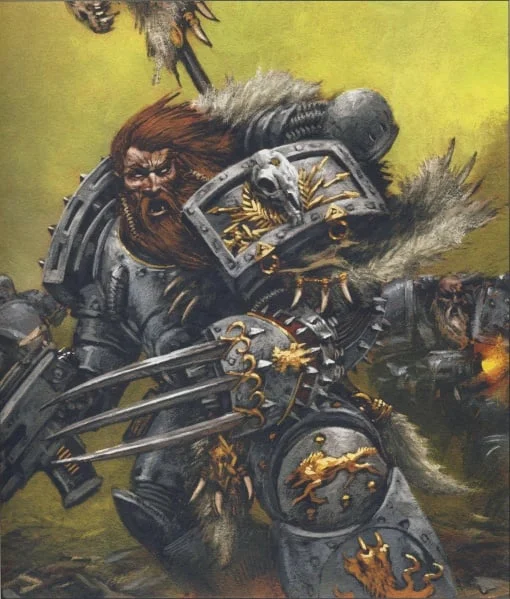
Bjorn himself describes the transition with characteristic bitterness. He did not want to be placed in the Dreadnought. He did not want to become a monument. He fought on from inside the chassis for another five hundred years before the accumulated weight of millennia began to slow him, and he started spending longer periods dormant in stasis. As of M42, he is the oldest living Space Marine in the Imperium — the last direct physical link to the age of Primarchs and Crusade and the war that broke the galaxy.
He is also, by his own account, still furious about being left behind. The anger has become, by now, a structural feature of his consciousness rather than an emotion. He believes Russ left him specifically because Bjorn's particular brand of grief — the grief that does not collapse but calcifies into cold purpose — was what the Space Wolves would need to survive the centuries of waiting. He may be right. That does not make it feel like less of an abandonment.
The Wolftime, as the Space Wolves understand it, will come when the Chapter faces extinction and Russ returns. Ten thousand years in, no Space Wolf has seen it. Every Great Hunt has come back empty. Bjorn wakes from stasis to recite the promise, then returns to sleep.
He is still waiting.
Part III will cover Leman Russ's place in the current M42 era — the Great Rift, the return of Primarchs, and the evolving Space Wolves under Logan Grimnar — as well as what the lore has established and left unanswered about the Wolftime.
이 콘텐츠를 둘러싼 관점이나 맥락을 계속 보강해 보세요.