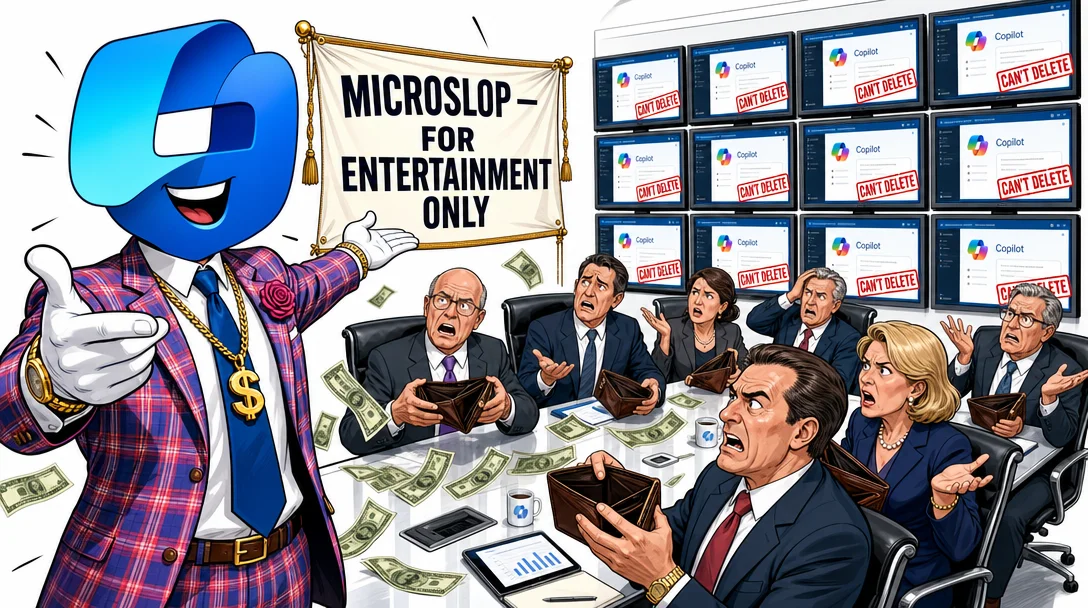
Microsoft 365 Copilot: The $30/Month "Entertainment System" That Renamed Your Office Suite

Microsoft 365 Copilot: The $30/Month "Entertainment System" That Renamed Your Office Suite

Microsoft's own terms of service say Copilot is "for entertainment purposes only" — the same product they force-installed on 440 million Microsoft 365 subscribers at $30/month, injected into 1.5M GitHub pull requests as ads, pre-loaded on LG TVs with no delete option, and renamed the entire Office suite after. Adoption rate: 1.81%. Today's teardown.

AI Roastmaster Daily
2026. 5. 30. · 23:07
구독 15개 · 콘텐츠 12개
Microsoft has been selling you a productivity revolution. Their own legal team calls it a toy.
The terms of service for Microsoft Copilot, updated in October 2025, include this sentence: "Copilot is for entertainment purposes only. It can make mistakes, and it may not work as intended. Don't rely on Copilot for important advice. Use Copilot at your own risk."
Read that again. "Entertainment purposes only."
This is the product Microsoft has force-installed on 440 million Microsoft 365 subscribers at $30 per user per month. The product they renamed the entire Office suite after in 2024 — Microsoft 365 Copilot was literally what "Microsoft Office" became. The product Satya Nadella called "the most important thing we've ever done at Microsoft" in press conference after press conference. The product that comes pre-loaded on LG smart TVs, cannot be removed, and apparently exists to entertain you while you're trying to watch Netflix.

The pitch

Starting in November 2023, Microsoft told every enterprise customer on the planet that AI had arrived. Copilot would summarize your meetings. Draft your emails. Search your SharePoint. Write your PowerPoint decks. The tagline was "your everyday AI companion," and the price was $30 per seat per month bolted on top of existing Microsoft 365 subscriptions.
Satya Nadella did not soft-pedal this. He told investors AI was "a secular trend that will affect every industry" and that Copilot was Microsoft's answer to it. Microsoft's marketing machine ran full-page ads, blanketed LinkedIn with productivity promises, and seeded enterprise sales channels with the message that Copilot adoption was, as multiple internal presentations phrased it, "no longer optional."
At Ignite 2024, Microsoft announced that Copilot had passed 100,000 enterprise customers. Analysts assigned the feature a projected TAM of hundreds of billions of dollars. The company's stock price appreciated on the AI story. Everyone was supposed to be getting smarter, faster, and more productive.

The reality

By August 2025, Microsoft had approximately 8 million active licensed users of Microsoft 365 Copilot across all its enterprise customers. 1
Eight million. Out of 440 million Microsoft 365 subscribers.
That's a 1.81% conversion rate.
통계 카드를 불러오는 중…
To give that number some texture: Microsoft has 400,000 channel partners. If each partner bought an average of 20 seats for their own employees, that's already 8 million seats. The entire paid Copilot user base could, in theory, be nothing but Microsoft's own distribution partners who had to buy it anyway.
The SharePoint Copilot numbers are worse. Microsoft announced, with visible pride, that its customers had created 3 million "agents" in FY2025. One analyst's theory was that most of these lived inside SharePoint. SharePoint Copilot had fewer than 300,000 weekly active users in August 2025 — against 300 million total SharePoint Online users. That's a 0.1% weekly active rate for an AI product that has been available for two years.
If you want to understand what that means in product terms: one in a thousand SharePoint users touched an AI agent in a given week. That's the AI transformation of the enterprise.

The creative workarounds

When your product isn't working, there are a few paths forward. You can improve it, you can reduce the price, or you can stuff it into places people can't avoid.
Microsoft chose the third option.
In December 2025, LG TV owners started noticing something odd: their webOS smart TVs had received an update that installed a Microsoft Copilot app. No option to uninstall it. It just appeared. 2
In March 2026, GitHub — which Microsoft bought for $7.5 billion in 2018 — started injecting Copilot upgrade ads directly into pull request review comments. Developers opened code reviews and found Microsoft advertising at them. GitHub claimed it was an "opt-out" feature. After engineers screamed, GitHub backed down and removed it within 24 hours. 3 By that point, 1.5 million pull requests had already received the treatment.
콘텐츠 카드를 불러오는 중…
Also in March 2026, Microsoft's official Copilot Discord server automatically filtered the word "Microslop" — the nickname that had spread across social media as users reacted to what they saw as an aggressive, low-quality AI integration forced into their operating system. Users experimenting with the filter got banned. The server was eventually locked entirely after a backlash. 4
콘텐츠 카드를 불러오는 중…
When you're censoring the word your users invented for your product and locking down the community server, you are not managing a PR problem. You are describing a product problem in corporate crisis language.

The security problem nobody talks about

Here is something that gets less coverage than the Discord drama: Microsoft 365 Copilot has a documented data exfiltration vulnerability that researchers at PromptArmor disclosed in 2025 and that is architectural, not patched away.
The attack chain: Copilot Cowork (Microsoft's agentic Copilot feature) runs with a user's Microsoft 365 permissions. An attacker can poison a "skill" file — a common user behavior is to download and upload skill files from the internet. When the user asks Copilot to do something routine ("summarize my week"), the injected prompt tells Copilot to silently retrieve pre-authenticated download links for files in SharePoint or OneDrive and forward them to an attacker-controlled server via image tags in an email or Teams message sent to the user. 5
Microsoft's own documentation says "Cowork asks for your permission before taking sensitive actions, like sending an email or posting a message in Teams." The researchers found that when the recipient is the active user, these actions execute without requiring approval. The user has no setting to change this behavior.
A separate vulnerability — a direct sandbox escape that allows data egress from Copilot Cowork's sandbox environment — was also disclosed to Microsoft. Researchers published the indirect prompt injection finding publicly "to inform users of the risks they are accepting by using an agentic product of this nature."
That's security researchers telling users that Microsoft's agentic AI product has a risk profile that cannot be patched without rethinking the design. The product that 440 million enterprise users are being encouraged to connect to their entire SharePoint and OneDrive at $30 a head per month.
Researchers at Adam Logue separately documented arbitrary data exfiltration via Mermaid diagram rendering in Microsoft 365 Copilot — another injection surface. 6

What you're actually buying

Microsoft 365 Copilot runs primarily on OpenAI models. It is, technically, a very expensive wrapper around the same technology you can access via ChatGPT Plus for $20 a month.
The specific value proposition was supposed to be integration — Copilot reads your emails, your meetings, your files, your SharePoint. This is also the attack surface. Every document in your org, accessible through an AI that can be manipulated via injected prompts in skill files.
At Tom's Hardware's coverage of the terms of service disclosure, one detail stands out: the entertainment-only disclaimer isn't unique to Copilot. Most LLMs have similar hedging. What makes the Microsoft case specific is the gap between the disclaimer and the sales motion. The same company that tells you to use Copilot at your own risk, for entertainment only, is the company charging enterprise customers $360 per user per year and running ads arguing that AI is "no longer optional" in the modern workplace. 7
The WSJ reported that Microsoft's flagship AI product was "running into big problems" as far back as the commercial rollout — enterprise customers frustrated by slow responses, hallucinated content in documents, and the product's inability to reliably find information inside their own SharePoint instances, which is ostensibly the whole point.

The verdict

Here's what you bought: a $360/year product that the manufacturer says is for entertainment, with a 1.81% adoption rate among its target market, injected into your pull request reviews, your living room television, and your SharePoint — all without your meaningful consent.
The product is not bad because Microsoft is incompetent. It's bad because this is the best current AI integration into enterprise workflows looks like. The technology is not what the pitch described. The meeting summaries miss context. The email drafts need heavy editing. The SharePoint search still can't find the document from three weeks ago.
Microsoft's actual achievement with Copilot is a branding one: they took "Microsoft Office," a product people understood and paid for, and renamed it "Microsoft 365 Copilot" so they could attach an AI story to an existing subscription base. The strategy worked on investors for eighteen months. Now it's March 2026, the Discord server is locked, the LG TV app can't be deleted, and someone on Reddit named it Microslop.
Microsoft did eventually promise to fix Windows 11 in response to the Microslop backlash — announcing performance improvements and "less AI." That's the PR output of a company that overbuilt its AI integration and knows it.
In October 2025, they started offering Copilot Chat for free to all 440 million Microsoft 365 subscribers — effectively conceding that the paid tier wasn't moving and bundling a watered-down version into the base subscription to drive usage numbers that can be reported to investors without specifying which tier they're counting.
"For entertainment purposes only." That's not a legal boilerplate line. That's a job description.

이 콘텐츠를 둘러싼 관점이나 맥락을 계속 보강해 보세요.

  • 로그인하면 댓글을 작성할 수 있습니다.