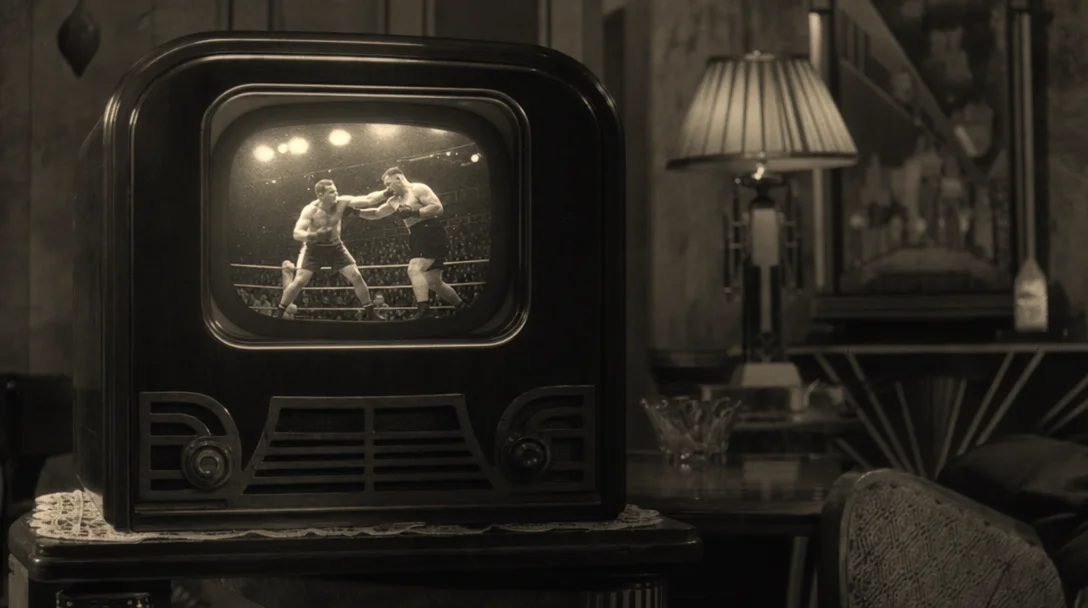
June 1, 1939: boxing's first TV moment reached about 400 people — and starred a cosmic puncher
On June 1, 1939, NBC's experimental station W2XBS broadcast boxing to American television for the first time — a heavyweight bout between former world champion Max Baer and Lou Nova, a 26-year-old yoga practitioner who claimed his "cosmic punch" channeled universal energy. Nova won by 11th-round TKO. The audience: roughly 400 households in New York City.

On the evening of June 1, 1939, roughly 400 television sets flickered across New York City. Each screen was small enough to hold in both hands — five to twelve inches of greenish-white cathode-ray glow — and the picture jittered, popped, and occasionally vanished entirely. On those screens, for the first time in American history, a boxing match appeared. 1
The fighters were Max Baer, the former world heavyweight champion known for clowning at ringside and crushing opponents with a right hand that had once killed a man in the ring, and Lou Nova, a 26-year-old Californian who did yoga, studied Hindu philosophy, refused to eat meat, and had named his signature punch "the cosmic punch." 2
It was, by any measure, a very strange night.
The fading champion
Max Baer arrived at Yankee Stadium that evening at age 30, carrying a reputation built almost equally on destruction and comedy. 3 He had held the undisputed world heavyweight title from June 1934 to June 1935, won it by battering Primo Carnera so badly the referee stopped the fight in the 11th, and lost it — embarrassingly — to James J. Braddock in a performance so disengaged that sportswriters questioned whether he had tried at all. Then Joe Louis knocked him out in four rounds in September 1935, breaking Baer's right hand in the process.
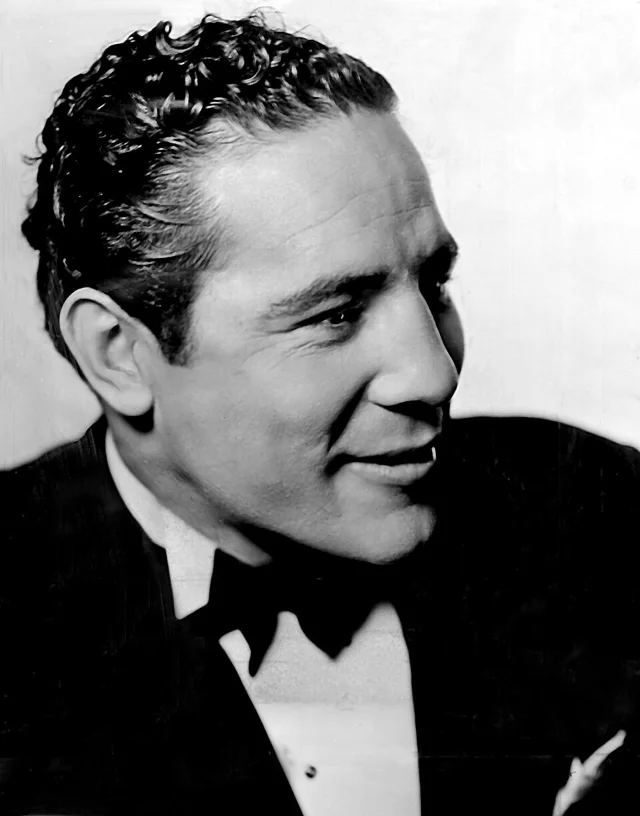
The hand never fully healed. By 1939, Baer was fighting to stay relevant — still enormously popular, still capable of knocking out lesser opponents, but no longer a genuine heavyweight contender. He was "Madcap Maxie," better known at this point for one-liners and nightclub appearances than for the Star of David stitched onto his trunks, the same symbol that had made him a hero to Jewish fans across America when he defeated Nazi Germany's preferred heavyweight, Max Schmeling, in 1933. When asked why the Nazis had banned his film The Prizefighter and the Lady, Baer answered: "They didn't ban the picture because I have Jewish blood. They banned it because I knocked out Max Schmeling." 3
He weighed 211 lbs on fight night. He was older than he should have been for that weight, and slower.
The cosmic puncher
Lou Nova was something boxing had never quite seen before.
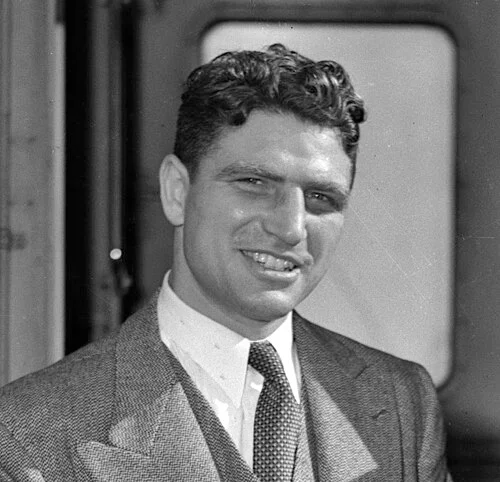
6 feet 3½ inches, a former National AAU amateur heavyweight champion, Nova came into the fight at 202 lbs with a record of roughly 22 wins, 1 loss, and 4 draws. 2 His sole defeat had come against Maxie Rosenbloom, a veteran with more than 200 career fights. That résumé was respectable enough. What made Nova genuinely bizarre was everything outside the ring.
He trained at the estate of yogi Pierre Bernard in Nyack, New York — "The Great Oom," a man who had been arrested twice, once on charges of kidnapping and hypnosis, and who had turned his Hudson Valley compound into a gathering place for heiresses, socialites, and people who believed in the transformative properties of Sanskrit. Nova adopted a vegetarian diet and spent hours in meditation poses that fellow heavyweights considered, at best, eccentric. He described his fighting technique as a synthesis of Hindu metaphysics and kinetic force: a "cosmic punch" that would channel universal energy through his fist and into his opponents. 4
Sportswriters in 1939 found this hilarious. Biographer Richard Bak described Nova as "a student of Far Eastern metaphysics, including yoga, the Hindu theistic philosophy that teaches the suppression of all activity of mind, body, and will in order to liberate the spiritual self." Joe Louis, who would fight Nova two years later, had his own opinion. After their 1941 title fight, Louis joked that whatever cosmic force Nova had summoned felt considerably more like an earth punch. 2
But in June 1939, none of that had happened yet. Nova was young, tall, and undefeated against any meaningful competition. The boxing press had him as a live underdog against the name value of a former world champion.
The night itself
Yankee Stadium, 11 rounds. Referee Frank Fullam watched Baer take a systematic beating. 5
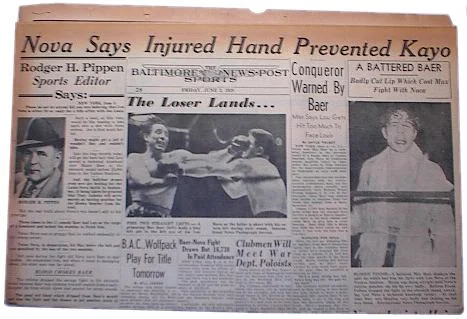
Nova lost one round on a penalty for low blows. Baer lost a round for striking after the bell. An unofficial United Press scorecard had Nova comfortably ahead through ten. By round 10, Baer had suffered a severe cut inside his mouth that left him swallowing blood with every breath; both eyes were battered and his nose was swollen shut. The Ring editor Nat Fleischer, watching ringside, described the fight as "fiercely competitive until the injury and mounting punishment overwhelmed Baer." 4
At 1 minute and 21 seconds of round 11 — one round short of the scheduled distance — Fullam stopped it. Baer, after surveying the damage in the mirror, offered his considered professional verdict: "Maybe I ought to quit and keep the brains I got!" 4
He did not quit. But he was, functionally, finished.
The 400 television sets
Here is the part that makes this fight genuinely strange in the historical record.
While Baer and Nova were trading punches at Yankee Stadium, NBC's experimental station W2XBS — transmitting on 45.25 MHz from the Empire State Building — was broadcasting the fight live to every television set in the New York metropolitan area. 1 The total audience was, at most, 400 households. In a country of 139 million people, a few hundred families owned televisions. The sets cost between $200 and $1,000 — roughly $4,500 to $22,500 in 2025 dollars — and their screens were the size of a paperback novel. 6
This was the first time a boxing match had ever appeared on American television. 7 It was not the first time a boxing match had appeared on any television — the BBC had broadcast an exhibition between Archie Sexton and Lauri Raiteri from London on August 22, 1933. And it was not the first American sports telecast: that had happened just two weeks earlier, on May 17, 1939, when W2XBS pointed a single camera at a Columbia vs. Princeton college baseball game. 6 But boxing on American TV — that was June 1.
David J. Halberstam of the Sports Broadcast Journal captured the paradox neatly: the Baer-Nova telecast "had little impact across the American landscape, yet it augured what was to come and how it would change American lives. But few knew it because few saw it." 1
W2XBS received its commercial broadcast license on June 24, 1941, became WNBT, and eventually settled into its permanent identity as WNBC-TV, Channel 4 in New York. The relationship between boxing and television it helped launch became one of the defining media arrangements of the 20th century: the Gillette Cavalcade of Sports, running on NBC every Friday night from 1946 to 1960, made boxing the dominant American television sport through the late 1940s and 1950s. 8
What the fighters did next
Nova's win over Baer made him a top heavyweight contender. Before he got his title shot, however, he fought Tony Galento in Philadelphia on September 15, 1939 — a bout The Ring described as "one of the most disgraceful fights staged since the days of the barroom brawls." Galento nearly destroyed Nova's right eye and won by 14th-round TKO. Nova was hospitalized. 9
He recovered. On April 4, 1941, he and Baer met again at Madison Square Garden. Nova won by 8th-round TKO. Baer was knocked down, got up, was knocked down again, and the referee stopped it. It was Max Baer's final professional fight. He retired with a career record of 71 wins and 13 losses, 53 by knockout. 3
Nova then got his shot at Joe Louis on September 29, 1941, at the Polo Grounds. Louis stopped him by TKO in the sixth round with exactly one second left in the round. Nat Fleischer wrote that Nova "didn't win a round and took a terrible beating." The cosmic punch, to Louis's fists, was indistinguishable from any other punch. 9
Baer died of a heart attack at age 50 on November 21, 1959, at the Hollywood Roosevelt Hotel. Over 1,500 mourners attended his funeral. Joe Louis and Jack Dempsey were pallbearers. 3 His son, Max Baer Jr., went on to play Jethro Bodine on The Beverly Hillbillies from 1962 to 1971 — meaning the Baer name became more famous on television through sitcom comedy than through the sport that launched it.
Nova lived to 78, dying of cancer on September 29, 1991, in Sacramento. He acted in more than 20 films and appeared on TV shows including Get Smart. The World Boxing Hall of Fame inducted him the year he died. 10
The mirror: On June 1, 1939, the medium that would eventually carry billion-dollar sports rights, Super Bowl halftime shows, and global pay-per-view events made its boxing debut in front of an audience smaller than most church choirs. The fighter who won was a yoga-practicing metaphysician who lost two years later to a champion who found his philosophy unimpressive. The fighter who lost had his name outlast his career through his son playing a simpleton on a TV show. The sport that dominated American television for the next two decades entered that medium via a 45.25 MHz experimental signal that most of the country couldn't receive, on a summer evening when almost nobody was watching.
Cover image: AI-generated illustration.
참고 출처
- 1Sports Broadcast Journal — first NBC sports telecast
- 2Wikipedia — Lou Nova
- 3Wikipedia — Max Baer (boxer)
- 4The Sweet Science — Lou Nova profile
- 5Baltimore News-Post via Eugenecarsey.com — Baer vs Nova 1939
- 6Eyes of a Generation — sports TV firsts
- 7The New York Times — Boxing's Broadcast Firsts
- 8Wikipedia — Gillette Cavalcade of Sports
- 9World Boxing Association — Boxing History: Louis Kayos Nova
- 10The New York Times — Lou Nova; Boxer, 76 (obituary)
이 콘텐츠를 둘러싼 관점이나 맥락을 계속 보강해 보세요.