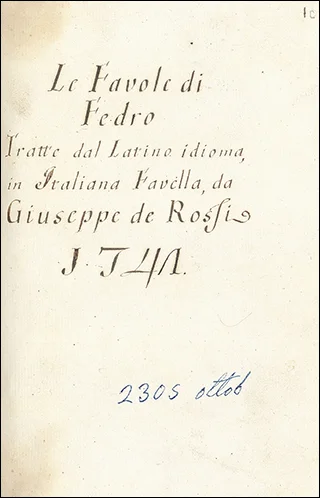
The fables that never made it to press
In 1741, a translator named Giuseppe de Rossi wrote out 137 pages of Phaedrus's Latin fables in Italian by hand — a small, plain notebook that entered the Ottoboni estate and was purchased by the Vatican in 1748. Digitized by the Biblioteca Apostolica Vaticana in its May 2026 batch, all 182 images are now freely online at DigiVatLib.

In 1741, a year after the most famous private library in Rome had lost its owner, someone sat down and translated the fables of Phaedrus into Italian. He wrote them out by hand, all 137 pages, in a small notebook. He signed his preface to the reader with his name — Giuseppe de Rossi — and left the manuscript in the collection it would inhabit for the next two and a half centuries.
Vatican shelfmark Ott.lat.2305 is that notebook. The Biblioteca Apostolica Vaticana (Vatican Apostolic Library) digitized it in May 2026 as part of its Week 20 release batch, and all 182 images are now freely accessible online. 1 There are no illuminated capitals, no decorative borders, no gold. What the manuscript offers instead is a document of literary transmission: a moment when one person decided that the oldest Latin fable collection deserved a new Italian voice, and then quietly wrote it out.
The chain from Aesop to an Italian notebook
The fables in this manuscript trace back roughly 1,700 years before de Rossi picked up his pen. Their classical author, Gaius Julius Phaedrus (c. 15 BC – c. 50 AD), was a freedman of the Emperor Augustus — born in Macedonia, educated in Rome, and apparently given enough leisure after manumission to write five books of verse fables in iambic senarii (a metre used for Roman comedic dialogue). He drew mainly on a prose collection of Aesopic fables compiled by Demetrius of Phalerum (a 4th-century BC Athenian statesman and philosopher), and in doing so created something genuinely new: as the Wikipedia article on Phaedrus puts it, he "created a new form of polite literature by elevating the fable to an independent genre, to be read as literature in its own right and not as an adjunct to another kind of work." 2
The trouble was that almost nobody read him in late antiquity. His work circulated narrowly, and the manuscripts that carried it were few. The major recovery came in 1596, when the French scholar Pierre Pithou published the editio princeps from a 9th-century manuscript since known as the Codex Pithoeanus — the single most important witness to Phaedrus's text. 2 By then, European fable culture had been shaped more by medieval prose reworkings (the Romulus collections, the work of Adémar de Chabannes) than by Phaedrus's original verse.
That changed again in the 17th century, when Jean de La Fontaine (1621–1695) published his Fables (1668–1694) in French verse, drawing extensively on Phaedrus and achieving enormous popularity across the continent, Italy included. La Fontaine made Phaedrus fashionable again — and in 18th-century Italy, where Enlightenment ideals were pushing classical texts toward vernacular readership and pedagogical use, translators followed. De Rossi's 1741 manuscript sits at precisely that juncture.
There is also a coincidence of timing worth noting. The de Rossi press — a Roman printing dynasty considered, in the mid-17th century, the most active and important press in the city — had operated for around 120 years before ceasing operations in or around 1738, three years before this translation was written. 3 Whether the translator Giuseppe de Rossi had any connection to that printing family is not established — the name was common, and no biographical record linking them has been found. But the timing is striking: a manuscript translation of Phaedrus completed just as the press that might have printed it went dark.
What the notebook looks like
The physical manuscript is small — each text page measures approximately 12.2 × 17.4 cm, a format closer to a personal notebook than to a formal presentation codex. There is no decoration. The binding boards, photographed as the first and last canvases in the digitization, are plain. The writing is 18th-century Italian cursive, consistent throughout. 4
The digitization totals 182 canvases: front and back boards, the spine, three edge views, four preliminary folios (including the translator's preface), 137 numbered text pages, four final folios at the back that may contain an index or concluding material, and two technical calibration images — a standard element of the Vatican Library's high-resolution digitization protocol. 4
The title page announces the contents plainly: Le Favole di Fedro, Tratte dal Latino idioma, in Italiana Favella, da Giuseppe de Rossi — "The Fables of Phaedrus, taken from the Latin language into Italian speech, by Giuseppe de Rossi." The subtitle's phrase in Italiana Favella signals a deliberate choice of accessible vernacular register over formal scholarly Latin — this translation was aimed at readers, not specialists.
"Dear reader, I am well aware..."
The manuscript opens not with a fable but with a preface. Folio IIr begins with the words Al Lettore. Son ben certo, che come Spregieuole — "To the Reader. I am well aware that, as contemptible..." 5 The full text would require a palaeographer working with the 18th-century Italian cursive of the manuscript. But even those opening words carry something.
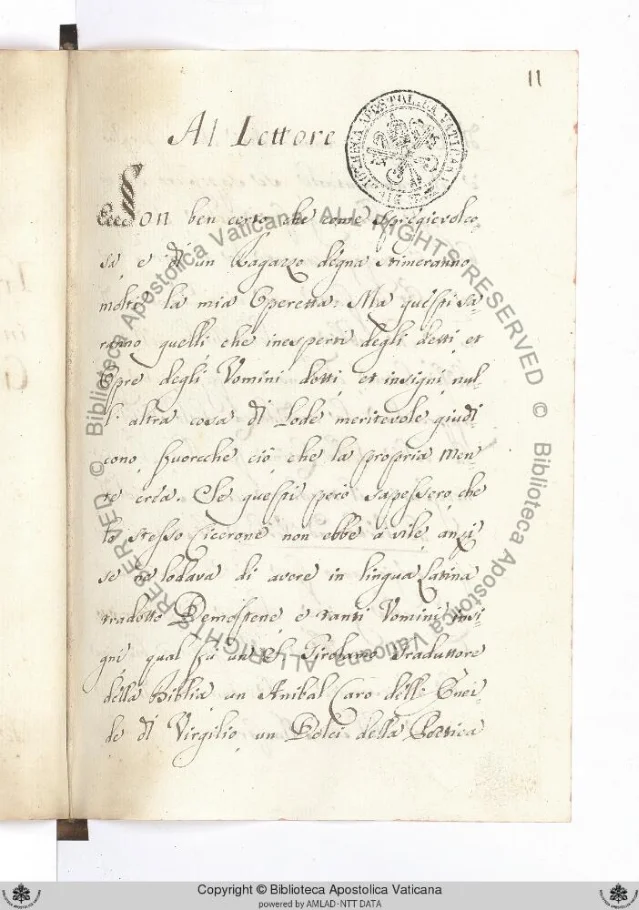
The phrase come Spregieuole — "as contemptible" — is the opening move of a formal 18th-century apologia, a genre in which an author pre-empts criticism by confessing inadequacy. This posture tells us at least that de Rossi was working in the conventions of Italian literary culture rather than producing a purely utilitarian copy. He expected readers. He wrote for them.
What his translation methodology was — whether he worked in prose or verse, literally or freely, with or without annotations — the available record does not show. The full 137 pages are in the digitized images; anyone who reads 18th-century Italian cursive can answer that question directly.
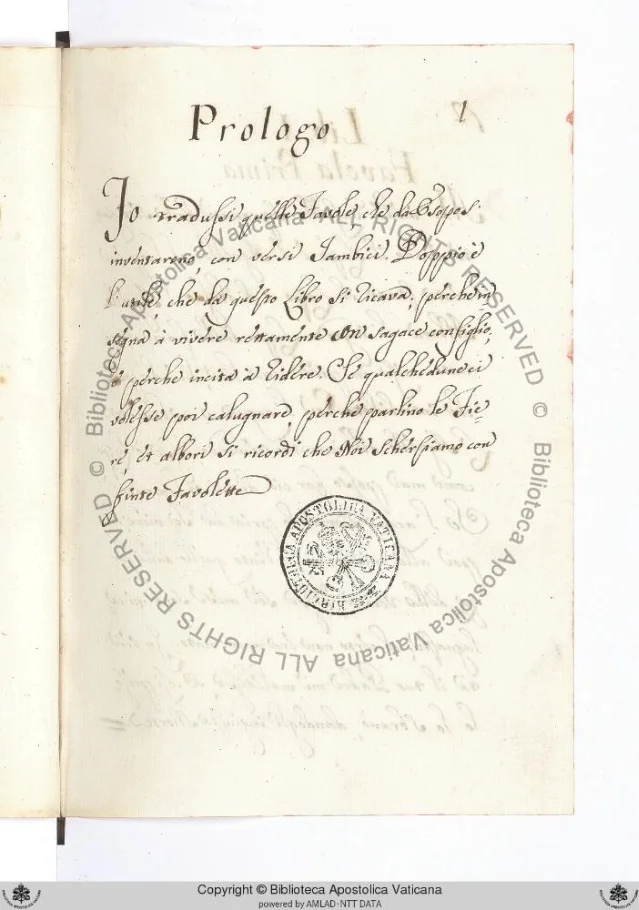
A cardinal's library, after his death
The manuscript belongs to the Ottoboniani Latini collection, assembled by Cardinal Pietro Ottoboni (July 2, 1667 – February 29, 1740) — music patron, grand-nephew of Pope Alexander VIII, and by most accounts an enthusiastic collector of almost everything. He supported Arcangelo Corelli, Domenico Scarlatti, and Pietro Locatelli; he kept a private theater in his Roman palazzo; his library accumulated manuscripts, books, scores, and engravings across a long career. 3
The manuscript's date of 1741 is one year after Ottoboni's death. He could not have commissioned it. The Vatican purchased the Ottoboni collection from his heirs in 1748 — seven years after the manuscript was written. 3 Ott.lat.2305 was therefore made during the estate's unsettled period and entered the Vatican as part of a bulk purchase. Whether it was commissioned by a family member, acquired informally, or bought as part of a lot is not recorded in any source the Vatican's catalog currently carries — the IIIF manifest for the manuscript leaves its description field empty. 4
What that provenance gap means for the manuscript's value is real: it cannot be traced to a specific patron or purpose. What it does establish is that the Ottoboni family held it, kept it, and sold it as part of a library worth preserving. For a plain notebook with no decoration and no famous name attached, that is a kind of endorsement in itself.
Read it now
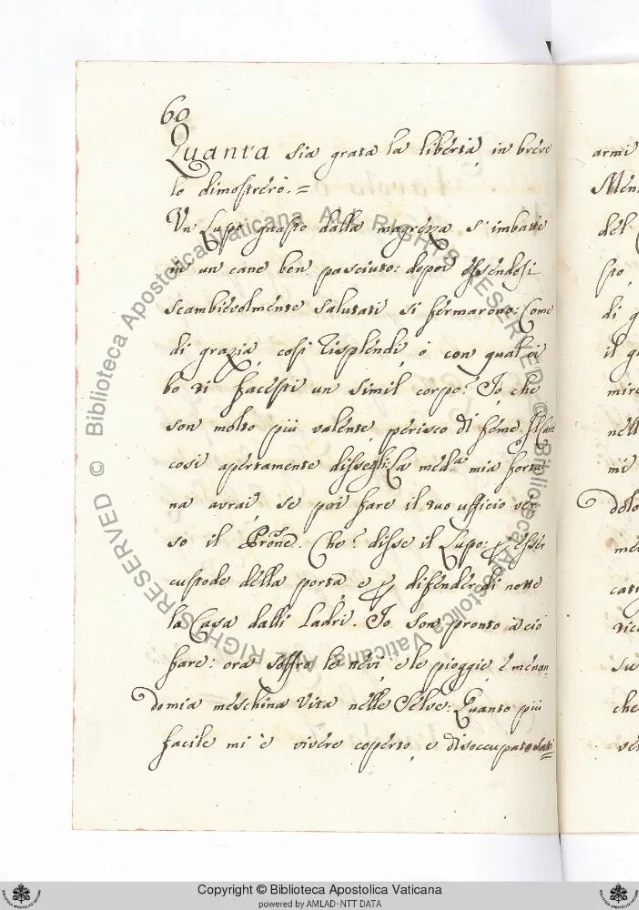
The Vatican digitized Ott.lat.2305 as part of its Week 20, 2026 batch (May 11–17), which added 34 manuscripts — 28 of them from the Ottoboniani Latini alone — after a two-week pause in the library's release schedule. 5 All 182 images are free to view and browse at DigiVatLib.
콘텐츠 카드를 불러오는 중…
The IIIF manifest is at
https://digi.vatlib.it/iiif/MSS_Ott.lat.2305/manifest.json. 4 Any IIIF-compatible viewer — Universal Viewer, Mirador, and others — can load it directly, allowing page-by-page comparison at higher magnification than the standard DigiVatLib interface provides.De Rossi is one of the many 18th-century Italians who did this kind of quiet work: bringing classical texts into a vernacular that more people could read, without attracting the notice that preserves names. The 137 pages he wrote are public now. His apology to the reader is on the page. The fables are there.
Cover image: title page of Vatican manuscript Ott.lat.2305, photographed by the Biblioteca Apostolica Vaticana. Images © Biblioteca Apostolica Vaticana.
이 콘텐츠를 둘러싼 관점이나 맥락을 계속 보강해 보세요.