Lady Chatterley's Lover — The Trial That Resolved Nothing
A deep-dive into D.H. Lawrence's Lady Chatterley's Lover — the novel that required thirty-two years of suppression across four continents, a six-day public trial at the Old Bailey with 35 expert witnesses, and a unanimous jury acquittal before it could be legally sold in Britain. The article traces the global ban history (UK, US, Japan, India, Canada, Australia), reconstructs the 1960 Regina v. Penguin Books trial in detail, examines the dissenting critics (Porter, Sontag, Millett, Hitchens) absent from the witness box, and uses Louis Menand's June 2026 New Yorker argument — that the trial created a 'highbrow exception' without defining 'obscene' — to connect 1960's public jury proceedings to 2026's closed-door administrative removals.
On October 20, 1960, Mervyn Griffith-Jones, QC (Queen's Counsel), rose before a jury at the Old Bailey and asked the question that would follow him for the rest of his career. 1 The question was addressed to the twelve people deciding whether Penguin Books should be prosecuted for publishing D.H. Lawrence's Lady Chatterley's Lover in an unexpurgated edition. The question was: "Is it a book that you would even wish your wife or your servants to read?"
The jury laughed. So did most of the press gallery. The word "servants" — applied, in 1960 England, to the kind of working-class readers who could actually afford Penguin's three-shilling-sixpence paperback — told the whole story of which side had already lost.
Twelve days later, after three hours of deliberation, the jury returned a unanimous verdict of not guilty. 1 All 200,000 pre-printed copies sold on the day of legal publication. Three million copies were sold within three months. Philip Larkin, in his poem "Annus Mirabilis," placed the moment as a civilizational hinge: "Sexual intercourse began / In nineteen sixty-three / (which was rather late for me) — / Between the end of the 'Chatterley' ban / And the Beatles' first LP." 2
The trial is reliably framed as a victory — for free expression, for literature, for the proposition that serious books should not be destroyed at the instigation of men who ask juries whether their servants are fit to read. That framing is not wrong. But it is not complete. In a long essay published in The New Yorker in June 2026, the literary critic Louis Menand (staff writer for The New Yorker) argued that the trial had actually handed censorship a quieter form of defeat: "Neither of the 'Chatterley' trials unpacked the conundrum at the heart of censorship cases, which is the definition of 'obscene.'" 3 The question was shelved, not resolved. And shelved questions have a way of coming back.
The man and the book
David Herbert Lawrence was born on September 11, 1885, in Eastwood, Nottinghamshire — a coal-mining town whose industrial scarring he never stopped writing about. 4 His father, Arthur John Lawrence, was a near-illiterate miner. His mother, Lydia Beardsall, had been a pupil-teacher before poverty drove her into factory work. The distance between them — class, education, aspiration — runs through nearly everything Lawrence wrote, surfacing most nakedly in Sons and Lovers (1913) and again, differently, in Lady Chatterley's Lover.
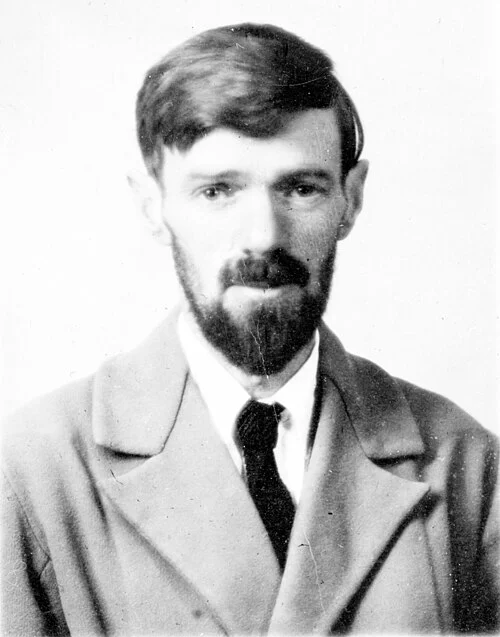
In 1912, Lawrence eloped with Frieda von Richthofen Weekley — six years his senior, wife of his former modern languages professor at University College Nottingham, mother of three young children. They married in July 1914. 4 His novel The Rainbow (1915) was prosecuted for obscenity; his publisher Methuen withdrew it and destroyed the print run. From that point forward, Lawrence spent most of his life outside England — Italy, Australia, Ceylon, the United States, Mexico, the south of France — returning only twice in the last decade of his life. He died of tuberculosis in Vence, France, on March 2, 1930, at forty-four. 4 At the time of his death, the critical consensus treated him as a pornographer. E.M. Forster's obituary was the famous dissent: Lawrence was "the greatest imaginative novelist of our generation." 5
Lady Chatterley's Lover was written three times over approximately fourteen months. Lawrence completed the final version in January 1928. 6 Between the second and final drafts, he wrote The Escaped Cock, a novella about resurrection, which affected his approach to the last version: he stripped out all religious vocabulary ("no sacreds or holys or godlikes or divines"), replacing it with what he described as a pagan, this-world idiom. 6 The title he kept: Lawrence had also considered Tenderness (which describes the book more accurately) and John Thomas and Lady Jane (slang for male and female genitalia, which describes the book more honestly). 2
The plot is architecturally simple. Constance "Connie" Chatterley, an educated woman from a cultured family, is married to Sir Clifford Chatterley, a baronet who was paralyzed from the waist down — rendered sexually incapacitated — by a wound in the First World War. Clifford is described, without sympathy, as "all mind": clever, cold, increasingly absorbed in running his coal mine with new machinery and in writing fashionable, brittle fiction. Connie, starving for physical connection, begins an affair with Oliver Mellors, the estate's gamekeeper — a man who has retreated from the class he was born into and the class he briefly entered, and who speaks in Derbyshire dialect when he wants to close distance and in standard English when he wants to make himself foreign.
The book's explicit sexual content — and there is a lot of it, including four-letter words that were not in print in English literature — is inseparable from its philosophical argument. Lawrence wanted to make the point that mind without body is a kind of death, that the industrial civilization of the 1920s was organizing itself around exactly that death, and that sexual experience, honestly rendered without shame, was one of the few forms of aliveness still available. He wrote to his literary agent around this time: "I always labour at the same thing, to make the sex relation valid and precious, instead of shameful. And this novel is the furthest I've gone. To me, it is beautiful and tender and frail as the naked self is." 7
The book had a specific target. The character of Tommy Dukes, who argues in one of the novel's set-piece conversations that "the life of the body is a greater reality than the life of the mind," is effectively Lawrence's mouthpiece. 2 And Clifford Chatterley — the disabled baronet, the modernist writer, the coal operator who wants to mechanize everything — is the thing Lawrence was arguing against: "mechanized greed," as he called it, the reduction of human beings to functions in a system.
Whether the book achieves its stated intentions is a harder question, addressed below.
Thirty-two years of suppression
Lawrence self-published the first edition of Lady Chatterley's Lover in Florence, Italy, in July 1928, through Tipografia Giuntina. The edition ran to 1,000 copies, sent to subscribers in England, the United States, and France — wrapped in plain brown paper with the title and a small phoenix emblem. 2 A second private edition of 200 copies followed in Paris in 1929. Almost immediately, pirated versions appeared on both sides of the Atlantic.
In 1929, American customs and the London Metropolitan Police moved simultaneously to seize copies entering through normal channels. The book was formally defined as obscene in the United States and Australia. It would not be commercially published in England in its complete form for thirty-two years. 2 In 1932, Martin Secker published a bowdlerized British edition — two years after Lawrence's death. The literary journalist Gerald Gould noted in The Observer that "passages are necessarily omitted to which the author undoubtedly attached supreme psychological importance." 8
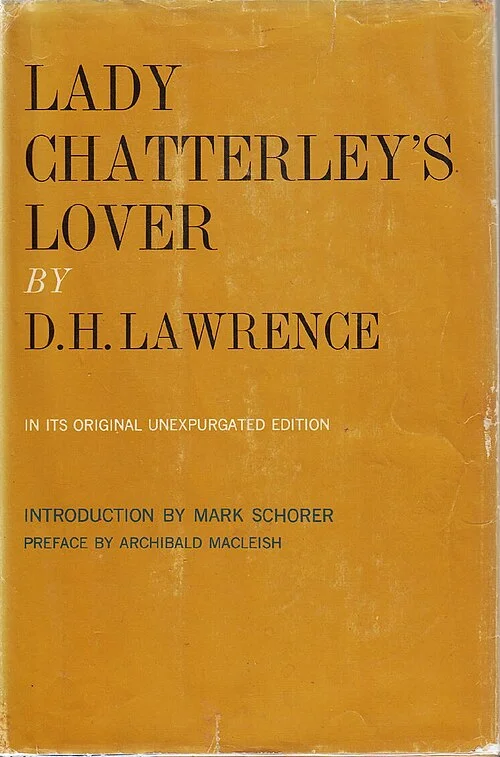
The American legal battle came first and cleared the way for Britain. In 1959, Barney Rosset of Grove Press published the complete, unexpurgated text in the United States. The New York Postmaster General, Robert Christenberry, declared the book obscene and seized copies. Grove Press appealed on First Amendment grounds. On July 21, 1959, federal judge Frederick van Pelt Bryan ruled that the book had "redeeming social or literary value" and was legally publishable. 3 Rosset had prepared the ground carefully: the Grove Press edition included a prefatory letter from Archibald MacLeish (Harvard professor, former Librarian of Congress) and an introduction by the Berkeley critic Mark Schorer — an early version of the academic credential-stacking that would define the English trial. Bryan's decision was upheld by the Second Circuit in 1960. Within a year of the ruling, the book was on the New York Times bestseller list at number two, with two million copies sold and five different unexpurgated editions on the American market. 3
The suppression was not only Anglo-American. In Japan, a 1950 translation by Sei Ito was prosecuted under obscenity law; the case wound through the courts until 1957, when the Supreme Court upheld the conviction, fining the translator ¥100,000 and the publisher Hisajiro Oyama ¥250,000. 2 The court defined obscenity as "unnecessarily sexually stimulating" material that "damages the normal sexual sense of shame of ordinary people." 9 Sei Ito's complete translation was not legally published in Japan until 1996 — sixty-eight years after Lawrence wrote the book. 2
In India, Prime Minister Jawaharlal Nehru — who had approached the question of Lolita's censorship with visible ambivalence and procedural caution — wrote on a government file on April 8, 1960: "I am clear that this book 'Lady Chatterley's Lover' should be banned. In case our order is challenged in a court of law, the matter can be faced." 10 The Indian Supreme Court upheld the ban in 1964, applying the Victorian-era Hicklin test — a standard that Britain and the United States had already abandoned. 10 Legal scholar Abhinav Sekhri, writing in the Modern Criminal Law Review in 2025, found that Nehru's unguarded decisiveness with Lady Chatterley — "I am clear" — sat in sharp contrast to the principled caution he showed elsewhere: "I do not like the censoring of books unless this is considered essential in a particular case," Nehru had written in a note on Lolita. 10
In Australia, the book was banned from 1929. In 1965, Alexander Sheppard, Leon Fink, and Ken Buckley smuggled a copy from Britain and printed 10,000 unauthorized copies, distributing them nationally. That act of civil disobedience preceded the July 1965 customs lifting of four simultaneous bans: Lady Chatterley's Lover, Borstal Boy, Confessions of a Spent Youth, and Lolita. 2 In Canada, the Supreme Court ruled 5–4 in 1962 — with McGill University law professor and modernist poet F.R. Scott arguing for the defense — that the book was not obscene. 2
The pattern across all four jurisdictions is the same: the same book, the same legal test (usually some version of the Hicklin standard, asking whether material tends to "deprave and corrupt" those exposed to it), and vastly different outcomes determined less by legal principle than by political climate and the identity of the officials involved. Senator Reed Smoot of Utah had captured the original American mood in a 1930 Senate floor speech: "I've not taken ten minutes on Lady Chatterley's Lover, outside of looking at its opening pages. It is most damnable! It is written by a man with a diseased mind and a soul so black that he would obscure even the darkness of hell!" 2 By 1962, Canadian senators were deciding the opposite, on the same evidence.
Six days at the Old Bailey
Penguin Books had been waiting for this moment deliberately. The British Parliament passed the Obscene Publications Act in August 1959 — largely at the lobbying of the Society of Authors — which replaced the Hicklin standard with a new framework. 1 Under the new Act, a work still had to be judged by whether it tended to "deprave and corrupt" those likely to read it (Section 2). But Section 4 introduced a "public good" defense: a publisher could argue that publication was justified in the interest of science, literature, art, or learning. 3 The Act was designed, in the words of its drafters, to protect literature. Penguin decided immediately that Lady Chatterley was the book to test it with.
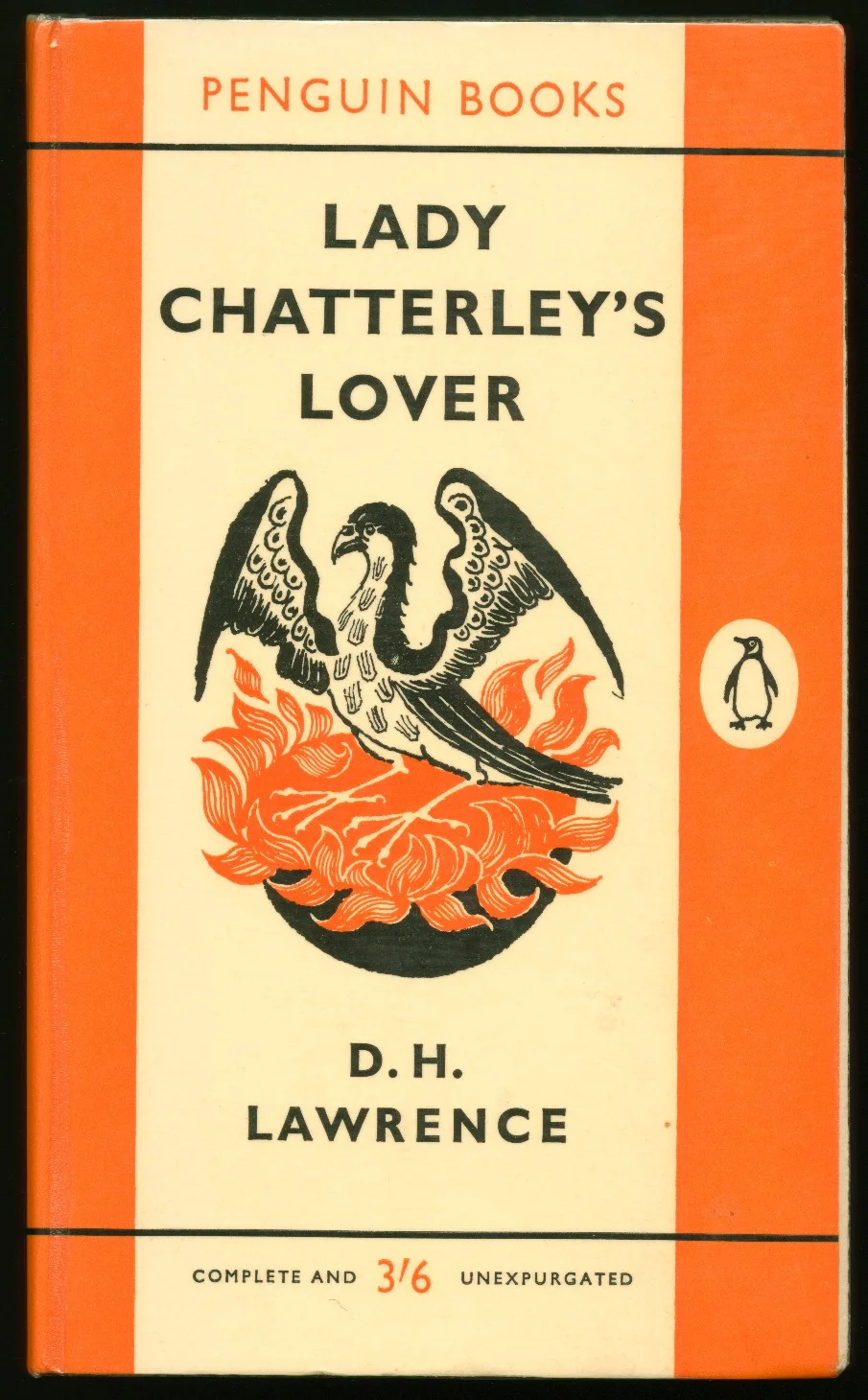
They printed 200,000 copies before the trial began and priced them at three shillings and sixpence — a pointed decision, placing the unexpurgated text within reach of exactly the readers Griffith-Jones was worried about. 8 The catalog number was 1484. The cover, designed by Stephen Russ, showed a phoenix rising from flames.
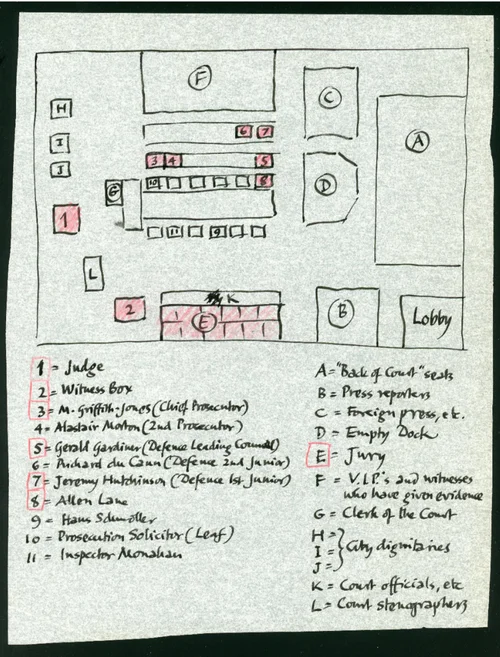
The trial ran for six days, October 20 to November 2, 1960, before Judge Laurence Byrne. 1 The defense, led by Gerald Gardiner QC (later Lord Chancellor), called 35 witnesses. The prosecution called two: a detective inspector and a Board of Trade official. 5 The asymmetry was theatrical and deliberate.
The 35 defense witnesses included E.M. Forster, Rebecca West, Cecil Day-Lewis, Raymond Williams, Helen Gardner, Roy Jenkins, and John Robinson, Bishop of Woolwich, who described Lawrence's intention as "to portray the sex relationship as something essentially sacred ... as in a real sense a holy communion." 1 Forster testified that Lawrence was "the greatest imaginative novelist of our generation," adding that Lady Chatterley's Lover had "very high literary merit" — though "it is not the novel of Lawrence which I most admire. That would be Sons and Lovers." 5
The defense's pivotal moment came from Richard Hoggart, a Birmingham-born literary critic and the author of The Uses of Literacy (1957) — a working-class intellectual whose origins matched Lawrence's and who gave the trial its most memorable exchange. Hoggart described the novel as "highly virtuous and, if anything, puritanical," explaining under cross-examination that "puritanical" meant "an intense sense of responsibility for one's conscience" — a usage that left Griffith-Jones visibly baffled. 5 When the question of the book's four-letter words arose, Hoggart described Lawrence's intention as saying, in effect, "In a simple, ordinary way, one fucks, with no sniggering or dirt." 1 The defense team later described Hoggart as the "man of the match."
Griffith-Jones, in his opening address, had invited the jury to consider whether they would wish their wife or servants to read it. He had also asked them to count the number of times the words "fuck" or "fucking" appeared (thirty times) and the word "cunt" (fourteen times). 5 Neither gesture helped him. The jury — three women and nine men — returned their unanimous not-guilty verdict after fewer than three hours.
Lawrence's stepdaughter, Barbara Barr, described her reaction: "I feel as if a window has been opened and a fresh air has blown right through England." 8
Several important things did not happen at the trial. Evelyn Waugh declined to testify for the defense, explaining in a letter to Penguin's solicitor that his memory of the book was "dull, absurd in places & pretentious" and that "Lawrence had very meagre literary gifts." 5 Graham Greene found "part of it rather ridiculous" and also declined. 5 F.R. Leavis — who had done more than anyone to establish Lawrence's literary reputation through his 1955 monograph D.H. Lawrence, Novelist — refused to testify and later wrote a withering assessment of Lady Chatterley's Lover specifically, arguing that Lawrence had been in "an abnormal state" when writing it and that there was "a disrupted integration in the artist." 6 T.S. Eliot was held in reserve by the defense team and never called.
No feminist critic testified. Kate Millett's Sexual Politics, which would take apart the novel systematically, was eleven years away. The expert witnesses who appeared represented a specific formation of the British cultural establishment — professors, bishops, poets laureate, a future Home Secretary (Roy Jenkins), a future Lord Chancellor (Gardiner). The asymmetry of the witness list, in other words, was not simply about literary support. It was about who got to decide what counted as literature.
What the critics said no
The 35-0 scoreline of the witness list created a misleading impression that everyone with serious literary credentials supported the book. They didn't.
Katherine Anne Porter — Pulitzer Prize-winning American short-story writer, not a political conservative (she had campaigned for Sacco and Vanzetti) — published "A Wreath for the Gamekeeper" in Encounter in February 1960, eight months before the trial. 11 Griffith-Jones read from it during his cross-examination of the first defense witness, Graham Hough. Porter wrote that when she first read the novel "thirty years ago," she thought it "a dreary, sad performance with some passages unintentional hilarious low comedy, one scene at least simply beyond belief in a book written with such inflamed apostolic solemnity." Her most quoted sentence: "Nowhere in this sad history can you see anything but a long, dull, grey monotonous chain of days, lightened now and then by a sexual bout. I can't hear any music, or poetry, or the voices of friends, or children. There is no wine, no food, no sleep or refreshment, no laughter, no rest nor quiet — no love." She concluded it was "the fevered dream of a dying man sitting under his umbrella pines in Italy indulging his sexual fantasies." 11
Susan Sontag, in a 1961 essay later collected in Against Interpretation (1966), called Lady Chatterley's Lover "sexually reactionary" and suggested that the importance given to vindicating it showed the United States was "plainly at a very elementary stage of sexual maturity." 2
Kate Millett, in Sexual Politics (1971), provided the most technically detailed prosecution. She called the novel "a quasi-religious tract ... whose god is the penis at whose altar Connie must worship." 7 Millett analyzed the specific instruction embedded in the novel's sexual scenes: Connie is repeatedly guided toward the one form of orgasm (simultaneous, penetrative) that Mellors approves of, and toward dismissal of any other. Chapter 14 contains Mellors's explicit taxonomy of female sexuality — categorizing other modes as "Lesbian," with the notation "I could kill them" — and a racist aside about Black women. 7 Millett was fair enough to add that compared to Norman Mailer and Henry Miller, "one still finds in this novel little of the sexual violence and ruthless exploitation so obtrusive in Mailer and Miller... With Lady Chatterley, Lawrence seems to be making his peace with the female... this last work appears almost an act of atonement." 7
Peter Hitchens, writing in First Things in 2018, cataloged the novel's "blots and scabs of anti-Semitism" and what he described as the revolting treatment of Sir Clifford Chatterley, a disabled war veteran. 11 His verdict: "Katherine Anne Porter was and is right, and nobody has yet put it better. Lady Chatterley is a dreadful, ridiculous book." 11
Iris Murdoch, in a single-sentence summary, called it "an eminently silly book by a great man." 3
None of this settles the question of whether the book should have been prosecuted. The question of whether a book is good and the question of whether the state should have the power to destroy it are separate questions — and conflating them was one of the errors built into the structure of the trial itself.
What the trial actually proved — and what it didn't
Louis Menand's New Yorker essay, written as a review of Guy Cuthbertson's scholarly study Lady C: The Long, Sensational Life of Lady Chatterley's Lover (Yale University Press), is the most precise recent account of what the trial established and what it failed to establish. 3
The trial established a "highbrow exception" — Menand's phrase. Professors, bishops, and poets laureate testified that the book had literary merit; the jury agreed; the book was acquitted. The legal mechanism was the 1959 Act's "public good" defense (Section 4), which asked whether publication was justified by literary, artistic, scientific, or other interests. In practical terms, this meant: if enough credentialed people said the book was literature, it was literature, and the state's claim that it would deprave and corrupt readers lost. 3
What the trial did not establish was any definition of "obscene." The legal standard — does it tend to "deprave and corrupt" those likely to read it? — was applied, not examined. Menand: "Every definition seems to require another definition. Under British law at the time of the 'Chatterley' trial, something was obscene if it tended 'to deprave and corrupt.' But what is depravity? Is it an action or a state of mind?" 3 The jury was never asked to answer that question. The defense redirected the jury toward literary value instead, and the redirection worked.
The paradox David Buckingham identifies in his academic analysis of the trial is sharper than it first appears. 12 The defense argued against paternalism — against the state telling adults what they could read. But it won by deploying exactly the kind of paternalism it was arguing against: a different set of authorities (professors, a bishop, a future Lord Chancellor) telling the jury what to think about the book. The verdict replaced one hierarchy with another.
Buckingham also notes what was absent from the defense's argument: any acknowledgment that the book's sexual politics might be problematic. 12 The feminist criticism that would arrive in the 1970s — Millett's analysis, Sontag's reservations, the question of whose sexuality was being "liberated" and on whose terms — was structurally excluded from the courtroom. The "liberation" on offer was conditional on the book meeting the standards of the existing literary establishment. It is a useful book to test the argument with, Buckingham observes, because "it could be read in ways that were by no means subversive of the cultural or moral status quo." 12
The American framework developed differently. The Supreme Court's 1973 decision in Miller v. California established a three-part test for obscenity that requires all three conditions to be met simultaneously: whether the average person, applying contemporary community standards, would find the work as a whole appeals to prurient interest; whether the work depicts or describes sexual conduct in a patently offensive way; and whether the work, taken as a whole, lacks serious literary, artistic, political, or scientific value. 13 The third prong — "serious literary value" — is the American descendant of the British "public good" defense. It requires evaluating the work as a whole, not isolated passages. It requires meeting all three conditions, not just one.
And it, too, leaves "obscene" undefined. As Menand puts it, "The novel isn't what opened the floodgates. It was the courts. 'Obscenity' had to be reinterpreted for Lawrence's novel to be legally printed and sold, and to then make it possible to print and sell 'Tropic of Cancer,' 'Naked Lunch,' 'Lolita,' 'Last Exit to Brooklyn,' and 'Fanny Hill' — Lady Chatterley's children." 3
The same question, different machinery
The legal standards established by the 1959 Obscene Publications Act and the 1973 Miller decision did not dissolve the underlying logic that animated the Chatterley suppression. They redirected it.
The contemporary American equivalent is the "harmful to minors" standard, which is Miller applied with a lower threshold: a work is harmful to minors if it appeals to the prurient interest of minors, is patently offensive by adult community standards for minors, and lacks serious literary, artistic, political, or scientific value for minors. 14 Ken Paulson, director of the Free Speech Center at Middle Tennessee State University, notes that "a book with substantive content, even if controversial, is unlikely to be harmful as a whole." 14 The legal standard, in theory, is more protective than the 1868 Hicklin test (which only required that a passage have a tendency to corrupt — not the work as a whole, and not specifically minors). In practice, what matters is the institutional mechanism through which the standard is applied.
In 1960, applying the standard required a six-day public trial at the Old Bailey. The jury had to read the complete book. Thirty-five expert witnesses testified in open court. The judgment was a matter of public record, subject to appeal. The entire procedure exposed the assumptions of the prosecution to scrutiny — which is how Griffith-Jones's question about wives and servants became both an embarrassment and a historical marker.
In 2026, the standard is applied through school board votes in closed session. In May 2026, dozens of books were removed from Duval County, Florida public schools — including Margaret Atwood's The Handmaid's Tale, Jodi Picoult's Nineteen Minutes, and Maya Angelou's I Know Why the Caged Bird Sings — without a clearly defined review process or public hearing. 15 PEN America described the removals as lacking any "transparent review." The Harford County, Maryland school board voted to restrict a book during a closed-door session. 16 There were no expert witnesses. No literary critics testified. No jury deliberated.
The research planner's framework for mapping these periods — "tendency to deprave and corrupt" (1959 UK) → "harmful to minors" (2020s US) — is an analytical parallel, not a legal equivalence any court has drawn. But the structural similarity is real: both standards allow removal based on anticipated harm to a vulnerable category of readers (then: anyone susceptible; now: specifically minors), both create a carve-out for works with demonstrated value, and both shift to less protective mechanisms when that carve-out becomes inconvenient. The difference is that in 1960 the carve-out had to be argued before a public jury. In 2026, it has to be argued before a school board that can vote in private.
Iowa's Senate File 496 — which requires school librarians to remove books depicting "sex acts" from school libraries, broadly defined — was held up briefly by a federal court injunction. The Eighth Circuit Court of Appeals declined on May 11, 2026 to reinstate that injunction, allowing the law to continue enabling the removal of hundreds of books. 17 Amanda Kordeliski, president of the American Association of School Librarians, called the ruling "deeply concerning because it prioritizes broad censorship over students' freedom to read." 18 SF 496 applies a category ("sex acts") without requiring evaluation of the work as a whole — which is exactly what the Miller test requires, and what the 1959 OPA's "public good" defense was designed to enable. The five publishers who have sued Iowa over SF 496 are in the position Penguin occupied in 1960: arguing that the legal category is too blunt to be applied to actual books.
BookRiot's analysis of five years of banned-books data (2021–2026) found that the average publication date of the most frequently challenged books is 2008. 19 These are not new books introducing dangerous new ideas. They are established books that sat on library shelves through the childhoods of many of the people now challenging them, without producing any documented harm. The same was true of Lady Chatterley's Lover in 1960, which had been in circulation — in expurgated form — for nearly thirty years. The prosecutorial argument was never primarily about the content. It was about who should be allowed to decide what counts as acceptable.
Menand's observation in the New Yorker is uncomfortable precisely because it applies equally to both directions: "The novel isn't what opened the floodgates. It was the courts." The courts that opened them, and the administrative processes now closing them, are operating on the same unresolved premise.
Worth reading?
Verdict: Yes, with clear eyes about what you're getting.
Lady Chatterley's Lover is not a uniformly good novel. It is an uneven, sometimes tedious, philosophically earnest book that works intermittently rather than continuously. Its sex scenes — explicit for 1928, considerably less so now — carry Lawrence's philosophical weight more than his narrative interest; they function as argument rather than scene. The prose has passages of genuine beauty and passages of what can only be called crank hectoring. Mellors's extended monologues in Chapter 14, with their casual homophobia and racist aside, are not incidental to the text: they are the character's voice and Lawrence's agenda partially merged, and they cannot be read charitably.
The fairest summary may be Iris Murdoch's: "an eminently silly book by a great man." 3 The Rainbow and Women in Love are better Lawrence. Sons and Lovers — Lawrence's mining-town Bildungsroman, the book E.M. Forster said he most admired — is the novel to read if you want to understand the writer at his best. 5
What the book does well:
- The class dynamics are rendered with the precision that only direct experience produces. Mellors switching between Derbyshire dialect and standard English depending on who he wants to close distance with or make foreign is observed, not invented.
- The industrial-versus-natural landscape — the coal mines, the blackened fields, the contrast between Clifford's mechanical projects and the wood where Connie and Mellors meet — gives the novel's philosophical argument a material texture that keeps it from being purely abstract.
- Chapter 6's reversal of the male gaze — Connie watching Mellors wash, unknowing, outside — is a genuine literary moment. Lawrence noticed things about embodiment that many writers of his generation didn't.
- As an artifact of the censorship story, it is irreplaceable. Reading the book that terrified governments on four continents, that required Nehru's personal sign-off to ban, that required thirty-five witnesses to acquit, is a different experience than reading about it.
Difficulty level: Moderate. The prose is not difficult. The philosophical set-pieces — extended conversations about class, politics, and the body between Connie's father, her sister, and various houseguests — are more demanding because Lawrence is doing philosophy through dialogue rather than through narrative, and the dialogue can feel staged. The dialect passages, once you calibrate to them, are not an obstacle.
Emotional weight: Medium. This is not a book that will devastate you. Its register is earnest and sometimes portentous, not intimate. The sex scenes may feel less transgressive than historically expected; the emotional content is less charged than Lawrence believed it to be.
Who should read it:
- Anyone following the contemporary book-ban story who wants to understand what the original court battles were actually about. The gap between what the book contains and what it was accused of containing is itself instructive.
- Readers interested in Lawrence's broader work who have not yet reached this one. It is the novel that made the literary world pay attention, even if it is not his best.
- Literary historians interested in the question of how a culture defines obscenity — and what that question reveals about the culture asking it.
Availability: Lady Chatterley's Lover is in the public domain and freely available in print and online. The text has been out of copyright in most countries for decades. It faces no current legal restrictions in the United States, United Kingdom, or most other jurisdictions. 2 The Wordsworth Classics and Oxford World's Classics editions both include useful scholarly introductions.
One final note. Lawrence originally titled this novel Tenderness. 2 Menand observes that prosecuting a book called Tenderness would have been considerably harder. The title Lady Chatterley's Lover pre-judges the case. The book itself is more complicated, more tedious, more philosophically driven, and more intermittently alive than its reputation suggests — which is, in its own way, a good argument for reading it rather than simply knowing about it.
Cover image: 1960 Penguin Books first unexpurgated UK edition of Lady Chatterley's Lover, cover design by Stephen Russ.
참고 출처
- 1R v Penguin Books Ltd — Wikipedia
- 2Lady Chatterley's Lover — Wikipedia
- 3What Did 'Lady Chatterley' Liberate? — The New Yorker
- 4D.H. Lawrence — Wikipedia
- 5Trial and Eros — The American Scholar
- 6The Long Essay: Leavis and Lady Chatterley's Lover — D.H. Lawrence: A Digital Pilgrimage
- 7Lady Chatterley — A Woman's View — Wordsworth Editions
- 8The book that changed Britain: why the Lady Chatterley's Lover trial still matters 60 years later — Penguin Books
- 9The translation of Lady Chatterley's Lover triggered Japan's first post-war obscenity trial — Red Circle Authors
- 10The Lady Again — Modern Criminal Law Review
- 11Chatterley on Trial — First Things
- 12The end of obscenity? Revisiting the trial of Lady Chatterley — David Buckingham
- 13Miller v. California, 413 U.S. 15 (1973) — Justia
- 14What is book banning? And what isn't? — Free Speech Center / MTSU
- 15Dozens of Books Removed from Florida's Duval County Schools Without Transparent Review — PEN America
- 16Intellectual Freedom News 6/5/2026 — ALA Office for Intellectual Freedom
- 17Appeals Court Denies Petition to Rehear Book Ban Case — Publishers Weekly
- 18AASL Issues Statement on Injunction of Senate File 496 — ALA
- 19Five Years of Banned Books Data — BookRiot
이 콘텐츠를 둘러싼 관점이나 맥락을 계속 보강해 보세요.