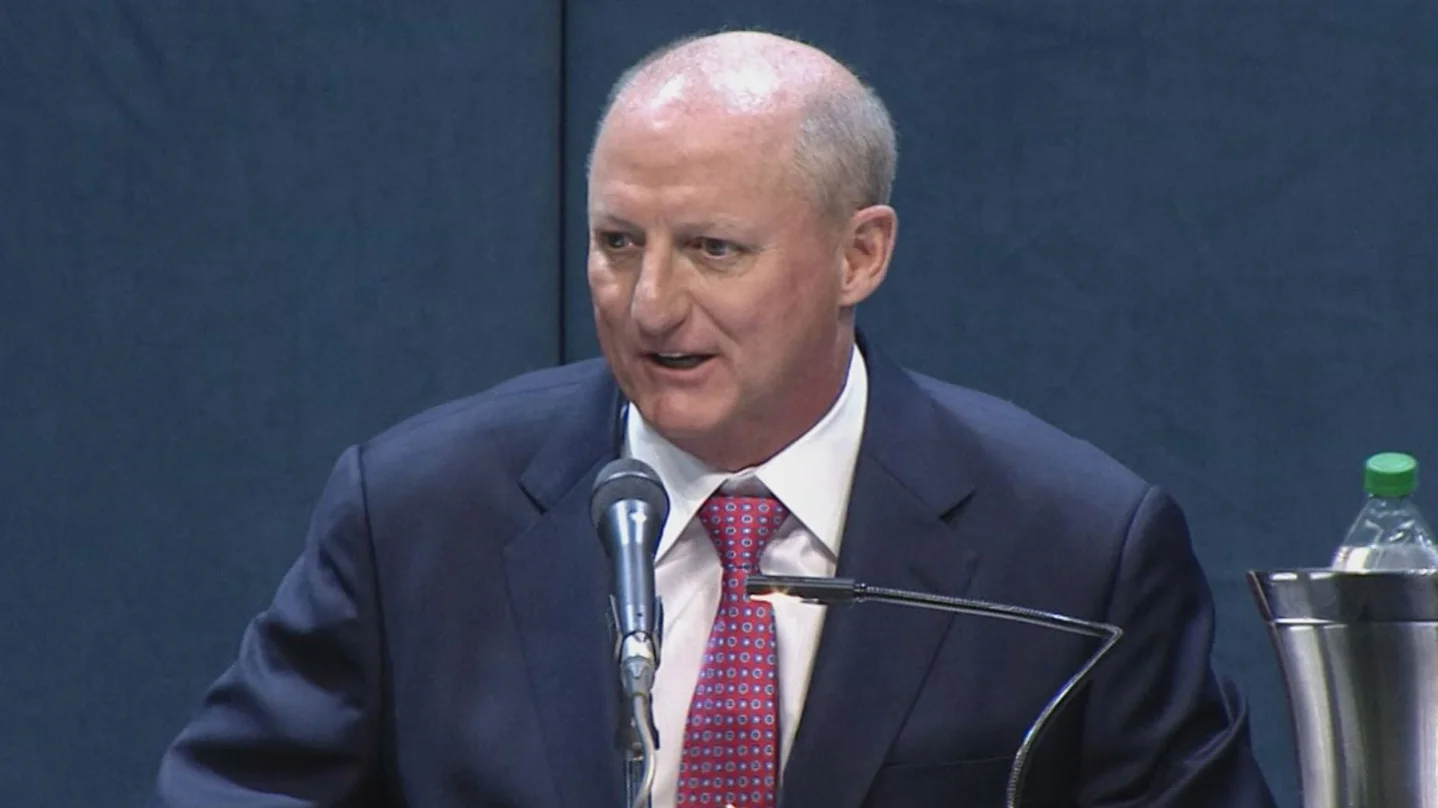
Greg Abel — the stewardship letter
Greg Abel's first letter as Berkshire Hathaway CEO (February 28, 2026) opens not with financial results but with a property claim — and a surrender of it: "Your capital is commingled with ours, but it does not belong to us. Our role is stewardship." The piece surfaces Abel's most distinctive moves: framing culture as an operating architecture rather than an aspiration, distinguishing his conditional management style from Buffett's near-abdication, laying out five explicit capital allocation rules against $370 billion in dry powder, and committing to a 20-year horizon while refusing quarterly guidance.

Published: 2026-02-28 — Berkshire Hathaway 2025 Annual Report, Greg Abel's Shareholder Letter
The opening declaration
Greg Abel's first letter as CEO of Berkshire Hathaway (Omaha-based conglomerate and one of the world's largest companies by market capitalization) does not open with financial results. It opens with a property claim — and then immediately surrenders it. 1
"Your capital is commingled with ours, but it does not belong to us. Our role is stewardship."
The sentence is short enough to memorize and specific enough to hold accountable. Abel is not just pledging good faith; he is drawing a legal and moral line between ownership and management that Berkshire's entire governance structure is supposed to enforce. 1
He then makes the argument that would have been easy to leave implicit but is instead placed on the first page:
"That stewardship has shaped a culture and reinforced a set of values that are not the result of our success, but the reason for it."
This sequencing — culture before financials — is itself a signal. Ravi Nagarajan at The Rational Walk noted that Abel's choice to address culture first, before discussing any business segment, reads as a deliberate statement of priorities. 2 Most CEO letters open with headline numbers; Abel opens with philosophy, and only gets to numbers after establishing the framework in which they should be read.
Culture as operating system, not aspiration
The letter's most substantive section is its treatment of culture. Abel describes six foundational values — decentralized operating model, integrity, financial strength, capital discipline, risk management, and operational excellence — and explicitly frames them as "mutually reinforcing and inseparable." 1 The list is not a mission statement. Abel is describing an architecture: a set of interlocking constraints that limit how any individual within Berkshire can behave, regardless of who runs the company at the top.
He also discloses that in January 2026 — a month before this letter reached shareholders — he sent a message to Berkshire's roughly 400,000 employees carrying a single sentence of substance: "Berkshire's culture and values remain unchanged and will continue into perpetuity." 1
The Charlie Munger passage that follows is the letter's most personal moment. Abel quotes Munger's comment from May 1, 2021 — when Munger inadvertently confirmed the succession plan at the annual meeting — "Greg will keep the culture," and writes that it "will forever resonate with me as both a reminder and a challenge." 1 The context matters: Munger said this publicly, unrehearsed, before Abel was formally announced as Buffett's successor. It was an endorsement of character, not credentials.
Where Abel diverges from Buffett's self-description is on the question of managerial distance. Buffett famously described his own style as delegating "almost to the point of abdication." Abel uses different language. His decentralized model is conditional: "autonomy grounded in deserved trust." 2 The qualifier matters. Autonomy that must be earned and can be withdrawn is a managed system, not an abdication. And he states the constraint explicitly: "Berkshire must have leaders that reflect its principles, and not principles that fit individuals." 1
Capital allocation: $370 billion and five rules
Abel's treatment of capital allocation occupies the letter's most practically useful section. The headline number: Berkshire's cash and U.S. Treasury holdings exceed $370 billion. 1 He anticipates the skeptical reading and addresses it directly:
"Many times in Berkshire's history, some observers have suggested that our substantial cash position signals a retreat from investing. It does not."
And then the statement he clearly wants on record:
"We will always aim for ownership of productive businesses over U.S. Treasuries."
The letter gives five explicit allocation criteria — presented here as Abel wrote them, not condensed: 1
- Invest in businesses that are deeply understood, with durable advantages and economic prospects
- Partner with leaders of high integrity who think like owners
- Avoid businesses that damage the social fabric or put Berkshire's reputation at risk
- Act decisively and concentrate capital in a small number of high-conviction ideas
- Maintain discipline and let compounding work
Rule 3 is the one that gets the least attention in commentary but is arguably the most structurally important for a company Berkshire's size. The constraint rules out entire categories of business regardless of their economics.
Abel applies rule 2 directly to a 2025 acquisition: Bell Laboratories (rodent control, family-owned), where the founding family's CEO Steve Levy sent a letter about his business that Abel describes as "perfect" — and adds "We only wish it had been ten times bigger." 1 The anecdote does what statistics cannot: it shows what "leaders of high integrity who think like owners" looks like in practice.
On dividends and buybacks, the letter restates Buffett's standard: retain capital as long as each retained dollar has a reasonable probability of creating more than a dollar of market value; buy back shares only when the price is below "conservatively determined" intrinsic value. Abel adds one governance detail that is new: any share repurchases require consultation with Warren Buffett, and the board has written this requirement into policy. 3
The 20-year commitment and what it means for communication
Abel closes the letter with a frank passage on time. He acknowledges he will not replicate Buffett's 60-year tenure ("simple arithmetic makes that — shall we say — an ambitious plan"), but commits to a 20-year horizon: 1
"20 years from now, when I will have just a fraction of the tenure that Warren had, my intention is that you — or your descendants — will be proud that your company is even stronger."
The phrase "or your descendants" is unusual in a corporate letter. It names the audience explicitly as multigenerational — not quarterly earnings followers, not institutional rebalancers, but people who may not be alive to see the outcome. That is a different kind of accountability than a performance target.
His communication philosophy follows from this: no quarterly calls, no quarterly commentary. "We concentrate on quality, not frequency. If a significant issue arises, you will hear from me, but it will not be through quarterly commentary, given our long-term horizon." 1 For investors accustomed to the modern earnings-call cadence — quarterly management theater with carefully staged guidance and analyst Q&A — this reads as a deliberate refusal to be managed by short-term expectations.
The Rational Walk's Ravi Nagarajan offered one of the more useful outside assessments: Abel is likely a more hands-on operational manager than Buffett, while Buffett as capital allocator is probably in a different category. If Buffett continues as an active chairman, the combination may produce better outcomes than either would achieve alone. 2 That read is plausible but still speculative — the real test, as Nagarajan also noted, is a decade-long one.
What this letter asks of the long-term investor
Abel's letter implies a specific question for the investor reading it: do you believe that culture is a durable operating mechanism, or a story that companies tell about themselves?
His answer, made on the opening page and repeated in structure throughout the letter, is that culture is the mechanism — not the marketing. The decentralized model with conditional autonomy, the five capital allocation rules, the explicit rejection of quarterly guidance, the governance constraint on buybacks, the 20-year commitment to shareholders and their descendants — each is a specific institutional design choice, not a sentiment. Whether that design holds under pressure from a genuinely adverse cycle is the question this letter cannot answer by itself, but it at least defines the terms on which Abel's stewardship should be judged.
The full letter is available at berkshirehathaway.com.
Cover image credit: Image from CNBC: Berkshire CEO Greg Abel vows to keep Buffett's culture of disciplined investing in first annual letter
이 콘텐츠를 둘러싼 관점이나 맥락을 계속 보강해 보세요.