
AI Product Updates Daily — June 5, 2026
Anthropic discloses Claude wrote 80%+ of its May production code and calls for a global AI development slowdown in the same breath. OpenAI launches Dreaming V3 memory for ChatGPT Plus/Pro, deploys Codex Sites, and rolls out six job-specific plugin packs covering analytics, creative, sales, and finance. NVIDIA's 550B-parameter Nemotron 3 Ultra lands on SageMaker JumpStart. Meta keeps delaying its developer API. Apple WWDC starts June 9.
The day's biggest signal came from Anthropic, which disclosed that more than 80% of code merged into its production codebase in May was written by Claude — and then, in the same news cycle, called on the world's top AI labs to consider slowing down. OpenAI pushed hard in the other direction, rolling out a redesigned memory system and converting Codex from a coding tool into a broad workplace platform with six job-specific plugin packs. NVIDIA landed its largest open reasoning model yet on AWS.
OpenAI: ChatGPT gets a memory overhaul, Codex goes cross-functional
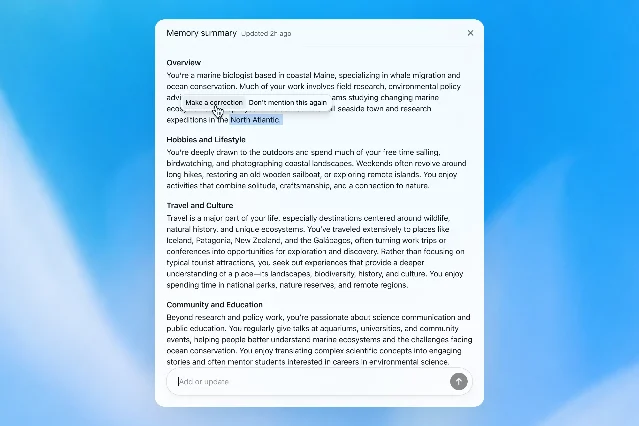
ChatGPT's Dreaming V3 memory is now rolling out to Plus and Pro subscribers in the US as of June 4. The new architecture — which OpenAI calls "Dreaming V3" — is a full rebuild rather than an incremental update. It consolidates what was previously a patchwork of manually saved memories and a background synthesis pass into a single system that automatically distills information from past conversations, organizes it into a searchable summary view, and keeps it current over time.1
Three specific behavioral improvements: the system now carries forward preferences and constraints without users having to restate them ("I'm vegetarian," "don't mention X topic"); it tracks state changes so that a trip planned for July doesn't stay in the future after July ends; and memory capacity for Plus and Pro users has doubled. The compute cost per user dropped roughly 5× versus the previous version — the reason free-tier users will get access in the coming weeks. The feature is still opt-out, not opt-in.
Codex Sites, also announced June 4, lets Business and Enterprise customers turn a plain-text prompt into a deployed, shareable internal web app — a KPI dashboard, an onboarding checklist, an event planner — via a plugin available in the Codex marketplace.2 The sites aren't meant as external products; they're closer to live documents with reactive data. OpenAI says these will eventually merge into ChatGPT, and is already working with Wix, Replit, Figma, Lovable, and Emergent on a partner ecosystem.
More structurally significant: Codex now has six role-specific plugin packs covering data analytics (connects to Snowflake, Databricks, Tableau), creative production (Figma, Canva, Shutterstock), sales (Salesforce, HubSpot), product design, equity investing (FactSet, LSEG, PitchBook), and investment banking (Moody's, Hebbia).3 The initial set bundles 62 apps and 110 skills. Codex has 5 million weekly active users, and non-developer knowledge workers now represent ~20% of that base — growing three times faster than the developer segment.
Anthropic: 80% AI-authored code, and a public call to slow down
Anthropic published internal data showing that, as of May 2026, Claude authored more than 80% of the code merged into Anthropic's own production codebase, up from low single digits before Claude Code launched.4 The result: engineers at the company ship 8× as much code per quarter compared to the 2021–2025 baseline.
Anthropic's coding evolution — from human-authored code (2021) to 80%+ AI-authored (May 2026) 4
A few numbers from the disclosure that are harder to explain away as marketing:
- Claude's success rate on open-ended, poorly-specified engineering tasks reached 76% in May — a 50-point gain in six months.
- In an isolated optimization task, an internal Mythos Preview model achieved a 52× speedup on model training code; a skilled human developer would take four to eight hours to reach a 4× speedup on the same codebase.
- In April, Claude autonomously resolved a persistent API error class by shipping 800+ individual fixes, dropping the error rate by a factor of 1,000. A human developer would have needed an estimated four years for the same work.
- An automated Claude code reviewer, running in CI/CD, caught roughly one-third of the production bugs responsible for historical outages on claude.ai.
The same day, the Wall Street Journal reported that Anthropic had called on top AI labs to consider slowing development, citing the risk of AI systems soon becoming capable of self-improvement without human intervention.5 The company's blog post frames the 80% figure not as a product announcement but as an early indicator of recursive self-improvement — a capability threshold that Anthropic considers worth broader attention.
The tension is real: Anthropic published metrics demonstrating faster-than-expected capability growth, then used those same metrics to argue for restraint. Whether that combination counts as transparent disclosure or strategic positioning depends on whom you ask.
NVIDIA: Nemotron 3 Ultra lands on SageMaker
NVIDIA Nemotron 3 Ultra is now available on Amazon SageMaker JumpStart with day-zero deployment, confirmed June 4.6 The model is a 550B-total-parameter, 55B-active-parameter hybrid Transformer-Mamba mixture-of-experts architecture with up to a 1M-token context window.
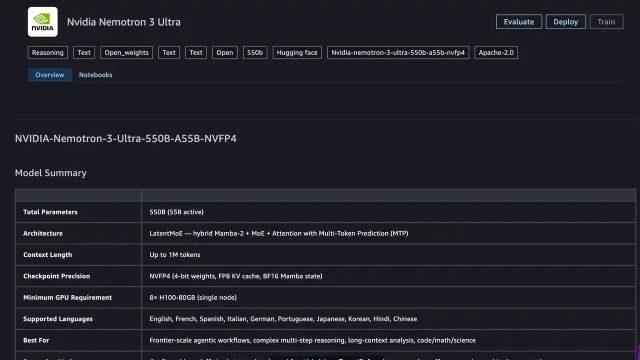
NVIDIA says Nemotron 3 Ultra delivers 5× faster inference and up to 30% lower cost compared to dense models on long-horizon agentic workloads — the design focus is on sustained multi-step reasoning: agentic orchestrators, large-codebase coding agents, deep research, and multi-step enterprise workflows. Supported instances on SageMaker:
ml.p5en.48xlarge, ml.p5.48xlarge, and ml.g7e.48xlarge. The model is also available free via OpenRouter.Meta: developer API still delayed
The Wall Street Journal reported on June 4 that Meta has delayed the developer API release of its new AI model multiple times — as of June 3, no scheduled date had been set, roughly two months after Meta AI's head told developers the API was coming "soon."7 The delay raises questions about Meta's ability to monetize its large-scale frontier model investment through third-party developer channels. The model — Muse Spark, which powers Meta's consumer AI chatbot — was released without an open-weights blueprint, a departure from the Llama series.
Elsewhere
- Apple WWDC 2026 starts June 9. The main AI expectation is Gemini integration in Siri for iOS 27, alongside additional Apple Intelligence features — the event is widely expected to define Apple's on-device AI positioning for the next year.8
- Microsoft Fabric June 2026 feature summary is live, covering a Copilot-powered real-time dashboard tile editor (preview), a new NL2SQL engine for the data agent, updated agentic workflow capabilities in Pipelines, and expanded Eventstream connectors.9
참고 출처
- 1Dreaming: Better memory for a more helpful ChatGPT — OpenAI
- 2Why Your Company Should Start Using OpenAI's New Vibe-Coding Tool — Inc.
- 3OpenAI to Expand Codex Beyond Coding to Role-Specific Applications and More — AI Data Insider
- 4Anthropic says 80% of its new production code is now authored by Claude — VentureBeat
- 5Anthropic Urges Global Pause in AI Development, Flags 'Self-Improvement' Risk — WSJ
- 6NVIDIA Nemotron 3 Ultra now available on Amazon SageMaker JumpStart — AWS Machine Learning Blog
- 7Exclusive: Meta Keeps Delaying the Release of Its New AI Model to Developers — WSJ
- 8WWDC 2026 — 7 biggest announcements we expect — Tom's Guide
- 9Fabric June 2026 Feature Summary — Microsoft Fabric Community
이 콘텐츠를 둘러싼 관점이나 맥락을 계속 보강해 보세요.