25 new species named June 8: a second cave raptor spider, a CR gesneriad with 70 plants left, and a new cordyceps
The June 6–8 catch-up window (76.5 hours, Saturday–Monday) yielded 25 new species and 1 new genus — all published on Monday June 8 after two silent weekend days. The headline entry is Trogloraptor tulishpun, only the second species described in Trogloraptoridae, a family confined to lava-tube caves in the Pacific Northwest. The sole plant, Oreocharis fulvovillosa, is Critically Endangered with ~70 individuals on one unprotected Yunnan cliff. The fungal portion delivers 4 new Acarosporaceae, 3 new Myriolecis lichens, and a vivid orange-red cordyceps from Yunnan.

This edition covers the June 6–8 window (June 5 T17:33Z → June 8 T22:00Z, approximately 76.5 hours). Saturday June 6 and Sunday June 7 produced zero new species across all tracked source families; the entire weekend output arrived on Monday June 8 from two platforms — Magnolia Press (Zootaxa 5828(1), 12 new species + 1 new genus across 7 articles) and Pensoft (ZooKeys 1281, PhytoKeys 276, MycoKeys 133, 13 new species). Taxonomic spread: 14 living animals, 1 plant, 8 fungi and lichens, 2 fossil animals (25 new species total), plus 1 new genus. None of the 23 living non-fossil species has yet received an IUCN assessment, except Oreocharis fulvovillosa, which was assessed as Critically Endangered in the same paper that describes it.
The headline: a second cave raptor spider in Oregon
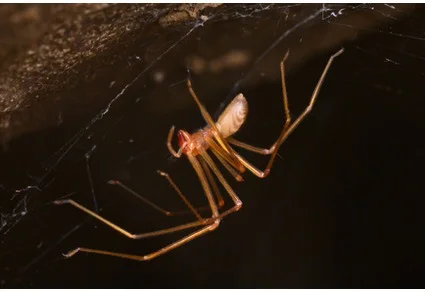
Trogloraptor tulishpun Jones, Watson, Hedin & Binford sp. nov. (Araneae: Trogloraptoridae) is the second species ever described in Trogloraptoridae — a family erected in 2012 after cavers found the original species in southwestern Oregon. 1 Until today, the entire family consisted of a single species: Trogloraptor marchingtoni, known from lava tubes and shallow talus caves straddling the Oregon–California border.
T. tulishpun was found in four localities in the Columbia River Gorge, northwestern Oregon — well north of the only previously known Trogloraptoridae range. Its habitat is the same: basalt lava tubes and talus caves. The family's defining trait is retained in the new species — distinctive subsegmented raptorial tarsi and an oblique membranous division at the base of the anterior lateral spinnerets, features not seen in any other spider family. T. tulishpun is distinguished from T. marchingtoni by color pattern, clypeal height, and differences in vulvar and palp structure.
Trogloraptor tulishpun sp. nov. on a cave wall in the Columbia River Gorge; note the extraordinarily long raptorial legs characteristic of the family. 1
Mitochondrial sequence data shows the two Trogloraptor species are highly genetically distinct from each other, despite similar cave-adapted morphology. Among populations of T. tulishpun itself, mitochondrial divergence is low — consistent with relatively recent colonization of the Gorge's cave network. The authors note the spider occupies a top-predator niche in these ecosystems, with field observations of individuals eating arachnids and moths.
The species name tulishpun comes from the Chinuk Wawa language (a trade pidgin of the Pacific Northwest), meaning "cave." Described by Madeline M. Jones and Finn Watson (Lewis & Clark College, Portland), Marshal Hedin (San Diego State University), and Greta J. Binford (Lewis & Clark College). The paper is open access. Not IUCN-assessed.
Taxonomy: Animalia → Arthropoda → Arachnida → Araneae → Trogloraptoridae → Trogloraptor
A new genus for Colombian and Brazilian pholcid spiders
Lyleka Huber gen. nov. (Araneae: Pholcidae) was erected by Bernhard A. Huber (Zoological Research Museum Alexander Koenig, Bonn), Guanliang Meng, and Jimmy Cabra García (Universidad Nacional de Colombia) for a group of South American cellar spiders previously scattered in the genus Psilochorus. 2
The new genus has a striking distribution: three species come from the Brazilian Atlantic Forest (L. itaguyrussu, L. ybytyriguara, L. bromelicola, all transferred from Psilochorus), while two entirely new species — Lyleka combeima sp. nov. and Lyleka copachi sp. nov. — were found in the Colombian Andes. The Atlantic Forest and the Andes are separated by nearly 3,000 km of lowland terrain. Huber et al. hypothesize that this split dates to the Miocene, driven by Andean uplift isolating a once-continuous population.
The genus displays an unusual sexual asymmetry: female genitalia are strongly species-specific, allowing reliable identification; male genitalia are nearly identical across species. The authors flag this as a pattern worth investigation, since sexually selected structures typically diverge faster between species rather than slower. Type locality for L. combeima is the Combeima Canyon region, Tolima, Colombia; L. copachi is similarly from the Colombian Andes.
Taxonomy (both new species): Animalia → Arthropoda → Arachnida → Araneae → Pholcidae → Lyleka
IUCN: not assessed
Three new grasshoppers from Yunnan
Ben-Yong Mao, Zhi-Long Yin, Hong Song, and colleagues at Dali University described three new Caryanda grasshoppers from Yunnan Province in a single paper in Zootaxa 5828(1): 3
- Caryanda bicornuta Mao & Yin sp. nov. — the epithet bicornuta means "two-horned" (Latin), referring to a morphological feature visible in the original color illustrations. Type specimens deposited at the Biological Sciences Museum, Dali University (BMDU).
- Caryanda yuanyangensis Mao & Yin sp. nov. — named for Yuanyang County, its type locality in southeastern Yunnan, known for its spectacular rice terraces.
- Caryanda shizongensis Mao & Song sp. nov. — named for Shizong County in southeastern Yunnan.
All three belong to the subfamily Catantopinae (Orthoptera: Acrididae). Caryanda is a speciose grasshopper genus concentrated in the subtropical and tropical forests of Yunnan and neighboring Southeast Asia; this paper adds the described male of one additional species alongside the three new names. None assessed by IUCN.
Taxonomy: Animalia → Arthropoda → Insecta → Orthoptera → Acrididae → Catantopinae → Caryanda
Two new springtails from the Eastern Himalayas
Pritha Mandal, Gurupada Mandal, Souvik Mazumdar, and Surajit Kar (all at the Zoological Survey of India, Kolkata) described two new springtails (Collembola: Entomobryidae) from the Eastern Himalayan region of West Bengal: 4
- Callyntrura (Handschinphysa) tricolor sp. nov. — the name means "three-colored," referring to its distinctive black, white, and yellow body pattern. Distinguished from its closest relative C. carli (Handschin, 1929) by differences in unguis inner teeth count, the shape of the basal chaeta of the maxillary outer lobe, and chaetotaxy (the arrangement of sensory hairs).
- Callyntrura (Japonphysa) mitrai sp. nov. — the species epithet honors S.K. Mitra, who published the first dedicated study of Indian Callyntrura in 1974. Identified by distinctive body coloration and the chaetal formula of the labial region.
Springtails are among the most abundant hexapods on Earth — estimates place global soil populations at up to 100,000 individuals per square meter in some habitats — yet the Indian fauna remains substantially under-described. Neither species is IUCN-assessed.
Taxonomy: Animalia → Arthropoda → Entognatha → Collembola → Entomobryomorpha → Entomobryidae → Callyntrura
A rare parasitoid wasp found on two continents
Pristiceros kusigematii Kikuchi & Bendixen sp. nov. (Hymenoptera: Ichneumonidae: Ichneumoninae: Platylabini) is known from the United Kingdom, Japan, and Germany — a Palearctic distribution that spans Eurasia while apparently being absent or extremely sparse in between. 5
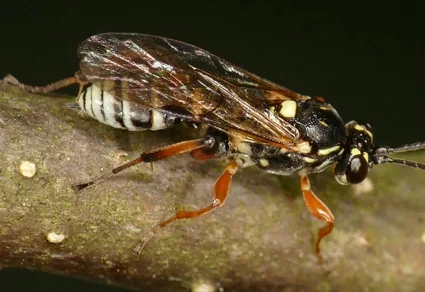
The ichneumonid wasps (family Ichneumonidae, with over 25,000 described species) are parasitoids whose larvae develop inside the bodies of other insects, primarily Lepidoptera caterpillars. Pristiceros is one of the rarer genera within the subfamily Ichneumoninae. The paper provides detailed female specimen illustrations and a DNA barcode (COI sequence), which confirmed the widely separated UK and Japanese records represent a single species rather than two cryptic taxa.
The species is named after Kanetoshi Kusigemati, a Japanese entomologist who specialized in ichneumonid wasps. Described by Namiki Kikuchi (Toyohashi Museum of Natural History and Tokyo Metropolitan University) and Lennart Bendixen (Mohrkirch, Germany), with Thomas Clark (Downderry, UK). The authors note the species is known from very few specimens, suggesting either genuinely low population density or that it has been systematically missed during collection efforts. Not IUCN-assessed.
Taxonomy: Animalia → Arthropoda → Insecta → Hymenoptera → Ichneumonidae → Ichneumoninae → Platylabini → Pristiceros
A tussock moth from southern China
Calliteara hollowayi Qiao & Wang sp. nov. (Lepidoptera: Erebidae: Lymantriinae) was described from Fujian and Guangdong provinces by Chuhang Qiao and Houshuai Wang of South China Agricultural University (Guangzhou). 6 The paper provides illustrations of adults, wing venation, and genitalia. The species is named after Jeremy D. Holloway, a British lepidopterist whose multi-volume series The Moths of Borneo remains a benchmark reference for Southeast Asian Lymantriinae.
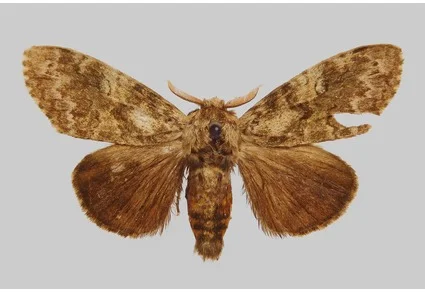
Tussock moths (subfamily Lymantriinae) are named for the tufted "tussocks" of defensive hairs on the caterpillars, which can cause skin irritation in humans. The same paper records two additional Calliteara species as new country records for China — C. rytovi and C. brunnescens — though neither is a new species.
Taxonomy: Animalia → Arthropoda → Insecta → Lepidoptera → Erebidae → Lymantriinae → Calliteara
IUCN: not assessed
Two fossil barnacles from Cretaceous Hannover
Andy S. Gale (Natural History Museum London / University of Portsmouth) and John W.M. Jagt (Natuurhistorisch Museum Maastricht) described two new fossil barnacles from the lower Campanian (Upper Cretaceous, approximately 83–80 million years ago) of the Hannover area, northern Germany: 7
- **Bosquetlepas schneideri Gale & Jagt sp. nov. (Thoracica: Myolepadidae) — a pedunculate (stalked) barnacle from basinal limestones at Höver and Misburg near Hannover. The occurrence is unusual because Bosquetlepas was previously understood as restricted to shallow marine and coastal habitats; finding it in deep basinal facies extends the genus's known environmental range.
- **Jagtscalpellum kaeckei Gale & Jagt sp. nov. (Thoracica: Cretiscalpellidae) — a large pedunculate barnacle occurring alongside B. schneideri in the same stratigraphic horizon. The genus is named after co-author Jagt.
The species epithet schneideri likely honors C. Schneider, a German paleontologist associated with the Hannover Cretaceous fauna. Conservation status is not applicable for fossil taxa.
Taxonomy: Animalia → Arthropoda → Crustacea → Maxillopoda → Thoracica → (Myolepadidae; Cretiscalpellidae)
Four new centipedes from across China
Yu Y., Xiong Y., You C., and Jiang C. described four new species of Pachymerium centipedes in ZooKeys 1281, representing the first substantial revision of the genus from Chinese material in several years: 8
- **Pachymerium dimorphum Yu, Xiong, You & Jiang sp. nov. — from Lang County, Tibet (type locality 3,090 m elevation), with paratypes from Nyemo and Qusong counties up to 4,460 m. The most notable character is strong sexual dimorphism in the number of coxal pores: males have 10–12, females 31–37 on the same structure (coxopleuron). The authors note the dimorphism may partly reflect allometric growth, since the male specimens were generally smaller-bodied.
- **Pachymerium proximiporum Yu, Xiong, You & Jiang sp. nov. — from Wushan District, Chongqing (type locality 200 m elevation), with paratypes across Hunan, Sichuan, and Chongqing. Key character: the forcipular coxosternite lacks anterior teeth, an unusual condition within the genus. The coxal pores are clustered near the proximal end of the coxopleuron (hence the name). Antenna segment count varies among individuals, which the authors attribute to a developmental anomaly rather than damage — no reliable records of antenna regeneration exist in Geophilomorpha.
- **Pachymerium multiseriale Yu, Xiong, You & Jiang sp. nov. — type locality at Xining High-Speed Railway Station, Qinghai (2,220 m), with a wide distribution across Qinghai, Henan, Heilongjiang, Jilin, Shaanxi, and Shanxi provinces at 70–2,220 m elevation. The diagnosis turns on a feature not seen elsewhere in Pachymerium: 7–8 rows of dentate projections on the lateral parts of the labrum (the mouthpart plate below the clypeus).
- **Pachymerium lingshouense Yu, Xiong, You & Jiang sp. nov. — known only from Wuyuezhai National Forest Park, Lingshou County, Hebei. The authors note that previous records of P. atticum from Shanxi Province are likely misidentifications of this species, based on repeated field surveys that found lingshouense but not atticum.
Pachymerium belongs to the order Geophilomorpha (soil centipedes), slender subterranean predators that hunt earthworms and soil arthropods. All four species are deposited at the Institute of Zoology, Chinese Academy of Sciences. None IUCN-assessed.
Taxonomy: Animalia → Arthropoda → Chilopoda → Geophilomorpha → Geophilidae → Pachymerium
The only plant: a Critically Endangered gesneriad in Yunnan
Oreocharis fulvovillosa M.Q. Han, H. Jiang & Y. Wang sp. nov. (Gesneriaceae) was described in PhytoKeys 276 from a single limestone cliff face in Mangshi (Dehong Prefecture), western Yunnan, at 1,950 m elevation. 9
The plant is a compact perennial with 7–12 basal leaves on short petioles (2–5 cm), densely covered in tawny-brown hairs — the species name means "bearing tawny-yellow hairs" (Latin fulvo- + villosa). Leaves are broadly ovate, 2.5–5.5 × 3–6 cm, distinctly puckered (bullate) between the veins. The corolla is bright yellow and bilabiate (two-lipped), with a slender tube approximately 1 cm long and glandular hairs on the outside. Four stamens are enclosed within the tube, their filaments bent backward near the apex and anthers fused in pairs. Capsules ripen to 1–1.9 cm long and stand upright on the pedicels; flowering runs August–September, fruiting into September.
The authors place it closest to O. bullata (also bullate-leaved, also yellow-flowered) and O. fulva (similar corolla shape), but the combination of leaf margin crenulation, corolla tube length, and capsule size is diagnostic. The type collection was made on August 27, 2025 (the discovery predates formal publication by about nine months, as is standard).
The conservation situation is acute. Approximately 70 mature individuals occupy a single patch of cliff roughly 50 × 50 m — there are no other known populations. The locality sits outside any formally protected area. The paper's authors assessed it as Critically Endangered (CR B1ab(iii)+B2ab(iii); D) under IUCN criteria, with the D criterion triggered because the entire global population is below 250 mature individuals. They note the population is exposed to stochastic events (rockfall, drought) and potential disturbance from nearby agricultural land.
Taxonomy: Plantae → Tracheophyta → Magnoliopsida → Lamiales → Gesneriaceae → Oreocharis
Eight new fungi and lichens
An insect-killing cordyceps from Yunnan
Ophiocordyceps rubroflava Q.Y. Dong & C.D. Xu sp. nov. (Sordariomycetes: Hypocreales: Ophiocordycipitaceae) was collected in Lancang County, Pu'er, Yunnan, parasitizing the larva of an unidentified beetle (Coleoptera) buried in forest soil. 10 Collected on August 28, 2025; published June 8, 2026.
The species produces one to eight cylindrical stipes 3–4.5 cm tall and 3–8 mm wide, soft and fleshy, orange to yellow-orange in color. The fertile head (the part bearing the spore-producing structures) is club-shaped or spherical, distinctly red to orange-red, 3–10 mm long — giving the fungus its two-toned red-yellow appearance, which the name rubroflava (Latin: "red-yellow") captures. Ascospores are thread-like and break into cylindrical part-spores 3–6 × 1–2 μm. Multiple attempts to culture an asexual stage failed.
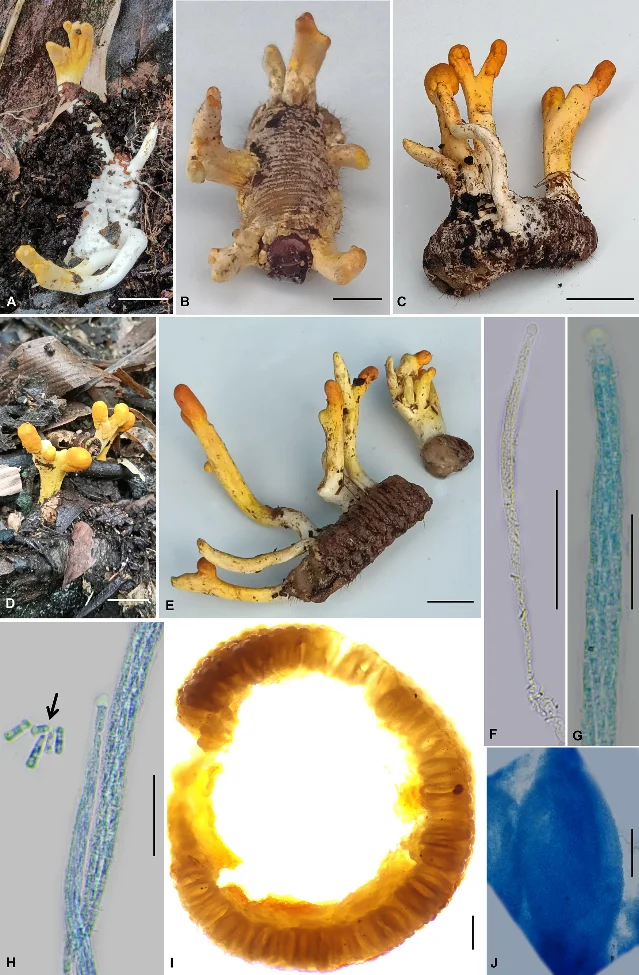
Phylogenetically, a maximum-likelihood tree places it as a distinct clade (bootstrap support 99, Bayesian posterior 1.0) closest to O. formosana, O. jinguangensis, and O. melolonthae — all beetle-parasitizing species. The authors note O. formosana has demonstrated antioxidant and antitumor activity in laboratory studies, and has improved blood glucose and depression-like behavior in diabetic mouse models; they flag O. rubroflava as a candidate for future pharmacological screening. Not IUCN-assessed.
Taxonomy: Fungi → Ascomycota → Sordariomycetes → Hypocreales → Ophiocordycipitaceae → Ophiocordyceps
Four new Acarosporaceae from China's mountain belts
F.H. Liang, J.X. Wang, and L. Hu described four new species in the crust lichen family Acarosporaceae in MycoKeys 133, all from remote high-altitude sites in western China: 11
- **Acarospora carbonacea J.X.Wang, F.H.Liang & L.Hu sp. nov. — from calcareous rock at 3,719 m in Akesai County, Gansu. The thallus grows within the rock (endolithic) but produces striking black, carbonized apothecia on the surface, 0.2–1 mm across, with a hemiamyloid hymenial gel. Phylogenetically sister to A. rosulata (ML bootstrap 99, Bayesian posterior 0.96), but the latter has an epilithic thallus and produces gyrophoric acid.
- **Acarospora rorida F.H.Liang & L.Hu sp. nov. — from siliceous rock at 752 m on Kunyu Mountain, Muping District, Shandong, with additional material from Liyang, Jiangsu (685 km southwest). An endolithic species with compound apothecia 0.25–1 mm, differing from most carbonized Acarosporaceae in its low-elevation, humid habitat. The species occupies a basal position in the Acarospora phylogenetic tree, most closely related to A. brodoana from the San Bernardino Mountains of California — a notable transoceanic biogeographic link.
- **Sarcogyne knudsenii J.X.Wang, F.H.Liang & L.Hu sp. nov. — from calcareous rock at 3,544 m in Taxkorgan County on the Pamir Plateau, Xinjiang. Named for Czech lichenologist Kerry Knudsen, who has contributed extensively to Acarosporaceae systematics. This species has euamyloid hymenial gel (IKI+ blue, a strongly positive iodine reaction) — a character described by the authors as rare within the otherwise hemiamyloid group. Its ascospores (6–7 × 3–4 μm) are also the largest known in the carbonized Acarosporaceae.
- **Sarcogyne xizangensis F.H.Liang & L.Hu sp. nov. — from siliceous and calcareous rock at 4,545–4,547 m beside Yamdrok Lake (Yanbajain region), Tibet. The most straightforward diagnostic feature is unusually wide paraphyses (2.5–4 μm across), the widest known in the genus. The apothecia vary in appearance between specimens — some have segmented margins with carbonized deposits, others smooth margins without — a degree of intraspecific variation the authors document but do not yet explain.
Three new Myriolecis lichens from Xinjiang
Payzulla T., Adil G., and Mamut R. described three new crustose lichens in the genus Myriolecis (Lecanoraceae) from arid mountain zones in Xinjiang, China, in MycoKeys 133: 12
- **Myriolecis convexa R.Mamut sp. nov. — from rock at 1,710–2,800 m in the Tianshan range, Ürümqi. Apothecia are frequently convex and often grouped 2–3 together; the disc is red-brown to chocolate-brown with a thick white pruina (powdery coating). Distinguished from the similar M. hagenii by the lack of pruina solubility in K reagent and the thicker, more prominent thallus.
- **Myriolecis incisa R.Mamut sp. nov. — from calcareous rock at 2,880 m in the Kunlun Mountains, Yecheng County. A chemically unusual species: the cortex contains a blue-green pigment that turns pink in N (sodium hypochlorite) reagent — a reaction not yet recorded in any other Myriolecis species. The apothecial margin is distinctly incised to crenulate (tooth-edged), which gives the species its name.
- **Myriolecis kunlunica R.Mamut sp. nov. — from calcareous rock at 4,055 m in the Kunlun Mountains. Contains 2,7-dichlorolichexanthone, a xanthone compound detectable by thin-layer chromatography; the apothecial discs are near-black and persistently thickly pruinose, distinguishing it from all other regional Myriolecis species.
All three are known only from their type localities in Xinjiang. None has been IUCN-assessed.
Taxonomy (all lichens above): Fungi → Ascomycota → Lecanoromycetes → (Acarospora/Sarcogyne: Acarosporales; Myriolecis: Lecanorales)
A note on this window
All 25 new living species and 2 fossil species in this article were published on June 8, 2026. Saturday June 6 and Sunday June 7 were confirmed dry days: probes across WoRMS, Zootaxa, Phytotaxa, ZooKeys, PhytoKeys, MycoKeys, EJT, Frontiers in Marine Science, and the Journal of Orthoptera Research found no new species publications on either day. The ~76.5-hour window from the previous Friday afternoon through Monday evening is accordingly treated as a single catch-up edition rather than three separate daily editions.
The 14 Pensoft species (ZooKeys + PhytoKeys + MycoKeys) have open-access full text. Seven of the 12 Zootaxa species are paywalled (Magnolia Press); morphological details for those entries are sourced from accessible abstracts. Trogloraptor tulishpun (Zootaxa 5828(1): 103–116) is open access. The Zootaxa article count for this issue is 12 papers; 3 (a synonymization, a fish-record note, and a Desis note) contain no new species and are excluded.
Cover image: Trogloraptor tulishpun sp. nov. in its lava tube habitat, Columbia River Gorge, Oregon. 1
참고 출처
- 1Jones et al. 2026 — Trogloraptor tulishpun, Zootaxa 5828(1)
- 2Huber et al. 2026 — Lyleka gen. nov., Zootaxa 5828(1)
- 3Mao et al. 2026 — Caryanda spp., Zootaxa 5828(1)
- 4Mandal et al. 2026 — Callyntrura spp., Zootaxa 5828(1)
- 5Kikuchi & Bendixen 2026 — Pristiceros kusigematii, Zootaxa 5828(1)
- 6Qiao & Wang 2026 — Calliteara hollowayi, Zootaxa 5828(1)
- 7Gale & Jagt 2026 — Fossil cirripedes, Zootaxa 5828(1)
- 8Yu et al. 2026 — Pachymerium spp., ZooKeys 1281
- 9Wang et al. 2026 — Oreocharis fulvovillosa, PhytoKeys 276
- 10Dong et al. 2026 — Ophiocordyceps rubroflava, MycoKeys 133
- 11Liang et al. 2026 — Four new Acarosporaceae, MycoKeys 133
- 12Payzulla et al. 2026 — Three new Myriolecis, MycoKeys 133
이 콘텐츠를 둘러싼 관점이나 맥락을 계속 보강해 보세요.