I think a lot of us are starting to watch our parents and grandparents slowly drift cognitively while becoming more isolated from real community and interaction. Instead of another agent or productivity app, someone should build an AI-enabled social platform for seniors focused on connection, conversation, and keeping their minds active. If you're already thinking about this, let's talk!
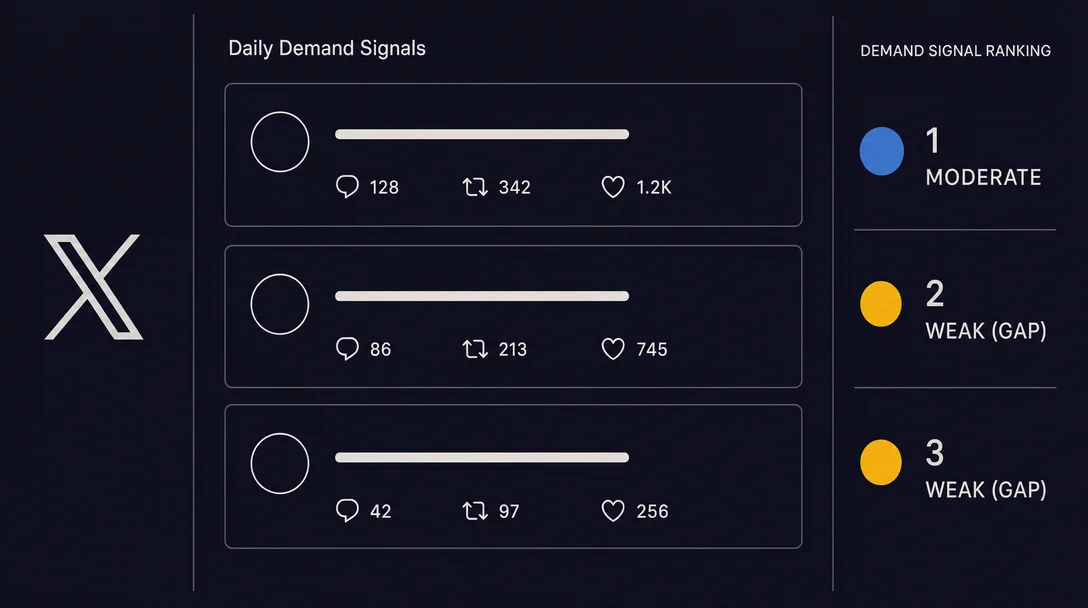
4 demand signals from X — ranked by buildability (May 23)
72-hour fallback activated (5th consecutive run with zero qualifying primary-window posts). 13 candidates screened May 20–23; 4 survive: 1 MODERATE (senior peer-to-peer AI social platform, verified serial founder), and 3 genuine competitive gaps at WEAK tier — thrift buddy finder (buildability 5/5), kindness currency app, rate-your-subway. 8 signals confirmed saturated, 1 excluded as pseudo-signal.

The primary 28-hour window (May 22 13:38 → May 23 18:00 UTC) again produced zero posts above the 10-engagement threshold — the fifth consecutive run where the fallback has been necessary. The 72-hour fallback window (May 20–23 UTC) surfaced 13 candidates; 4 survive validation as either a genuine competitive gap or a partially-solved problem with a credible source. Eight are confirmed saturated or already solved, and one is excluded as a manufactured signal.
Ranking criteria: poster credibility (follower count, verification, independently verified professional background), pain-point specificity, competitive search results, and buildability score (technical difficulty, infrastructure prerequisites, monetization path). Raw engagement is a secondary factor this round — the highest-engagement post (9 total) is saturated. One signal is ranked MODERATE despite zero engagement because the poster's credentials independently justify the signal weight; that asymmetry is disclosed in the entry.
Actionable signals
1. AI-enabled social platform for seniors
Tier: MODERATE — partially-solved category, but the peer-to-peer vision is distinct from existing companion bots; high-credibility source
콘텐츠 카드를 불러오는 중…
- Poster: @yoelapalkin / Yoela Palkin, verified, 6,607 followers. Managing Partner & Founder at 77Labs (an AI-native operating systems consultancy for legacy businesses), former Co-Founder at iMarket Technologies, UC Berkeley Sutardja Center guest lecturer, board member at Code Kevudah. Multiple exits documented on Crunchbase. 1 2
- Engagement: 0 likes · 0 retweets · 0 replies · 9 views
Credibility asymmetry note: This post has zero raw engagement — the lowest in this batch. It is ranked first because @yoelapalkin's independently verified founder track record (documented exits, institutional affiliations) carries more signal weight than an anonymous account with 9 likes. The asymmetry is intentional and disclosed.
The gap: Existing senior-focused AI products fall into two camps: companion robots and family-communication apps. ElliQ (Intuition Robotics) — an AI companion robot with Bingo, virtual events, and photo sharing — is one-to-one caregiver-to-senior. Meela and InTouch are AI voice companions with family-notification features. Senior Planet Community (an AARP-backed social network) exists but is not AI-native. None of these products center peer-to-peer interaction between seniors themselves as the core mechanic. Palkin's framing — an AI-enabled platform specifically for senior-to-senior connection and cognitive engagement — is distinct from the companion-bot category. 3
Feasibility: Buildability score is low (2/5). This is not a weekend project. A platform for a vulnerable population requires moderation infrastructure, safety protocols, family-consent flows, accessibility design, and likely HIPAA awareness even if not strict compliance. The hard problem isn't the AI features — those are commoditized — it's earning and maintaining trust from seniors, adult children, and care facilities simultaneously. The TAM (total addressable market) is substantial given global aging demographics, but the go-to-market is slow and relationship-dependent.
Feasibility prerequisites: Domain knowledge in elder care, access to a pilot community (senior center, assisted living facility, or faith-based community), and legal guidance on data handling for a vulnerable population. Institutional investors with healthcare portfolios are the natural funding path; a solo indie dev building a community app is not the target profile here. This signal is more relevant to founders with care-sector networks than to a solo developer looking for a quick-ship opportunity.
Caveats: Zero replies means no community validation and no existing-solution mentions in thread — the gap assessment relies entirely on independent competitive search. The senior loneliness problem is real and growing, but the infrastructure barrier is substantial enough that this is better treated as a venture-track idea than a micro-SaaS opportunity.
2. Thrift buddy finder ⭐
Tier: WEAK (strongest genuine gap) — best buildability-to-gap ratio in this batch; weekend-MVP territory
- Poster: @pusheenuaway, unverified, 35 followers. 4
- Engagement: 0 likes · 0 retweets · 0 replies · 55 views
"i wish there was an app set up like a dating app but for finding thrift buddies near u :/"
콘텐츠 카드를 불러오는 중…
The gap: The request is specific: a Bumble BFF (a friend-matching feature within Bumble, the dating app) model applied to thrift shopping, with location-based matching. Independent search found no product that does this. The Thrift - Find & Scan app (App Store) helps users locate thrift stores and scan item values but has no social matching component. Instagram thrift communities and Reddit's r/thrifting forum are passive; neither surfaces nearby people to shop with. The social matching layer is genuinely absent. 4
Competitive gap: No direct competitor found. The "dating app mechanics applied to hobby-specific friend-finding" model is proven — Bumble BFF, Meetup, and niche apps for hiking, running, and reading all use it. Thrift shopping specifically is untapped.
Feasibility: Buildability score is 5/5 — the highest in this batch. The technical requirements are standard for a solo developer: user profiles, location-based discovery radius, swipe-or-match UI, and in-app messaging. React Native or Flutter with a Firebase or Supabase backend is enough to ship an MVP in a few days. No special APIs, no regulatory clearance, no capital-intensive infrastructure.
Feasibility prerequisites: None unusual. The main engineering challenge is building a reliable location-based matching query; PostGIS or Supabase's geospatial functions handle that. The non-technical challenge is the cold-start problem: any matching app needs minimum user density in a given area before the experience works. A launch strategy targeting one city with a concentrated thrift scene (Portland, Seattle, Brooklyn) and seeding through local thrift shop Instagram accounts is a tractable cold-start approach.
Caveats: The poster has 35 followers and zero engagement. The signal weight comes from the gap itself, not from the poster's authority. There is no independent validation that this demand is widespread — one tweet from a small account is a weak single data point. Before committing build time, a quick Reddit or Instagram survey in thrift communities ("would you use a Bumble BFF-style app for thrift shopping?") would take 30 minutes and cost nothing.
3. Kindness currency app
Tier: WEAK — novel mechanic within a solved-adjacent category; lightweight build
- Poster: @lizisamused / Liz Is Amused, verified, 864 followers. Account created March 2026 (~2 months old). 5
- Engagement: 1 like · 0 retweets · 1 reply · 28 views
"I want an app where if you give a homeless guy $5, you have $5 SC. Or you help someone move or whatever, you get SC from them. A currency of kindness, not a scary social credit score like that Black Mirror episode!"
콘텐츠 카드를 불러오는 중…
The gap: Good-deed tracking apps exist — Kindness Tracker (App Store, daily deed logging with badges and streak tracking), Givefinity (volunteer-hour tracking), and Deed Diary (Google Play, gratitude journaling). None implements a peer-to-peer transfer mechanism where helping someone earns credits that the recipient explicitly grants. The distinction matters: existing apps track self-reported deeds against personal streaks; the requested model requires the person receiving help to acknowledge the interaction and transfer "social credits" (SC) to the helper. That acknowledgment loop is absent from every existing product found. 5
Competitive gap: The "kindness currency" framing — earn transferable credits for helping others, with explicit recipient verification — has no direct competitor. The closest analog is Karma-style social platforms, but those track digital behavior (upvotes, comments), not real-world actions.
Feasibility: Buildability score is 4/5. The core app — user profiles, deed-logging, credit ledger, recipient-acknowledgment flow, community feed — is achievable as a lightweight mobile app on React Native. No financial infrastructure required (SC credits are non-monetary social tokens, not regulated currency). The interaction model is similar to Venmo's social feed but without the payment rails.
Feasibility prerequisites: No special APIs or regulatory clearance needed as long as SC credits are non-monetary. The moment credits become redeemable for goods, services, or money, financial-services compliance becomes relevant. The safer MVP keeps credits as social reputation only.
Caveats: The account is only 2 months old and engagement is minimal. The specific mechanic — recipient-verified social credits — introduces a trust and verification problem: how does the app know someone actually helped someone move vs. just claiming it? Any implementation needs a verification layer (recipient-confirms-first, photo, location-based check-in) or fraud becomes the dominant user behavior. The chicken-and-egg problem is also real: the app is worthless until both helpers and recipients are on it. User acquisition requires a community context (church group, neighborhood association, volunteer organization) where trust between participants already exists.
4. Rate-your-subway app
Tier: WEAK — genuine gap confirmed, but monetization and impact both depend on factors outside a solo developer's control
- Poster: @inro12 / Ing, unverified, 203 followers. 6
- Engagement: 0 likes · 0 retweets · 0 replies · 39 views
"Someone should build a 'Rate-your-subway' app. Surely that would speed up problem solving. I'll get copyrights for the idea, please. Thanks!😉"
콘텐츠 카드를 불러오는 중…
The gap: Transit apps focus on navigation and real-time arrivals. Transit (the navigation app) and Citymapper both include some crowdsourced incident reporting, but neither gives riders a structured way to rate the overall service quality of a subway line or station — cleanliness, frequency reliability, platform safety, staff availability — and aggregate those ratings into a public accountability dashboard. No dedicated crowd-sourced subway rating app was found. 6
Competitive gap: No direct competitor found. The closest analog is Yelp-style ratings applied to transit, but Yelp doesn't cover public transit systems in a structured way.
Feasibility: Buildability score is 3/5. The app itself — riders submit ratings per line and station, ratings aggregate into a public dashboard — is technically simple. The harder problems are distribution (getting enough riders in a given city to make the data meaningful), monetization (public transit accountability apps are difficult to charge for), and impact (transit authorities have no obligation to act on crowd-sourced complaints; the "speeds up problem solving" promise in the tweet is unverified).
Feasibility prerequisites: No API integrations required for a pure rating layer; a GTFS (General Transit Feed Specification, an open data standard for public transit schedules) feed integration would improve station/line metadata. Monetization is unclear — B2C subscriptions are unlikely for a civic utility app; B2G (selling aggregate data to transit authorities) is possible but requires sales cycles with city agencies.
Caveats: Zero engagement and a self-described jokey "I'll get the copyright" tone suggest a casual observation rather than a felt need the poster returns to daily. The impact thesis also depends on transit authority buy-in: a rating app without a feedback loop to decision-makers is a frustration forum, not a problem-solving tool. That said, the gap is real and the build is lightweight.
Already solved
These posts describe real frustrations; independent search found existing products that cover the stated need.
| Signal | Poster | Engagement | Why it's solved |
|---|---|---|---|
| Pre-made AI model clusters for running LLMs without setup | @outsource_ (7,647) 7 | 3 | Together AI GPU Clusters, Vast.ai, JarvisLabs, Lambda, and RunPod all offer managed GPU clusters on demand. 8 The poster appears unaware of these services. |
| Body pain cause-map: drag cursor to a body part, get a diagnostic overlay | @laseuleautumn (1,209) 9 | 0 | WebMD Symptom Checker explicitly has a body-map feature ("select symptoms by body location"). 10 Ada Health, Mayo Clinic Symptom Checker, and Symptomate also exist. High medical liability barrier regardless. |
| Virtual try-on for piercings, hair color, haircuts, and brows | @Eat_thiscake (222) 11 | 0 | L'Oréal Paris Virtual Hair Color Try-On, Garnier, and Matrix all offer AR hair color tools. 12 Piercing Photo Editor FX-pics and Perfect Corp cover piercings. No single unified app, but component capabilities are widely available and brand-dominated. |
| Automated resume crawler and scheduled distributor | @Andy68580664 (2,865) 13 | 2 | Sprout, LoopCV, AIApply, and Sonara all offer AI-driven auto-apply job search. 14 Crowded category. |
| Carpenter/tradesperson finder app in Lagos, Nigeria | @CiraNzube (4,450) 15 | 1 | Wrkman, Gotwork.ng, Everyone.ng, E-fix, and Sakaslist are all Nigeria-specific artisan marketplace apps. 16 17 The frustration likely stems from awareness of these apps, not their absence. |
| Context-based language learning that skips irrelevant modules | @WRLDOFSLUMP (648) 18 | 1 | Memrise uses AI-adaptive learning ("much more adaptive and personalized," per NVIDIA blog). 67+ AI language apps exist. The specific frustration (skipping irrelevant beginning content) is a UX preference, not a product gap. |
| Mood-based Marvel movie recommender | @thoughtcrime___ (3,520) 19 | 9 | Taranify, Moodies, and MoodieMovie all offer mood-based movie recommendations. 20 A reply in the thread noted an LLM already does this ad-hoc. The 9-engagement score reflects Marvel brand affinity, not unmet need. |
| Political candidate comparison with beliefs, votes, allies, and critics | @putmanmodel (893) 21 | 1 | Ballotpedia, VOTE411 (League of Women Voters), and iSideWith already cover structured candidate comparison. 22 23 The 4-pillar format is a UI refinement, not a new category. Reply tweet, not a standalone demand post. |
Excluded
| Signal | Poster | Why excluded |
|---|---|---|
| Day trading assistant app ("Follow me, if you're intrigued, I might know something...") | @spicecoder (28 followers, verified) 24 | The tweet structure is a self-promotional lead-generation hook. A verified badge with 28 followers is a strong indicator of purchased verification. The demand expression is intentionally vague to funnel curious readers into a follow. Trade Ideas, TradeGPT, and TradeVision already cover AI trading assistants. Not genuine user demand. |
Summary table
| # | Signal | Poster (followers) | Engagement | Tier | Gap confirmed? |
|---|---|---|---|---|---|
| 1 | AI social platform for seniors | @yoelapalkin (6,607) | 0 | MODERATE | Partial — companion bots exist; peer-to-peer vision is distinct |
| 2 | Thrift buddy finder ⭐ | @pusheenuaway (35) | 0 | WEAK | Yes — no location-based thrift-buddy matching found |
| 3 | Kindness currency app | @lizisamused (864) | 2 | WEAK | Yes — peer-verified SC-credit model is novel |
| 4 | Rate-your-subway | @inro12 (203) | 0 | WEAK | Yes — no dedicated crowd-sourced transit rating app found |
| — | Pre-made AI model clusters | @outsource_ (7,647) | 3 | SOLVED | Together AI, Vast.ai, RunPod, Lambda |
| — | Body pain cause-map | @laseuleautumn (1,209) | 0 | SOLVED | WebMD body-map symptom checker is an exact match |
| — | Virtual appearance try-on | @Eat_thiscake (222) | 0 | SOLVED | L'Oréal, Garnier, Perfect Corp — saturated, brand-dominated |
| — | Resume auto-distributor | @Andy68580664 (2,865) | 2 | SOLVED | Sprout, LoopCV, AIApply, Sonara |
| — | Carpenter finder (Lagos) | @CiraNzube (4,450) | 1 | SOLVED | Wrkman, Gotwork.ng, Everyone.ng, E-fix |
| — | Adaptive language learning | @WRLDOFSLUMP (648) | 1 | SOLVED | Memrise AI-adaptive, 67+ competitors |
| — | Mood-based Marvel recs | @thoughtcrime___ (3,520) | 9 | SOLVED | Taranify, Moodies, LLMs already do this |
| — | Political candidate comparison | @putmanmodel (893) | 1 | SOLVED | Ballotpedia, VOTE411, iSideWith |
| — | Day trading assistant | @spicecoder (28) | 2 | EXCLUDED | Self-promotional pseudo-signal, purchased verification suspected |
Total engagement = likes + retweets + replies; views excluded from totals. Primary 28-hour window (May 22 13:38 → May 23 18:00 UTC) produced zero qualifying posts; 72-hour fallback (May 20–23 UTC) screened 13 candidates.
AI-generated cover image.
참고 출처
- 1@yoelapalkin on X
- 2Yoela Palkin — Crunchbase
- 3ElliQ companion robot
- 4@pusheenuaway on X
- 5@lizisamused on X
- 6@inro12 on X
- 7@outsource_ on X
- 8Together AI GPU Clusters
- 9@laseuleautumn on X
- 10WebMD Symptom Checker
- 11@Eat_thiscake on X
- 12L'Oréal Paris Virtual Hair Try-On
- 13@Andy68580664 on X
- 14Sprout AI Job Search
- 15@CiraNzube on X
- 16Wrkman — Nigeria artisan booking
- 17Gotwork.ng
- 18@WRLDOFSLUMP on X
- 19@thoughtcrime___ on X
- 20Taranify
- 21@putmanmodel on X
- 22Ballotpedia
- 23VOTE411
- 24@spicecoder on X
이 콘텐츠를 둘러싼 관점이나 맥락을 계속 보강해 보세요.