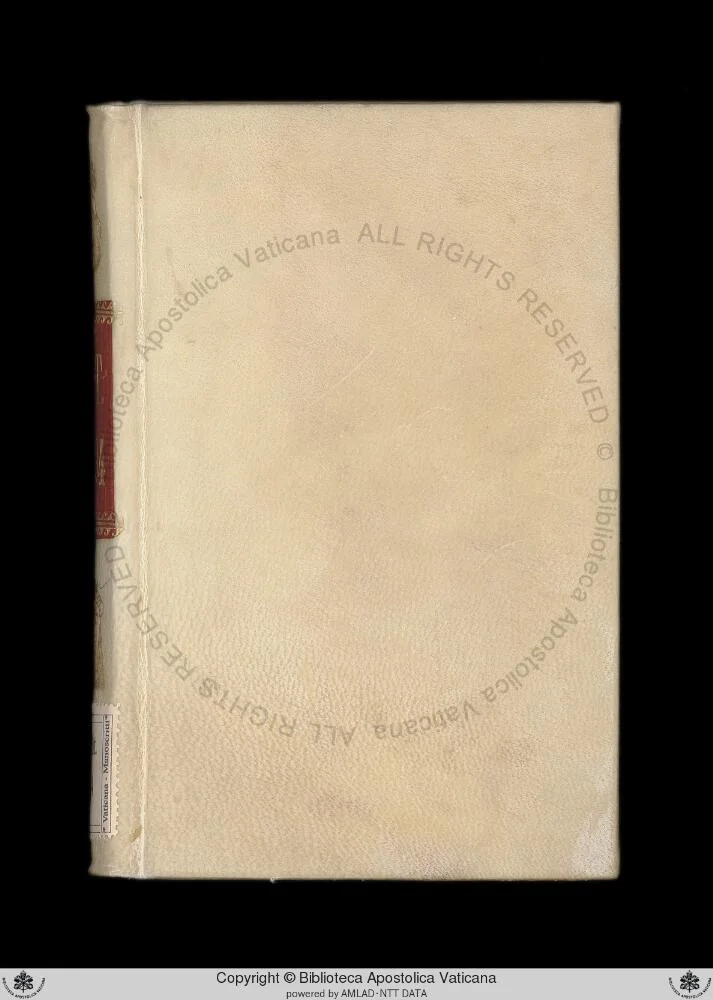
A grammar lesson that outlasted its teacher
Vatican manuscript Ott.lat.2294 — a 15th-century copy of an Ars Grammatica attributed to the otherwise-unknown Alberti Lauri — was digitized by the Biblioteca Apostolica Vaticana in its May 2026 Week 20 batch and is now freely accessible online. The article traces the 1,400-year genre lineage from Aelius Donatus through the medieval university trivium to the age of print, examines the physical manuscript (155 folios, UV fluorescence captures), and follows the Ottoboni provenance chain to the Vatican.

In the 15th century, learning Latin meant sitting with a book called an Ars Grammatica. It was not one specific book — the title had been a genre for over a thousand years — but every copy followed the same basic logic: here are the parts of speech, here is how declensions work, here is how a literate person writes. The student who worked through it would have done so by hand, often under the supervision of a teacher who was himself a minor figure, unrecorded, known to nobody outside his city.
Vatican shelfmark Ott.lat.2294 is one such book. Cataloged as the Ars Grammatica of Alberti Lauri, dated to the 15th century, it comprises 155 folios of Latin grammar instruction — roughly 310 pages of text, written on what the manuscript's physical proportions and period suggest is parchment. 1 The Biblioteca Apostolica Vaticana digitized it in its Week 20 batch (May 11–17, 2026) and made all 330 IIIF canvases — covering the binding, the guard leaves, and every folio — freely accessible online. 2 3
A 1,400-year textbook tradition
The Ars Grammatica as a genre starts in Rome. The first composition bearing that title was written by Remmius Palaemon in the first century AD; it is now lost. What survived, and shaped everything that followed, was the work of Aelius Donatus (active c. 350 AD), a Roman grammarian whose two-part manual became the grammar textbook of the Western Middle Ages. 4
Donatus divided his teaching across two texts. The Ars Minor covered the eight parts of speech — noun, pronoun, verb, adverb, participle, conjunction, preposition, interjection — in a question-and-answer format designed to be memorized aloud. The Ars Major moved into style: figures of speech, faults of diction, the rhetorical patterns that separate serviceable Latin from elegant Latin. 5 Donatus's Ars Minor was so central to medieval education that when Johannes Gutenberg was testing his press in the 1450s, one of the first texts he chose to print was the Donatus grammar — a sign of how large the existing market for Latin instruction already was.
By the 8th century, the Donatian tradition had been extended and adapted by writers like Alcuin of York (c. 730–804), who composed his own question-and-answer Ars Grammatica around the 790s for use in Charlemagne's palace school. Scholars Rita Copeland and Ineke Sluiter (in their 2012 Oxford University Press volume Medieval Grammar and Rhetoric) described Alcuin's text as "highly derivative in content" but pedagogically inventive — using the inherited framework to serve a new ideological and educational agenda. 4
In the medieval university curriculum, grammar occupied the first position in the trivium — the three-part foundation of a liberal arts education (grammar, rhetoric, logic) — before students advanced to arithmetic, geometry, music, and astronomy. Every student in Bologna, Paris, or Oxford in the 12th through 15th centuries would have passed through grammar instruction that ultimately traced back to Donatus. Ott.lat.2294 sits at the tail end of that tradition, written in the century just before print made hand-copied grammar books redundant.
The manuscript on the page
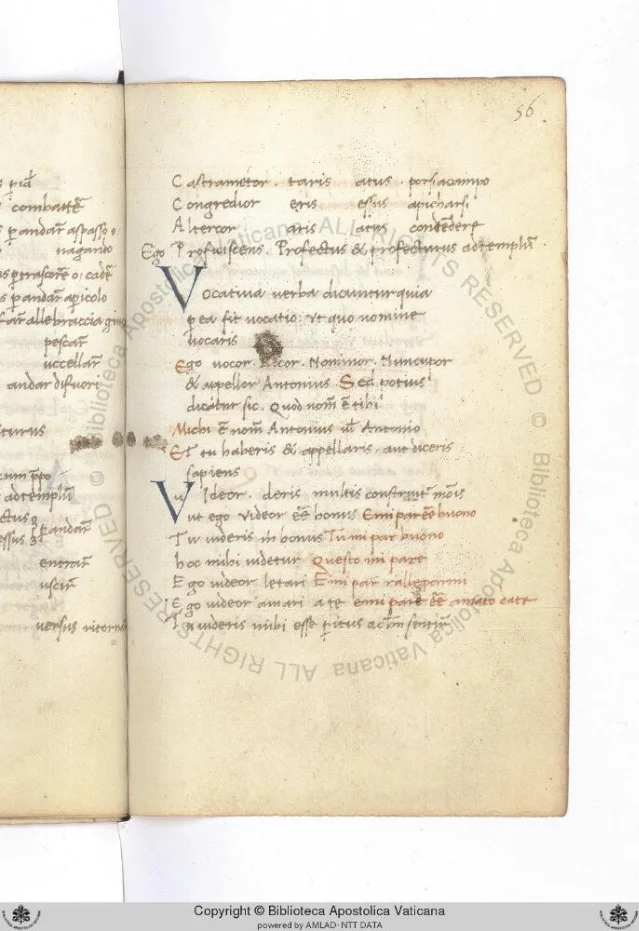
The text begins at folio Ir with the line: Litera est nox q[uem] sembi po[n]t — a scribal rendering of the standard medieval grammar opening, Litera est vox quae scribi potest ("A letter is a sound that can be written"). 2 The incipit is conventional, practically diagnostic: any medieval Ars Grammatica copy, regardless of whose version, was likely to start here. The scribe's spelling variant (nox for vox, sembi for scribi) may reflect a regional pronunciation, a copy-chain error, or simply individual handwriting habits — without examining more of the text, the cause is unclear.
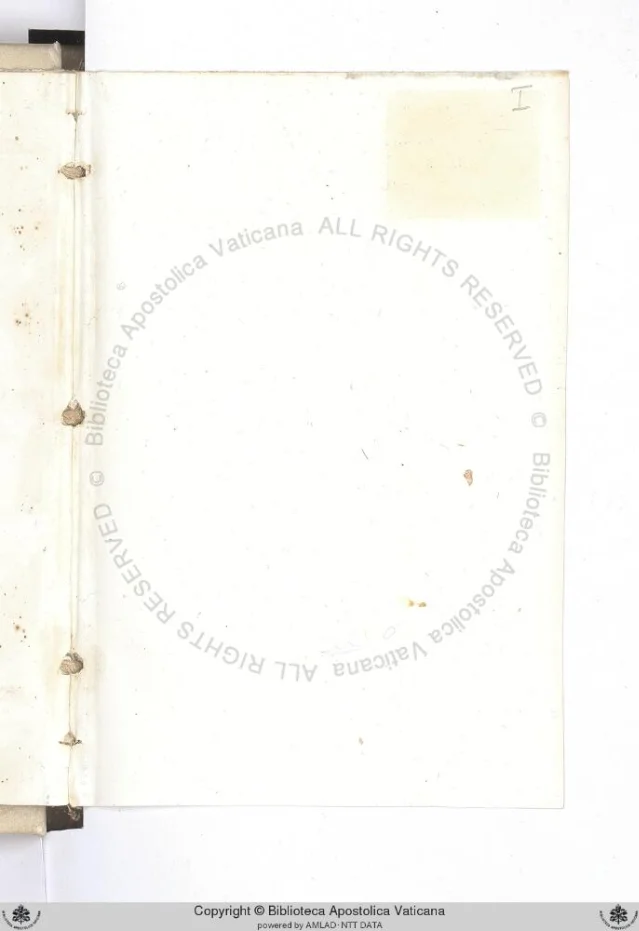
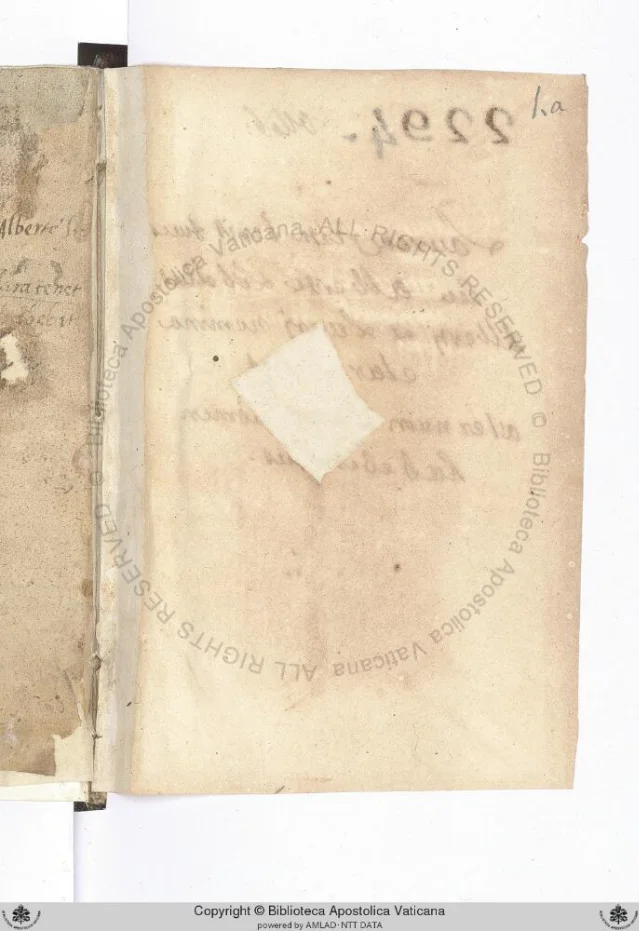
The digitization includes six ultraviolet fluorescence frames — three on folio 1r and three on folio 1v, coded as
.fn.0000 in the IIIF manifest. 1 UV imaging is used to recover ink that has faded below visible-light legibility, or to detect erasures and corrections beneath later text. The fact that the Vatican's conservation team targeted these two specific folios suggests either damage or alteration at the very start of the text. What the UV frames reveal is visible in the digitized images at the DigiVatLib viewer — the Vatican's standard IIIF interface displays all image sequences, including the fluorescence captures, alongside the regular photographs.The full 330 canvases run from the front cover through all 155 numbered folios to the rear boards, and include edge views and a color-calibration card. At roughly 1,046 × 1,523 pixels per standard canvas, individual letterforms are legible without zooming.
The author with one book
Alberti Lauri — the name is in the Latin genitive, meaning "of Albertus Laurus" or possibly "of Albertus Laurentius" — appears nowhere except on this manuscript's catalog record and the Wiglaf digitization listing. 2 Wikipedia has no article for him. The Thesaurus of the Consortium of European Research Libraries (CERL), which tracks personal names across thousands of medieval and early modern sources, has no entry. The Italian national encyclopedia Treccani does not record him. Google Books returns nothing.
This kind of absence is not unusual for a 15th-century grammar teacher. The Ars Grammatica was a schoolroom genre — composed or compiled by working pedagogues (called magistri in medieval Latin), not by scholars seeking literary fame. Hundreds of such teachers operated across Italian towns and cities, running small schools or tutoring privately, copying or adapting grammar manuals for their students. Most left no trace beyond a name scratched somewhere in the record, and many did not leave even that.
There is also a further complication. In medieval manuscripts, the boundary between author, compiler, and scribe was often blurry. "Alberti Lauri" may designate the person who wrote this specific copy, or the person who assembled its contents from earlier sources, or the original author of the text — or some combination. Without reading the manuscript in full, or finding a corroborating source, those three possibilities cannot be resolved.
From a cardinal's shelves to the Vatican
The manuscript belongs to the Ottoboni Latini collection, the same provenance line that runs through every Ott.lat. manuscript digitized in this Vatican batch. That collection was assembled by Cardinal Pietro Ottoboni (July 2, 1667 – February 23, 1740), grand-nephew of Pope Alexander VIII and the last person to hold the curial post of cardinal-nephew — a position abolished by Pope Innocent XII in 1692. 6
Ottoboni is remembered primarily as a music patron — he supported Arcangelo Corelli, Domenico Scarlatti, and Pietro Locatelli, and maintained a private theater in his Roman palazzo. His library, though, was substantial: Latin and Greek manuscripts, printed books, scores, and engravings accumulated over a long life of collecting. A contemporary description of him recorded that he "loved pomp, prodigality, and sensual pleasure, but was in the same time kind, ready to serve, and charitable." 6 His manuscript collection was not built around any single theme; Ott.lat.2294, a plain grammar textbook with no decorative illumination, sits in the same collection as important classical codices and literary manuscripts.
After Ottoboni's death in 1740, the collection passed to the Vatican under Pope Benedict XIV, who purchased it in the following decade. 7 How the Ars Grammatica of Alberti Lauri entered Ottoboni's hands — whether purchased, gifted, inherited, or collected incidentally — the Vatican catalog does not record.
Read the manuscript
The full digitization is freely accessible at DigiVatLib. All 330 canvases, including the UV fluorescence captures of folios 1r and 1v, are browsable and downloadable under the Vatican Library's standard terms.
콘텐츠 카드를 불러오는 중…
Ott.lat.2294 came online as part of the Vatican's Week 20 batch, a single release of Ottoboni Latini manuscripts after a gap in the library's digitization schedule. Among them, quietly, a grammar primer from a teacher whose name is still attached to his book — six centuries after he finished copying it.
Cover image: front binding of Vatican manuscript Ott.lat.2294, photographed by the Biblioteca Apostolica Vaticana. Images © Biblioteca Apostolica Vaticana.
이 콘텐츠를 둘러싼 관점이나 맥락을 계속 보강해 보세요.