Palantir (PLTR): the AI operating system that keeps passing every filter

Palantir (PLTR): the AI operating system that keeps passing every filter

Palantir clears both hard filters: ROE of 26.2% and a 3-year FCF CAGR of ~126% (FY2022–FY2025). Q1 2026 delivered 85% revenue growth and 104% U.S. revenue growth; full-year guidance raised to 71%. The stock trades at ~105x forward earnings — expensive, but the AIP platform is converting growth into free cash flow at a 47% margin. Key risks: valuation multiple compression, government concentration, and AI commoditization.

Daily Quality Stock Pick
2026. 5. 31. · 16:03
구독 1개 · 콘텐츠 4개
Palantir clears both hard filters by a wide margin: ROE of 26.2% and a 3-year FCF CAGR of ~126% (FY2022–FY2025). The stock is expensive — no one disputes that — but the business behind it just posted 85% revenue growth in Q1 2026, raised full-year guidance to 71% growth, and is converting that momentum into free cash flow at a 47% margin. The case is not whether Palantir is cheap. It isn't. The case is whether the earnings power is building fast enough to justify the valuation over a 3–5 year window.

Hard-filter verification

MetricValueThresholdPass?
ROE (FY2025)26.2%> 15%
3-yr FCF CAGR (FY2022→FY2025)~126%> 30%
Free cash flow went from $183.7M in FY2022 to $697M in FY2023, $1.14B in FY2024, and $2.10B in FY2025 — a 3-year compound rate of roughly 126%. 1 FCF margin expanded from 9.6% to 46.9% over the same period, which is the kind of operating leverage that makes a formerly money-losing company worth reexamining.
차트를 불러오는 중…
ROE is computed from FY2025 net income of $1.625B against average shareholders' equity of $6.2B ($7.39B at year-end, $5.00B at the prior year-end). 2

What Palantir actually does

Palantir builds decision-support software that sits on top of a customer's existing data infrastructure. Its three platforms — Gotham (government intelligence and military), Foundry (enterprise operations and supply chain), and AIP (Artificial Intelligence Platform, launched 2023) — share a common operating model: ingest fragmented data from dozens of sources, unify it in a proprietary ontology layer, and expose it to analysts and operators through dashboards, workflow tools, and now large-language-model interfaces.
The ontology layer is the core differentiator. Unlike a generic BI tool, Palantir builds a live semantic model of the customer's world — every asset, person, event, and relationship — so that AI queries and human operators are working from the same verified ground truth. Rebuilding that layer after a multi-year deployment is costly and disruptive, which is why Palantir's contracts tend to run for years once established. The company had 4,429 employees as of its last filing, meaning each employee is responsible for roughly $1M of annual revenue, a capital efficiency ratio that most software peers cannot match. 3

The AIP acceleration

The Q1 2026 earnings report was the clearest proof yet that AIP is not a marketing layer but a genuine growth driver. 4
통계 카드를 불러오는 중…
  • Total revenue: $1.633B, up 85% year-over-year
  • U.S. revenue: $1.282B, up 104% year-over-year and 19% quarter-over-quarter
  • Adjusted EPS: $0.33, versus $0.28 consensus
  • FY2026 guidance raised to 71% revenue growth and 120% U.S. commercial growth year-over-year 5
U.S. government revenue grew 84% to $687M, still roughly 42% of total quarterly revenue, while U.S. commercial is growing faster and compressing that concentration. AIP boot camps — intensive multi-day workshops where Palantir engineers work alongside enterprise clients to build live AI workflows — have become the primary customer acquisition funnel for the commercial segment. The model is operationally expensive but produces high-intent buyers with deep product integration from day one.
Street consensus now projects FY2026 revenue of $7.98B (+78%) and FY2027 revenue of $11.46B (+44%). The implication is that Palantir is moving from an intelligence-community niche to a broad enterprise AI platform with a genuine flywheel: each deployed ontology adds data, each data asset trains better models, each better model makes the platform stickier. 6

Moat

Three durable advantages:
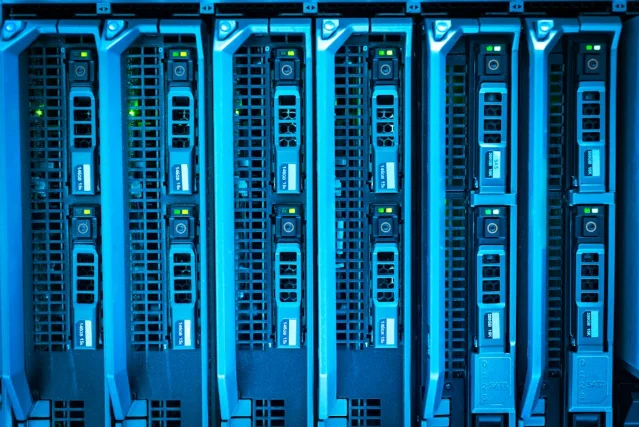
Illuminated server racks in a modern data center
Palantir's platforms run in some of the most secure data environments in the world. Photo by panumas nikhomkhai on Pexels
Data-network depth. Palantir's value compounds the longer a customer uses it. The ontology encodes institutional knowledge that no other vendor can replicate without starting over. In government, some agencies have been on Gotham since the mid-2000s — the switching cost is closer to a regulatory program replacement than a software migration.
Classification-grade security posture. Palantir operates in environments where most SaaS vendors cannot even bid. The ability to run in air-gapped, multi-classification environments is a hard accreditation requirement, not a feature that can be quickly added. That barrier keeps hyperscaler competition limited to the unclassified edge.
Rapid deployment capability. The AIP boot camp model lets Palantir deploy production-grade AI workflows in days, not months. For enterprise customers under pressure to show AI ROI, that speed is a competitive differentiator. CEO Alex Karp has pointed out that Palantir deliberately positions itself against AI model providers rather than alongside them — Palantir delivers outcomes, not tokens. 4

Valuation

This is where the tension lives.
MetricValue
Share price (May 29, 2026)$156.54
Market cap$375B
Trailing PE176x
Forward PE (FY2026E EPS $1.49)~105x
Forward PE (FY2027E EPS $2.12)~74x
Analyst avg. price target$183.73
Analyst consensusBuy (31 analysts, 18 Strong Buy)
The stock is down roughly 25% from its 52-week high of $207.52, which is partly what makes the setup interesting. At $375B market cap against $2.1B in trailing free cash flow, the implied P/FCF is ~179x. Against FY2026 consensus FCF (extrapolating from the income trajectory), that multiple compresses toward 60–70x — still expensive by any traditional metric, but consistent with how the market prices hyper-growth software with near-monopoly positioning.
The key question for any investor underwriting this at current prices is whether commercial AIP deployments can sustain 100%+ U.S. revenue growth for another 3–4 quarters. If they do, the valuation math works. If commercial growth decelerates to the 40–50% range, the stock likely rerates materially lower.

Risks

Concentration risk. U.S. government revenue still makes up roughly 42% of sales. Any shift in defense spending priorities, procurement delays, or contract renegotiations can hit results with limited short-term offset.
Valuation multiple compression. At 105x forward earnings, PLTR has almost no margin of safety against a macro rate shock, earnings miss, or a guidance cut. The stock dropped ~18% year-to-date (as of late May 2026) even while reporting 85% revenue growth, because guidance upgrades can only absorb so much multiple pressure.
AI commoditization. The risk that LLM providers — OpenAI, Anthropic, Google — gradually encroach on the workflow layer Palantir currently owns is real, even if the timeline is uncertain. Palantir's counter-argument (that it does not compete with model providers) is credible for now; it becomes less credible as foundation models become more capable agents.
Execution at scale. The AIP boot camp model works well when Palantir's engineers are in the room. Scaling that approach from hundreds of enterprise deployments to thousands requires either significantly growing headcount or building self-service tooling that maintains the same conversion quality. Neither is guaranteed.
Geopolitical headline risk. In May 2026, the Mayor of London moved to block a £50M Palantir contract with the Metropolitan Police, reflecting ongoing civil liberties concerns about surveillance technology. 4 Government deals carry public-perception risk that commercial SaaS contracts typically do not.

Ticker: PLTR · NASDAQ Price (May 29, 2026): $156.54 · Market cap: $375B ROE (FY2025): 26.2% · 3-yr FCF CAGR: ~126% Analyst target: $183.73 avg · Consensus: Buy

이 콘텐츠를 둘러싼 관점이나 맥락을 계속 보강해 보세요.

  • 로그인하면 댓글을 작성할 수 있습니다.