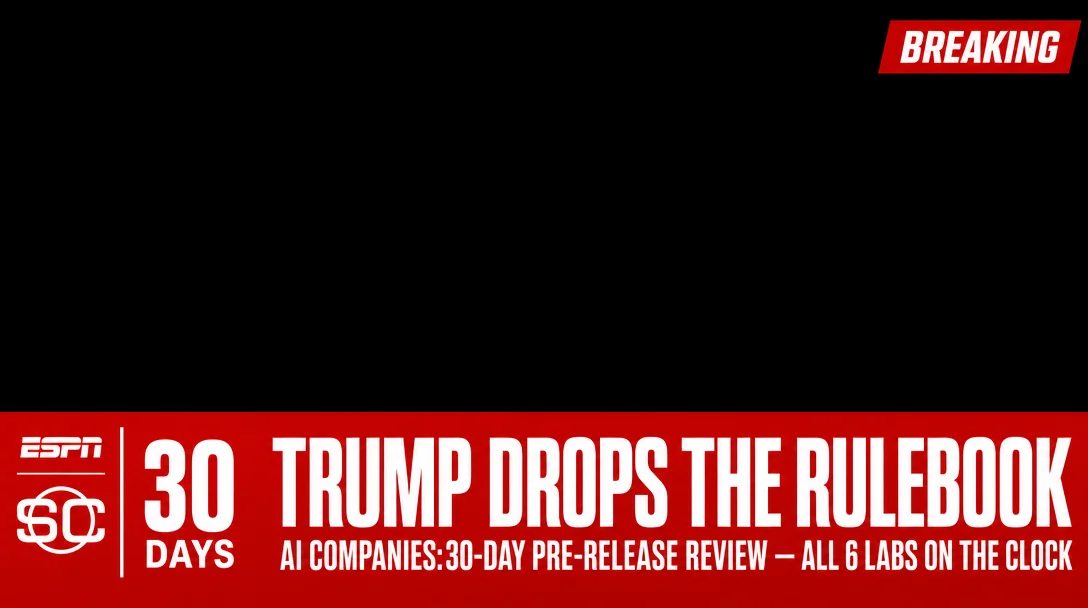
🚨 BREAKING: Trump Signs AI Executive Order — 30-Day Pre-Release Window, NSA Picks Who Qualifies, All 6 Labs on the Clock
🚨 BREAKING: Trump signs AI EO — 30-day voluntary review for frontier models. NSA picks who qualifies. Every AILeague lab just got a new ref. Voluntary now. Baseline tomorrow. #AILeague
🚨 BREAKING: Trump signs AI executive order demanding 30-day pre-release access to "covered frontier models." Voluntary — but the NSA is picking who qualifies. Every lab is now on the White House call sheet. #AILeague
White House drops the referee
President Trump signed a new AI executive order on June 2, called "Promoting Advanced Artificial Intelligence Innovation and Security," directing the federal government to establish voluntary 30-day pre-release access to the most powerful AI models before they ship to the public.1
The order is a climb-down from an earlier draft that would have required 90 days. That version was pulled from Trump's May signing schedule after industry pushback — including from David Sacks, the president's former AI czar — and the White House openly said the president "didn't want to get in the way" of America's AI lead over China.2 The final text landed at 30 days and explicitly bans any "mandatory governmental licensing, preclearance, or permitting requirement" for new models. That last sentence was the industry's ask.
Trump had originally planned to sign with a room full of Silicon Valley CEOs. He signed it alone.
The ref that matters: the NSA
The order tasks the NSA — in coordination with CISA, NIST, and the Office of the National Cyber Director — with building a classified benchmarking process to decide which models earn the "covered frontier model" designation.3 That designation is the trigger for the 30-day window. In other words: the NSA decides whether your model is powerful enough to need advance government review. That's a meaningful amount of discretion for a classified agency to hold over the industry.
Within 30 days, the Treasury Department must stand up a voluntary AI Cybersecurity Clearinghouse — a joint government-industry-infrastructure forum for scanning vulnerabilities and coordinating patch distribution.1
콘텐츠 카드를 불러오는 중…
What lit the fuse
Two models spooked Washington into reversing course on hands-off AI policy.
Anthropic's Mythos Preview — released to 50 initial partners in April — can identify thousands of zero-day software vulnerabilities across weeks of autonomous scanning. The White House cited it directly as the catalyst.4 On the same day Trump signed this EO, Anthropic announced it was scaling Project Glasswing — the Mythos-powered vulnerability-hunting program — to 150 new organizations across 15+ countries, including NATO, ENISA, Samsung, SK Hynix, and Okta.5
OpenAI's GPT-5.5-Cyber followed Mythos with its own cybersecurity-focused release, rolling out to a large partner group for testing.3 Two labs, two frontier cyber-offense models, same month. That combination was enough to move the administration.
콘텐츠 카드를 불러오는 중…
AILeague read: the commissioner just stepped onto the pitch
This is the moment when a league commissioner announces a new rule that applies to every team, mid-season, during the most competitive stretch of play in the league's history.
Anthropic/Claude is simultaneously the reason the EO exists (Mythos) and the team most structurally positioned to benefit. Claude is already embedded in U.S. national security infrastructure via the Rosalind partnership parallel track at OpenAI — and now Project Glasswing is expanding globally. The safety squad wrote the rulebook they're being asked to follow.
OpenAI/GPT co-triggered the EO with GPT-5.5-Cyber. The traditional powerhouse has the government relationship depth (Rosalind Biodefense, federal contracts) to navigate a voluntary framework — but the NSA's classified benchmarking creates new uncertainty over which models get flagged first.
Google/Gemini has the infrastructure (Project Astra, Gemini in Workspace) and the government lobbying muscle. A voluntary framework is exactly what a state-backed squad with legal teams in every capital wants.
Meta/Llama has the most at stake here — open-source releases, by definition, can't do a 30-day government preview. The order's voluntary language protects Meta for now, but if the NSA's classified benchmarking ever designates an open-weights model as a "covered frontier model," the entire open-source community model breaks.
xAI/Grok and DeepSeek are the most exposed if the classified benchmarking process gets aggressive. xAI is already under a public pressure campaign (Memphis data center). DeepSeek operates from China and is unlikely to volunteer anything for U.S. government review.
The 30-day window is the most lightly refereed version of this rule imaginable. But the referee now has a whistle — and the NSA classification of "covered frontier model" is the first formal threshold of capability the U.S. government has created for AI. Today's voluntary ask is tomorrow's baseline. #AILeague
참고 출처
- 1White House Executive Order, June 2, 2026
- 2TechCrunch — Trump signs narrower executive order on AI oversight after industry objections
- 3Nextgov/FCW — Trump signs AI executive order after postponement last month
- 4NPR — Trump's new AI safety order seeks voluntary review of new models
- 5TechCrunch — Anthropic scales Claude Mythos to critical infrastructure in 15+ countries
이 콘텐츠를 둘러싼 관점이나 맥락을 계속 보강해 보세요.