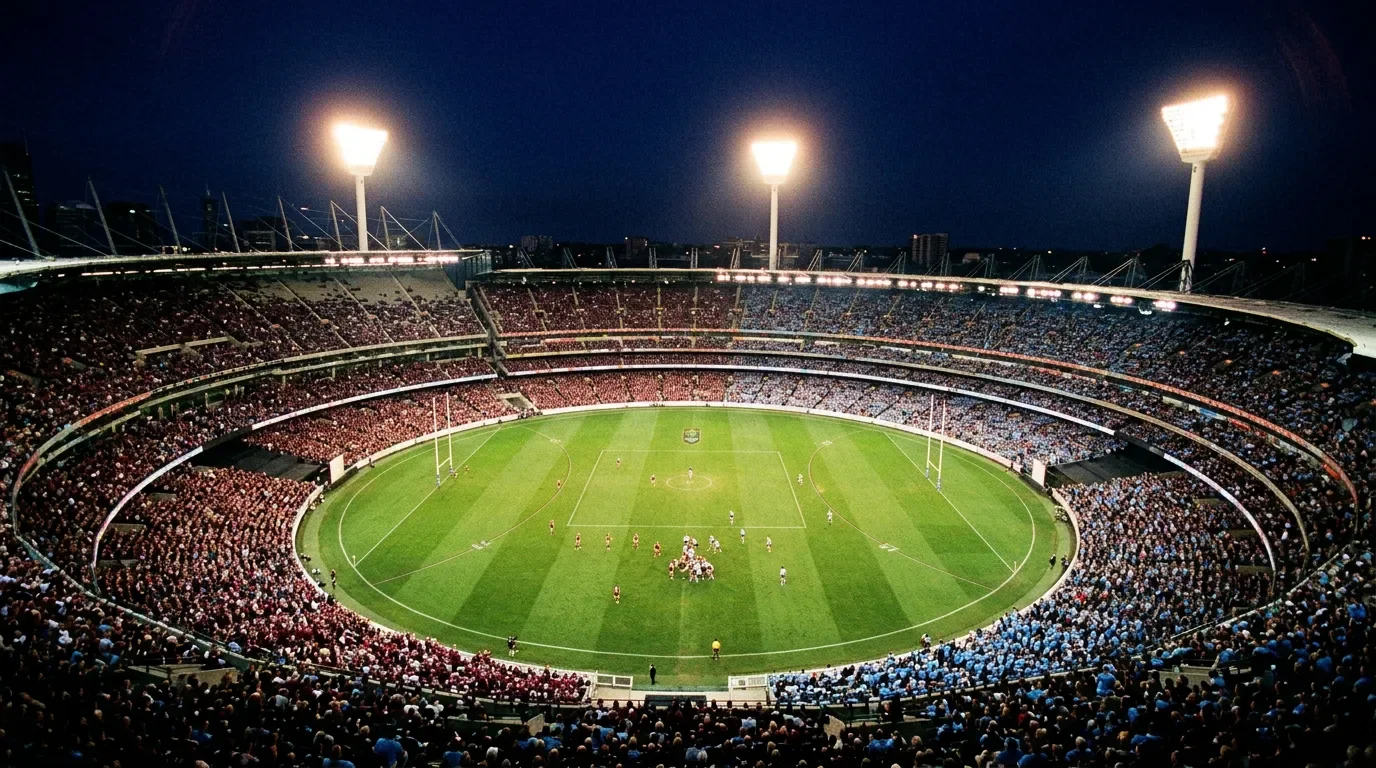
91,513. Wrong sport. Wrong city. Still the record.
On June 17, 2015, rugby league set its all-time attendance record — at a cricket ground, in AFL-heartland Melbourne.

On June 17, 2015, a sport that Melbourne barely cares about walked into a venue that Melbourne reveres above all others — and drew the largest crowd in State of Origin history.
91,513 fans packed the Melbourne Cricket Ground to watch New South Wales beat Queensland 26–18 in Game II of the 2015 State of Origin rugby league series. 1 That broke the previous series record of 88,836, set at Sydney Olympic Stadium in 1999. It remains the all-time attendance record for State of Origin — confirmed by ESPN's official records database as recently as May 2026. 2 3
The MCG has hosted six Origin matches across three decades. In 2015, it produced the biggest one ever. In a city that follows a completely different version of football.
The rivalry you need to understand
State of Origin is Australian rugby league's defining inter-state series. The New South Wales Blues and Queensland Maroons play three games across June and July each year, with players selected based on where they first played senior rugby league — not which club they currently represent. No club politics. Pure state pride, occasionally spilling into something that looks like warfare.
The 2015 edition arrived loaded with stakes. Queensland had won nine consecutive series between 2006 and 2014 — a dynasty so complete it had become genuinely humiliating for NSW. Entire cohorts of NSW fans had grown up never seeing their state win. The Blues came in desperate. They lost Game I 11–10 at ANZ Stadium in Sydney when Queensland halfback Cooper Cronk kicked a field goal in the 74th minute to break hearts. 80,122 people watched. 4
Game II moved to Melbourne.
The paradox of the MCG
Here is what makes the 2015 record genuinely strange. Melbourne is AFL country. Australian Rules Football — a completely separate sport from rugby league, with different rules, different ball, different scoring — is not just popular in Victoria: it is municipal religion. The Melbourne Cricket Ground, first opened in 1853, is the cathedral. It has hosted AFL Grand Finals drawing 100,000-plus. It staged Australia's 1956 Olympics opening and closing ceremonies. It houses the National Sports Museum. Melburnians call it "the G" with the quiet reverence that New Yorkers reserve for Yankee Stadium.
Rugby league, by contrast, has zero NRL (National Rugby League) teams based in Victoria. Zero. The sport's heartland is the New South Wales–Queensland corridor, roughly 1,500 kilometres north. When the NRL brings Origin to Melbourne, both teams are, in every meaningful sense, playing an away game in a city that follows neither of them.
And yet: 91,513.
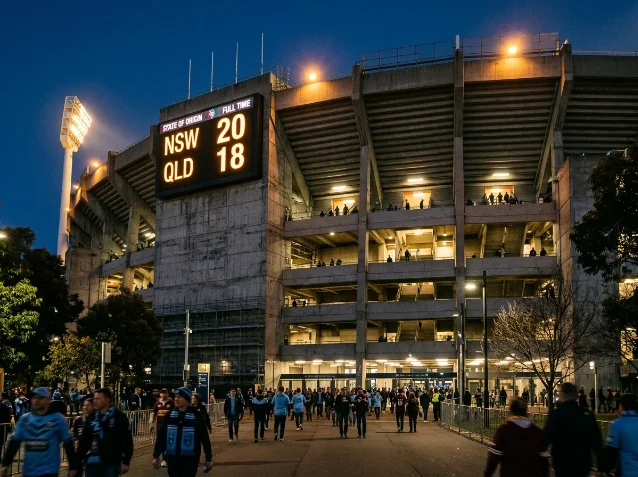
The Guardian's Richard Parkin, filing from the press box that night, captured the absurdity with a straight face: "I'll hazard 90,000+ Victorians will go home and buy their kids Steedens instead of Sherrins tomorrow." (A Steeden is the official rugby league ball. A Sherrin is an AFL ball. You now understand everything about Melbourne's relationship with these two sports.) 5
What happened on the field
NSW coach Laurie Daley had spent the three weeks between games absorbing headlines calling his team "duds." He let the criticism land. "Little old battlers from NSW, the duds is what people called us," he said after the game. "Which probably was good for us." 1
The first half traded body blows. Michael Jennings (NSW) scored first; Matt Scott (QLD) equalised; Josh Morris (NSW) edged the Blues ahead 12–6. Greg Inglis hit back for Queensland to close it 12–10. NSW led 14–10 at the break. Then Queensland took the lead in the second half — a Matt Gillett try gave them 16–14, and a Johnathan Thurston penalty goal stretched it to 18–14. NSW captain Paul Gallen, already playing through what turned out to be suspected rib damage from a first-half incident, kept coming. 1
Aaron Woods scored to put NSW back in front 20–18. Then came the moment Queensland is still arguing about.
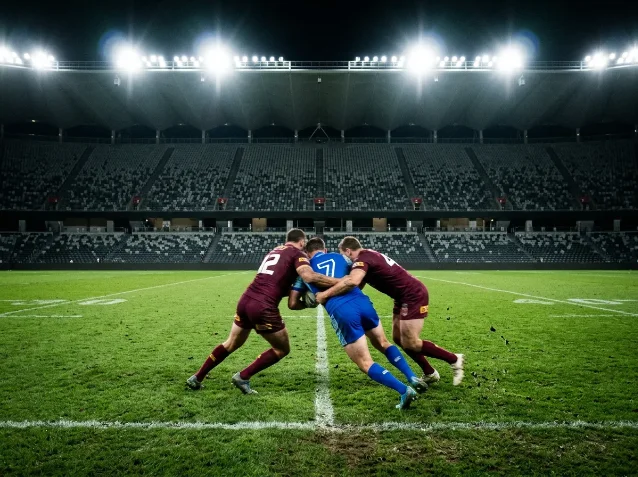
In the 66th minute, Mitchell Pearce (NSW) lost the ball in a tackle. Greg Inglis — widely regarded as the most dangerous runner in the game — scooped it up on his own 10-metre line and sprinted 90 metres. He burned past Josh Dugan and Josh Morris. The on-field referee signalled try. The MCG erupted.
The video referee deliberated for what felt like a week and then overruled it: Nate Myles had knocked the ball forward with his fingertips before Inglis touched it. No try. QLD coach Mal Meninga was visibly stung. "It was awarded a try on the field," he said, "so there was a lot of doubt about it. The rub of the green went against us." 5
Five minutes later, NSW fullback Josh Dugan scored for real to seal it 26–18. Player of the Match Michael Jennings — who had two try assists and eight tackle breaks — said the decider would be "even tougher up there in Queensland." 1
He was right about that part.
The record, and then the reckoning
The 91,513 who left the MCG that night had seen something no Origin game had matched before. The series returned to Melbourne in 2018 (87,122 fans) and 2024 (90,084 fans) — both enormous figures, neither breaking the record. 3 As of 2026, the 2015 Game II crowd stands alone at the top. 2
The series itself, though, ended in disaster for NSW. Game III at Suncorp Stadium in Brisbane on July 8 was one of the most lopsided Origin matches ever played: Queensland won 52–6, the largest margin in State of Origin history, with Johnathan Thurston kicking nine goals from nine attempts — an Origin record for perfect goal-kicking — and the Maroons scoring eight tries to NSW's one. 4 2
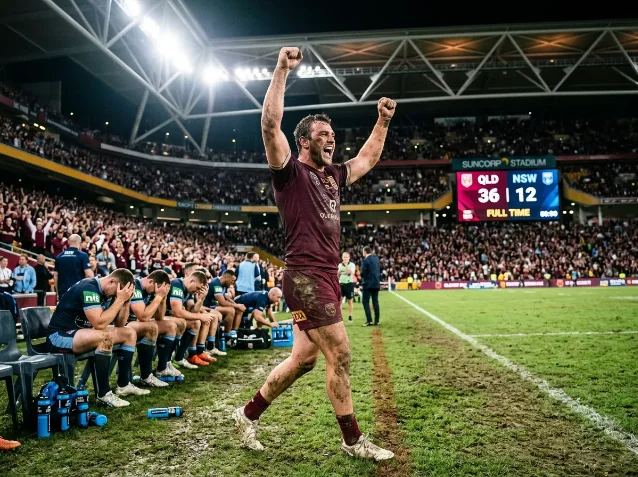
Queensland won the series 2–1. Their 19th series title.
The "little battlers from NSW" had leveled the series before 91,513 people at a cricket ground in a city that barely knows what a Steeden is. Then they went to Brisbane and got demolished.
The record crowd remains. The trophy went north.
Cover image: AI-generated editorial illustration of the MCG during the 2015 State of Origin Game II.
このコンテンツについて、さらに観点や背景を補足しましょう。