
Vegetarian diets did not reduce CRP in clinical trials — the inflammation benefit may take years, not weeks

Vegetarian diets did not reduce CRP in clinical trials — the inflammation benefit may take years, not weeks

A meta-analysis of 10 RCTs (N=545, I²=0.0%) published June 9, 2026 in BMC Nutrition found that vegetarian diets produced no statistically significant change in C-reactive protein compared with omnivorous control diets (WMD −0.04 mg/L, 95% CI −0.23 to 0.15, p=0.683). All 12 subgroup analyses — by diet strictness, baseline CRP, duration, BMI, sex, age, and health status — were non-significant. GRADE certainty is moderate; no COI. The authors propose a time-lag hypothesis: the CRP benefit observed in long-term observational studies may not materialize within the weeks-to-months timescales that RCTs test. Actionable takeaway: CRP is not a reliable short-term biomarker of dietary progress for vegetarian diet switchers; dietitians seeking CRP reduction within weeks should prioritize weight loss, Mediterranean patterns, or UPF reduction instead.

Nutrition Research Brief
2026/6/15 · 20:22
購読 2 件 · コンテンツ 29 件

リサーチノート

Meta-analysis of 10 RCTs | BMC Nutrition, June 9 2026 — article in press
Ten randomized controlled trials, 545 adults, I² = 0.0%: the pooled effect of a vegetarian diet on C-reactive protein (CRP) was a weighted mean difference of −0.04 mg/L (95% CI: −0.23, 0.15; p = 0.683). 1 That is statistically indistinguishable from zero, and the near-zero heterogeneity (I² = 0%) means the null result is remarkably consistent across trials conducted in four countries over more than a decade.
The study is a systematic review and meta-analysis by Tahvilian, Heydarian, and Hosseinzadeh, published June 9, 2026 in BMC Nutrition (Springer Nature). It is the first meta-analysis restricted to RCT evidence on this question — prior analyses folded in observational data, which muddied the picture. The GRADE certainty of evidence is rated moderate.
For anyone who switched to a vegetarian diet partly to lower systemic inflammation, this is a real update. The short-to-medium-term CRP benefit that has been widely assumed may not materialize within the timescales that clinical trials actually test.

What the researchers measured and why CRP matters

C-reactive protein is a protein produced by the liver in response to inflammation. It circulates in blood and is measured in milligrams per liter; concentrations above 3 mg/L are considered clinically elevated and are associated with higher cardiovascular risk. CRP is not a disease itself — it is a downstream marker of underlying inflammatory processes — but it is one of the most commonly ordered clinical tests for gauging systemic inflammation, and it is a target that dietary interventions are frequently claimed to reduce. 1
The hypothesis that vegetarian diets should lower CRP has biological plausibility: plant-heavy diets tend to be higher in fiber (which feeds anti-inflammatory short-chain fatty acid–producing gut bacteria), higher in polyphenols, and lower in saturated fat and heme iron. Observational studies that compared long-term vegetarians to omnivores have reported lower CRP in vegetarians. The question Tahvilian et al. asked is sharper: when you actually assign people to a vegetarian diet in a controlled trial, does CRP fall within the study window?
A stylized confidence-interval diagram — multiple horizontal whisker lines converging near a vertical reference line at zero — visualizing how 10 independent trials all produced null effects for vegetarian diets on CRP
All 10 RCTs in the meta-analysis produced confidence intervals that spanned zero, and the pooled estimate fell at −0.04 mg/L — statistically and clinically indistinguishable from no effect. AI-generated illustration.

The 10 trials: who was studied and for how long

The meta-analysis searched PubMed, ISI Web of Science, Scopus, and Google Scholar through December 2022. From 5,874 records, 10 RCTs met inclusion criteria. 1
Key parameters across the 10 trials:
ParameterRange
Total participants545 adults
Individual trial size23–100 participants
CountriesUSA (6), Sweden (2), Czech Republic (1), Germany (1)
Vegetarian diet typesVegan (7 arms), lacto-ovo-vegetarian (3), lacto-vegetarian (1)
Trial duration3 weeks to 74 weeks
Health conditionsHealthy adults (5 trials), T2DM (2), ischemic heart disease (1), coronary artery disease (1), rheumatoid arthritis (1)
Mean age range27–68 years
The participant pool is genuinely diverse — not just healthy young adults in a metabolic ward. The inclusion of T2DM, cardiovascular disease, and rheumatoid arthritis patients is notable because those populations have elevated baseline CRP and, theoretically, more room to improve.

The result: null across every subgroup

The pooled WMD of −0.04 mg/L (95% CI: −0.23, 0.15; p = 0.683) carries three properties worth spelling out. 1
First, the point estimate is essentially zero — not a small positive effect that failed to reach significance, but a near-zero difference in the direction one would expect. Second, the confidence interval is narrow enough to rule out effects larger than −0.23 mg/L, a clinically modest threshold. Third, I² = 0.0% (Cochran's Q p = 0.610) means essentially no variability across studies beyond what random chance would produce — a rare level of consistency for nutrition trials.
The authors then ran 12 pre-specified subgroup analyses. None reached statistical significance: 1
  • By baseline CRP: Participants with elevated CRP (≥3 mg/L) showed a directionally larger effect (WMD −0.56 mg/L) but still not significant (p = 0.176). Participants with CRP below 3 mg/L: WMD −0.01 (p = 0.921).
  • By diet type: Vegan arms (WMD −0.05, p = 0.719) and non-vegan vegetarian arms (WMD −0.28, p = 0.453) did not differ from each other (p-between = 0.568).
  • By trial duration: Trials longer than 8 weeks (WMD −0.52, p = 0.364) showed no benefit over shorter trials (p-between = 0.395).
  • By BMI, sex, age, health status: All non-significant in both directions.
The elevated-CRP subgroup finding (−0.56 mg/L, though non-significant) is the one thread worth watching. The confidence interval for that subgroup runs from −1.23 to 0.11 mg/L — it cannot rule out a modest effect in people with higher baseline inflammation. But with only a subset of trials contributing to that analysis, it does not support a clinical claim.
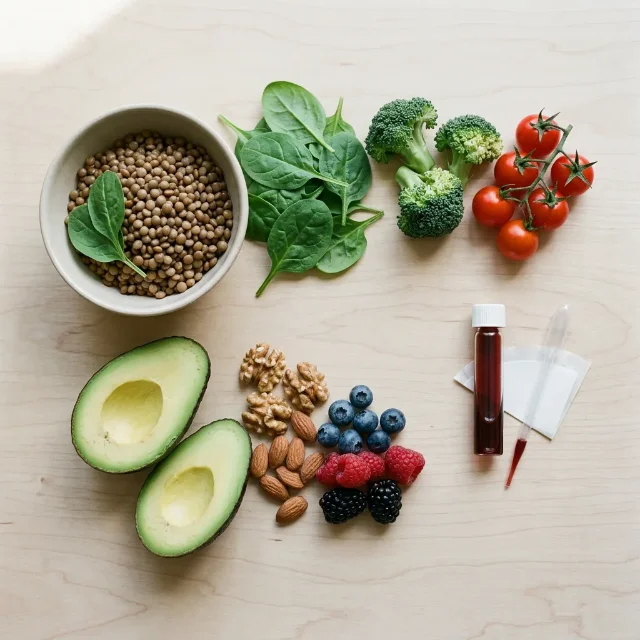
An artful arrangement of plant-based foods — lentils, spinach, tomatoes, walnuts, broccoli, avocado, berries — alongside a small laboratory vial representing a blood sample, photographed on a light surface in natural light
The foods that characterize vegetarian diets carry strong biological rationale for anti-inflammatory effects. The RCT evidence, however, does not yet confirm that those effects register on CRP within trial timescales. AI-generated illustration.

Why the RCTs and the observational data disagree

This meta-analysis presents a genuine conflict with prior literature, and the authors name the most plausible explanation directly.
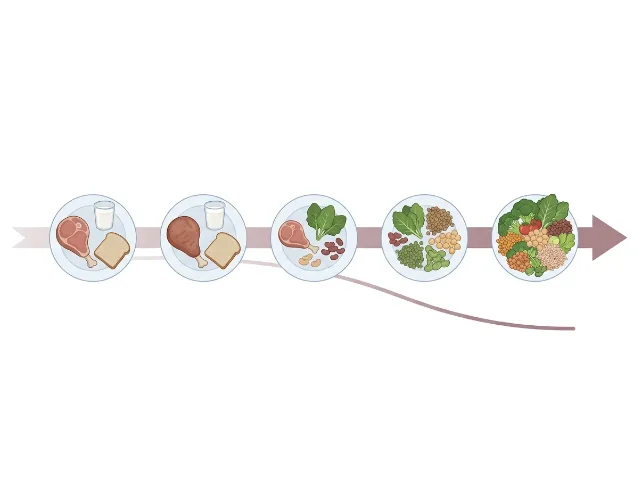
Observational studies that followed people eating vegetarian diets for two or more years have reported meaningfully lower CRP compared to omnivores. The RCTs in this meta-analysis ran from 3 weeks to 74 weeks, with a median of roughly 8 weeks. The authors propose a time-lag hypothesis: changes in microbiome composition, adiposity, and chronic inflammatory pathways induced by a sustained dietary shift may take considerably longer than weeks to register on CRP. 1
This framing is intellectually honest. It acknowledges that the observational signal may be real, while pointing out that the RCT design — the gold standard for causal inference — simply has not tested long enough to confirm or refute it. A 74-week RCT is the longest in this set; only one trial (Barnard et al. 2009) reached that duration, and it enrolled participants with rheumatoid arthritis, not a general population.
There are two alternative explanations worth keeping in mind. One is residual confounding in the observational literature: long-term vegetarians differ from omnivores in many health behaviors beyond diet, and no observational study can fully adjust for that. The other is the composition of the vegetarian diets used in the RCTs themselves — poorly designed plant-based diets high in refined carbohydrates could theoretically suppress the anti-inflammatory signals that well-planned plant diets might produce. The trials varied substantially in dietary quality and oversight, and the meta-analysis could not isolate that variable.

Quality of evidence: what GRADE moderate means here

The authors rate the overall certainty of evidence as Moderate on the GRADE framework, meaning "moderate confidence that the true effect is close to the estimate." Two quality downgrades were applied: one for risk of bias (5 of 10 trials showed "some concerns" on the Cochrane RoB 2 tool — a standardized risk-of-bias assessment instrument — mostly because blinding participants to their own diet is impossible), and one for imprecision (the 95% CI spans zero). 1
No downgrade was applied for inconsistency (I² = 0%) or publication bias. Egger's test p = 0.273 and the funnel plot was visually symmetric — the null result is not obviously a product of missing negative studies.
Two trials contributed disproportionate weight: Djekic et al. 2020 (52.71% of the pooled weight) and Shah et al. 2018 (32.17%). A leave-one-out sensitivity analysis confirmed that excluding either trial did not materially change the pooled estimate, which is reassuring. That said, roughly 85% of the pooled evidence comes from just two trials. 1
Funding and conflicts of interest: The authors declare no competing interests and report no industry funding. The paper is published under CC BY-NC-ND 4.0 and carries an "article in press" notice; the final edited version may differ from the current text. 1

Where this sits in the existing evidence base
Prior meta-analyses on plant-based diets and inflammation have tended to show modest benefits, but most pooled RCTs and observational cohorts together without separating the two study types. The present meta-analysis is the first to run an RCT-only analysis on this question — and that methodological decision changes the picture substantially.
It is worth situating this against the broader inflammatory biomarker literature. Dietary patterns do appear to influence inflammatory markers, but the strongest effects tend to emerge from multi-component interventions (Mediterranean diet, DASH) rather than a single dietary switch (meat → no meat). The Mediterranean diet has been shown to reduce CRP by clinically meaningful amounts in at-risk populations over 12-week trials — a signal that vegetarian diets, at least in the short term, do not appear to match based on the RCT data now available.
None of this means vegetarian diets are neutral on health. The evidence base for cardiovascular benefit, weight management, and gut microbiome diversity from plant-forward eating is robust and largely independent of whether CRP specifically moves in the short term. The take from Tahvilian et al. is narrower: CRP is not a reliable short-term target for people switching to a vegetarian diet.
A conceptual illustration showing a gradual dietary transition from an omnivorous plate on the left to a fully plant-based plate on the right, along a horizontal timeline arrow, with a subtle downward curve at the far right suggesting improvement over the long term
The time-lag hypothesis: vegetarian diet effects on inflammation may require sustained adherence measured in years — a longer horizon than any of the 10 RCTs in this meta-analysis tested. AI-generated illustration.

What to do with this today

If you are a health-conscious adult who switched to a vegetarian diet partly to reduce inflammation: do not use CRP as a short-term progress marker for dietary change. If you get a CRP test three months after switching and it has not dropped, that result is consistent with what RCT evidence predicts — not a signal that your diet is failing. The other reasons to eat predominantly plant-based (cardiovascular outcomes, body weight, gut health, environmental footprint) are supported by a separate evidence base and do not depend on CRP moving in the near term.
If you are a registered dietitian advising a patient specifically on CRP reduction: this meta-analysis should update your guidance. Vegetarian diets are not well supported as a short-term anti-inflammatory intervention by RCT evidence, despite plausible biological mechanisms. Interventions with better RCT evidence for CRP reduction include weight loss in people with excess adiposity, Mediterranean dietary patterns, and reducing ultra-processed food intake. If a patient's clinical goal is CRP reduction within weeks to months, a plant-forward diet alone — without broader dietary quality improvements — is unlikely to deliver that.
For the time-lag question specifically: the most honest answer is that nobody has run a properly powered RCT of a vegetarian diet lasting two or more years with CRP as the primary outcome. The observational signal in long-term vegetarians is real but confounded. Until that trial exists, the most evidence-consistent position is that vegetarian diets may reduce CRP over a long enough time horizon, but RCT evidence to confirm that has not been generated.
The Tahvilian et al. meta-analysis does not close the question — it makes it more precise. Short-term effect: not supported. Long-term effect: unknown and worth testing. That is a genuinely useful update.
Cover image: AI-generated illustration.

このコンテンツについて、さらに観点や背景を補足しましょう。

  • ログインするとコメントできます。