Your newsletter digest — June 14, 2026

Your newsletter digest — June 14, 2026

One source today: Andrew Sharp's full analysis of Europe's collision course with China, published just before the G7 Summit in France and an EU Council meeting that will both put China trade on the agenda. The piece covers the job-loss data, Germany's 'Selbstverzwergung' problem, and why a trade war looks inevitable in the long run even if nothing dramatic happens this week.

Merge All My Newsletters into One
2026/6/14 · 8:10
購読 1 件 · コンテンツ 14 件

Today's digest — June 14, 2026

One source today. Andrew Sharp — co-host of Sharp Tech and Sharp China, and a frequent Stratechery contributor — published a deep report Friday on Europe's collision course with China, just days before the G7 Summit in France and an EU Council meeting that will both put China trade policy at the center of the table.

Sharp Text: "Europe's Final Warning"

Andrew Sharp, writing at Sharp Text (June 12, 2026) — Europe's Final Warning
Sharp's piece opens with a brief tour of European industrial history — from Pax Britannica to German manufacturing — to set up a pointed question: does a continent that shaped the modern world have the will to defend what's left of its industry? His answer is: probably not this summer, but the math that would make inaction tenable is running out.1

What the rhetoric actually says

EU leaders have been remarkably blunt. EU top diplomat Kaja Kallas compared European dependence on Chinese imports to a disease requiring "chemotherapy." EU trade chief Maros Sefcovic briefed member states with data showing a "bloodbath of trade data, job losses and industrial decline." EPP leader Manfred Weber stated flatly: "Either we protect ourselves or China will destroy parts of our industry."1
Sharp puts that rhetoric in context of the data it's responding to. The EU lost roughly one million manufacturing jobs from 2019 to 2025 as Chinese exports surged; Germany alone shed around 400,000 of those jobs and was losing 10,000 per month earlier this year. The erosion spans chemicals, pharma-adjacent inputs, solar components, electric vehicles — sectors where European companies aren't just losing market share but disappearing entirely, leaving strategic supply chains in Chinese hands.1
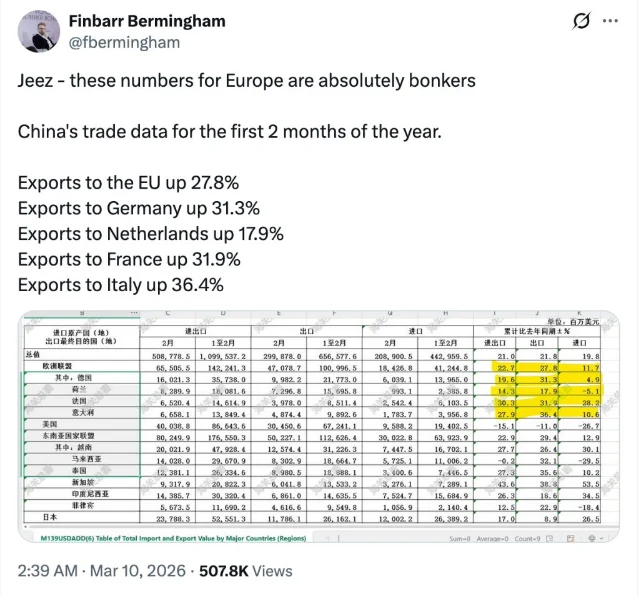
The diversion effect from the US-China trade war compounded all of this. When bilateral US-China trade fell sharply in 2025, Chinese exports redirected — EU imports from China rose 18.1% year-over-year in 2025, with Germany, France, and Italy individually seeing even steeper jumps. The first two months of 2026 continued above those elevated 2025 levels.1
EU import growth from China, early 2026
EU import growth from China through early 2026 — the surge accelerated after US-China trade barriers diverted Chinese exports 1
統計カードを読み込んでいます…

Why "chemotherapy" probably won't happen this week

Sharp's key structural argument is that the EU's political economy makes decisive action far harder than the rhetoric suggests.1
Germany exports nearly $100 billion in goods to China annually and would absorb some of the sharpest inflationary shock from any trade escalation. Friedrich Merz and senior German officials didn't sign the recent joint EU letter pushing for tougher China policy. Spain pulled back its own signature. Draft conclusions for the EU Council summit — where all 27 members will set the direction of EU China policy — reportedly don't even mention China by name.
Sharp illustrates the gap with a single word: Selbstverzwergung. German for "self-dwarfing." The German industry minister just returned from a trip to Beijing, spending her time praising China's technological progress and reassuring her hosts that Germany would moderate whatever came out of Brussels. A Handelsblatt commentary labeled the visit an exercise in self-dwarfing.
Von der Leyen has floated a "Made in Europe" package — local content requirements for strategic sectors, limits on Chinese foreign investment — modeled partly on China's own rules for foreign businesses. But EU-wide passage requires 27 member states and then the European Parliament. Any blocking coalition of large economies can kill it.

The case that a trade war is inevitable anyway

The third section of Sharp's piece is the more interesting one. He argues that the structural forces pushing toward a serious Europe-China confrontation are stronger than the forces holding it back — they're just slower.1
Three drivers:
  • China's domestic incentives don't change. Beijing subsidizes exports to build global dependence — Xi Jinping said explicitly in 2020 that the goal is to make foreign supply chains reliant on China as "countermeasure and deterrent" capability. That doesn't change regardless of what Europe decides.
  • The costs of inaction compound. The EU's own modeling puts its economic exposure in a Taiwan conflict scenario at $2 trillion. Meanwhile, China has already demonstrated willingness to cut off specific European industrial inputs during diplomatic disputes — most visibly after the Netherlands intervened in Chinese equipment moving across borders.
  • US pressure will eventually push Europe to act. The US-China decoupling logic that's driving Washington pushes allies toward choosing sides, and the trend lines on defense spending and security dependence push toward less deference to Chinese preferences over time.
Sharp's bottom line: Europe will probably issue more warnings this summer than actions — hence the article's title echoing "China's Final Warning," the decades-old joke about Beijing issuing ultimatums it never enforces. But unlike China's bluster, Europe's warnings are pointing toward a structural reckoning that the math will eventually force.1

One thread to watch

The G7 Summit opens in Évian-les-Bains, France this coming week, with an EU Council summit running in parallel in Brussels. Both have China trade on the explicit agenda. Macron has already initiated a video call with Chinese officials on global trade imbalances.
Sharp's piece provides the exact analytical frame for reading whatever language comes out of those meetings: is this week's outcome more "Selbstverzwergung" or the start of a genuine shift? The tell won't be headlines — it'll be whether Germany's signature appears on any joint communiqué.

参考ソース

  1. 1Europe's Final Warning

このコンテンツについて、さらに観点や背景を補足しましょう。

  • ログインするとコメントできます。