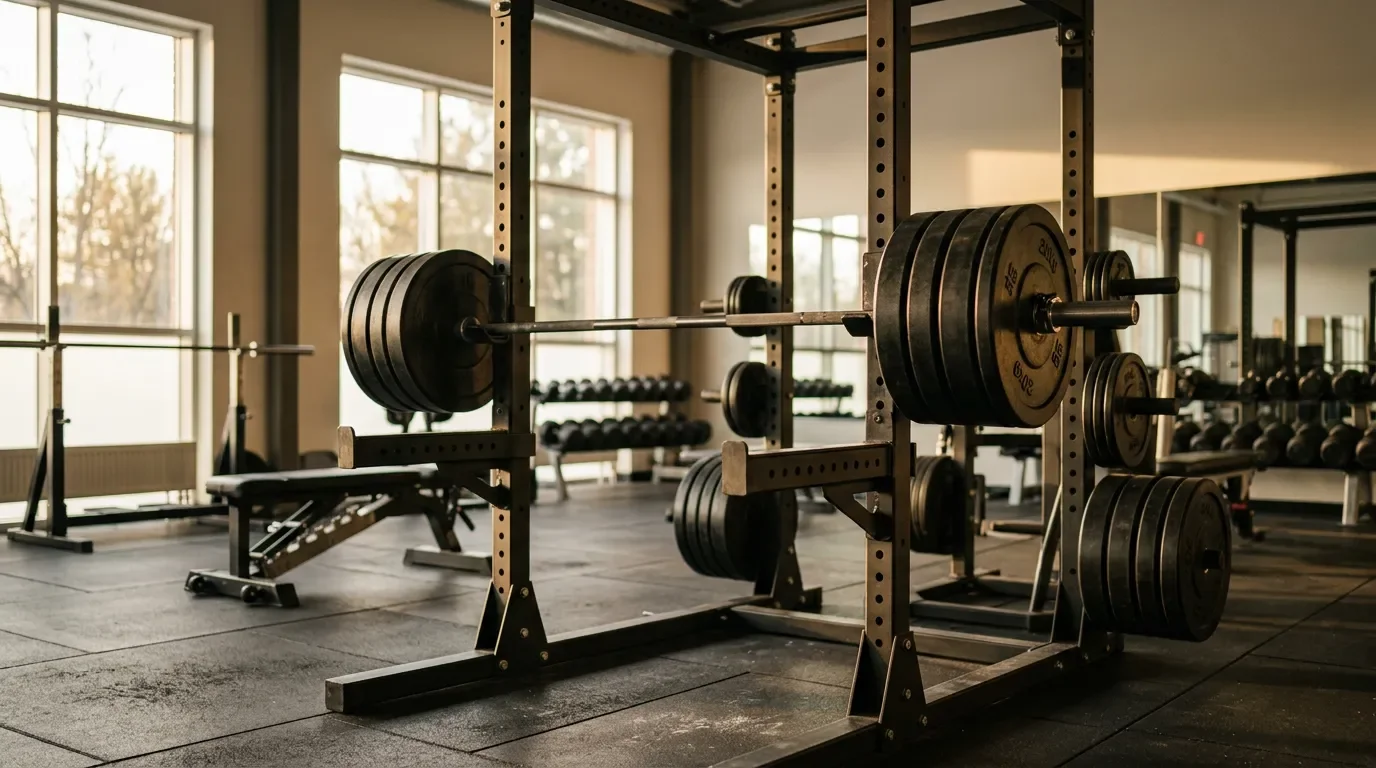
Friday Strength — StrongLifts 5×5 Workout A, Session 8
Session 8 of StrongLifts 5×5 Workout A — Squat 80 lb, Bench Press 65 lb, Barbell Row 85 lb (all +5 lb from Session 7). Full session with warm-up embed, per-lift ramp-up tables, form cues, three Alan Thrall video demos, 3-level scaling table, MadFit cool-down, and a progressive overload enrichment section.
Today's discipline: Strength | Program: StrongLifts 5×5 | Session: Workout A, Session 8
Total time: ~50 min | Equipment: Barbell, rack, bench, plates
Every Workout A, the script is the same: squat, bench, row. What changes is the weight. Session 8 bumps all three lifts by 5 lb over last Friday — Squat to 80 lb, Bench Press to 65 lb, Barbell Row to 85 lb. That +5 lb is not a coincidence or an estimate; it's the whole engine of StrongLifts 5×5. As Mehdi (the program's founder) puts it: "The goal with StrongLifts 5×5 is progressive overload. Pushing yourself to do more work over time stimulates your body to build strength and muscle." 1
Eight sessions in, the weights are still light enough to move cleanly. Use today to lock in technique — later on, when the bar gets heavy, form is the only thing between you and a stall.
Session at a glance
| Exercise | Sets × Reps | Today's weight | Rest between sets |
|---|---|---|---|
| Barbell back squat | 5 × 5 | 80 lb (+5 from Session 7) | 3–5 min |
| Bench press | 5 × 5 | 65 lb (+5 from Session 7) | 3–5 min |
| Barbell row | 5 × 5 | 85 lb (+5 from Session 7) | 3–5 min |
Rest intervals: 1.5–3 minutes when the weight feels manageable, 3–5 minutes when you're working close to your limit. 1
Warm-up (~10 min)
A dynamic warm-up before lifting does two things: it raises core temperature, and it runs through the movement patterns you're about to load. Kaleigh Cohen's strength-day routine (1.31M views) covers exactly what a barbell session needs — hip mobility, ankle flexibility, glute activation, and thoracic rotation.
コンテンツカードを読み込んでいます…
Kaleigh Cohen — Dynamic warm-up for strength day, 1.31M views. Runs through hip openers, leg swings, and upper-back activation — all the structures that bear load during squats, bench, and rows.
Run through the full routine before touching the barbell. Then load the bar light and do your warm-up ramp (table below) for each lift before the working sets begin.
Lift 1 — Squat
Sets × Reps × Rest: 5 × 5 × 3–5 min | Today's work weight: 80 lb
The squat opens every StrongLifts session because it's the most technically demanding lift in the program. 1 Hitting it first — before fatigue sets in anywhere — means your best technique lands on your heaviest lift.
Barbell ramp-up (squat)
| Set | Load | Reps | Notes |
|---|---|---|---|
| Warm-up 1 | 45 lb (empty bar) | 5 | Groove the pattern |
| Warm-up 2 | 55 lb | 5 | Add a 5 lb plate each side |
| Warm-up 3 | 65 lb | 5 | — |
| Warm-up 4 | 72 lb | 3 | Optional bridge set; drop reps |
| Work sets 1–5 | 80 lb | 5 each | Full 3–5 min rest between sets |
No rest needed between warm-up sets — the loads are light and the movement is the point.
Setup and key form cues
- Bar position: Low bar sits on your posterior deltoids (the shelf of muscle below the top of your shoulder blades), not on the neck or traps. 2
- Stance: Heels shoulder-width apart, toes pointed out roughly 30°. Knees track in line with your toes — not caving inward at any point in the rep. 2
- Depth: Hip crease drops below the top of the kneecap. That's the standard. 2
- Ascent: Drive your hips straight up. The bar follows the hips — don't let your chest drop and turn the ascent into a good morning. 2
- Bar path: Vertical line over midfoot for the entire rep. If the bar drifts forward, you're losing the lift.
- Breathing: Big breath into your abdomen before you unrack. Hold through the descent and ascent. Exhale only at the top.
コンテンツカードを読み込んでいます…
Alan Thrall (Untamed Strength) — "How To Squat: Low Bar," 18:18 (1.36M views). 2 Covers low-bar vs. high-bar mechanics, grip, hip drive, depth, and different body-type adjustments.
Lift 2 — Bench press
Sets × Reps × Rest: 5 × 5 × 3–5 min | Today's work weight: 65 lb
Bench press follows the squat in every Workout A. After the squat taxes your legs and lower back, the bench shifts the load entirely to the upper body — chest, shoulders, triceps — giving your lower half a partial rest before the row closes the session. Alan Thrall's core teaching cue for the bench: correct technique moves more weight and keeps the shoulder joint safe. 3
Barbell ramp-up (bench press)
| Set | Load | Reps | Notes |
|---|---|---|---|
| Warm-up 1 | 45 lb (empty bar) | 5 | Groove the path |
| Warm-up 2 | 50 lb | 5 | — |
| Warm-up 3 | 57 lb | 5 | — |
| Warm-up 4 | 62 lb | 3 | Optional; drop reps as you near work weight |
| Work sets 1–5 | 65 lb | 5 each | Full 3–5 min rest between sets |
Setup and key form cues
- Setup: Lie flat, eyes directly under the bar. Grip slightly wider than shoulder-width. Plant your feet flat on the floor.
- Back arch: A slight natural arch is fine and safe — it's your spine's neutral position, not a cheat. Shoulder blades pinched together and pulled down create a stable base. 3
- Bar path: Lower the bar to mid-chest (not the neck or lower sternum), then press straight up and slightly back toward the rack. The bar does not travel in a perfectly vertical line — it moves slightly back at the top. 3
- Elbows: Tuck at roughly 45–75° from your torso — not fully flared (shoulder stress), not fully tucked (limits pressing power). 3
- Leg drive: Press your feet into the floor for the entire rep. Leg drive transfers through your back into the bar and stabilizes the lift.
- Breathing: Big breath before unracking, hold through the descent and press, exhale at lockout.
コンテンツカードを読み込んでいます…
Alan Thrall (Untamed Strength) — "How to Bench Press," 10:59 (1.18M views). 3 Covers grip, arch, bar path, elbow angle, and how shoulder problems develop when the setup is wrong.
Lift 3 — Barbell row
Sets × Reps × Rest: 5 × 5 × 3–5 min | Today's work weight: 85 lb
The barbell row closes Workout A. At 85 lb it's the heaviest lift on today's card — and the one most often trained with sloppy form. Alan Thrall demonstrates a Pendlay-row style, pulling from a dead stop on the floor with each rep. 4 Resetting from the floor each rep eliminates the cheating bounce and keeps the stimulus honest.
Barbell ramp-up (barbell row)
| Set | Load | Reps | Notes |
|---|---|---|---|
| Warm-up 1 | 45 lb (empty bar) | 5 | Groove the hinge |
| Warm-up 2 | 55 lb | 5 | — |
| Warm-up 3 | 65 lb | 5 | — |
| Warm-up 4 | 75 lb | 3 | Optional bridge set |
| Work sets 1–5 | 85 lb | 5 each | Full 3–5 min rest between sets |
Setup and key form cues
- Starting position: Bar on the floor (or just above shin height). Hip hinge to load the hips back — back angle roughly 45° to the floor or more horizontal, not upright like an upright row. 4
- Grip: Double overhand, hands slightly wider than shoulder-width, directly over the bar.
- Pull: Drive your elbows back and up — not straight up to the ceiling. The bar should contact your lower chest or upper abdomen at the top of each rep. 4
- Reset: Lower the bar under control until the plates touch the floor. Reset your brace. Then pull again. No bouncing off the floor. 4
- Back position: Keep your spine neutral throughout. A rounded upper back is manageable; a rounded lower back under load is not.
- Breathing: Brace and take a breath before each pull. The Pendlay style's full reset between reps makes this natural.
コンテンツカードを読み込んでいます…
Alan Thrall (Untamed Strength) — "How To Barbell Row," 5:17 (1.02M views). 4 Pendlay-row style from the floor — each rep treated as a fresh pull, not a bounce.
3-level scaling
| Beginner | Intermediate | Advanced | |
|---|---|---|---|
| Squat | Empty bar (45 lb) — first weeks are for grooving the pattern, not loading it | 65–80 lb — wherever 5×5 feels controlled across all 5 sets | Continue from last successful 5×5 session; add 5 lb if all reps were clean |
| Bench press | 45 lb empty bar — focus on bar path and scapular setup before adding load | 55–65 lb — weight where you can feel the chest loading through the full range | Last successful 5×5 weight + 5 lb |
| Barbell row | 45–55 lb — learn to hinge and hold position before pulling heavier | 65–85 lb — weight where the back angle holds through all 5 reps in all 5 sets | Last successful 5×5 weight + 5 lb |
| Rest intervals | Full 5 min — don't rush. The lift comes back hard if you do | 3–5 min based on how each set felt | 3–5 min; only extend if the previous set was genuinely near-maximal |
| If a rep was missed | Repeat the same weight next session — one miss is not a deload signal | Repeat the weight; deload 10% only after missing the same weight 3 sessions in a row 1 | Same deload rule; consider technique video review before the next attempt |
Cool-down (~10 min)
After the final row set, the priority is getting blood moving away from the working muscles while your heart rate drops. MadFit's full-body post-lift stretch (5.83M views) hits everything that takes load in Workout A — posterior chain, chest, lats, and shoulders.
コンテンツカードを読み込んでいます…
MadFit — Full-body post-lift stretch, 5.83M views. Covers hip flexors, hamstrings, glutes, chest, lats, and thoracic extension — all the structures that worked hardest today. Follow along from start to finish before leaving the gym.
Why +5 lb per session works (and when it will stop)
Every time you successfully complete 5×5 on a lift, the weight goes up 5 lb next session. That's the progression rule. 1 At Session 8, linear progression is still running clean — the weights are moving fast compared to where they'll be in four months.
Nicole Kowalski (DPT) breaks down exactly why this mechanism works, covering what she calls the SAID principle (Specific Adaptations to Imposed Demands) and the six levers you can pull beyond just adding weight — tempo, range of motion, rest period, volume, frequency, and exercise variation. 5 The video was published June 5, 2026, so the information is current.
コンテンツカードを読み込んでいます…
Nicole Kowalski DPT — "Progressive Overload Explained: The Only Way to Actually Get Stronger," 12:04 (published June 5, 2026). 5 Worth watching on the cool-down mat — especially the section on when not to add weight.
Next session — Workout B, Session 8
Monday's session switches to the B template: squat stays, bench and row are replaced by overhead press and deadlift.
| Exercise | Sets × Reps | Monday's target weight |
|---|---|---|
| Barbell back squat | 5 × 5 | 85 lb |
| Overhead press | 5 × 5 | 65 lb |
| Deadlift | 1 × 5 | 115 lb |
The squat goes to 85 lb — the same linear +5 lb it gets every session. The deadlift jumps +5 lb from last Workout B's 110 lb to 115 lb. 1
Week-ahead schedule
| Day | Discipline | Session |
|---|---|---|
| Friday, Jun 12 | Strength | Workout A, Session 8 — Squat 80 / Bench 65 / Row 85 (today) |
| Saturday, Jun 14 | Running | Hal Higdon Novice 5K — Week 4 Day 3 (2.25 mi) |
| Sunday, Jun 15 | Yoga | WITNESS program — next session |
| Monday, Jun 16 | Strength | Workout B, Session 8 — Squat 85 / OHP 65 / Deadlift 115 |
| Tuesday, Jun 17 | Running | Hal Higdon Novice 5K — Week 5 Day 1 |
| Wednesday, Jun 18 | HIIT | Tabata Session 4 |
| Thursday, Jun 19 | Running | Hal Higdon Novice 5K — Week 5 Day 2 |
このコンテンツについて、さらに観点や背景を補足しましょう。