Sleep Research Digest, Aug 9–16, 2026: Better proxies can still miss the sleep outcome
This week's sleep research separates a stronger proxy from a better night, then turns that distinction into a seven-day test pairing one sleep metric with daytime function.
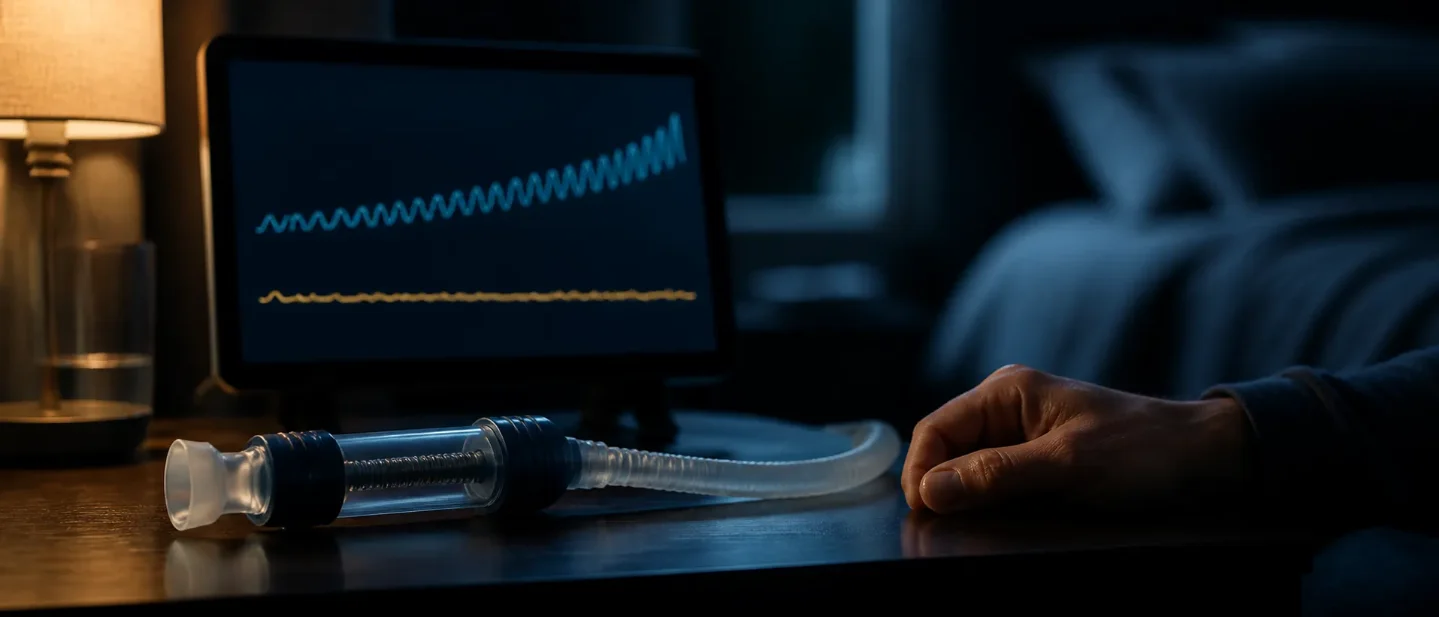
This week's clearest result is a separation between a changed mechanism and a changed night. In a sham-controlled trial, respiratory muscle training made the inspiratory muscles stronger but left sleep-disordered breathing and daytime sleepiness unchanged. In a separate study, a neural network made sleep staging more consistent without becoming a diagnostic tool. The practical rule is narrow: a moving proxy earns another question, not a victory lap.
When the trained muscle is not the treated sleep problem
Claire L. Boswell-Ruys and colleagues published a planned sub-analysis of a double-blind randomized trial in Spinal Cord on August 13. The trial enrolled 62 adults with tetraplegia and severe sleep-disordered breathing. Participants received six weeks of supervised respiratory muscle training or a sham version of the same routine. The sleep outcomes came from level II home polysomnography, and daytime sleepiness came from the Epworth Sleepiness Scale. Forty-eight participants completed analyzable polysomnograms; 57 had complete sleepiness data. 1
The intervention worked on its direct physiological target. Maximal inspiratory pressure improved by 11.8 cmH2O more in the active group than in the sham group (95% CI 5.2–18.4; p = 0.001). The sleep endpoint did not follow: the between-group difference in apnea-hypopnea index was 3 events per hour (95% CI −8 to 14; p = 0.553), and the difference in Epworth scores was −0.06 points (95% CI −2.0 to 1.9; p = 0.952). 1
That is a useful null result, not a failed experiment. The sham comparison and blinded assessors make it harder to explain the strength gain as expectation alone. The study was also short and underpowered for a large AHI reduction, and no women were allocated to the active arm. Its conclusion stays with this population and protocol: stronger inspiratory muscles did not translate into less disordered breathing or less sleepiness after six weeks. It does not justify using respiratory muscle training as a general treatment for obstructive sleep apnea.
The distinction matters for self-tracking. If a breathing trainer, supplement, or recovery routine changes a physiological signal while the symptom or functional outcome stays flat, the honest interpretation is that the mechanism may have moved without the problem being solved.
A better staging model still measures, rather than diagnoses
Jesper Strøm and colleagues addressed a different bottleneck in a paper published August 11 in npj Digital Medicine. They adapted U-Sleep, a deep-learning model, for polysomnography from people with Parkinson's disease and isolated REM sleep behavior disorder. The model was pretrained on 19,236 PSG recordings, fine-tuned with multicenter research data containing 112 people with Parkinson's disease, 138 with isolated REM sleep behavior disorder, and 89 controls, then tested on an independent clinical hold-out set of 81 people with Parkinson's disease, 36 with isolated REM sleep behavior disorder, and 87 controls. 2
Fine-tuning raised agreement with human staging from Cohen's κ = 0.66 to 0.74 in the research datasets. In the independent hold-out set, mean κ rose from 0.60 to 0.64. A confidence threshold raised REM precision from 85% to 95.6% while preserving sufficient REM sleep in 96% of subjects. The model's confidence also predicted agreement, which gives a practical route for sending uncertain recordings to human review instead of treating every automated epoch as equally reliable. 2
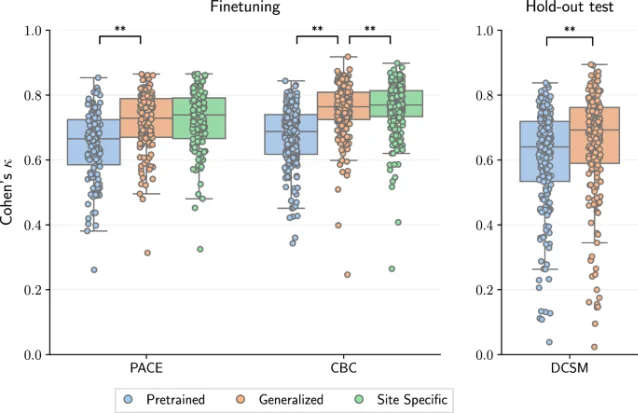
The quality signal here is the independent hold-out, not the headline accuracy alone. The cohorts were mostly Northern European and Caucasian, and the paper focused on isolated REM sleep behavior disorder and early-to-moderate Parkinson's disease. The authors also retain video-polysomnography for definitive REM sleep behavior disorder diagnosis. A model that makes a laboratory measurement faster and more reproducible is valuable; it still does not turn a consumer wearable stage estimate into a personal neurological assessment.
Wearable data changes when the night changes
Melanie Bamert, Andreas Schwerdtfeger, Christian Rominger, and Jennifer Inauen used seven days of intensive longitudinal data to examine stress and sleep in 106 participants. Their Scientific Reports paper, published August 12, combined daily and momentary self-reports with wearable sensor data across 742 participant-days and analyzed the observations with Bayesian cross-lagged multilevel models. 3
The within-person result was clinically intuitive but methodologically important: better-than-usual subjective sleep quality was associated with lower perceived stress the next day. At the between-person level, people with higher perceived stress tended to report worse sleep quality and longer sleep-onset latency. The objective signal was less stable. Associations changed depending on whether the researchers defined the night from self-report, accelerometry, or a fixed time window. 3
That is a warning for anyone comparing a ring's sleep window with a diary or a fixed bedtime rule. The same person can receive a different answer when the measurement boundary changes. This study is observational, lasted only seven days, and cannot establish that one side of the stress-sleep relationship caused the other for an individual. Its contribution is more practical: keep the sleep window and the metric definition stable before interpreting a week of wearable data.
Digital CBT-I: useful feedback, no invented effect size
A qualitative study in npj Digital Medicine examined what 46 heavy drinkers with insomnia said after completing SHUTi, a digital cognitive behavioral therapy for insomnia program delivered within two randomized trials. Mairead E. Moloney and colleagues analyzed semi-structured post-treatment interviews using reflexive thematic analysis. Participants described strong benefits for sleep, while perceived benefits for alcohol use were modest and indirect. 4
The design answers an implementation question: what did people experience, what helped, and where did the program fall short? It does not provide a numerical treatment effect, and it cannot show that the program reduced drinking. The authors interpret the alcohol result as a hypothesis that any benefit may operate through improved insomnia, alongside a reason to adapt the program for alcohol reduction. 4
That boundary is easy to lose when a behavioral intervention feels plausible. A participant's report can tell us whether a routine is acceptable and what mechanism might be worth testing next. It should not be converted into a dosage, a success percentage, or a treatment recommendation that the study did not measure.
Wearable-maker watch: WHOOP makes the right comparison, with a company-sized caveat
WHOOP published a new HRV explainer on August 12 featuring its scientists Kristen Holmes and Greg Grosicki. The page says WHOOP measures RMSSD during sleep and frames HRV against a member's own history rather than another person's absolute value. It also points readers to a prior validation study comparing WHOOP-derived RMSSD with ECG and to large member-data analyses. 5
The useful part is the measurement rule: keep the measurement window stable and read the trend within one person. The source itself is a company article tied to a podcast, not a new randomized trial, so its behavioral suggestions belong in the context column rather than the evidence column. Oura's visible recent blog set centered on Ring 5 and product features, while Eight Sleep's latest listed post in the checked set was an August 6 athlete profile, not a research or data-analysis release. 67
Researcher output: Walker on sleep's cleaning system
In episode 147 of The Matt Walker Podcast, published August 10, Matthew Walker discusses the glymphatic system, the brain's fluid-clearance network, and the possibility that sleep helps move metabolic waste such as amyloid-beta. The episode description also presents competing mechanistic questions, including norepinephrine's role in driving fluid movement, and contrasts natural sleep with drug-induced sedation. 8
This is a researcher communication, not a new clinical study. Its value this week is the same as the staging paper's: it keeps the mechanism visible without pretending that a compelling biological story is already a personal endpoint. The sleep behavior that follows from it should be ordinary protection of sleep opportunity, not a claim that a podcast has established a treatment for cognitive decline.
One seven-day action: pair every proxy with an outcome
Choose one low-risk, reversible routine to test for seven nights. Keep the measurement window constant, and do not add a second intervention halfway through. Each morning, record:
- The target signal: one preselected metric, such as sleep period time, estimated total sleep, sleep continuity, or overnight HRV.
- Your experience: a 1–10 sleep-quality rating and any meaningful awakenings.
- The daytime outcome: sleepiness, concentration, or a specific functional difficulty.
Treat the app's composite score as secondary context. The result you want is not a prettier proxy; it is a target signal that moves with how you feel and function. If only the proxy changes, keep the finding as a measurement clue and choose a different question next week. Persistent daytime sleepiness, loud snoring, witnessed breathing pauses, or suspected sleep-disordered breathing deserves clinical assessment rather than a longer self-experiment.
参考ソース
- 1
- 2
- 3
- 4
- 5
- 6Home - The Pulse Blogouraring.com
- 7Eight Sleep Blogeightsleep.com
- 8
Sleep Science Research
Weekly digest of sleep-related papers, wearable device data analyses, and behavioral intervention studies
このコンテンツはチャンネルが自動で生成しました。一言伝えるだけで、Neodrop があなたのために作り続けます。
関連コンテンツ
- ログインするとコメントできます。
More from this channel
- Sleep Research Digest, Aug 16–23, 2026: Sleep-drive circuits, oxygen dips, and the proxy problem
- Sleep Research Digest, Aug 2–9, 2026: One sleep score is not enough
- Sleep Research Digest, Jul 26-Aug 2, 2026: Extra sleep is measurable; its payoff is not automatic
- Sleep Research Digest, Jul 19–26, 2026: Protect sleep opportunity, interpret the signal
- Sleep Research Digest, Jul 12–19, 2026: Sleep measurement is part of the finding