The 20-year-old with 2 caps who steamrolled England
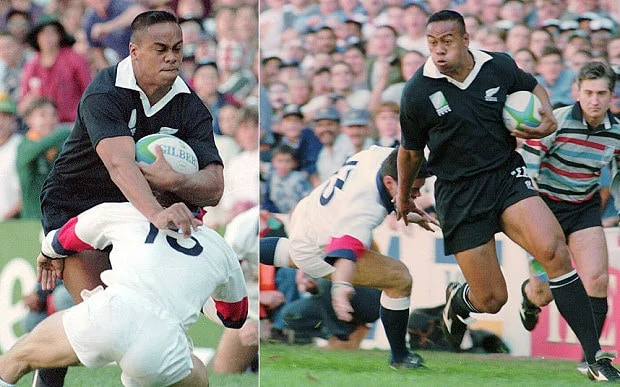
On June 18, 1995, a 20-year-old New Zealand winger with exactly two international caps scored four tries against England in the Rugby World Cup semi-final in Cape Town — running over England fullback Mike Catt in the most iconic image in rugby history. New Zealand won 45–29 in what became the day rugby union discovered it had a global superstar.

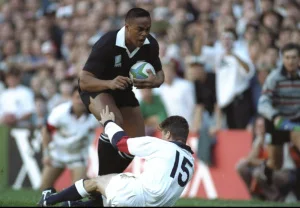
Mike Catt had one job on June 18, 1995. He was England's last line of defense, a reliable fullback who had handled difficult situations before. Jonah Lomu picked up the ball, put his head down, and ran directly at him. What happened next ended up on highlight reels for the next three decades.
Lomu didn't go around Catt. He ran through him. Literally over him, actually — stepping on the prone fullback mid-stride on the way to the tryline. The commentator for New Zealand's television feed, Keith Quinn, let out an involuntary gasp that became part of broadcasting lore. And with that single moment, in the third minute of a Rugby World Cup semi-final in Cape Town, a 20-year-old with exactly two international caps to his name became the first genuine global superstar that rugby union had ever produced. 1
The kid who had no business being there
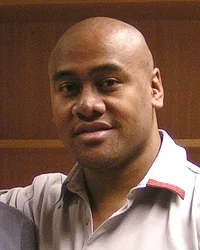
By any reasonable measure, Jonah Lomu should not have been starting in a World Cup semi-final. He was born in May 1975 — Tongan heritage, raised in Auckland — and had played his first test for the All Blacks in June 1994, aged 19 years and 45 days. That made him the youngest All Black since 1905. 1 By the time the 1995 Rugby World Cup opened in South Africa, he had accumulated exactly two international appearances. Two.
Then there were the numbers. Lomu stood 196 cm (6 feet 5 inches) and weighed somewhere between 119 kg and 125 kg depending on who was doing the measuring — about 265 pounds of muscle that, in his final year of high school, had clocked 100 meters in 11.2 seconds. 1 2 He played wing. People described him as "a freight train in ballet shoes," which sounds like hyperbole until you watch the footage.
His first RWC match had been against Ireland. He scored two tries. Against Scotland in the quarter-final, he added another. England knew what was coming. England had no way to stop it.
Four tries, forty-five points, forty minutes of shock
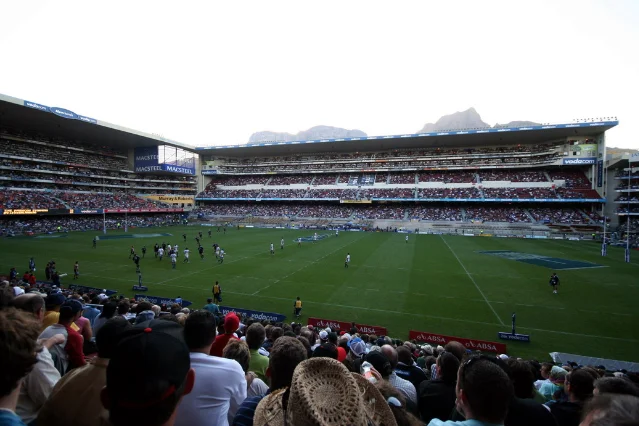
The match kicked off at Newlands Stadium, Cape Town, before 43,414 fans on a Sunday afternoon. 4 By the 25-minute mark, New Zealand already led 25–3.
Lomu scored in the 3rd minute. Then the 25th. Then the 42nd. Then the 69th. Four tries in a single World Cup knockout match — a performance so dominant that it redefined what a rugby winger could be and do. The full scoreline read New Zealand 45, England 29, though England's second-half rally (Rory Underwood and Will Carling each bagging two tries) flattered a scoreline that had been genuinely ugly much earlier than that. 5
The rest of the All Blacks were barely irrelevant by comparison — though No.8 Zinzan Brooke did manage to drop-kick a goal from distance, which in rugby union is the kind of trick play you almost never see from a forward. Almost nobody remembered it. They were watching the wing.
チャートを読み込んでいます…
The try that became a meme before memes existed
Ask any rugby fan over 40 which single image represents the 1995 World Cup. They will describe it: Lomu catching a flat pass on the left flank, shaking off Tony Underwood's attempted tap-tackle, brushing Will Carling aside like he wasn't there, and then running over Mike Catt — not past, over — to score in the corner. The Guardian later described Lomu going through Catt "as if he were a cardboard cut-out." 6
In 2015 — twenty years later — MasterCard ran a poll across 13 rugby nations asking 4,000 fans to vote for the greatest try in Rugby World Cup history. Lomu's first try against England won with 27% of the vote. Not "one of the best." The best, by a margin. 6
"He is a freak"
England captain Will Carling gave perhaps the most honest post-match assessment in World Cup history. The full version, recorded by the World Rugby Museum: "I am hoping not to come across him again. He is a freak and the sooner he goes away the better." 3
England coach Jack Rowell was more measured but landed in the same territory: "Lomu is a phenomenon. He plays a different game." 3
Neither man was wrong. At that moment, Lomu genuinely was playing a different game from everyone else on the pitch — a game where a wing could be the biggest man on the field and still the fastest.
What it broke, what it built
The 1995 Rugby World Cup was the last tournament of rugby union's amateur era. Two months after New Zealand beat England in that Cape Town semi-final, the International Rugby Football Board abolished amateurism on August 26 — professionalism arrived almost overnight. Lomu's performance at the tournament is widely credited, by historians of the sport, as one of the forces that made the transition commercially viable. 2
The Sydney Morning Herald has reported — though this particular story falls into "told often, harder to fully verify" territory — that Rupert Murdoch, watching Lomu steamroll Catt, told his colleagues to buy the broadcast rights to southern hemisphere rugby on the spot. News Corp did sign a 10-year, US$555 million deal shortly afterward that funded the creation of Super Rugby and the Tri-Nations (now Rugby Championship). Whether or not Murdoch said exactly what the legend claims, the dollars changed hands. 2
New Zealand, it should be noted, did not win that World Cup. They lost the final 15–12 to host nation South Africa in extra time — scoreless on tries, decided entirely on kicks. Nelson Mandela, wearing the Springboks jersey and presenting the Webb Ellis Trophy to captain François Pienaar, made the cover of every newspaper on the planet that weekend instead. Lomu finished the tournament with 7 tries — tied for the tournament lead with Marc Ellis — and walked away without a medal. 7
He went on to play in the 1999 World Cup and scored 8 more tries, bringing his World Cup career total to 15 — a record he shares with South Africa's Bryan Habana, achieved in two tournaments versus Habana's three. 1 He was inducted into the International Rugby Hall of Fame in 2007 and the World Rugby Hall of Fame in 2011. He died in November 2015 of kidney disease complications, aged 40.
Mike Catt, for his part, went on to have a long international career, won the 2003 World Cup with England, and later coached Italy and the Lions. He is remembered, correctly, as an excellent rugby player.
He is also the man Jonah Lomu ran over in the third minute on June 18, 1995. That will be in the first line of his Wikipedia entry forever.
Cover image: Jonah Lomu in action for the All Blacks against England at the 1995 Rugby World Cup semi-final. Photo: AP Photo.
参考ソース
- 1Wikipedia: Jonah Lomu
- 2The Sydney Morning Herald: The day Lomu changed rugby forever
- 3World Rugby Museum: Jonah Lomu — the day he announced himself to the world
- 4World Rugby: England v New Zealand — Men's Rugby World Cup 1995
- 5BBC Sport: 1995: N Zealand 45-29 England
- 6The Guardian: Jonah Lomu effort tops poll for greatest RWC try
- 7Wikipedia: 1995 Rugby World Cup
このコンテンツについて、さらに観点や背景を補足しましょう。