June 20 in business history: Morse's patent, Ford signs with the UAW, the Deutsche Mark, and Jaws

June 20 in business history: Morse's patent, Ford signs with the UAW, the Deutsche Mark, and Jaws

On June 20, 1840, Samuel Morse received US Patent No. 1,647A for the electromagnetic telegraph — a system whose relay circuit became the global standard but whose creator was largely bypassed in the commercial rollout. On June 20, 1941, Ford Motor Company — the most violently anti-union automaker in history — signed a contract with the UAW that outbid both GM and Chrysler, converting forced capitulation into competitive advantage. On June 20, 1948, Ludwig Erhard abolished Nazi-era price controls in West Germany without authorization — choosing Sunday so occupation authorities couldn't stop him — triggering the Wirtschaftswunder that grew industrial output 53% in six months. And on June 20, 1975, Jaws opened on 464 screens with $700,000 in national TV advertising, breaking three industry rules simultaneously and creating the summer blockbuster model that still governs Hollywood.
On This Day in Business History
2026/6/19 · 20:26
購読 3 件 · コンテンツ 32 件
Four events on June 20 — 1840, 1941, 1948, 1975 — all share a pattern that runs deeper than their obvious differences: the person or organization that moved decisively under duress set terms that compounded for decades, while the party that thought it had won often found itself on the wrong side of history within a few years. A patent awarded after an eight-year slog. A labor contract signed under ultimatum that outbid the winning side. A Sunday decree issued without authorization that rewired an economy overnight. A television ad buy that broke three industry rules at once and created a business model still running today.

1840 — Morse's patent: the repeater circuit that ate the world
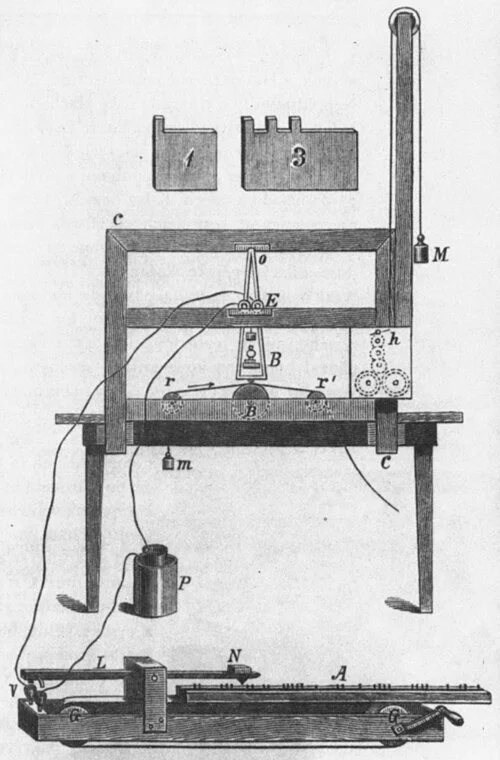
On June 20, 1840, the United States Patent Office issued US Patent No. 1,647A to Samuel F. B. Morse of New York, titled "Improvement in the Mode of Communicating Information by Signals by the Application of Electromagnetism." 1 The patent described a complete system: the dot-based signaling scheme that became Morse code, a send-and-record circuit, and the key innovation that made everything else irrelevant — the repeater.
Morse's original telegraph apparatus from US Patent No. 1,647A, 1840
Technical diagram of Morse's telegraph from the 1840 patent application, showing the electromagnetic relay mechanism. 1
Cooke and Wheatstone had a working commercial telegraph in England by 1838 — two years before Morse's patent. Their five-needle, six-wire system operated trains and transmitted news. But it required multiple parallel wires, making long distances expensive. Morse's single-wire system solved a different problem: when a signal weakened, a battery and electromagnet at each relay station boosted it forward. Distances became unlimited in principle. By 1851, Morse's single-wire system with the dot-dash code had become the global standard everywhere outside the UK. 2
Morse had conceived the idea aboard the ship Sully in October 1832, built a crude working device at New York University by January 1836, and gave a first public demonstration with Alfred Vail on January 11, 1838 in Morristown, New Jersey. 2 Congress rejected his 1838 funding request. He spent two more years in legal preparation before securing the 1840 patent, then lobbied until Congress appropriated $30,000 (roughly $1 million in 2025 dollars) to build a 38-mile experimental line from Washington to Baltimore. 2 The line opened on May 24, 1844, with Morse's famous "What hath God wrought."
The commercial explosion bypassed Morse almost entirely. By 1850, 12,000 miles of wire crisscrossed the United States. 3 Five New York newspapers formed the Associated Press in 1846 specifically to share telegraph costs. 4 Western Union, founded in 1851 by businessmen (not Morse), obtained a virtual monopoly on American telegraphy by 1866 and launched the stock ticker that year — eliminating geographic arbitrage in securities markets — followed by standardized time service in 1870 and wire money transfer in 1871. 5 Morse's 1848 letter captures the experience: "I have been so constantly under the necessity of watching the movements of the most unprincipled set of pirates I have ever known, that all my time has been occupied in defense." 2
The Supreme Court's 1853 ruling in O'Reilly v. Morse upheld his core repeater-circuit claims but struck down Claim 8 — his attempt to monopolize any use of electromagnetism for communication. 6 That ruling — you cannot patent "an abstract natural force," only a specific implementation — is the foundational precedent for software patent eligibility, cited in Alice Corp. v. CLS Bank and Bilski v. Kappos. Morse died in 1872 with an estate of approximately $500,000 (about $13.4 million today). 2 Ezra Cornell, who built Western Union's infrastructure on Morse's patent, used the fortune to found Cornell University.
Decision mirror. The inventor of the infrastructure is rarely the consolidator who captures most of its value. Morse won the technical race and the legal battle; he lost the monetization race to businessmen who built the network. His Claim 8 also illustrates a durable problem: filing a claim broad enough to cover "any use of electromagnetic force" invites the exact ruling that restricts you to your specific implementation while competitors build adjacent systems. Narrow, specific claims around the working mechanism are harder to circumvent — and much harder to invalidate.

1941 — Ford and the UAW: forced capitulation as competitive advantage
On June 20, 1941, Ford Motor Company signed its first contract with the United Automobile Workers of America (UAW-CIO), becoming the last of the Big Three automakers to recognize the union. 7 GM had signed in February 1937. Chrysler had signed in March 1937. Ford had spent the intervening four years deploying a 3,000-person private security force — described by The New York Times as "the largest private quasi-military organization in existence" — to spy on, intimidate, and physically attack union organizers. 8
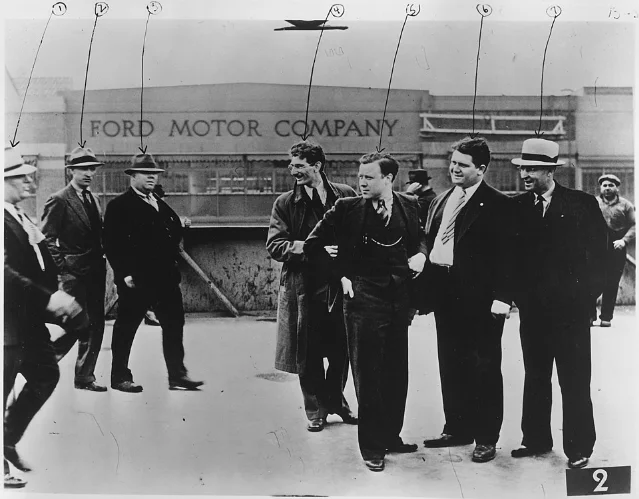
Ford Service Department men confronting UAW organizers at Gate 4 of Ford's River Rouge plant, May 26, 1937 — the Battle of the Overpass
Ford Service Department men confront UAW organizers Walter Reuther (fifth from left) and Richard Frankensteen (sixth from left) at the River Rouge overpass, May 26, 1937. Sixteen unionists were injured; the photographs, smuggled out by Detroit News photographer James Kilpatrick, turned national public opinion against Ford. 8
The sequence that ended Ford's resistance compressed into ten weeks. On April 1, 1941, Harry Bennett fired eight union grievance committee members from the River Rouge plant, triggering a wildcat sit-down strike by 50,000 workers that shut production for ten days. 9 An NLRB-supervised election on May 21 produced a decisive outcome: 70% of approximately 78,000 ballots voted for the UAW; only 2.5% voted "no union." 9 Ford had already lost a $10 million defense contract due to labor law violations and was facing an overwhelming NLRB case. 7 The final push came on June 18: Clara Ford, Henry's wife, gave him an ultimatum — sign, or she would leave him and sell her controlling shares. Henry Ford signed on June 20 and later described the moment publicly: "Mrs. Ford was horrified. … She insisted that I sign what she called a peace agreement. … I felt her vision and judgement were better than mine. Don't ever discredit the power of a woman." 9
The contract Ford signed gave workers more than GM or Chrysler had conceded: a full union shop requiring all employees to be members, automatic payroll deduction of dues, wages matched to the highest rates in the industry, back pay for over 4,000 wrongfully discharged workers, rehiring of union activists, and a non-discrimination clause drafted by Black foundryman Shelton Tappes. 7 Harry Bennett called the NLRB election result "a great victory for the Communist Party, Governor Murray Van Wagoner and the NLRB." 9 Walter Reuther — whom Bennett's men had thrown down two flights of concrete stairs at the overpass in 1937 — used the pattern Ford set to negotiate the 1950 "Treaty of Detroit" with GM: a five-year contract with cost-of-living adjustments, a productivity-linked 2% annual wage increase, a $125/month pension, and health insurance. 10 Fortune magazine coined "Treaty of Detroit" for a settlement it recognized as the foundational compact of American industrial relations. UAW membership peaked at 1.5 million in 1979. 11
Decision mirror. Ford's arc illustrates a specific dynamic: the party that breaks first in a prolonged standoff often has the most leverage over the terms. Ford was cornered by overlapping pressures — defense contracts, NLRB exposure, a decisive election, an ultimatum from the person whose judgment he trusted most. But the decision to offer more than demanded, rather than the minimum required, converted forced capitulation into a competitive positioning move. By going from the most violently anti-union company in the industry to the one with the best contract, Ford neutralized the UAW's momentum, secured labor peace for wartime production, and turned a liability into a template. The question for today's equivalent situations — a regulatory action, a major customer demand, a board ultimatum — is not whether to concede, but whether to meet the minimum or leapfrog it.

1948 — The Deutsche Mark: the Sunday decree that rewired an economy
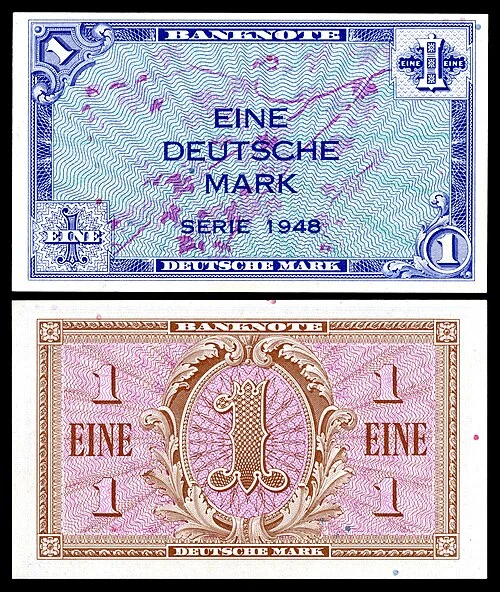
On June 20, 1948 — a Sunday — the Deutsche Mark (DM) was introduced in the three Western occupation zones of Germany, replacing the Reichsmark, which had become functionally worthless. 12 Each West German resident received an initial allotment of DM 40; wages, salaries, and rents converted at 1:1. Savings accounts converted at far less — the effective result was a roughly 93% reduction in the monetary supply. 13
The first Deutsche Mark banknote, Series 1948
The Series 1948 Deutsche Mark banknote — front (blue) and reverse (brown) — the first currency issued in postwar West Germany, June 20, 1948. 12
The currency reform alone was dramatic enough. What made June 20, 1948 a business-history event was what Ludwig Erhard, then director of economics for the Bizone (the merged U.S. and British occupation zones), did simultaneously: without authorization from the occupation authorities, he broadcast an announcement abolishing virtually all remaining Nazi-era price controls and rationing systems in a single edict. He chose Sunday because the U.S., British, and French authorities' offices were closed and they could not immediately reverse him. 12 When a U.S. Army colonel confronted Erhard about altering the occupation directives, Erhard replied: "I have not relaxed rationing; I have abolished it! Henceforth, the only rationing ticket the people will need will be the deutschemark." 14 When General Lucius Clay, the U.S. military governor, told Erhard his advisers were warning against the move, Erhard said: "Herr General, pay no attention to them! My advisers tell me the same thing." 14
Germany in 1948 was an economy paralyzed by its own price signals. The Reichsmark had been inflated to fund the Nazi war machine — by 1945, the monetary supply was five to six times the economy's real value. Price controls dating from 1936 kept official prices so disconnected from real scarcity that workers spent roughly 9.5 hours per week absent from jobs to barter food directly from farmers; money couldn't buy what they needed. 14 Cigarettes functioned as de facto currency at roughly seven Reichsmarks apiece.
The reform's effect was not gradual. On Monday, June 21, shop windows that had been empty filled with goods overnight — hoarded merchandise became worth more sold than stored. 13 Worker absenteeism fell from 9.5 hours per week in May to 4.2 hours by October. 14 The Bizone's industrial output climbed from 51% of 1936 levels in June to 78% by December — a 53% increase in six months. 15 West Germany's economy grew at roughly 8% annually through the 1950s; wages' purchasing power rose 73% between 1950 and 1960. 15 The Wirtschaftswunder — the economic miracle — was underway. The Soviet Union used the DM's introduction as its stated pretext for sealing all ground access to West Berlin on June 24, just four days later, triggering the Berlin Blockade; the Western Allies responded with 278,228 airlift sorties delivering 2,334,374 tons of supplies. 16
Total Marshall Plan aid to West Germany reached roughly $1.4 billion — less than 5% of West German national income at peak; over the same period Germany was paying occupation costs of approximately $2.4 billion annually. 14 The recovery was driven by the June 20 package: currency reform, price decontrol, rationing elimination, and a same-day tax reform that cut middle-income marginal rates from 85% to 18%. 14 Four interdependent reforms, all on the same Sunday. The Bundesbank's Joachim Nagel said in 2023: "Before June 20, 1948, people had money but could not buy anything. After June 21, money bought goods again." 17
Decision mirror. Erhard's move is the canonical case for "big bang" versus gradualist reform. He had to do all four things simultaneously because each one required the others to work. Price signals only function when prices are free. Production only responds to free prices when currency holds value. Investment only responds when marginal tax rates stop confiscating returns. A hoarding merchant only releases inventory when she believes money will still buy something tomorrow. Any partial reform left the equilibrium trap intact: the actors who needed to believe the system had changed could observe that it had not. The same logic applies whenever a company or institution is trying to reverse a credibility deficit — half-measures in a loss-of-confidence scenario rarely do more than extend the decline.

1975 — Jaws: how three broken rules built Hollywood's summer
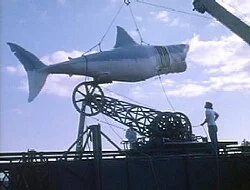
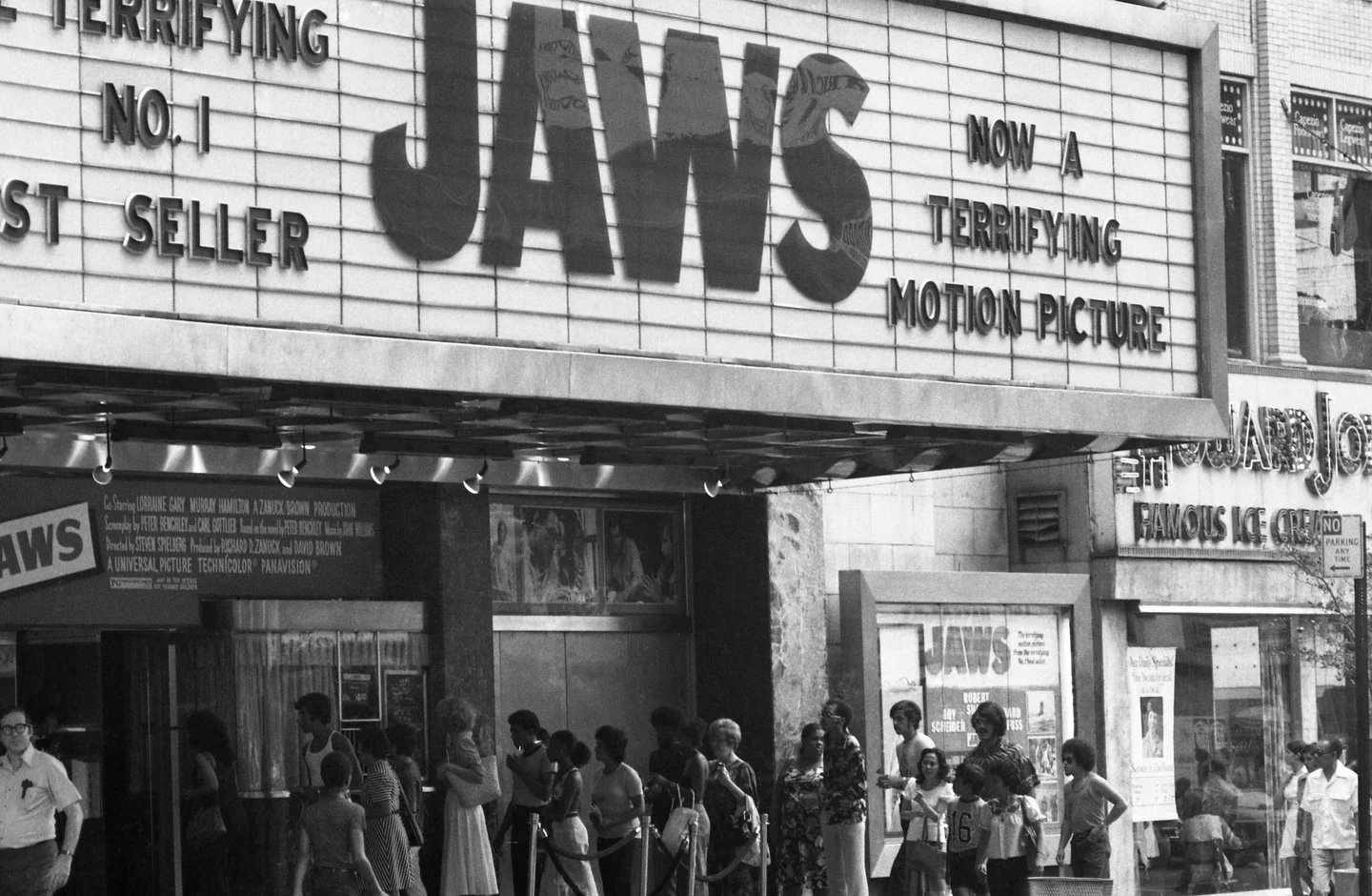
On June 20, 1975, Jaws opened across North America on 464 screens — 409 in the United States, the rest in Canada. 18 Universal had spent $700,000 on 30-second national television commercials on June 18, 19, and 20, buying time on nearly every primetime network show across those three nights. Total marketing spend reached $1.8 million. Universal's publicity director Clark Ramsey confirmed it was "the largest expenditure on advertising of a release in the history of the company." 19
The mechanical shark "Bruce" being hoisted by crane on the Jaws set, Martha's Vineyard, 1974
The pneumatic mechanical shark, nicknamed "Bruce" after Spielberg's lawyer, on location at Martha's Vineyard, 1974. The shark failed so frequently that Spielberg resorted to suggestion over direct display — a constraint he later called "a godsend." 20
Universal broke three rules simultaneously. Summer was the film industry's off-season — studios released pictures they expected to fail in summer; summer accounted for only 32% of annual box-office revenue in the years before Jaws. 21 Opening on hundreds of screens at once was read as a distress signal — quality films opened in a few major-city theaters and expanded deliberately. Heavy television advertising for films was considered wasteful. Film historian Joseph McBride described the prevailing view: "The attitude previously was, if you had a very wide opening, it meant it wasn't a very good film and they were trying to get their money quickly before the word of mouth spread." 21
The film itself was a production disaster that became a creative breakthrough. Three full-scale pneumatic mechanical sharks — built at a cost of approximately $3 million for special effects alone — failed continuously in the salt water off Martha's Vineyard. 20 The original 55-day shooting schedule extended to 159 days. The budget expanded from $3.5 million to $9 million. 20 Because the primary shark could rarely be made to function, Spielberg was forced to suggest its presence through John Williams's minimalist two-note score and underwater camera angles rather than direct display. Spielberg later called the malfunction "a godsend. It made me become more like Alfred Hitchcock than like Ray Harryhausen." 22 Richard Dreyfuss summarized the production: "We started the film without a script, without a cast and without a shark." 20
Jaws grossed approximately $7 million in its opening weekend and $8.9 million in its first four days from 409 U.S. venues. 19 It became the first film in history to surpass $100 million in U.S. theatrical rentals — achieving that in 59 days. 18 After 78 days it surpassed The Godfather as the highest-grossing film of all time; it held that record until Star Wars (1977) applied the same playbook. 23 By the 1980s, summer accounted for roughly 40% of annual studio box-office revenue; by 1996 the percentage had nearly doubled from the pre-Jaws baseline of 32%. 21 Co-screenwriter Carl Gottlieb put the transformation plainly: "That notion of selling a picture as an event, as a phenomenon, as a destination, was born with that release." 24
Decision mirror. Universal's Jaws release is the standard case for how industry "best practices" function as competitive ceilings rather than floors. All three rules Universal broke — summer release, wide opening, heavy TV advertising — were rules because they were correct for lower-quality films trying to minimize losses. They were wrong for a high-quality film with genuine word-of-mouth potential. The wide release combined with the ad blitz created a first-week financial event that turned early viewer enthusiasm into a self-reinforcing phenomenon. The constraint worth examining in your own context: which rules in your industry were written for average-quality products, and whether they still apply when the product is genuinely differentiated.

June 20, across 135 years, keeps producing the same underlying dynamic. Morse locked in a patent that survived 13 years of litigation. Ford signed a contract that outbid everyone in an industry it had fought for years. Erhard broadcast a decree no one had authorized. Universal bought television time the industry called wasteful. In every case the actor moved under duress, against convention, or without permission — and the terms set on that day compounded forward for decades. The clearest lesson is not about boldness. It is about timing: there is a window when structural positions are still being negotiated, and the party that moves inside that window, rather than waiting for certainty, tends to set the terms everyone else works inside afterward.
Cover image: Crowds line up outside a movie house to see Jaws, 1975 — Bettmann Archive/Getty Images, via HISTORY.com

このコンテンツについて、さらに観点や背景を補足しましょう。

  • ログインするとコメントできます。