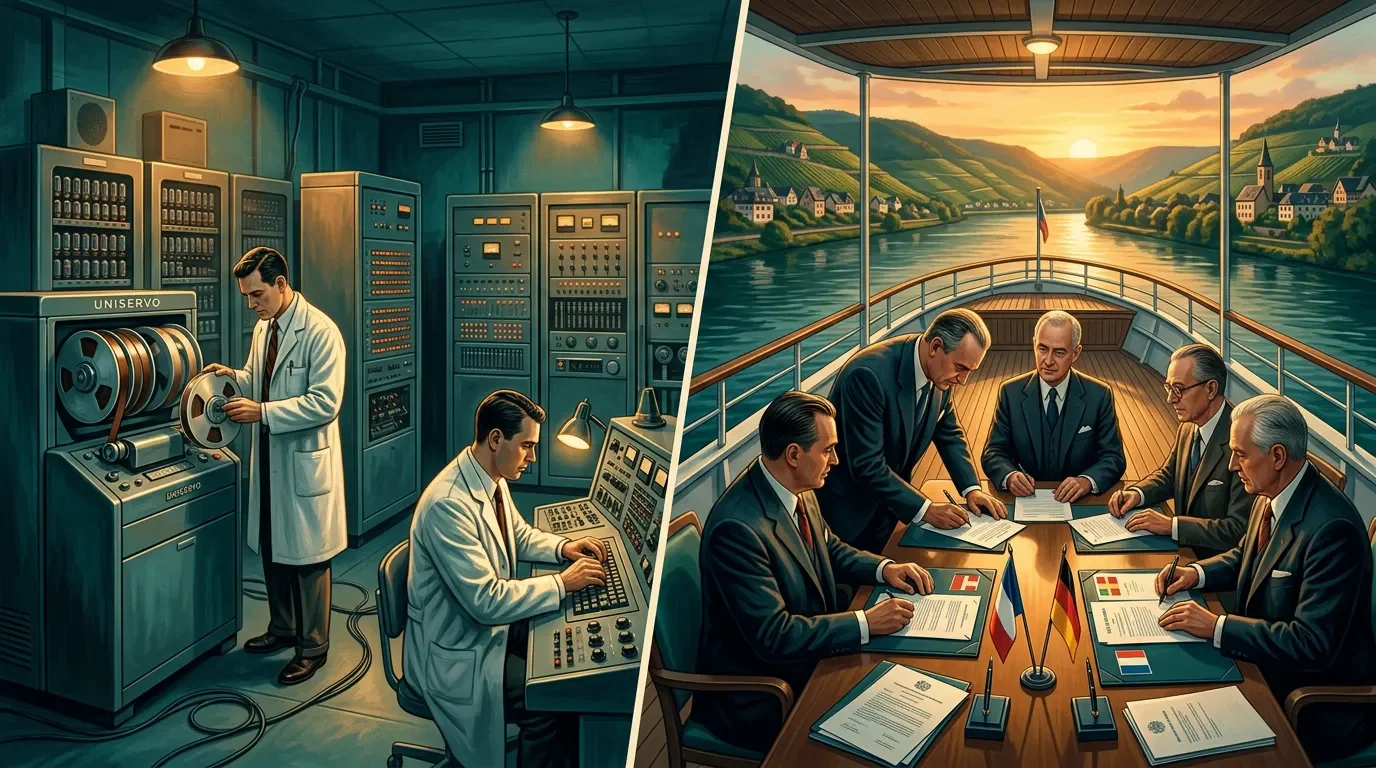
June 14 in business history: The computer that lost its market, the treaty that remade a continent, the factory that won a war, and the machine that waited 150 years
Four June 14 events across 163 years: UNIVAC I dedicated in 1951 (invented the business-computer market, surrendered it to IBM through undercapitalization); the Schengen Agreement signed on a Moselle riverboat in 1985 (5 nations, 31 articles, compounded into a 29-country $29T economic zone); Boeing Wichita Plant II groundbreaking in 1941 (built 41% of all B-29s, later divested for $1.2B and reacquired for $8.3B); Charles Babbage's Difference Engine proposed in 1822 (technically achievable, never built — the prototype-to-product gap in full display).

Four events on June 14, separated by 163 years. A computer that invented an industry handed it to a competitor. Five civil servants signed a 31-article agreement on a riverboat and quietly set in motion the largest free-movement zone in human history. A groundbreaking in the Kansas flatlands turned a mid-continent city into the arsenal that bombed Japan into submission. And a mathematician proposed a machine that would not actually exist — in working form — until 1991, using tolerances his era was perfectly capable of achieving.
The common thread is not innovation. It is the gap between inventing something and capturing its value — and the ways that gap gets closed, or doesn't, by organizational decisions that look tactical at the time and enormous in retrospect.
1951 — UNIVAC I is dedicated in Philadelphia. IBM takes notes.
On June 14, 1951, the US Census Bureau held a formal dedication ceremony at the Eckert-Mauchly Division factory at 3747 Ridge Avenue, Philadelphia, for UNIVAC I (Universal Automatic Computer I) — the first general-purpose electronic digital computer designed specifically for business applications. 1 The machine had been formally accepted by the Census Bureau on March 31, 1951, though it was not physically shipped to Washington until December of that year; the Bureau processed data on the prototype at the factory for months beforehand. 2
The machine earned the dedication. UNIVAC I ran on 6,103 vacuum tubes, weighed 16,686 pounds, consumed 125 kilowatts of power, occupied over 382 square feet of floor space, and processed approximately 1,905 operations per second. 2 Its UNISERVO magnetic tape drives — the first commercial computer tape drives — held 1,440,000 decimal digits on 1,500-foot tapes at 100 inches per second. Census Bureau officials described its accuracy in terms that have aged entertainingly well: "We have never found it in error." 3
The designers behind it — J. Presper Eckert (chief engineer) and John Mauchly (conceptual design), veterans of the wartime ENIAC project — had been trying to commercialize computing since March 1946, when they left the University of Pennsylvania after the school adopted a patent policy requiring them to assign all computer patents to the institution. 4 They founded the Electronic Control Company (later Eckert-Mauchly Computer Corporation, EMCC) and secured a $300,000 deposit from the Census Bureau in April 1946. Then the money ran out.
By summer 1948, EMCC had nearly depleted its cash after drastically underbidding a project for Northrop Aircraft. A racetrack-betting-machine investor named Harry Straus stepped in with $500,000 for a 40% equity stake — and died in a plane crash in October 1949, after which his company immediately withdrew support. 4 Eckert and Mauchly approached IBM. Thomas Watson Sr. turned them down — his instinct was that magnetic tape, which could be erased, could not be trusted. Watson Jr. later described his father's position plainly: "On a punch card, you had a piece of information that was permanent. You could see it and hold it in your hand... But with magnetic tape, your data were stored invisibly on a medium that was designed to be erased and reused." 5 On February 15, 1950, Remington Rand — a diversified conglomerate best known for typewriters and electric shavers — acquired EMCC for approximately $538,000. 4
UNIVAC's cultural moment came on election night, November 4, 1952. CBS News used the fifth UNIVAC I (built for the Atomic Energy Commission) to predict the presidential race between Dwight Eisenhower and Adlai Stevenson. With only 3,398,745 votes counted — roughly 5.5% of total turnout — UNIVAC predicted Eisenhower would win at 100-to-1 odds with 32,915,949 popular votes. 6 The prediction looked so implausible that CBS programmers and Remington Rand executives suppressed it, adjusting a "national trend factor" to produce a more palatable 268-263 forecast. After midnight, a Remington Rand representative came on air and admitted what happened: "It was right. We were wrong. Next year we'll believe it." 6 The actual result — Eisenhower won with 34,075,029 votes and 442 electoral votes — was within UNIVAC's margin of error by 3.5%.
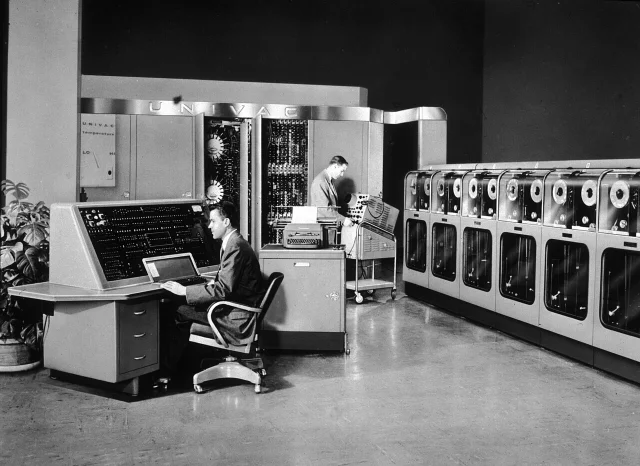
UNIVAC became a household name — appearing on Superman comic book covers, in Warner Bros. cartoons, and in everyday conversation as the generic term for "computer." 7 But the company that built it lost the market.
In 1953, IBM won the SAGE (Semi-Automatic Ground Environment) air defense contract — approximately 50 Whirlwind computers — that Remington Rand had been expected to capture despite possessing UNIVAC's prestige and the leadership of Manhattan Project director Leslie Groves. MIT's Jay Forrester chose IBM because Remington Rand had already cut UNIVAC production quotas by 50% under Groves, signaling insufficient manufacturing capacity. From the SAGE project, IBM learned random-access magnetic-core memory, cathode-ray-tube displays, index registers for easier programming, and real-time data processing — and immediately integrated those capabilities into its IBM 701 and 650 commercial lines. 5 Watson Jr. did not hide the outcome: "They made the UNIVAC obsolete and we soon left Remington Rand in the dust." 5
By the early 1960s IBM held roughly 70% of the computer market. UNIVAC had become one of "IBM and the Seven Dwarfs." 2 Remington Rand merged with Sperry Corporation in 1955 to form Sperry Rand. The lineage eventually became Unisys (NYSE: UIS), which still operates today as an IT services company — a living corporate descendant of EMCC's original $538,000 acquisition. 8
The decision mirror: UNIVAC built the invention and surrendered the market through a cascade of failures that had nothing to do with the technology: chronic undercapitalization, a wrong acquirer with a punch-card culture, a general who cut production quotas, a sales force never trained on the product, and a McCarthy-era security investigation that sidelined Mauchly for two years. Historian Matthew Lasar's summary holds: "Innovation and genius are not always a match for influence and organizational scale." 5 The relevant question for any organization that has just invented something is not "do we have the best product?" — UNIVAC clearly did — but "do we have the manufacturing capacity, the distribution culture, and the institutional will to keep winning what we've started?"
1985 — Five civil servants sign 31 articles on a riverboat. The European economy eventually absorbs $29 trillion.
The Moselle River runs through vine-covered hills where France, Germany, and Luxembourg converge. On June 14, 1985, a pleasure boat called the MS Princesse Marie-Astrid was moored on that stretch of water near the village of Schengen, Luxembourg. Five state secretaries — representing Belgium, France, West Germany, Luxembourg, and the Netherlands — signed a document titled "Agreement between the Governments of the States of the Benelux Economic Union, the Federal Republic of Germany and the French Republic on the gradual abolition of checks at their common borders." 9 The location was deliberate: Schengen sits at the exact tripoint where France, Germany, and Luxembourg meet. With Belgium, Luxembourg, and the Netherlands linked as the Benelux Economic Union, the village was the only spot where all five signatories symbolically intersected. 10
The signing happened outside the European Communities' official framework because the other five EEC member states could not reach consensus. The five willing nations — three of whom had already abolished mutual border controls under the Benelux Economic Union since 1970 — forged ahead independently. 9 The signatories were not heads of state. The initial agreement ran to 31 articles covering reduced-speed vehicle checks, freedom for border-area residents to cross at non-designated points, and visa harmonization. It was, by the standards of continental integration, a modest document.
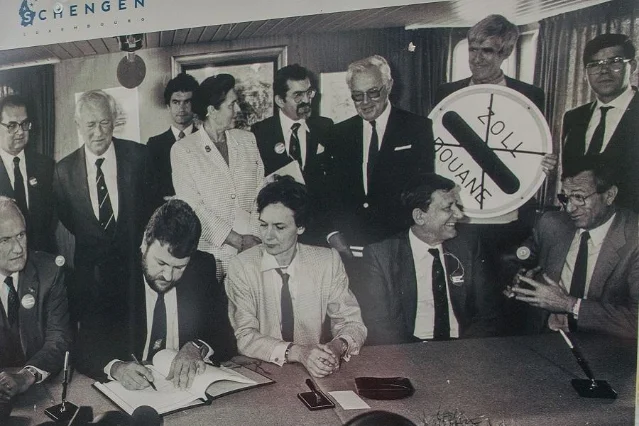
What the June 14 document started compounded through a specific institutional trajectory. A full implementing convention followed in June 1990. Seven countries — the five founders plus Spain and Portugal — actually abolished internal border controls in March 1995. The Amsterdam Treaty of 1997 incorporated Schengen acquis into EU law, making membership legally binding on new EU entrants. Expansion followed in 1997, 2000, 2001, and the largest single enlargement in December 2007 when nine central and eastern European countries joined simultaneously. 12 Switzerland joined in 2008 after a popular referendum three years earlier. Bulgaria and Romania completed full membership in early 2025. 12
The 2025 numbers: 29 member countries, covering 4,595,131 square kilometers, 453 million people, and a combined nominal GDP of $21.9 trillion ($29.9 trillion at purchasing power parity). 12 The European Commission estimates 32 million companies operate with reduced cross-border costs within the zone. 11 Approximately 1.7 million people commute across an internal Schengen border every working day. 13
The economic quantification of what those 31 articles created is now substantial. A 2016 CEPR study by Felbermayr, Gröschl, and Steinwachs found that Schengen membership reduces bilateral trade costs by 0.42% to 1.59% depending on geography — equivalent to a tariff reduction of approximately 0.7 percentage points per border crossing. 13 The same study modeled what a full collapse of Schengen would cost: a 4.2% decline in EU trade (€221 billion annually) and a 0.31% fall in aggregate EU GDP (€39.3 billion per year). 14 A Bertelsmann Foundation analysis projected cumulative losses of approximately €1.43 trillion over 2016-2025 under a full-collapse scenario. 13 The zone has been stress-tested — by the 2015 refugee crisis, when seven countries temporarily reimposed border controls, and by the COVID-19 pandemic, when virtually all internal and external borders closed simultaneously in March 2020 — and survived both without permanent structural unraveling. 9
The decision mirror: The Schengen case is the clearest available example of what institutional economists call "variable geometry" integration — when full consensus is blocked, a willing subset experiments, demonstrates value, and creates a model that subsequent entrants adopt as the standard. The five signatories on June 14, 1985, were not designing the future of European economic policy. They were solving a specific practical problem (border delays were slowing commerce between countries that already had near-identical economic regimes) with a minimum viable agreement. The lesson is not that ambitious institutional design compounds over decades — that is obvious. The specific lesson is that not waiting for full consensus is often the condition that makes compounding possible. The five willing nations moved. The other five watched. Forty years later, 29 countries operate under the framework those five created.
1941 — Ground is broken in Wichita. Four years later, 1,644 bombers have come off the line.
On June 14, 1941 — six months before Pearl Harbor — Boeing broke ground for Plant II at Wichita Municipal Airport. 15 The construction firm was the Austin Company of Cleveland. The facility would encompass 2.8 million square feet — nearly 180 acres under one roof — built on land adjacent to the existing Stearman Aircraft factory (Boeing's presence in Wichita since its 1929 acquisition). 16 Wichita had been chosen for reasons of geography: it sat in the American heartland, far from both coasts and potential enemy attack, with flat terrain for aircraft construction. Seattle's existing plants lacked the room needed for the B-29 Superfortress — the bomber that Plant II was being built to produce.
J. Earl Schaefer, Boeing-Wichita's general manager, had learned of the B-29 directive on May 17, 1941, from a newspaper reporter's phone call. His account of the challenge, as described by aviation historian Edward Phillips, was that Schaefer's team had to "obtain tooling that did not exist, install them in a phantom factory, manufacture the world's most sophisticated bomber whose design and systems were constantly in flux, and build it with non-existent, unskilled labor that had no training or experience for such a task." 16 Partial operations began by June 1942. Full completion came in January 1943.
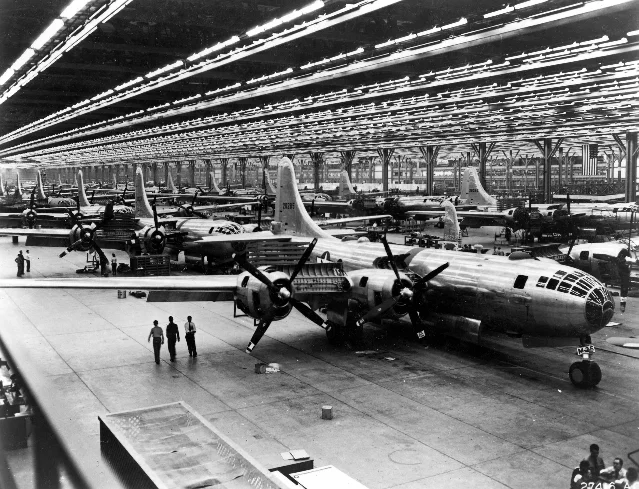
The production numbers that followed are among the more striking in American industrial history. Boeing-Wichita built 1,644 B-29 Superfortress bombers — 41% of the 3,970 total B-29s produced across all four assembly plants (Boeing Wichita, Boeing Renton, Bell Marietta, and Martin Omaha). 17 The first production B-29 from Wichita made its maiden flight on June 29, 1943. Every B-29 used in the first bombing raid on Japan — the June 15, 1944 strike on the Yawata steel works — was built in Wichita. 16
The workforce that built them was largely invented from scratch. Peak employment reached approximately 29,795 workers in December 1943. 18 Of roughly 35,000 people dedicated to B-29 manufacturing at Wichita, approximately 40% were women — housewives, teachers, clerks, and farmers' wives who had never worked in manufacturing. 19 Workers ran two 10-hour shifts six days a week. The Plant II cafeteria served 15,000 hot meals a day at 28 cents each. 16 Man-hours per bomber fell from 157,000 for the first 100 units to under 20,000 for the last 100 — a learning-curve compression of nearly 90%. 16 Peak production reached 4.2 bombers per day in July 1945. 16
The B-29 program itself cost $3 billion in wartime dollars — equivalent to roughly $54 billion in 2025 — making it the most expensive weapons program of World War II, exceeding the $1.9 billion Manhattan Project. 20 General Hap Arnold, commander of the Army Air Forces, told the Wichita workers after the war: "You were given a job to do and the way you finished the job met our greatest expectations. For myself and on behalf of the Army Air Forces, I say to you, well done, and thanks from the bottom of my heart." 16
The facility's postwar trajectory illuminates a different kind of business history. Plant II was reactivated for B-47 Stratojet production starting in 1948 and later became the primary source of 737 fuselage sections — shipped by rail to Boeing's Renton, Washington final assembly line. 18 In June 2005, Boeing sold the Wichita commercial division to Canadian investment firm Onex Corporation for $1.2 billion enterprise value; the new company became Spirit AeroSystems. 21 The rationale was financial engineering — divesting assets to boost return on net assets under CEO Harry Stonecipher's McDonnell Douglas-era metrics. Onex invested $375 million initially and eventually extracted $3.2 billion when it sold its final shares in 2014. Spirit became Boeing's primary fuselage supplier and a public company on the NYSE.
The outcome was labeled "now widely recognized as a massive strategic mistake" by The Air Current after the January 2024 Alaska Airlines Flight 1282 door-plug blowout, which involved a fuselage manufactured by Spirit. 22 Spirit reported net losses of $2.1 billion in 2024 and revenue of $1.65 billion, a 9% decline. 23 Boeing agreed to reacquire Spirit in June 2024 in an all-stock transaction valued at $4.7 billion equity ($8.3 billion enterprise value including debt). 21 The reacquisition closed in December 2025 — 20 years after the original divestiture, at a cost roughly seven times the original sale price.
The decision mirror: The June 14, 1941 groundbreaking produced a facility that could go from zero to producing 41% of the most complex bomber in American history, on a 21-month schedule, using a workforce that had never built aircraft. That organizational capability was accumulated over decades and embedded in the Wichita operation. The 2005 divestiture treated it as a cost-reduction opportunity. Boeing spent $1.2 billion to shed a supplier, spent the next 20 years dealing with quality control consequences, and paid $8.3 billion to get the operation back. The arithmetic of that decision is now visible in the rearview mirror. The less obvious lesson is that core manufacturing capability — the kind that ramps from 157,000 to 20,000 man-hours per unit over a production run — is extremely hard to rebuild once it leaves a corporate structure.
1822 — Babbage proposes a machine. It works perfectly fine. Nobody builds it for 150 years.
On June 14, 1822, Charles Babbage — then 30 years old and Secretary of the Astronomical Society of London — read a paper before that body titled "Note on the application of machinery to the computation of astronomical and mathematical tables." 24 He had already built a small working prototype — a hand-cranked decimal calculator demonstrating the feasibility of mechanical computation. The paper proposed scaling that prototype into a full Difference Engine: a machine that would tabulate polynomial functions using the method of finite differences, requiring only addition and subtraction, which were far simpler to mechanize than multiplication.
The motivation was practical frustration. Babbage and his friend John Herschel had been checking mathematical tables for a new Nautical Almanac and found them riddled with errors — errors that propagated into navigational calculations and had caused, by some estimates, real deaths at sea. In 1821, Babbage had said to Herschel: "I wish to God these calculations had been executed by steam." 24
The Astronomical Society awarded him its Gold Medal in 1824. The British government granted £1,700 in 1823 to begin construction. 25 Total government expenditure eventually exceeded £17,000 — equivalent to the cost of 22 brand-new steam locomotives from Robert Stephenson's factory in 1831, or roughly £2 million in current terms. 25 The full Difference Engine No. 1 design called for approximately 25,000 parts weighing 4 tons. Only one-seventh was ever built: a working 2,000-part model completed in 1832 by engineer Joseph Clement, capable of handling 6-digit numbers by second-order differences.
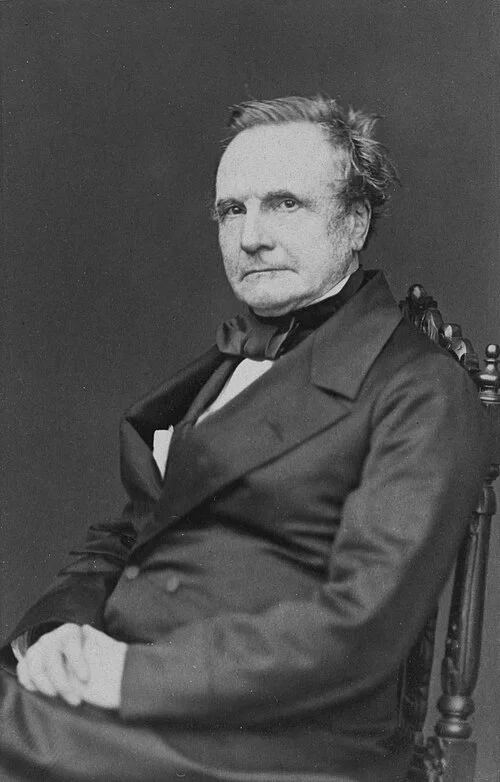
The project collapsed through a specific combination of institutional failures. In 1833, chief engineer Clement halted work in a dispute over ownership of the specialized tools he had built for the project — under trade custom of the era, Clement owned them and could charge Babbage for their use. 25 Simultaneously, Babbage's attention had already shifted to a vastly more ambitious design: the Analytical Engine (conceived 1834), a fully programmable general-purpose computer with separate Store (memory: 1,000 numbers of 40 decimal digits each) and Mill (arithmetic logic unit), controlled by punched cards borrowed from the Jacquard loom, supporting conditional branching, loops, and parallel processing. It is now recognized as Turing-complete. By improving the concept, Babbage made the Difference Engine obsolete in the government's eyes — turning what had already been an expensive project into what appeared to be an endless one. Conservative politicians including future Prime Minister Robert Peel privately mocked it as "the creation of a wooden man to calculate tables from the formula x² + x + 41." 27
Babbage's collaborator Ada Lovelace (1815-1852), daughter of Lord Byron, translated an 1842 Italian paper on the Analytical Engine and added seven Notes (A through G) approximately three times the length of the original. Note G contains a step-by-step algorithm for calculating Bernoulli numbers, widely regarded as the first published computer program. Her Note A captured what Babbage himself had not yet fully articulated: the machine "might act upon other things besides number, were objects found whose mutual fundamental relations could be expressed by those of the abstract science of operations... the engine might compose elaborate and scientific pieces of music of any degree of complexity or extent." 28 Babbage called her the "Enchantress of Number." 29
No complete working machine was built in Babbage's lifetime. He died in 1871. The first general-purpose computer (Konrad Zuse's Z3) arrived in 1941 — 119 years after his June 14 paper. In 1985, the Science Museum in London began constructing Difference Engine No. 2 to Babbage's 1847-1849 revised design, using tolerances achievable with 19th-century technology. The calculating section was unveiled in 1991 — the bicentenary of Babbage's birth. The printer and stereotyping apparatus were completed in 2002. It worked correctly, resolving a long-standing debate: Babbage's design could have been built with the engineering methods of his era. The obstacle was never technical feasibility. 24 A second complete Difference Engine No. 2, funded by Nathan Myhrvold (former Microsoft CTO), was displayed at the Computer History Museum in Mountain View, California from 2008 to 2016. 25
The decision mirror: The 150-year gap between Babbage's June 14 proposal and the Science Museum's 1991 proof-of-concept is the most compressed summary of the invention-to-execution problem available. The math was sound. The engineering was achievable. The funding model was entirely dependent on government patronage with no commercial recoupment mechanism. The perpetual redesign cycle (Difference Engine abandoned for the Analytical Engine, which was never completed either) destroyed funder confidence. Babbage's abrasive personality alienated potential allies — he lost two parliamentary elections, wrote a polemic titled Reflections on the Decline of Science that antagonized the scientific establishment, and repeatedly demanded that the government fund an increasingly open-ended project while offering no delivery timeline. The Wikipedia summary of Martin Campbell-Kelly's analysis is precise: "The government valued only the machine's output, not the development of the machine itself. Babbage refused to recognize that predicament." 25 Any founder navigating the gap between a working prototype and a delivered product is operating in territory Babbage mapped in 1822 — and did not escape.
Four June 14 events. UNIVAC had the invention and lost the market to a competitor who learned from watching it. Schengen had a minimum viable agreement and compounded it into a $29 trillion economic zone over 40 years. Plant II built the capability, lost it through financial engineering, and the acquiring company paid seven times the sale price to get it back. Babbage had a working prototype, achievable tolerances, and a government patron — and no commercial model, no delivery discipline, and a habit of redesigning before shipping. The pattern that connects all four is not complexity. It is the distance between what an organization builds and what it captures — and whether the people making decisions inside it can see that distance clearly enough to close it.
参考ソース
- 1U.S. Census Bureau: UNIVAC I
- 2Wikipedia: UNIVAC I
- 3History Factory: The First Commercial Digital Computer
- 4Wikipedia: Eckert-Mauchly Computer Corporation
- 5Ars Technica: The troubled life of America's first computer
- 6NPR: The Night A Computer Predicted The Next President
- 7Computer History Museum: UNIVAC Predicts an Eisenhower Win
- 8Wikipedia: Remington Rand
- 9Wikipedia: Schengen Agreement
- 10Government of Luxembourg: The Schengen Agreements
- 11European Commission: History of the Schengen area
- 12Wikipedia: Schengen Area
- 13CEPR VoxEU: Trade costs of border controls in the Schengen area
- 14ifo Institute: The Trade Effects of Border Controls
- 15OnThisDay.com: Historical Events on June 14
- 16King Air Magazine: Wichita Builds the B-29
- 17Airplanes-Online.com: B-29 Assembly Plants & Production Numbers
- 18Wings Over Kansas: Boeing Wichita History
- 19National Park Service: Aviation Production in Wichita, WWII Heritage City
- 20Wikipedia: Boeing B-29 Superfortress
- 21Wikipedia: Spirit AeroSystems
- 22The Air Current: Chronicling the decline and demise of Spirit AeroSystems
- 23Financial Modeling Prep: Spirit AeroSystems Faces Deep Losses
- 24Science Museum London: Charles Babbage's Difference Engines and the Science Museum
- 25Wikipedia: Difference engine
- 26Wikipedia: Charles Babbage
- 27Christie's: Babbage's 1822 offprint auction listing
- 28Yale CS: Ada Lovelace — Notes
- 29Wikipedia: Ada Lovelace
このコンテンツについて、さらに観点や背景を補足しましょう。