June 18 in business history: the LP record Columbia gave away, the ad split that built Google, and the marketplace eBay couldn't build
On June 18, 1948, Columbia gave away the LP format and outflanked RCA. In 2003, Google launched AdSense with a 68% publisher split. In 2005, Etsy launched with a $0.10 listing fee and became $10B in annual commerce.

On June 18, 1948, Columbia Records quietly disclosed a new disc format to a room of industry executives — no press, no public fanfare — and then gave the technology away for free. On June 18, 2003, Google flipped a switch that let any website owner paste a snippet of code and start earning from advertising. On June 18, 2005, three New Yorkers launched a site for handmade goods in a Brooklyn apartment, charged ten cents to list an item, and reached zero dollars in outside marketing for their first year. Three different industries, three different scales. The common thread runs straight through all of them.
1948 — Columbia Records discloses the LP: the format you give away wins
By the summer of 1948, the 78 rpm shellac disc had dominated recorded music for half a century. It held roughly four minutes of audio per side, scratched in transit, shattered when dropped, and cost consumers $7.25 to hear forty-five minutes of a Beethoven symphony across five separate discs. Columbia Records chairman Edward Wallerstein had authorized research to fix this in 1939 under the project name "roulette," suspended during the war, and resumed in earnest in 1945. 1
The solution took three interlocked innovations: replacing brittle shellac with vinyl (a PVC plastic originally developed by B.F. Goodrich), cutting the groove width from about ten mils to three mils, and slowing the platter speed to 33⅓ rpm. Together, those changes stretched a 12-inch disc from four minutes per side to 22½ minutes — roughly six times the capacity of a 78. 2 The team that solved the engineering problems was a CBS Laboratories group assembled by chief engineer Peter Goldmark, with key work from William Bachman (recruited from General Electric), Howard Scott, Bill Savory, and five other researchers. Wallerstein later insisted the LP was "a development, not an invention" and a "team effort" — singling out Bachman's heated stylus and variable pitch control as the starting point for much of what followed. 3
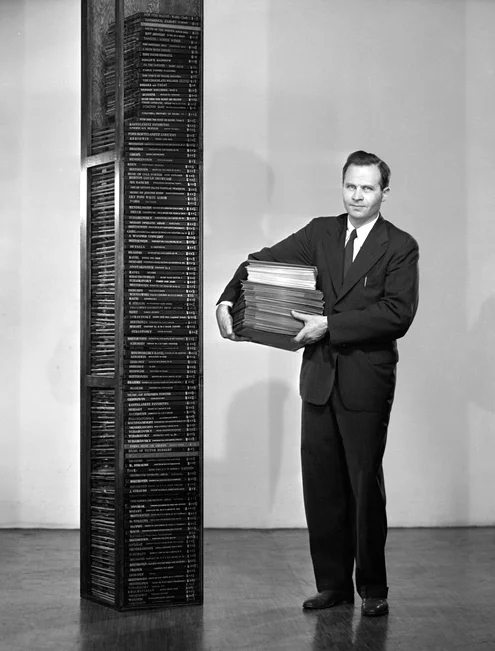
On June 18, 1948, Columbia disclosed the format to recording-industry executives in a private preview — the first time the technical specifications were openly shared outside CBS. Three days later, on June 21, Wallerstein staged the public announcement at the Waldorf-Astoria. He posed beside an eight-foot tower of 78 rpm albums while cradling a small stack of new LPs in his arms and told roughly forty reporters: "Gentlemen, what I hold in my hands represents the same amount of music contained in that giant stack of 78s." 3 The first catalog went on sale the same day: 133 recordings at $4.85 for a 12-inch classical disc, versus $7.25 for the equivalent on five 78s. 1
Two months before the public launch, Wallerstein had also offered the technology to RCA chairman David Sarnoff and proposed a shared license. Sarnoff declined. RCA's response was to develop its own competing format: the 7-inch 45 rpm single, launched March 31, 1949, with color-coded vinyl and a dedicated rapid changer. 2 The "War of the Speeds" lasted 18 months. Columbia made the LP format freely available to any label that wanted it, without licensing fees, on the calculation that — as historian Allan Sutton at Mainspring Press later put it — there was "little patentable about the LP" and it could only succeed through universal adoption. 3 Atlantic, Mercury, and M-G-M adopted the LP in early 1949. RCA's classical 45-rpm sets were outsold by Columbia's LP equivalents by a substantial margin. On January 4, 1950, RCA capitulated and announced LP production. Wallerstein noted with some satisfaction: "I was amazed when I learned that during the period in which RCA held out against the LP — that is, from June 1948 to January 1950, it lost $4.5 million." 3
Columbia sold 1.25 million LP records by the end of 1948. 2 By 1958, LPs held 58% of US recorded music dollar sales; the 78 had collapsed to 1.2%. 4 The format dominated home listening for thirty-five years — until cassettes overtook it in 1984. In 2022, vinyl sales in the US reached 41 million units, surpassing CDs for the first time since 1987, with vinyl revenue hitting $1.2 billion. 5
The decision mirror: Columbia's open-license choice has a pattern that shows up in technology platform wars repeatedly. When a format's commercial success depends on ecosystem breadth rather than per-unit margin, the company that subsidizes adoption beats the one that protects it. RCA's $4.5 million loss was the cost of a defensive IP strategy applied to a problem that needed network effects. Columbia had no patent moat to protect — so it built the moat out of installed base instead.
2003 — Google AdSense launches: the ad that paid for the internet
Before June 18, 2003, a website operator who wanted to earn advertising revenue had roughly two options: sell ad space directly to large advertisers (requiring a sales team and a large enough audience to be worth their time) or join a banner-ad network that paid fractions of a cent per impression and filled pages with animated GIFs for diet pills. Neither option worked for the long tail of the web — the independent blogs, niche news sites, and hobbyist directories that made up most of the internet but had no sales staff.
Google had acquired Applied Semantics, a Santa Monica company, on April 23, 2003, for approximately $102 million in cash and pre-IPO stock. Applied Semantics held a patent on CIRCA, a semantic text-processing technology that could read a page's content and select contextually relevant advertisements. The product name "AdSense" came with the acquisition. 6 After a March 2003 beta called "content targeting advertising," Google opened the self-service version to any publisher on June 18. Applicants filled out a form at google.com/adsense, waited for editorial review, and activated the service by pasting a snippet of HTML into their pages. Google's network at launch included more than 100,000 advertisers. 7
Sergey Brin (Google co-founder and president of technology at the time) framed the launch in terms of the web's ad environment: "Google AdSense improves the overall web user experience by bringing relevant, unobtrusive, text ads to web pages rather than disruptive, unrelated ads such as pop-ups and animations." 7
The revenue split Google offered was 68% to publishers for content ads, a rate that Google later confirmed had never changed from launch day until a 2023 restructuring — 20 years of unchanged economics. 9 Premium publishers at launch included ABC.com, HowStuffWorks, CNET, and Lycos Europe. Within ten years, the program had grown to more than 2 million publishers earning over $7 billion annually. 8 Google Network revenue — primarily AdSense — grew from $629 million in 2003 to $32.78 billion in 2022. 10
The model had a dark side. By giving any publisher a revenue stream tied directly to traffic volume and click-through rates, AdSense made low-quality content financially viable at scale. Demand Media (the operator of eHow and Livestrong.com) went public at a $2 billion valuation in January 2011 after building an industrial content-production operation optimized entirely for AdSense economics. Google's Panda algorithm update in February 2011 largely dismantled that model by demoting thin content in search rankings. 11
In November 2023, Google restructured the revenue share into separate buy-side and sell-side rates. The net effect for publishers remained approximately 68%, but the per-click payment model shifted to per-impression — aligning AdSense with the rest of the display advertising industry 20 years after launch. 12
The decision mirror: The 68% publisher split was an act of competitive generosity in 2003 — Google needed publishers to choose AdSense over rival networks, and paying them most of the revenue was the fastest way to do it. The structure also meant Google built its ad business on top of the open web rather than trying to own all the content itself. The content farms were a predictable downstream effect of the incentive structure Google created, corrected only when Google's own search product was threatened. Anyone deploying a marketplace or platform revenue-share model faces the same tension: the rate that attracts supply creates the incentives for supply.
2005 — Etsy launches: what eBay couldn't build in Brooklyn
Robert Kalin was a carpenter who built wooden computers and couldn't sell them on eBay. The platform wasn't hostile to what he made — it was just indifferent to it. eBay in 2005 was optimized for commodity goods, used electronics, and collectibles with clear price discovery. A one-of-a-kind handmade object, produced by someone who wanted to build a relationship with a buyer, had no natural home. 13
Kalin described his motivation: "We want to create new ways to shop that are only possible using the Web as a medium. The industrial revolution and consolidation of corporations are making it hard for independent artisans to distribute their goods. We want to change this." 14 He recruited co-founders Chris Maguire and Haim Schoppik, who moved into Kalin's Brooklyn apartment and spent six weeks coding almost continuously. Jared Tarbell joined remotely from Albuquerque. The stack was PHP, Python, PostgreSQL, OpenBSD, and Gentoo Linux. The name came from Kalin watching Fellini's 8½: "I was watching Fellini's 8½ and writing down what I was hearing. In Italian, you say 'etsi' a lot. It means 'oh, yes.' And in Latin and French, it means 'what if'." 15
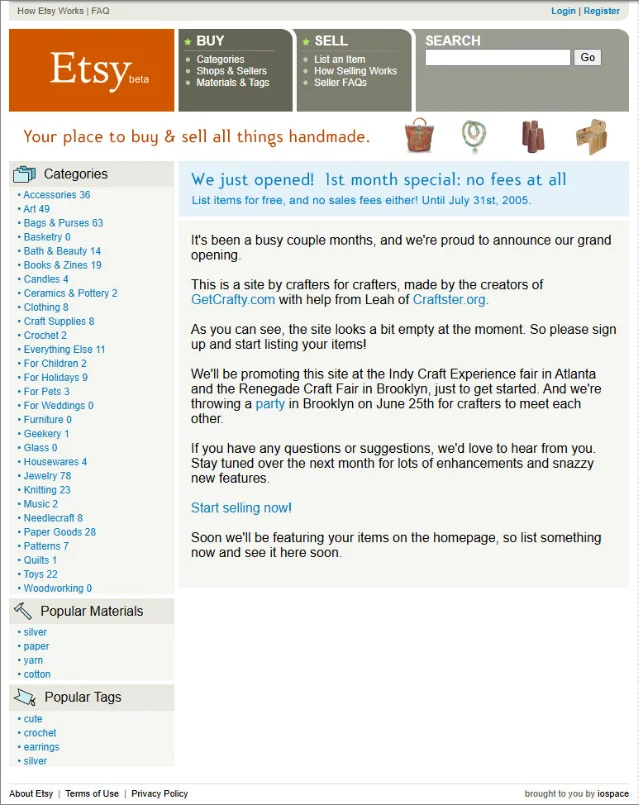
On June 18, 2005, Etsy went live. The business model was minimal: $0.10 per listing, 3.5% transaction fee, no advertising budget. 13 The first item sold was a cardboard owl sculpture, which subsequently became a permanent fixture in the Brooklyn office. By June 2006 — ten months in — Etsy had 10,000 registered sellers, 40,000 registered buyers, and more than 100,000 listings, all through word-of-mouth. Initial angel funding was approximately $193,000. 14
The growth arc that followed was nonlinear. Fred Wilson of Union Square Ventures joined the board in 2007 and described what made the community distinctive: "This is a low friction marketplace where buyers and sellers can transact without overhead. But it's also a fanatic community where users flag goods that aren't handmade and get them taken down quickly." 14 That self-policing dynamic — the community enforcing its own standards more aggressively than any platform algorithm could — was the moat eBay couldn't replicate.
Etsy went public on the Nasdaq on April 16, 2015, at $16 per share, raising approximately $267 million. 15 Shares closed the first day at $30, up 86%, on a pricing valuation of $1.8 billion. The company passed through a contentious period beginning in 2017, when activist investor Black-and-White Capital publicly pressured management over costs, the founder was ousted, and new CEO Josh Silverman (a former Skype and eBay executive) cut 22% of staff in his first two months. 16 The transaction fee rose from 3.5% to 5% in 2018 and to 6.5% by 2022. The take rate — total revenue as a share of gross merchandise sales — grew from roughly 10% in 2015 to 24.2% in 2025. 17
Etsy's 2025 full-year gross merchandise sales (GMS) were $11.92 billion, with the core Etsy marketplace contributing $10.46 billion. Total revenue reached $2.88 billion. 17 Kalin's $193,000 seed-funded experiment had become a $6.85 billion public company employing 5.6 million active sellers. The first item sold, a cardboard owl, is still in the office.
The decision mirror: Etsy's founding bet was that a niche too small for eBay could be a platform unto itself. The handmade market was not undersupplied — it was mis-categorized. Existing platforms served it poorly not because they didn't know it existed but because it didn't fit the unit economics of their core model. The question Kalin asked in 2005 — "what if the constraints of eBay are also the feature that makes eBay eBay?" — is a template for marketplace founders today. When a dominant platform under-serves a constituency, that constituency is usually a company waiting to be built. The moat is not the technology; it is the community that accretes around a use case the incumbent cannot prioritize.
Three June 18ths across 57 years: Columbia gave away a format and won the market. Google gave away 68 cents on every dollar and built the largest ad network on earth. Kalin charged a dime a listing and ended up with $10 billion in annual commerce. The pattern across all three is the same — the economics that looked like weakness turned out to be the mechanism of lock-in.
Cover image: AI-generated illustration.
参考ソース
- 1Library of Congress Blog: Inside the Archival Box — The First Long-Playing Disc
- 2Wall Street Journal: What Goes Around Comes Around Again — 75 Years of the LP
- 3Mainspring Press: Battle of the Speeds — LPs, 45s, and the Decline of the 78
- 4Wikipedia: LP record
- 5AEI: Recorded Music Sales by Format Share, 1973–2022
- 6Google Press Release: Google Acquires Applied Semantics
- 7Google Press Release: Google Expands Advertising Monetization Program for Websites
- 8Google: Celebrating 10 years of shared success
- 9WebmasterWorld: Google reveals Adsense revenue share
- 10Statista / Alphabet: Advertising revenue of Google network websites, 2001–2025
- 11Wikipedia: Google AdSense
- 12Google: Updates to how publishers monetize with AdSense
- 13VentureBeat: A brief history of Etsy, from 2005 Brooklyn launch to 2015 IPO
- 14Investment Talk: A History of the Bazaar of Digital Commerce
- 15Wikipedia: Etsy
- 16Retail Dive: Etsy to cut staff by 22% in 2017 amid turnaround
- 17Etsy Inc.: Q4 and Full Year 2025 Results
このコンテンツについて、さらに観点や背景を補足しましょう。