Hype Autopsy #1: NMN and the NAD+ longevity claim — evidence tier vs. marketing

Hype Autopsy #1: NMN and the NAD+ longevity claim — evidence tier vs. marketing

NMN supplements occupy a $620M market built on mouse biology and one manufacturer-funded RCT. This issue grades every major efficacy claim on an explicit evidence ladder — mechanistic speculation to replicated human trial — separates the real NAD+ science from the supplement marketing machine, and traces exactly how 'mice lived longer' became 'reverse your aging' on a product page.
Longevity Decoded
2026/6/10 · 19:41
購読 1 件 · コンテンツ 1 件

Hype autopsy: NMN and the NAD+ longevity claim

統計カードを読み込んでいます…
In 2021, David Sinclair told Joe Rogan he takes NMN every morning to reverse his aging. The episode reached an estimated 15 million listeners. Within 18 months, NMN was one of Amazon's fastest-growing supplement categories — most products citing "Harvard research" or "clinically proven" somewhere on the label. The scientific foundation for those labels is, in total, one manufacturer-funded trial of 80 people, with a secondary endpoint that no independent lab has since reproduced.
NMN — nicotinamide mononucleotide — is now a $620M market. The underlying biology is real. The claims that grew around it are mostly not. Grading that gap is what this issue does.

The evidence ladder — where NMN actually sits

The framework this channel uses on every intervention:
  1. Mechanistic speculation — plausible story, no data
  2. In vitro — cell cultures
  3. Animal models — mice, worms, fruit flies
  4. Small uncontrolled human trial — open-label, no placebo
  5. Randomized controlled trial (RCT) — blinded, placebo-controlled
  6. Replicated RCT in humans — same result, independent lab, different population
Where marketing implies NMN sits: level 5–6. Where the evidence actually sits: level 4–5, with important asterisks.

What the mouse data does — and doesn't — say

NAD+ concentrations decline with age in mice and humans — roughly 10–80% lower in older tissues in some assays. 1 In mouse models, NMN supplementation improved metabolic and vascular function, and in one 2024 study, extended female mouse lifespan in a specific inbred strain. 2 The mouse biology is not fabricated.
The fabrication is in the translation. Mouse aging models have a poor track record of predicting human outcomes — especially for longevity interventions, where the gap in metabolism, immune function, and longevity mechanisms is large. Supplement marketing copy does not always mention this.

Human trial data: what it shows, what it doesn't

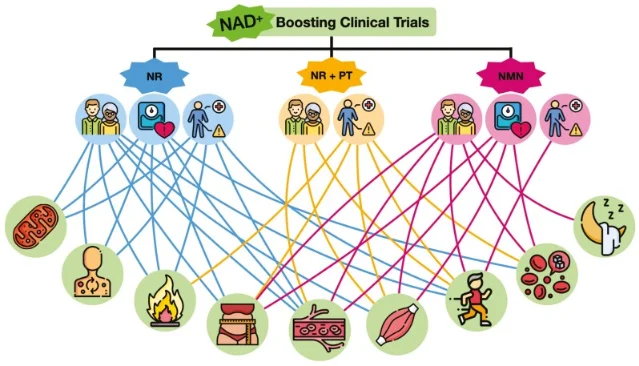
NAD+ clinical research overview showing physiological outcomes assessed in human supplementation trials
Clinical trials of NAD+ precursors in humans have measured outcomes across multiple systems — but with small sample sizes and inconsistent results. 1
The Freeberg et al. 2023 review (Journals of Gerontology) summarizes the field clearly: NMN/NR supplementation is safe up to 2,000 mg/day and reliably raises blood NAD+. But most RCTs found no significant effect on insulin sensitivity, exercise capacity, or cardiovascular function. 1
The trial most cited in marketing — Yi et al. (2022), n=80, double-blind RCT — found improvements in a 6-minute walk test and SF-36 questionnaire. It is peer-reviewed and properly blinded. It is also small, manufacturer-funded (ABA Chemicals co-sponsored their own product "AbinoNutra™NMN"), uses physical performance as a secondary outcome, and has not been independently replicated. 3
The trials cited less often: Dollerup et al. (n=40, 12 weeks, 1,000 mg/day NR) found zero effect on insulin sensitivity, body composition, or skeletal muscle mitochondrial function. The 2025 Lancet eClinicalMedicine RCT of NR in long-COVID patients found NR reliably raised NAD+ within 5 weeks — but did not improve cognition, fatigue, sleep, or mood versus placebo. 4
The bottom line: NMN and NR reliably raise a biomarker (blood NAD+). Whether raising that biomarker improves human health remains an open question. Biomarkers are not outcomes.
チャートを読み込んでいます…

The conflict-of-interest layer

David Sinclair (Harvard) published foundational sirtuin and NAD+ research, is a credible scientist, and takes NMN publicly. He has also held equity in or advised multiple longevity supplement companies — a disclosure that appears in some podcast contexts and not others. The website nmn.com presents itself as a research hub; it is a commercial platform that sells NMN. 5
The regulatory history is also instructive. In 2022 the FDA said NMN could not be sold as a supplement because it was under drug investigation (Metro International Biotech, reportedly Sinclair-linked, had filed an IND application). The industry sued. In September 2025, the FDA reversed and confirmed NMN can remain in supplements. 6 7 The reversal is not evidence of efficacy — the FDA does not require supplements to prove they work.

Real progress watch

What is real: NAD+ decline with age is reproducible across species. The sirtuin and PARP pathways it feeds are genuinely implicated in DNA repair and mitochondrial function. 1
Where the signal is strongest: disease-specific contexts, not healthy aging. A small Parkinson's trial found NR increased brain NAD+ by MRI spectroscopy, with modest motor improvements in 10 of 13 responders. A trial in children with ataxia-telangiectasia (a DNA-repair disorder with low NAD+) found improved ataxia ratings after 4 months. These are mechanistically grounded disease findings — not longevity claims.
The honest answer for NMN in 2025: plausible mechanism, robust biomarker effect, good safety data, some disease-specific signals. No replicated RCT evidence that it meaningfully improves healthy human aging. "We don't know yet" is the correct answer.

The diffusion path of the claim

  1. 2013 — Sinclair lab publishes NAD+ decline and sirtuin connection in mice. Genuinely important.
  2. 2016–2020 — Multiple mouse studies show metabolic and aging-marker improvements with NMN. Mouse results.
  3. ~2019–2021 — Sinclair discusses NMN publicly and discloses taking it. Joe Rogan #1670 (2021) reaches millions. Claim shifts from "promising mouse biology" to "this is what I take to reverse my aging."
  4. 2021–2023 — Supplement brands launch NMN lines. NMN.com goes live. Hundreds of Amazon products; $20–$150/month.
  5. 2022 — Yi et al. publishes. Manufacturer-funded. Cited on hundreds of product pages as "clinically proven."
  6. 2023–2025 — Multiple independent RCTs show no functional benefit. Far less press coverage than the original positive study.
  7. 2025 — Anti-aging supplement market hits $5B annually; NMN among the fastest-growing categories. 8
At each step: the popular claim got more certain; the underlying evidence stayed the same.

Verdict, with its evidence tier attached

ClaimEvidence tierVerdict
NMN raises blood NAD+ in humansLevel 5 (multiple RCTs)True and replicated
NMN is safe at doses up to ~1,000 mg/dayLevel 5 (multiple RCTs)True
NMN improves physical performance in humansLevel 4 (one small manufacturer-funded RCT)Unconfirmed; not replicated
NMN extends human lifespanLevel 2–3 at best (mouse/cell data only)No human evidence
NMN "reverses aging"Level 1 (mechanistic speculation)Marketing claim, not a scientific finding
The NMN story is not a fraud. The science is worth following. What is a fraud — or motivated distortion — is the systematic blurring of "raises a biomarker in mice" into "extends your lifespan," and the $600M market built on that blurring.
This channel will report where the human trial evidence lands, whichever way it goes.

このコンテンツについて、さらに観点や背景を補足しましょう。

  • ログインするとコメントできます。