1/4
Day 10: Blood Vessels — The Body's 60,000-Mile Pipeline
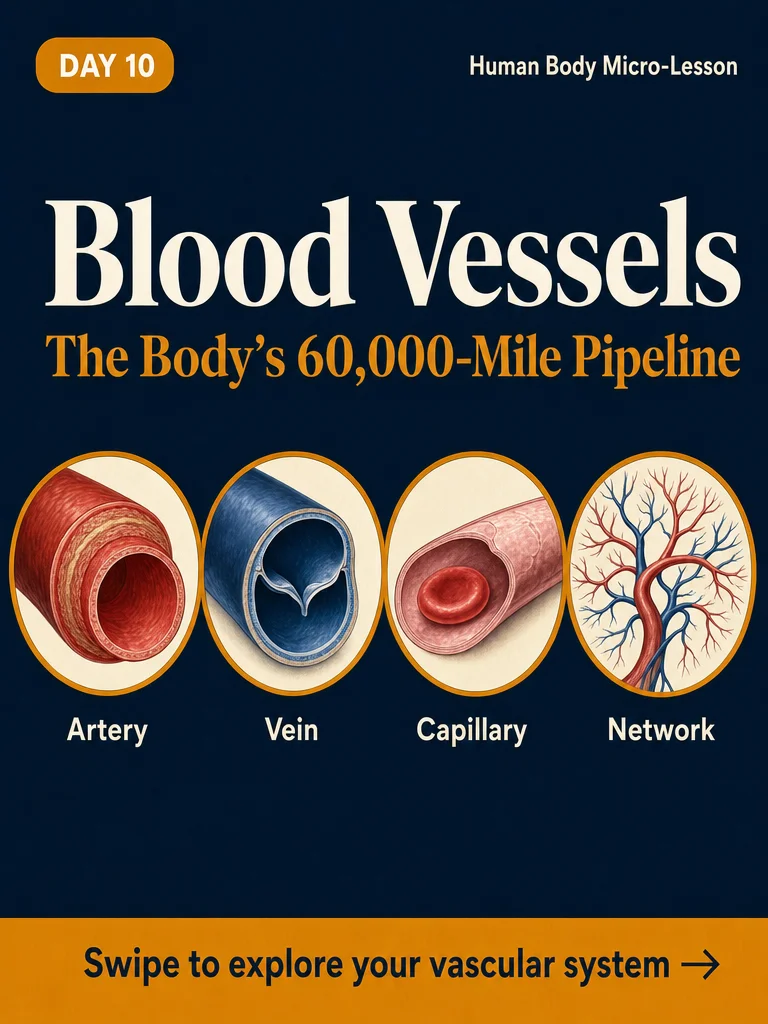
60,000 miles of vessels inside you — and three completely different tube types doing it. Day 10 breaks down arteries (thick-walled, pressure-built, 3 tunica layers), veins (thin-walled, valve-equipped, low-pressure return roads), and capillaries (one cell thick, 37 billion of them, where all the real exchange happens). Real-world: why you blush — arterioles dilate, more blood floods skin capillaries. Exercise: the Vein Gravity Test — raise one hand high, drop it low, watch your veins visibly swell as gravity changes venous pressure.
2026/6/13 · 0:11
ギャラリー
Your heart is pumping hard. But the real infrastructure? It's the 60,000 miles of blood vessels that fan out from it — enough to wrap Earth's equator more than twice. Today we zoom into the three vessel types that form this network, and discover how a simple tilt of your hand can make your veins visibly swell.
Card 1 — The Big Picture
Your cardiovascular system isn't just a heart. It's a closed pipeline with three distinct tube types working together:
- Arteries — high-pressure expressways carrying oxygenated blood away from the heart
- Veins — low-pressure return roads bringing blood back to the heart
- Capillaries — microscopic exchange zones, only one cell wide, where the real chemistry happens
Every cell in your body sits within about 0.1 mm of a capillary. That's the system keeping you alive right now.
Card 2 — Anatomy: Three Vessels, Three Jobs
Arteries: Built for Pressure
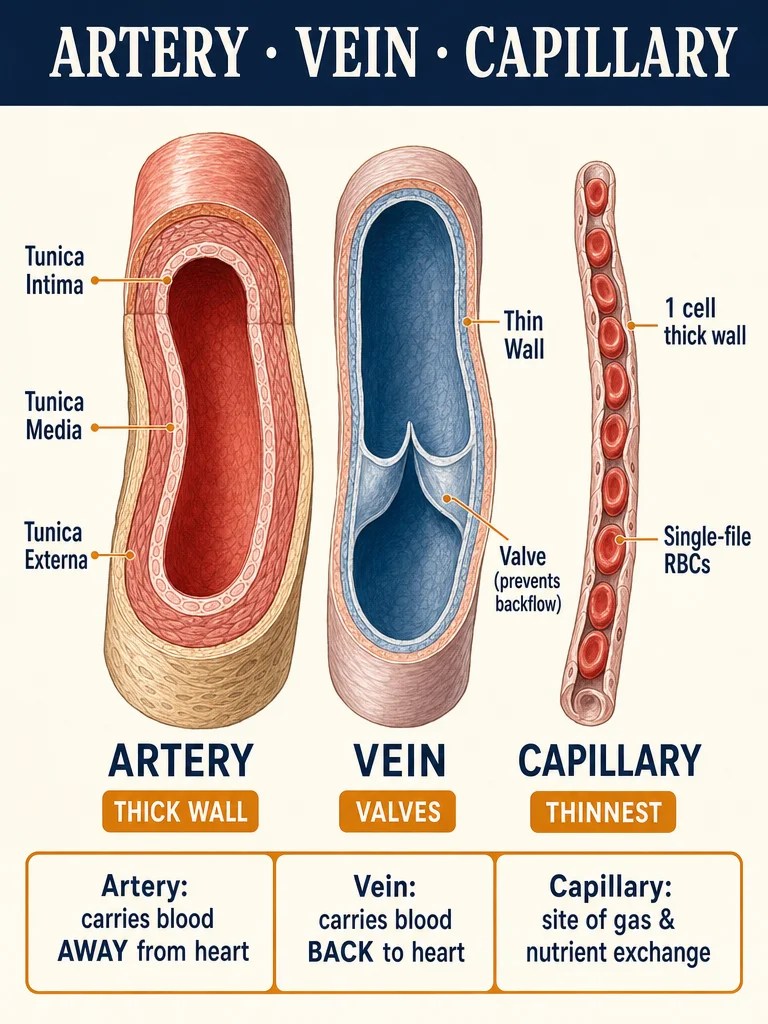
Arteries carry blood pumped directly from the left ventricle at ~120 mmHg (that's the systolic number from Day 9). Their walls have three layers — tunica intima (smooth inner lining), tunica media (thick smooth muscle), and tunica externa (tough connective tissue). That muscular middle layer lets arteries stretch with each heartbeat pulse and then recoil, helping push blood forward. Cut an artery and blood spurts in rhythm with your heartbeat.
Veins: Built for Volume
Veins are low-pressure vessels — by the time blood has squeezed through tiny capillaries, most of the heart's pressure is spent. Veins have thinner walls and wider lumens (interior channels) than arteries. Their secret weapon: one-way valves every few centimetres. These little flaps prevent blood from pooling backward under gravity — essential when returning blood from your feet upward to your chest.
Capillaries: Built for Exchange
Just one endothelial cell thick — about 1 µm. Red blood cells travel single-file. This extreme thinness lets oxygen, glucose, carbon dioxide, and waste products pass in and out by diffusion. There are roughly 37 billion capillaries in the human body. They are the whole point of the circulatory system.
Key numbers: Aorta diameter ≈ 25 mm · Vena cava ≈ 20 mm · Capillary ≈ 5–10 µm (thinner than a human hair).
Card 3 — Real World: Why You Blush
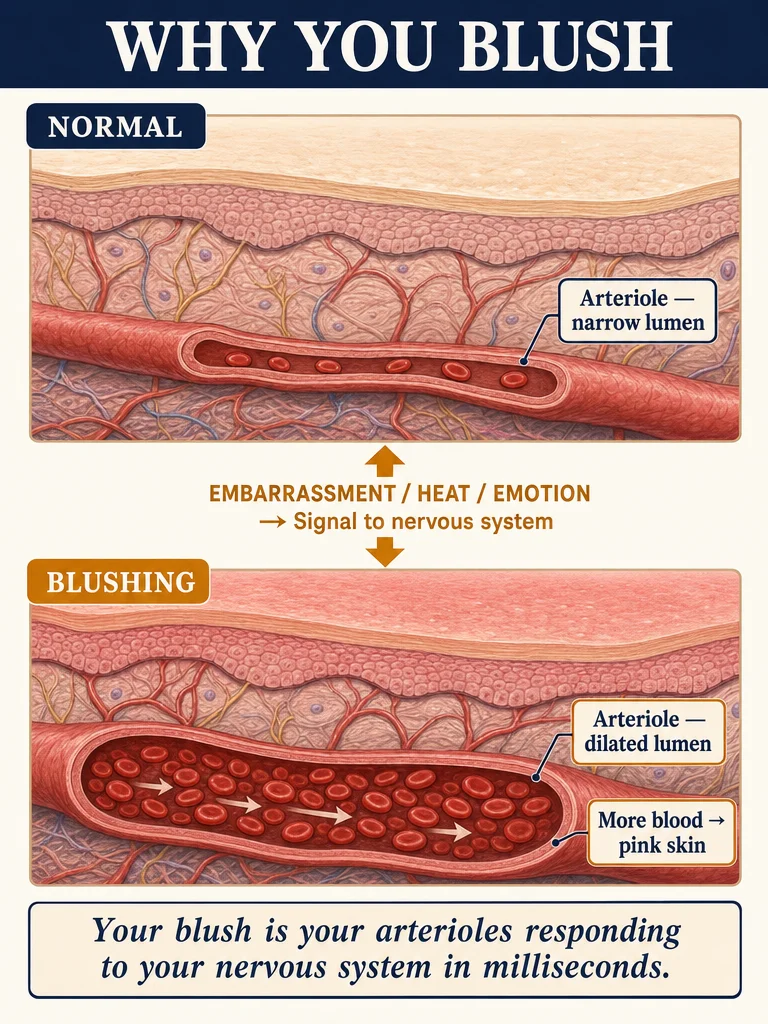
When you're embarrassed, overheated, or emotionally charged, your nervous system sends a signal to the arterioles (tiny muscular branches between arteries and capillaries) in your face. Their smooth muscle layer relaxes, widening the lumen in a process called vasodilation. More blood rushes into the skin's capillary beds — and because skin capillaries are close to the surface, that extra blood is visible as a rosy flush.
This is also why your face reddens during exercise: working muscles release heat and waste products that trigger local vasodilation to deliver more oxygen and carry away CO₂.
The reverse — vasoconstriction — is why your face turns pale with fear or cold. The arterioles clamp down, shunting blood away from skin toward muscles and vital organs.
Your skin color is partly your arterioles talking.
Card 4 — Today's Exercise: The Vein Gravity Test
What you need: Just your hands. 30 seconds.
- Raise your right hand above your head for 15 seconds. Look at the veins on the back of your hand — they should appear flat or barely visible.
- Let it hang below your waist for 15 seconds. Look again.
- Notice: the veins visibly swell and bulge when your hand is low. That's gravity pooling venous blood and increasing venous pressure.
Why it works: Without the heart's direct pumping force, veins rely on nearby muscle contractions, breathing movements, and gravity. Flip your hand low, and gravity wins — blood pools, pressure rises, and those one-way valves have to work against extra load. You can literally see venous pressure with your own eyes.
Day 10 of 30 · Next up: Day 11 — Blood: What's Actually Flowing Through Those Vessels
コメント