The Dining Room That Ate Its Owner

The Dining Room That Ate Its Owner

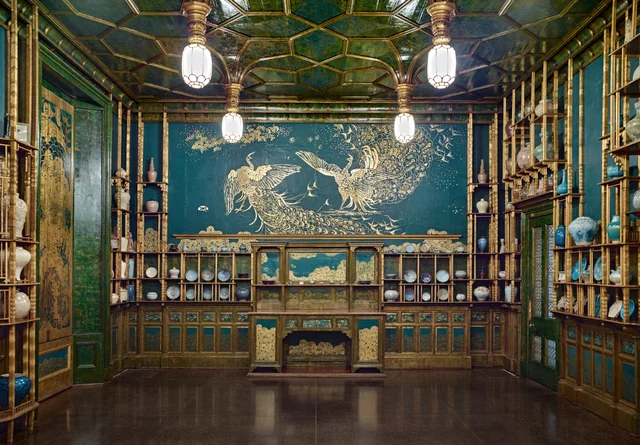
In the winter of 1876, James McNeill Whistler was asked to touch up the colors in a Liverpool shipping magnate's dining room. He kept going for six months — covering sixteenth-century Spanish gilded leather with Prussian blue, gilding carved walnut shelving with dutch metal foil, and painting the ceiling from a hammock — until the entire room became a single immersive painting. The result, Harmony in Blue and Gold: The Peacock Room (Freer Gallery F1904.61), is the only surviving intact Whistler interior, a masterwork of the Aesthetic Movement and Anglo-Japanese design. This is the story of its creation, the feud that produced its most famous image, and the improbable journey — through Detroit and eventually the National Mall — that made it the founding gift of America's first Asian art museum.
si.eduarchive.orgsmithsonianmag.comほか 9 件のソース
Museum Artifact Story Pick
2026/6/18 · 23:31
購読 2 件 · コンテンツ 36 件
In the winter of 1876, a painter went quietly mad with joy in a borrowed room in Kensington.
James McNeill Whistler — American-born, Paris-trained, habitually broke, and possessed of a dandy's certainty that his taste surpassed everyone else's — had been asked to advise on a color scheme for the dining room at 49 Princes Gate. The room belonged to Frederick Richards Leyland, a Liverpool shipping magnate who collected Pre-Raphaelite paintings and Chinese porcelain in roughly equal measure, and who had recently spent years and a fortune transforming his London townhouse into something he hoped would feel like "the life of an old Venetian merchant in modern London." 1
The architect Thomas Jeckyll (1827–1881) had already fitted the room with an ingenious system of carved walnut shelves for Leyland's Kangxi porcelain, hung Tudor-pendant ceiling panels overhead, and installed sixteenth-century Spanish gilded leather — Cuir de Cordoue embossed with Catherine of Aragon's pomegranate crest and red Tudor roses — along the walls. 2 Jeckyll had then fallen ill and left the project. What he had built was already remarkable. Whistler was only supposed to touch up the colors.
Leyland went north to Liverpool on business. Whistler stayed behind and, as he later told it, simply kept going.
"I just painted on. I went on — without design or sketch — it grew as I painted. And toward the end, I reached such a point of perfection — putting in every touch with such freedom — that when I came round to the corner where I started, why, I had to paint part of it over again, as the difference would have been too marked. And the harmony in blue and gold developing, you know, I forgot everything in my joy in it!" 2
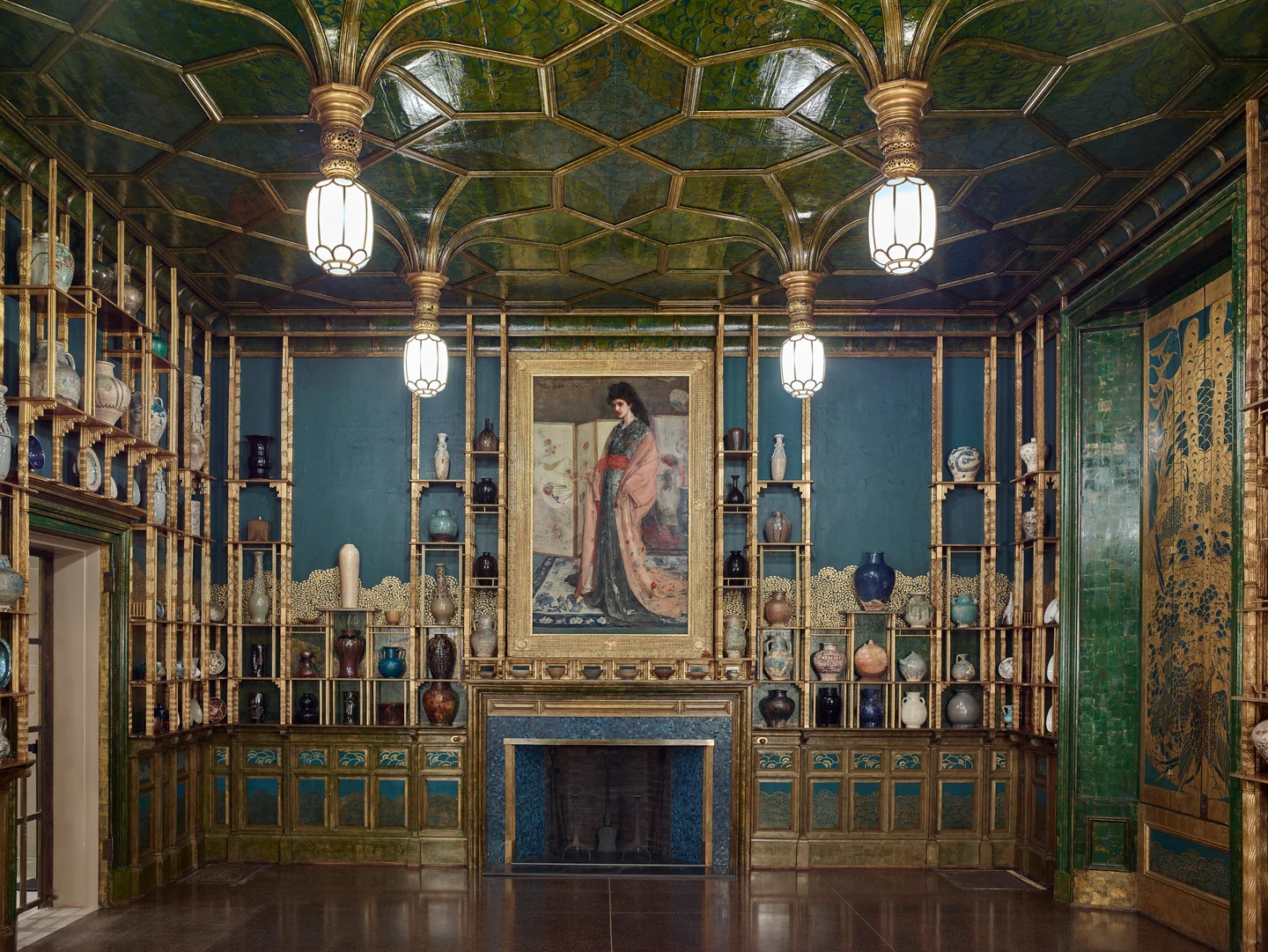
By the time Leyland returned in October 1876, his dining room no longer existed. In its place stood something that had no name yet in the English language — a total work of art, an entire room conceived as a single immersive painting, from the Prussian-blue-and-gold peacock feathers cascading across every panel of leather to the gilded scales that Whistler had applied to the carved walnut shelves using sheets of dutch metal beaten into the grain. The ceiling, which Jeckyll had designed with Tudor pendant panels, was now an intricate canopy of peacock-eye motifs worked in dutch metal squares, painted while Whistler lay on a hammock swung beneath it, manipulating brushes lashed to fishing rods. 3
The result — Harmony in Blue and Gold: The Peacock Room (accession F1904.61, Freer Gallery of Art) — now fills Gallery 12 of the Freer Gallery of Art at the Smithsonian's National Museum of Asian Art in Washington, DC. It measures 421.6 × 613.4 × 1026.2 centimeters (roughly 166 × 241 × 404 inches) and is the only surviving intact interior decoration by Whistler. 1 Art historians classify it within the Aesthetic Movement and Anglo-Japanese style, and regularly describe it as one of the most significant proto-installation artworks of the nineteenth century. 4 What those labels compress into bureaucratic tidiness is a story of breathtaking artistic ambition, spectacular personal betrayal, a Victorian lawsuit that changed the history of art criticism, and a room that passed through three hands before it found a permanent home — and changed the museum that received it.

A room within a room

To understand what Whistler did, it helps to understand what the dining room was supposed to be. Leyland (1831–1892) was a self-made man who had started as an office boy at the Liverpool shipping firm John Bibby and Sons, taken control of the company by thirty, and renamed it Leyland Line. 5 Whistler called him "the Liverpool Medici," not entirely as a compliment. Leyland dressed in a signature style of ruffled Flemish shirts — which would come to matter later — and his ambition for 49 Princes Gate was to fill every room with art that reflected his cultivated taste, not mere money. 3
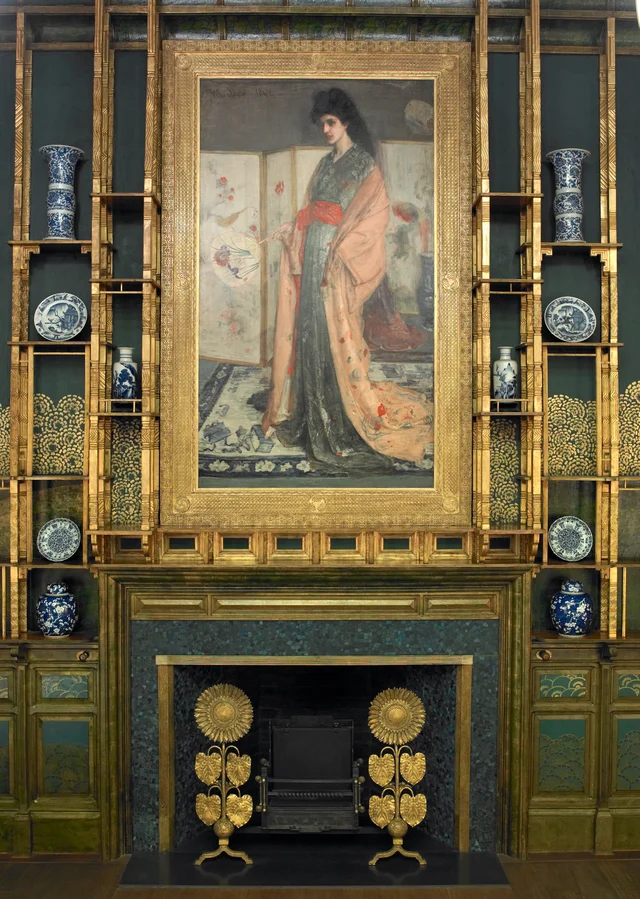
The dining room's anchor was a painting Whistler had sold him in 1865: Rose and Silver: The Princess from the Land of Porcelain (accession F1903.91a-b), a canvas of 199.9 × 116.1 centimeters depicting a Western woman — Christine Spartali, daughter of the Greek consul-general in London — dressed in a pink-and-silver kimono, holding a fan, standing before a six-panel screen. 4 The model had never been to Japan. Whistler had never been to Asia either. The painting belonged to a series of "costume pictures" he made in the 1860s, constructing imaginary Orient-spaces from objects he collected at London and Paris shops dealing in Japanese and Chinese wares — the visual equivalent of how the Aesthetic Movement generally treated Japan: as a distant, dreamlike reservoir of compositional ideas rather than a living culture. 6
The Princess from the Land of Porcelain above Jeckyll's sunflower andirons, with gilded shelves flanking the fireplace
Rose and Silver: The Princess from the Land of Porcelain (1863–65), oil on canvas, 199.9 × 116.1 cm 4
Leyland hung The Princess over the fireplace at the north end of the dining room, where Jeckyll had positioned his most distinctive piece: a pair of gilded sunflower andirons — fireplace fender ornaments — cast in a distinctively Anglo-Japanese style, with radiating petals in hammered gold. Above the painting, the walnut shelves stepped outward in receding tiers, holding dozens of Kangxi blue-and-white porcelain pieces acquired from Murray Marks, Leyland's principal dealer. The room was conceived as a setting for the painting, and the painting as the room's centerpiece.
The problem Whistler identified was color. The red flowers on the Spanish leather and the red border of Leyland's carpet conflicted, he told Leyland, with the pinks and silvers in The Princess. Leyland agreed to let Whistler "touch up" the leather flowers, replacing the red with yellow. While he was at it, Whistler proposed a wave pattern along the cornice. Leyland assented. He then left for Liverpool.

The months of transformation

What followed over the autumn and winter of 1876–77 remains one of the strangest episodes in the history of Western decoration. Whistler, with no patron present to restrain him, with no contract beyond a verbal understanding that had been limited to small adjustments, simply continued painting.
He painted the leather Prussian blue-green — covering the entire surface, including Leyland's expensive Cuir de Cordoue that had cost £1,000 to acquire. 2 He applied dutch metal foil — an alloy of copper and zinc that imitates gold leaf — to the walnut shelves, then glazed it in transparent green. He covered the Tudor pendant ceiling in a dense pattern of peacock-eye roundels, each worked in dutch metal and deep Prussian blue. He painted the three tall east-wall shutters on their inner faces: when closed, the shutters show large blue peacocks on a gold background — reversing the room's color logic, gold-on-blue becoming blue-on-gold — and when open, they reveal a private garden in South Kensington. 4
East wall with closed painted shutters and gilded shelves bearing Chinese porcelain
The east wall's full-height shutters, painted with blue peacocks on gold, flanked by shelves still holding Chinese blue-and-white porcelain. 1
Whistler recruited helpers — the painter brothers Walter and Henry Greaves — and settled into a routine of arriving before dawn and painting until dusk. He received visitors while at work, including Prince and Princess of Teck and the Marquess of Westminster, distributing press releases printed by his friend Thomas Way that described the room as it took shape. These press releases — arguably the first modern artist's PR documents — generated newspaper coverage that further enraged Leyland when he eventually read them: his private home was being publicized as Whistler's public exhibition. 2
There had been one intermediary letter. In August 1876, Whistler wrote to reassure Leyland that he had "carefully erased all trace" of an early experimental blue application and was leaving the leather "perfect and complete," with only a wave pattern added above and below on a gold ground. 4 This was technically true — at the moment he wrote it. By the time Leyland arrived back in London in mid-October, every square centimeter of leather, every panel, every shelf, and every square inch of ceiling had been repainted.

The quarrel that produced a masterpiece
The financial dispute that followed has been rehearsed often enough to become legend. Whistler demanded 2,000 guineas — the currency gentlemen used to pay artists — for six months of unauthorized work. The initial agreement had been 500 guineas, later raised in correspondence to 1,000. Leyland, furious at the appropriation of his home and the liberties taken with his leather, offered 1,000 pounds. 3
The difference between pounds and guineas was not merely arithmetical. A guinea equaled 21 shillings; a pound equaled 20. By convention, gentlemen paid artists in guineas — the extra shilling being a token of cultural recognition. Payment in pounds was what you gave tradesmen. Leyland's choice of currency was a deliberate insult, a reclassification of Whistler's work from art to commerce.
Whistler's response was to paint the south wall.
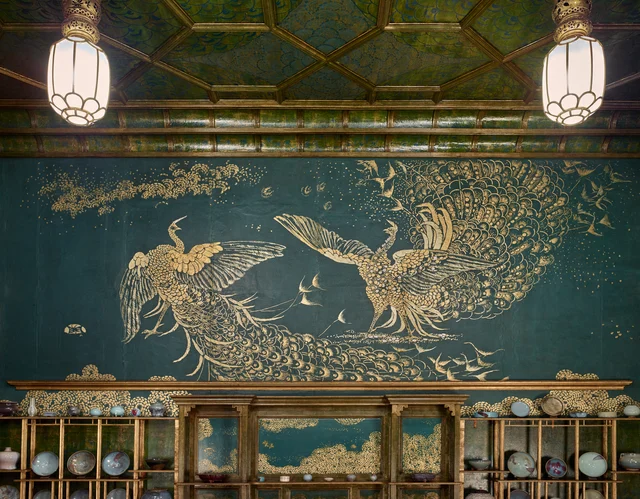
He had originally planned to hang another large canvas — Three Figures: Pink and Grey, now in Tate Gallery, London — opposite The Princess. Instead, across the empty leather panels above the Welsh dresser, he painted Art and Money; or, The Story of the Room: two large fighting peacocks in silver and gold against the Prussian blue ground. The right bird, aggressive and ruffled, with silver frills around its neck mimicking Leyland's signature shirts, has coins scattered at its feet — one claw resting on a pile of silver shillings. The left bird, with a delicate silver crest resembling Whistler's own streak of white hair, holds its ground with composed dignity. 1 Whistler completed the mural on 4 December 1876 and named it in French — L'Art et l'Argent — for the aristocratic resonance.
The south wall mural Art and Money: two fighting peacocks in gold and silver on Prussian blue
Art and Money; or, The Story of the Room (1876), the south wall mural: the ruffled peacock (Leyland) with coins at its feet faces the crested peacock (Whistler). 3
"I refer you to the Cartoon opposite you at dinner," Whistler wrote to Leyland's wife, "known to all London, as L'Art et l'Argent or the Story of the Room." 2 Leyland banned Whistler from the house. Whistler told a reporter that Leyland would go down to posterity "like the man who paid Correggio in pennies!" 7 Leyland reportedly called Whistler "an artistic Barnum" and threatened to horsewhip him if he went near Frances Leyland. 3
The room's architect did not survive the news. Thomas Jeckyll, who had already left the project in fragile health, reportedly saw the transformation of his design and suffered a collapse. According to Whistler's biographers Joseph and Elizabeth Pennell, he was discovered at home covering his studio floor with gold leaf, "gilded his floor, and forgot his grief in a mad house." He was confined to an asylum and died there in 1881. 4 Whistler, who had known Jeckyll for years, wrote to Jeckyll's brother expressing genuine grief, and later acknowledged in the press that Jeckyll had designed the room's structural elements. The episode remains one of the sadder footnotes to the room's creation.
Meanwhile, 1876 gave way to 1877, and the broader art world was absorbing its own Whistler-related shock. The Grosvenor Gallery opened on Bond Street that spring — the same season the Peacock Room was finished — and exhibited several Whistler nocturnes. The critic John Ruskin (1819–1900), who had spent forty years as the arbiter of British taste, attacked Whistler in print for his Nocturne in Black and Gold: The Falling Rocket, accusing him of "flinging a pot of paint in the public's face" and charging 200 guineas for it. 8 Whistler sued for libel. The 1878 trial became a referendum on what art was permitted to be — pure sensation versus moral instruction, paint-as-music versus paint-as-narrative — and the Aesthetic Movement hung in the balance of its verdict.
Whistler won, technically. The jury awarded him one farthing in damages — the smallest coin in British circulation — and no legal costs. The costs broke him financially: he was declared bankrupt in 1879, with Leyland as one of his principal creditors. 9 Before losing his Tite Street house, Whistler painted one last broadside: The Gold Scab: Eruption in Frilthy Lucre (The Creditor) (1879, de Young Museum, San Francisco), depicting Leyland as a demonic peacock crouched on Whistler's house, playing the piano — in the exact blue-and-gold palette of the Peacock Room. 3
Leyland, for his part, kept the room exactly as Whistler had left it and dined in it every night until his death on 4 January 1892. As the Freer Gallery curator Lee Glazer has noted: "He sat in that room at the head of his table looking at that vicious portrait of himself as an avaricious peacock with ruffled feathers, until he died. So, he must have secretly understood the value of Whistler's work." 6

The room's transit: from Kensington to Detroit to the National Mall

After Leyland's death, 49 Princes Gate passed to a brewing family. Leyland's porcelain collection was dispersed at auction; his Princess from the Land of Porcelain sold at Christie's on 28 May 1892 to the Glasgow dealer Alexander Reid, who sold it to the shipping magnate William Burrell, who sold it in August 1903 to an American. 4
That American was Charles Lang Freer (1854–1919), a Detroit industrialist who had made his fortune manufacturing railway freight cars through the American Car and Foundry Company he helped assemble in 1899, and who had spent the years since his retirement building what would become the world's largest collection of Whistler's work — 1,189 pieces eventually. 10 Freer had first encountered Whistler's etchings in 1887 at the New York apartment of the lawyer Howard Mansfield, bought immediately, and three years later introduced himself to Whistler in London. The two became close friends, traveling together and corresponding until Whistler's death in July 1903.
One year after Whistler's death, Freer learned that the Peacock Room itself was available. The new owner of 49 Princes Gate, Mrs. James Watney, had never liked the room and was prepared to sell it intact. Freer telegrammed his misgivings to a London dealer: "The architectural design of the shelving and ceiling I have never liked, and I think if they were taken down and replaced in some other room, the result would never be particularly interesting." 2 He wanted only the shutters and panels.
He reversed course within weeks. On 16 May 1904, through the London dealer Obach & Company, Freer purchased the entire room. It was dismantled into 27 crates and shipped across the Atlantic to Detroit, where Freer had a purpose-built annex constructed at his Ferry Avenue residence to receive it. 11
Freer promptly filled the shelves with more than 250 ceramics from his own collection — Syrian, Iranian, Japanese, Chinese, Korean, and pieces from Detroit's Pewabic Pottery — treating the room as a demonstration of what he considered art's fundamental unity across cultures and centuries. He consistently called it "the blue room" rather than the Peacock Room, finding the latter name "too sensational." 2 He believed Whistler "more than any other contemporary artist united the art of the West with that of the Orient," and the room served as physical evidence of that conviction. 6
In December 1905, Freer wrote to President Theodore Roosevelt proposing to bequeath his entire collection — approximately 9,500 works — to the Smithsonian Institution, along with a $1 million endowment for a building. The Smithsonian's Board of Regents accepted in May 1906, making it the first private donation of a complete art collection to the United States government. 10 Freer stipulated three conditions that still shape the museum today: no outside donations to the permanent collection; no temporary exhibitions of non-collection works; no loans of any permanent collection objects. (The no-loans clause was later modified by court ruling, though the Peacock Room itself remains in place.)
Freer died in New York on 25 September 1919. The Freer Gallery of Art broke ground in Washington in 1916 but was delayed by the First World War; it opened to the public on 2 May 1923, the first art museum on the National Mall. The Peacock Room was installed as the collection's centerpiece, and has remained there ever since. 6

What the room is, and what it changed

Walking into Gallery 12 at the Freer today, a visitor enters a room that operates simultaneously on three registers.
The first is purely sensory. The walls read at a distance as a deep blue-green — roughly the color of a peacock's neck in shadow — broken by the warm gold of the shelving and the wave-and-feather patterns Whistler applied to every surface. The ceiling floats above in gilded hexagonal coffers packed with peacock-eye motifs. Pendant lanterns (originally gas fittings, now electric) cast warm pools of light that make the dutch metal shimmer with a depth real gold leaf would not. The east wall's shutters, currently open, reveal layers of blue peacocks when folded back. Four butterfly signatures — Whistler's personal cipher, which he developed in the 1860s as a compressed "JW" monogram — are hidden across the room: on the central window shutter, in the ceiling's southwest corner, on the cabinet top, and at the left end of the long panel above the dresser. 4
The second register is art-historical. The room is the most complete surviving example of the Gesamtkunstwerk — the "total work of art" — in English-speaking decorative arts, a concept usually associated with Richard Wagner's operatic theory but here achieved in a domestic interior. 2 Every surface is subordinated to a single color harmony; there is no element that was not deliberately resolved as part of the whole. The Japonisme running through the room — the flat decorative planes, the asymmetrical feather patterns, the preference for implied over stated form — draws directly from the Hiroshige and Hokusai woodblock prints that Whistler collected through Parisian dealers in the 1860s, following Japan's reopening to trade in 1858 and its debut at the 1862 London International Exhibition. 12 The room's influence on later designers is traceable: the Vienna Secession's ornamental language, Art Nouveau interiors throughout Europe, and Frank Lloyd Wright's organic approach to architectural space all share the Peacock Room's foundational assumption that interior design is not decoration applied to architecture but a single coherent artistic act.
Whistler also used the room to advance a more pointed intellectual argument. The musical titles he gave his works — Harmony, Symphony, Nocturne, Arrangement — were partly Leyland's idea: it was Leyland, a devoted Chopin fan, who suggested "Nocturne" as a replacement for Whistler's "moonlights" in 1872. Whistler wrote back that the name was "an irritation to the critics and consequent pleasure to me — besides it is really so charming and does so poetically say all I want to say and no more than I wish." 13 The Peacock Room's title — Harmony in Blue and Gold — belongs to the same system, insisting that the room be judged as a painter judges a canvas: by its tonal relationships, not by its narrative content or moral instruction. This was exactly the position Ruskin had attacked in the 1878 trial, and which Whistler spent his career defending.
The third register is personal and vindictive, and it is the one that makes the room live. The fighting peacocks on the south wall are not allegory in the polite Victorian sense — not encoded mythology to be decoded by a gentleman's classical education. They are a portrait, a libel pinned to the wall of the very house they defame, in the language of the room itself. Leyland could not remove them without destroying what had become the room's centerpiece. He could not redecorate without conceding that Whistler's vision had been right all along. So he sat across from his own image, ruffled and coin-footed, and ate his dinner.

A room still in motion

The Peacock Room has required active care at every stage of its life. A 1949 conservation project by John A. Finlayson and Richard M. Finlayson of the Museum of Fine Arts, Boston, involved removing and treating the ceiling — itself a testament to the structural ambition of Jeckyll's original armature, which had survived the Atlantic crossing in 27 crates. The room was modernized with air conditioning in 1957, set to maintain 50 percent relative humidity to stabilize the painted leather surfaces. 14
In 2022, conservators Jenifer Bosworth and Ellen Chase of the National Museum of Asian Art undertook the first comprehensive surface treatment in thirty years, working across the walls, ceiling, and woodwork with small brushes to clean and consolidate individual strokes of paint. The process offered close readings of Whistler's technique: the dutch metal foil applied with different densities across the shelving, the oil glazes in varying dilutions that give the walls their slightly iridescent depth, the areas where Whistler's assistants' hands can be distinguished from his own by the regularity of their work. 14 The 2022 reinstallation drew on George Swain's 1908 photographs of the room in Freer's Detroit home to identify roughly 250 of the ceramics visible in those images and return them to the same shelf positions — a form of historical reconstruction made possible by the accidental thoroughness of Freer's own documentation. 11
The current exhibition, "The Peacock Room in Blue and White," opened 27 September 2025, presenting the shelves as they might have appeared under Leyland — filled with blue-and-white Kangxi-style porcelain, including new commissions produced in Jingdezhen in 2019 to approximate the originals that Leyland's heirs auctioned off in the 1890s. 1 A companion exhibition, "Ruffled Feathers: Creating Whistler's Peacock Room," continues in Gallery 11 through January 2027, presenting drawings, correspondence, and studies that document the room's creation. 7
What Leyland got — what he kept, resentfully, until he died — turns out to have been the founding document of the museum that now holds it. Freer's conviction that Whistler's room belonged in the same building as Asian art was not a category error but a critical insight: the room's entire visual program argues for the irrelevance of the distinction between Eastern and Western aesthetic traditions. A Liverpool shipping heir's dining room, transformed without permission into one man's argument about what art could be, crossed an ocean twice and ended up as the permanent home of a collection dedicated to exactly that argument. The room outlasted everyone who thought they owned it.

このコンテンツについて、さらに観点や背景を補足しましょう。

  • ログインするとコメントできます。