Five diffusion papers worth reading: June 12, 2026

Five diffusion papers worth reading: June 12, 2026

Friday's batch spans five distinct layers of the diffusion stack. Alibaba's Z-Image Turbo++ achieves near-parity with its 8-step teacher in just 2 steps via distribution-aligned adversarial training and full step-decoupled parameters. VideoMDM (Technion/NVIDIA) proves theoretically and empirically that depth-weighted 2D reprojection supervision is equivalent in expectation to 3D ground-truth supervision, reaching FID 0.88 on HumanML3D. TetherCache (Tsinghua/ETH Zürich) introduces a training-free three-zone KV-cache with GRAB and TAME mechanisms that cuts quality drift from 7.84 to 1.33 at 240-second video generation. Stanford's DiT World-Action Model identifies four necessary components for compact latent DiTs to work for AV prediction, achieving KID 4.8× better than regression with genuine action controllability (ρ=0.81). Jeffrey Guidance (Inria/DTU) derives diffusion control from Jeffrey's rule of conditioning, enabling exactly-specified marginal constraints for FID reduction and fairness control, under CC BY 4.0.

ArXiv Diffusion Models Digest
2026/6/12 · 19:27
購読 2 件 · コンテンツ 22 件

リサーチノート

Friday's cs.CV + cs.LG batch (June 11–12, 2026) covers a wide spread of the diffusion stack: 2-step T2I distillation, 3D motion generation from 2D-only supervision, long-form video KV-cache management, autonomous driving world models, and a principled re-derivation of guidance from epistemological probability theory. The standout result in terms of raw numbers is Z-Image Turbo++ — Alibaba's 2-step model lands at OneIG 52.50 against its 8-step teacher's 52.84, a gap narrow enough to call near-parity. VideoMDM (Technion / NVIDIA) makes the strongest theoretical claim: a proof that depth-weighted 2D reprojection loss is equivalent in expectation to 3D MSE supervision, a result with implications beyond motion generation.

Speed-read table

PaperarXivInstitutionCore methodKey numberCode / demo
Z-Image Turbo++2606.12575Alibaba / CUHKDistribution-aligned GAN + step-decoupled params + E2E iterative reg.OneIG 52.50 (teacher 8-step: 52.84)
VideoMDM2606.13364Technion / NVIDIA2D-supervised 3D motion diffusion via depth-weighted reprojection lossFID 0.88 on HumanML3D (3D-supervised MDM: 0.54)Project page
TetherCache2606.13035Tsinghua / ETH ZürichThree-zone KV-cache (Sink/Memory/Recent) + GRAB + TAMEQuality drift 7.84 → 1.33 at 240sDemo site
DiT World-Action Model2606.12987StanfordCompact latent DiT with residual anchoring + x₀ objective for AVKID 0.078 vs. regression 0.375 (4.8×)
Jeffrey Guidance2606.13240Inria / DTUJeffrey's rule of conditioning as a principled guidance updateFID 20.13 → 12.91 (embedding guidance, CIFAR-10)

1. Z-Image Turbo++: Alibaba's 2-step model nearly matches its 8-step teacher

arXiv: 2606.12575 | Z-Image Team (Alibaba) / CUHK | cs.CV
Peer-review status: Preprint. No public code.
Two-step distillation is harder than it looks. At 4–8 steps, student models have enough capacity to amortize different denoising tasks across steps with shared weights. At 2 steps, a single-model parameterization forces the network to solve two qualitatively distinct problems — coarse structure at step 1, fine detail at step 2 — simultaneously, and neither task is well served by a shared weight manifold. 1
"Few-step diffusion distillation has become increasingly mature for 4–8-step generation, yet pushing further to 2 steps remains challenging." — Dongyang Liu et al. 1
Z-Image Turbo++ addresses this with three targeted changes to the standard distillation recipe:
  1. Distribution-Aligned Adversarial Learning. The GAN discriminator's real samples come from the teacher model's outputs, not from external natural photos. The reasoning: student outputs sit in a distribution that is closer to teacher outputs than to real photographs — a discriminator trained on real photos can exploit surface statistics (texture frequency, noise floor) rather than perceptual quality differences, producing misleading gradients. Using teacher samples as the "real" target narrows the domain gap and provides more informative signal. 1
  2. Step-Decoupled Parameterization. Rather than sharing all weights across steps (or using per-step LoRA adapters), the model allocates fully independent parameters to each step, both initialized from the same teacher checkpoint. The ablations are direct: on LongText-CN, per-step LoRA scores 80.71 versus 91.62 for full decoupling. At 2 steps, the parameter savings from sharing are not worth the capacity penalty. 1
  3. End-to-End Training with Iterative Regularization. Gradients from the final image quality at step 2 flow back through step 1's denoising, while an explicit step-1 loss acts as an iterative regularizer. This lets the model learn a step-1 trajectory that is jointly optimal for the complete 2-step chain, not just for an isolated step-1 prediction. 1
"we find that the choice of learning target is crucial: the target should be strong enough to improve perceptual quality, but also close enough to the student's attainable distribution to provide useful gradients." — Dongyang Liu et al. 1
The teacher is Z-Image Turbo (8-step, built on a 6B S3-DiT with Flow Matching). The combined improvements bring the 2-step student to: OneIG 52.50 (teacher: 52.84), GenEval 75.70, DPG-Bench 85.86, LongText-CN 91.62, LongText-EN 89.88 — outperforming TwinFlow, DMD2, and the 2-step variant of Z-Image-Turbo across all five benchmarks. 1
Why read it: The distribution-aligned GAN trick is the most transferable idea here. The general principle — that a discriminator's "real" distribution should be the closest attainable target, not the theoretically ideal one — applies to any few-step distillation regime where student and teacher distributions are meaningfully different from real data. The full decoupling result also settles a practical question for researchers building 2-step models: LoRA is insufficient at this step count, and the compute cost of full decoupling is justified.

2. VideoMDM: 3D human motion diffusion from 2D supervision only

arXiv: 2606.13364 | Amir Mann et al. (Technion / NVIDIA) | cs.LG
Peer-review status: Preprint. Project page with method figures and qualitative comparisons.
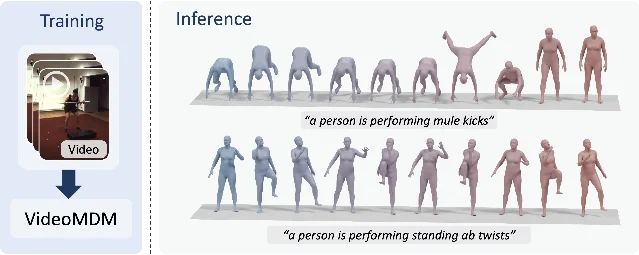
3D motion datasets are bottlenecked by capture infrastructure — MoCap suits, multi-camera rigs, manual skeleton fitting. Monocular video, by contrast, is available at internet scale. VideoMDM's core claim is that 3D motion diffusion priors can be trained directly from 2D pose annotations extracted from standard video, without any 3D ground truth at any stage of training. 2
"We introduce VideoMDM, a diffusion-based framework that trains 3D human motion priors directly from accurate 2D poses extracted from monocular videos, without any 3D ground truth." — Amir Mann et al. 2
The pipeline has two stages. First, a pretrained 2D-to-3D lifter generates approximate 3D poses as a noisy teacher. Second, a 3D diffusion model is trained by denoising in 3D space and supervising the result via reprojection back to 2D. The key question is whether this indirect supervision is strong enough. The paper provides a theoretical answer: under two mild assumptions — that predicted joint depths match true depths on average, and that training camera azimuths are uniformly distributed — a depth-weighted 2D reprojection loss is equivalent in expectation to direct 3D MSE supervision. 2
"under mild assumptions, a depth-weighted 2D reprojection loss is equivalent in expectation to direct 3D supervision" — Amir Mann et al. 2
Two motion regularizers are adapted to the 2D setting: a depth-weighted 2D velocity loss for temporal coherence, and a motion-representation alignment loss that supervises redundant channels (joint rotation, velocity, foot contact) via ray-projection pseudo-targets.
Results: HumanML3D FID 0.88 (full 3D-supervised MDM is 0.54 — this is the gap VideoMDM narrows without seeing 3D labels). On Fit3D real fitness video, MPJPE drops to 111mm versus 228mm for WHAM; motion smoothness improves 5.5× (acceleration 3.16 vs 17.66 m/s²). On NBA, human preference rate is 64% over MAS. 2
VideoMDM training uses stacked video frames as input; inference generates 3D mesh motion sequences for prompts like "mule kicks" and "standing ab twists"
VideoMDM trains on monocular video (left), then generates 3D motion sequences from text (right). 2
The generalization test is worth noting separately: VideoMDM generates human-preferred motions for actions like mule kicks and burpees on the Fit3D evaluation — motions that do not exist in AMASS (the standard 3D motion corpus used to train prior work) and are therefore outside the lifter's distribution. That the model handles out-of-distribution actions well suggests the 2D supervision is learning genuine 3D motion structure, not overfitting to the lifter's coverage. 2
Why read it: The theoretical equivalence result is the most useful contribution for researchers outside human motion. The proof that indirect 2D supervision converges to 3D MSE under reasonable camera coverage assumptions is a general statement — it applies to any 3D generative task where 3D labels are expensive but 2D projections are cheap. Animal motion, hand poses, and scene flow are all plausible next targets for the same framework.

3. TetherCache: training-free KV-cache management for long-form autoregressive video

arXiv: 2606.13035 | Yu Meng et al. (Tsinghua / ETH Zürich) | cs.CV
Peer-review status: Preprint. Code and demo available.
Autoregressive video diffusion models (like those built on Wan2.1) generate long videos by conditioning each new frame on a cache of previous frames. Two problems compound as generation length grows: the KV-cache budget cannot hold the full history, so frames get evicted; and conditioning repeatedly on model-generated frames produces a context distribution shift that accumulates over time, degrading later frames. At 240 seconds, this drift is severe enough to substantially distort semantic consistency. 3
"extending these models to minute-level generation remains challenging: the limited KV-cache budget prevents the model from retaining the full history, while repeatedly conditioning on self-generated frames induces a context distribution shift that accumulates over time" — Yu Meng et al. 3
TetherCache reorganizes the fixed-budget cache into three named zones:
  • Sink (frozen initial frames): Initial frames carry trustworthy statistical distributions — they were generated without any self-conditioning contamination, so their feature statistics are anchored to the training distribution.
  • Memory (selective long-range storage): Frames that were evicted from Recent but deemed worth retaining based on content relevance and temporal diversity.
  • Recent (sliding window): The most recent frames, maintained as a FIFO queue.
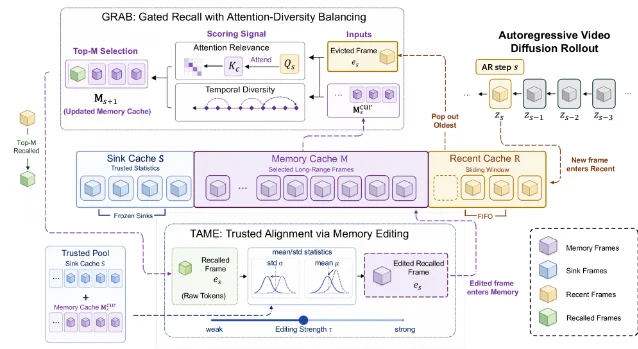
Two mechanisms manage the Memory zone:
GRAB (Gated Recall with Attention-Diversity Balancing) scores evicted frames jointly on attention-based relevance (how much the current query attends to that frame's key) and temporal diversity (how different the frame is from what's already stored). This avoids filling Memory with redundant near-duplicate frames. 3
TAME (Trusted Alignment via Memory Editing) uses the Sink frames' feature statistics (mean μ, standard deviation σ) to lightly re-align recalled Memory frames before they enter the attention computation. The intuition: Sink statistics are a reliable proxy for the training distribution; recalled frames have drifted away from it. A soft normalization toward Sink statistics reduces the contamination without fully overwriting the recalled frame's content. 3
TetherCache architecture showing three cache zones (Sink, Memory, Recent), GRAB gated recall module, and TAME trusted alignment module with labeled data flows
TetherCache's three-zone cache structure with GRAB (memory selection) and TAME (distribution re-alignment). 3
On VBench-Long at 240s: quality drift from 7.84 → 1.33, Imaging Quality 68.58 (vs. Self-Forcing baseline 58.51), Semantic Score 98.96 (vs. 78.78). User preference rate exceeds 70% against all comparison methods on average. 3
"TetherCache consistently improves long-video generation quality on VBench-Long across 30s, 60s, and 240s settings." — Yu Meng et al. 3
Why read it: The TAME mechanism is the conceptually novel piece. Sink frames have been used before to stabilize attention (notably in Sink Attention / StreamingLLM), but using their feature statistics as a distribution anchor to re-align recalled history is a different kind of operation — closer to a soft instance normalization guided by trusted reference statistics. The paper's framing of initial frames as "trusted pools" that carry distribution priors is a useful reframe for anyone building long-context generative pipelines in other modalities.

4. DiT World-Action Model: what makes a diffusion transformer work for AV scene prediction

arXiv: 2606.12987 | Ruslan Sharifullin, Benjamin Jiang, Kai Xi Chew (Stanford) | cs.CV
Peer-review status: Preprint. No public code.
World models for autonomous driving are supposed to simulate future sensor observations given an action plan. Most recent work reaches for large pretrained video diffusion models and adapts them. This paper takes a different approach: train a compact latent DiT from scratch on nuScenes (850 scenes, 150 test), deliberately vary architectural choices, and diagnose which components are actually responsible for the quality gap between diffusion and direct regression. 4
"Standard distortion metrics (cosine similarity, SSIM) favor the blurry regression mean, masking the fact that the diffusion model is far closer to the real frame distribution." — Ruslan Sharifullin et al. 4
The paper makes an early methodological point about evaluation: standard distortion metrics like cosine similarity and SSIM favor blurry regression outputs because they penalize any prediction not at the conditional mean. KID (Kernel Inception Distance), a distribution-level metric, reveals the full gap. The diffusion model reaches KID 0.078 versus 0.375 for direct regression — a 4.8× improvement that SSIM comparisons would substantially obscure. 4
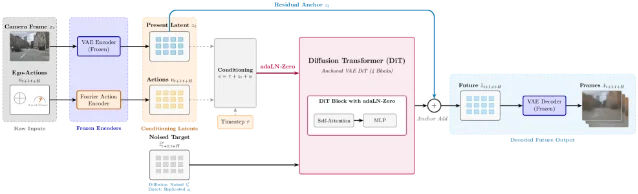
Through controlled ablations, the paper identifies four components as necessary for a compact DiT to function in this setting: 4
ComponentWhy it matters
Spatial tokens (not pooled)Pooled vectors lose the spatial grid structure needed for per-location prediction
x₀ prediction objectiveε-prediction causes near-copy collapse in compact latent space; x₀ recovers 88.5% of the performance gap
Residual anchoringPredicting residuals from the anchor latent reduces prediction difficulty
Sampling matched to target uncertaintyMismatched sampling degrades distributional quality even with correct training
The action conditioning result is the most practically important finding: steering inputs (encoded as Fourier embeddings) achieve a Spearman correlation with scene lateral displacement of ρ = 0.81, versus ρ = −0.18 for direct regression. The diffusion model not only generates more realistic frames — it actually moves the vehicle in the right direction when given a turn command. 4
DiT World-Action Model architecture: camera frame and ego-actions feed into frozen VAE encoder and Fourier action encoder, then through a 4-block AnchoredVAEDiT, decoded to future frames via frozen VAE decoder
The AnchoredVAEDiT pipeline: latent encoding, action conditioning, 4-block DiT denoising, and residual-anchored decoding. 4
A secondary finding: among 6 frozen visual encoders tested, V-JEPA2 rep64 with 16-frame temporal context brings RMSE to 0.058 — a 40% reduction over the best single-frame encoder. Temporal context in the representation matters for AV prediction in ways that image-based encoders structurally cannot provide. 4
Why read it: The ε-prediction collapse result is the most immediately actionable finding. If you are building a DiT for a domain with compact latents (medical imaging, robotics, limited-resolution sensors), the paper gives a concrete warning: ε-prediction does not gracefully degrade — it collapses to near-copy behavior, and x₀ prediction is the correct default. The evaluation methodology point — always include a distribution metric alongside distortion metrics — also applies broadly and is made quantitatively here rather than as a recommendation.

5. Jeffrey Guidance: deriving diffusion guidance from probability theory

arXiv: 2606.13240 | Raphaël Razafindralambo et al. (Inria / CNRS / Université Côte d'Azur / DTU) | cs.LG
Peer-review status: Preprint. CC BY 4.0.
Most diffusion guidance methods specify a sampling rule — classifier-free guidance scales the score difference between conditional and unconditional models; classifier guidance adds the gradient of a log-likelihood. Both are effective, but neither directly answers the question: what is the actual target distribution these methods produce, and is it the one we want? Jeffrey Guidance starts from that question. 5
"A key strength of diffusion models lies in their flexibility, since their outputs can be controlled at sampling time through guidance. However, beyond simple cases such as conditional sampling, the target distribution is often left implicit, defined only through a sampling rule or a heuristic energy function." — Raphaël Razafindralambo et al. 5
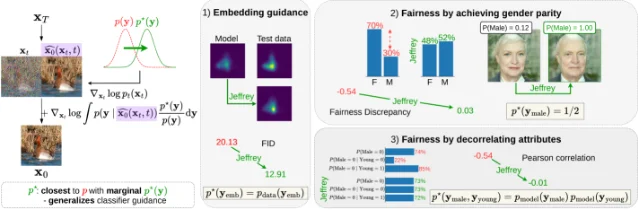
Jeffrey's rule of conditioning (from epistemology / Bayesian probability theory) specifies how to update a joint distribution when new information arrives as a marginal constraint, rather than as an observed event. The rule: update the joint p(x, y) to the new joint p′(x, y) such that (a) the marginal p′(y) matches the target p★(y), and (b) the conditional p′(x | y) remains unchanged (minimum structural perturbation). 5
Translated to diffusion guidance: specify the desired output marginal p★(y) explicitly, then derive the score correction that enforces this marginal while disturbing the joint distribution as little as possible. Standard classifier guidance is a special case of Jeffrey Guidance where p★(y) is a point mass on the target class. 5
The paper demonstrates two applications where specifying p★(y) explicitly is useful:
Embedding guidance: Set p★(y) to match the empirical distribution of Inception embeddings in the training set. The effect on CIFAR-10: FID drops from 20.13 → 12.91. On FFHQ, FID drops from 32.79 → 18.76. The correction requires estimating the current marginal at inference time (via a discriminator or a fitted distribution), which is the main implementation cost. 5
Fairness control: On CelebA-HQ, enforce the constraint that Male and Young are statistically independent in the generated distribution. Standard unconditional models inherit training-set correlations between attributes. Jeffrey Guidance provides a principled way to specify the target joint marginal (independence = product of marginals) and derive the score correction to enforce it. 5
Jeffrey Guidance overview: left panel shows the guidance update rule with score correction; center panel shows FID improvement from embedding guidance on CIFAR-10; right panels show fairness control results including gender parity and attribute decorrelation on CelebA-HQ
Jeffrey Guidance applied to embedding guidance (FID improvement) and fairness control (attribute decorrelation). 5
"Jeffrey guidance both recontextualizes standard classifier guidance and opens up new possibilities for diffusion model control." — Raphaël Razafindralambo et al. 5
Why read it: The fairness application is novel in that it treats distributional fairness as an explicit marginal constraint rather than an auxiliary loss — which means the constraint is exactly specified rather than approximately enforced by a tunable weight. The more general implication is that any desired marginal property of the output distribution (not just attribute independence, but also class balance, stylistic diversity, or calibration) can in principle be expressed as a Jeffrey Guidance constraint and handled without modifying training. The CC BY 4.0 license makes re-use straightforward.

Summary table

PaperarXivInstitutionCodeVenue
Z-Image Turbo++2606.12575Alibaba / CUHKPreprint
VideoMDM2606.13364Technion / NVIDIAvideomdm.github.ioPreprint
TetherCache2606.13035Tsinghua / ETH ZürichDemoPreprint
DiT World-Action Model2606.12987StanfordPreprint
Jeffrey Guidance2606.13240Inria / DTUPreprint (CC BY 4.0)
TetherCache and VideoMDM have project pages or demo sites at submission. Z-Image Turbo++, the DiT AV model, and Jeffrey Guidance are code-pending preprints — the Jeffrey Guidance paper's CC BY 4.0 license means implementations can be built and shared freely once code appears.
Cover image: from the Z-Image Turbo++ paper (arXiv 2606.12575), showing 2-step generated samples across 25 diverse prompts. arXiv.org non-exclusive license.

このコンテンツについて、さらに観点や背景を補足しましょう。

  • ログインするとコメントできます。