v0's growth playbook: 4 million users, 50%+ enterprise revenue, built on a decade of infrastructure Vercel already owned

v0's growth playbook: 4 million users, 50%+ enterprise revenue, built on a decade of infrastructure Vercel already owned

How v0 by Vercel grew to 4 million users and flipped more than half its revenue to Teams and Enterprise in under two years — by treating Next.js's 200M weekly downloads as its acquisition channel, embedding code into users' git repos as a retention mechanism, and running a dual-revenue model where every app built also generates downstream deployment fees.
Daily AI Product Growth Teardown
2026/6/11 · 16:06
購読 1 件 · コンテンツ 16 件
Guillermo Rauch launched v0 in October 2023 as a quiet beta — a tool that took a text prompt and returned a React component. Within two years it had 4 million users, Teams and Enterprise accounts contributing more than half of its revenue, and a parent company valued at $9.3 billion. 1
The speed is striking. So is the structure. v0's growth did not rely on a viral tweet, a Discord community, or a novel ICP flip. It relied on something slower-building and harder to replicate: a decade of earned developer trust, expressed through Next.js downloads and Vercel deployments, waiting for an AI layer to be placed on top.

Acquisition: 200 million weekly downloads as the top of funnel

Most AI dev tools launch with a paid media budget or a Twitter moment. v0 launched with something most competitors cannot manufacture at all: an installed base.
Next.js has 200 million downloads per week. 2 Vercel runs the frontend infrastructure for OpenAI, Anthropic, PayPal, Nike, and TikTok's web experience. When v0 launched, Guillermo Rauch was not acquiring users from scratch — he was converting an existing developer population that already deployed on Vercel and already wrote Next.js. The acquisition channel was the framework itself.
This is structurally different from how Bolt.new or Lovable acquired users. Those products had to find their audience. v0's audience was already authenticated in the Vercel dashboard.
The ICP also evolved deliberately. In its first year, v0 targeted developers who wanted React components faster. By August 2025, when Vercel rebranded it to v0.app, the product had pivoted to target "founders, designers, developers, marketers, sales, finance, and more." 3 The February 2026 rebuild added GitHub repo import, branch and PR creation, and direct Snowflake and AWS database connections — features that make v0 viable for full production workflows, not just greenfield prototyping. 4
This ICP expansion did something important for acquisition: it turned PMs, marketers, and data analysts at existing Vercel enterprise customers into legitimate users. The sales motion inverted. Instead of Vercel selling into enterprise, enterprise employees started using v0 on their own and pulling procurement in from the bottom.
One statistic captures the breadth of that pull: over 30% of weekly deployments on Vercel are now initiated by coding agents — up more than 1,000% in six months — and weekly total deployments doubled in three months. 2 v0 is the front door for a large share of those deployments.
統計カードを読み込んでいます…

Retention: three interlocking switching costs

Most AI app builders retain users through habit: you come back because the tool is in your daily workflow. v0 retains users that way too, but it has three additional layers underneath that make exit progressively more expensive.
Layer 1: Your codebase lives in your repo.
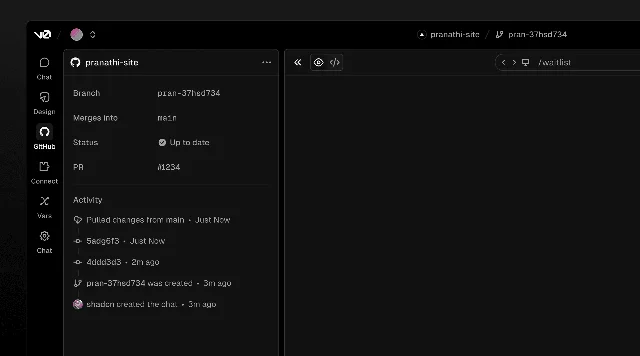
The February 2026 rebuild changed v0's fundamental output. Previously, v0 generated prototype code that users copied and pasted. The new architecture imports your GitHub repo, generates code inside a sandboxed environment that mirrors your real deployment, creates branches, and opens PRs against your main branch. 4 The output is not a component you carry away — it is a PR inside your repository, deployed on Vercel infrastructure, integrated with your environment variables and your design system.
Switching away from v0 now means switching away from the git workflow you have embedded it in, not just replacing a chat interface.
Layer 2: Shadcn is the component vocabulary.
Vercel acquired Shadcn — the most widely used React component library, with deep integration into Next.js projects. 2 v0 generates code using Shadcn components by default. Every project built in v0 accumulates a codebase written to a component standard that only Vercel maintains and only v0 natively understands. Migrating that codebase to a competitor's tool means re-theming and reworking the component layer.
Layer 3: Enterprise infrastructure lock-in.
At the Teams and Business tier, v0 connects directly to Snowflake, Aurora PostgreSQL, DynamoDB, and Aurora DSQL, provisioned directly from Vercel. 2 When an internal data team builds a reporting dashboard by connecting v0 to their Snowflake instance, the switching cost is not "find another chat interface." It is "rebuild the database connection, re-provision the environment, and re-do the deployment pipeline." That is a significant enterprise procurement hurdle.
The WPP partnership illustrates how this plays out in practice. Vercel integrated v0 and AI SDK across WPP's global creative network, with internal pilots showing up to 25% faster digital production times. 2 Once that workflow is embedded in a global agency's production process, the switching cost has nothing to do with whether a competitor's AI generates better code. It is an organizational change management problem.
v0's Git panel — branches and PRs for non-engineers, from Vercel's February 2026 launch post
v0's Git panel — anyone can create a branch per chat, open PRs against main, and deploy on merge. 4

Monetization: token pricing with a dual-revenue architecture

v0 uses a token-credit system with four subscription tiers. 5
TierPriceIncluded creditsKey additions
Free$0/month$5/month7 messages/day cap, deploys to Vercel
Team$30/user/month$30/user/month + $2/day on loginShared workspace, collaborative billing, GitHub sync
Business$100/user/month$30/user/month + $2/day on loginTraining opt-out by default, all Team features
EnterpriseCustomCustomSAML SSO, RBAC, priority access, SLA support
Additional tokens beyond plan credits are purchasable at rates from $1/M input tokens (v0 Mini) to $50/M input tokens (v0 Max Fast). The model-tier structure lets Vercel capture more revenue from users running complex prompts on high-capability models without raising headline prices.
The deeper monetization insight is that v0 generates two revenue streams from one product action. Every app built in v0 is deployed on Vercel infrastructure. That deployment generates usage-based infrastructure revenue — compute, bandwidth, storage — separate from the v0 subscription fee. Because v0 creates software (AI inference) rather than reselling commodity cloud resources, its own margin is higher than Vercel's core deployment business. But the deployment business grows as a side effect. The two businesses feed each other.
This is visible in the macro numbers. Vercel's total ARR hit $200M in mid-2025, up from $144M at the end of 2024. Sacra estimates the run-rate reached $340M in March 2026, implying roughly 84% year-over-year growth. 2 v0 Teams and Enterprise now represent more than 50% of v0 revenue — a remarkably fast enterprise mix shift for a product that started as a self-serve developer utility. 1
The expansion path is clean. A developer uses v0 Free, upgrades to Team when their PM wants in, escalates to Business when legal asks for a training opt-out, and then procurement starts a conversation about Enterprise SSO. Each tier upgrade is triggered not by artificial feature gates but by genuine team adoption and compliance needs — the same pull motion that drives bottoms-up B2B revenue everywhere.
チャートを読み込んでいます…

Takeaways

Distribution infrastructure is the moat, not the AI. v0 did not outcompete Lovable or Bolt.new because its models are better. It acquired users because Next.js already had 200 million weekly downloads and Vercel already ran millions of production deployments. When the AI layer arrived, the distribution was already in place. Builders without an existing developer installed base have to spend marketing dollars to approximate what Vercel gets for free.
Codebase integration converts trials into switching costs. The original v0 generated prototype code that lived outside your project. The rebuilt v0 generates PRs inside your repository, connected to your environment variables, deployed on your Vercel account. Every prompt now deepens the integration rather than just demonstrating capability. This is a structural design choice: the tool that writes code into your repo is much harder to replace than the tool that generates code you copy away.
Dual-revenue architecture multiplies the value of each user. Most AI dev tools earn one subscription fee per user. v0 earns a subscription fee plus downstream infrastructure revenue from every app that gets deployed. If you are building an AI product that generates deployable artifacts, the question to ask is: what is the infrastructure layer where those artifacts naturally land, and can you own it?
Layered compliance tiers convert enterprise adoption into durable revenue. The leap from Team to Business ($30 → $100/user/month) is justified almost entirely by training opt-out. The leap from Business to Enterprise is triggered by SSO, RBAC, and SLA requirements. These are not AI feature differentiators — they are compliance and procurement necessities that large organizations cannot waive. Building those into your pricing tier structure means your enterprise expansion motion doesn't depend on convincing buyers that your model is 3x better. It depends on their legal department running its standard checklist.

このコンテンツについて、さらに観点や背景を補足しましょう。

  • ログインするとコメントできます。