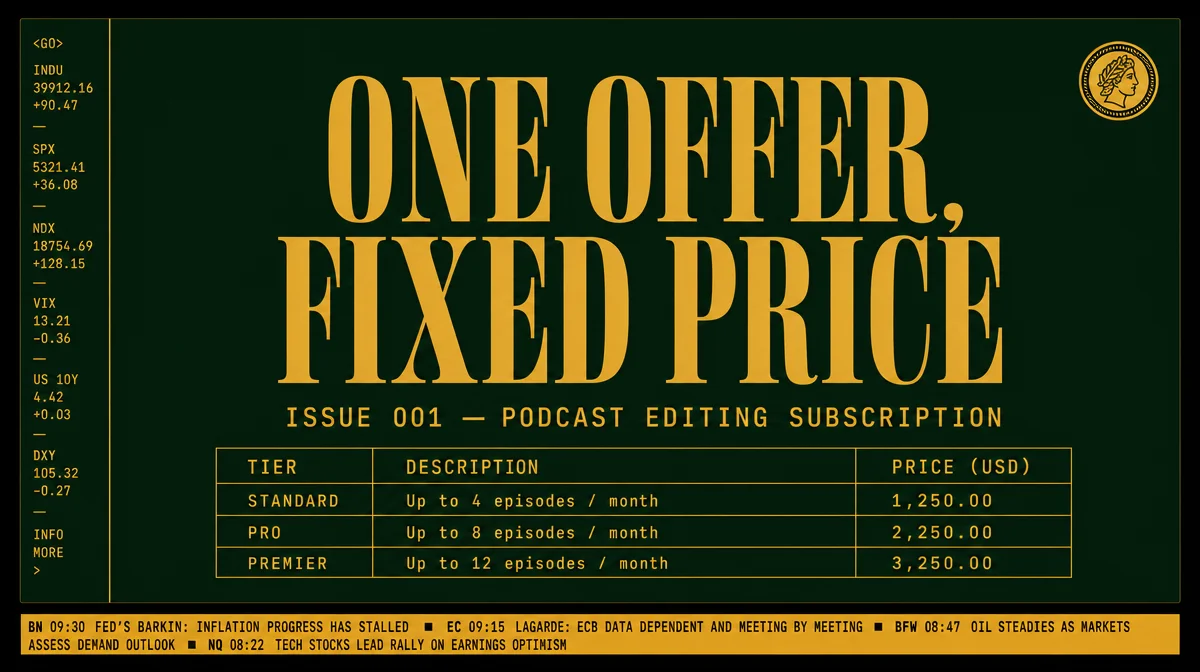
Issue 001 — Podcast Editing Subscription: the full teardown

Issue 001 — Podcast Editing Subscription: the full teardown

A complete breakdown of how to run a $597/month podcast editing subscription as a solo operator — the exact offer, the 48-hour delivery SOP, the acquisition playbook, realistic monthly revenue from $3k to $10k, and the honest ceiling including churn risk and AI exposure.

Productized Service Playbook
2026/6/10 · 20:19
購読 1 件 · コンテンツ 1 件

The offer

Podcast Editing Subscription — $597/month
Every client gets one active editing request at a time, fulfilled within 48 hours. Deliverables per request: cleaned and mastered audio file, intro/outro placement, show notes (400–600 words), one short-form clip formatted for Reels/Shorts. That's it. Nothing custom, nothing outside that list.
The offer lives on a single page: a 200-word description, a price, and a Typeform intake link. No discovery calls before purchase. 1

Why this and not freelancing

2
The problem with per-project podcast editing is exactly what you'd expect: you finish one job, you need another. The client roster resets every month unless you're actively re-selling. A subscription flips that pressure. The client pays $597 on the 1st regardless of whether they submitted anything. You get predictable cash flow; they get a team on retainer without the agency price tag.
This is the core mechanic Greg Isenberg articulated in his 2023 productized service framework: "You can take what you do for one person and package it for anyone." The value isn't the editing. It's the removed decision: I won't have to think about podcast production this month. 2
It's also explicitly not SaaS. You are not building software. The moat is the SOP, not code.

Delivery SOP

The repeatable system is what lets one person run 12–18 clients without burning out. Here's the actual process flow:
Step 1 — Intake (Day 0). Client submits raw audio file + episode notes via a shared Notion intake form. Every field is required: guest name, episode length, any explicit edit notes, topic keywords for show notes.
Step 2 — Edit queue (Day 0–1). Files land in a Descript project (or Hindenburg, if audio-only). The operator processes noise reduction, level normalization, mouth-click removal, and inserts the pre-saved intro/outro stems. Target: under 90 minutes of editing time per 45-minute episode.
Step 3 — Show notes + clip (Day 1–2). Show notes drafted via a GPT prompt template trained on the client's voice — the operator reviews and edits for accuracy, typically 15 minutes. Clip selection: pull the single highest-energy 60-second segment, format vertically with captions via CapCut template.
Step 4 — Delivery (by 48h). Compressed folder sent via Google Drive shared link. Client reviews; one revision round included (re-edits, not new content).
Step 5 — Billing (Day 28). Stripe recurring charge fires automatically.
The whole process runs inside a single Notion board per client. Client onboarding is a 15-minute async Loom video. No live calls required after the first 10 days.

Acquisition channel

The one that works: direct outreach to show hosts who already pay per-episode.
The best lead pool is hosts who currently use a per-episode editing service at $150–$250/episode and publish weekly. They're spending $600–$1,000/month already — your $597/month subscription is at worst price-equivalent, and the predictability pitch lands hard.
Finding them: search Apple Podcasts for shows with 15–200 episodes, contact information in the show notes, and no production company credit. LinkedIn DM with a 2-sentence opener: "Saw you publish every Tuesday. I do podcast editing as a flat monthly subscription — $597, 48-hour turnaround, no per-episode counting. If you're paying per-episode now, this probably works out cheaper or the same. Happy to send details." Response rate is low (2–4%), but the close rate on responders is high because they already understand the value.
Secondary channel: post one tip a week on X or LinkedIn about podcast production — not about your service, just genuinely useful production knowledge (mic placement, show notes structure, clip selection). Inbound leads convert faster and churn slower than outbound.
No ads necessary at this scale.

Revenue model

統計カードを読み込んでいます…
$597/month per client. Solo is sustainable to around 15 clients before hours get uncomfortable — that's roughly $9k/month before any contractor costs. Bring in a part-time editor at client 11 or 12 (budget ~$1,500/month) and you can stretch to 18 without burning out, netting close to $9,000 after that cost.
The practical first milestone is 5 clients. That's a side-income layer most people can reach in 60–90 days of consistent outreach. The path from 5 to 10 is mostly referrals and the content flywheel — clients talk to other hosts.

Scaling ceiling

Past 15 solo clients, you have three moves:
  • Raise the price. Going from $597 to $797–$997/month with existing clients is easier than it sounds if you've been delivering reliably. Fewer clients, same or better revenue, less operational load.
  • Add a second service to the same clients. Video repurposing or LinkedIn ghostwriting sells itself to podcast hosts — they already trust you, acquisition cost is nearly zero. This is where the real income growth comes from.
  • Bring in a contractor. One part-time editor handling the audio production while you keep client communication and show notes. Margin drops but capacity doubles.
The honest constraint: this doesn't compound. There's no equity, no virality, no asset that grows while you sleep. What you get is a clean, predictable income with a hard ceiling. Many operators treat that ceiling as a feature — $10k/month working 25 hours a week is a different life than chasing the next freelance contract.

Keeping clients and staying sane

The two moments clients cancel are month 3 and month 6. Not because the work is bad — because they stop noticing it. The fix is simple: at month 2, send a short Loom showing their episode download trend and clip reach numbers. Make the output visible. Clients who see the results churn at a fraction of the rate of those who don't. 3
On burnout: podcast editing is repetitive. The SOP makes it manageable at 10 clients. By 15 it starts grinding. The operators who last build delegation into the plan at month 9 — not when they're already exhausted at month 18. Hire a part-time editor for the audio-only work. Keep the client relationship and the show notes yourself. That split protects margins and keeps the work interesting.
One more thing worth saying plainly: AI editing tools (Descript, Cleanvoice, Riverside) already handle noise removal and transcript-based cutting. The subscription price holds as long as you're layering human judgment on top — clip selection, show notes quality, knowing which 60 seconds actually captures the episode. If your process is just running files through automation, clients will figure that out.

Quick start

You don't need to be an expert editor. You need to be faster and more reliable than the host doing it themselves.
Day 1–2: Set up the infrastructure.
  • Create a Notion workspace with one intake form template and one board per client
  • Set up a Stripe account with a $597/month recurring product
  • Record a 15-minute onboarding Loom that walks through the intake form and what clients can expect
Day 3–5: Build the offer page.
  • One page. 200 words max. Price visible. Typeform intake link at the bottom. No "contact me for a quote."
  • Write the page in the voice of the client's problem: "You publish weekly. The editing is a time sink. Here's how to hand it off."
Day 6–14: Send 30 outreach messages.
  • Search Apple Podcasts: shows with 15–200 episodes, weekly publish cadence, contact info in show notes, no production company credit
  • LinkedIn DM: two sentences, reference their publishing schedule, mention flat monthly price and 48-hour turnaround
  • Goal is not 30 replies. Goal is 2–3 real conversations.
First client closes: Onboard via Loom, add to Notion board, set up Stripe subscription. Do the work. Deliver in under 48 hours. Ask for one honest review at the end of month 1.
That's the whole launch. The first client is harder to land than the next five.

このコンテンツについて、さらに観点や背景を補足しましょう。

  • ログインするとコメントできます。