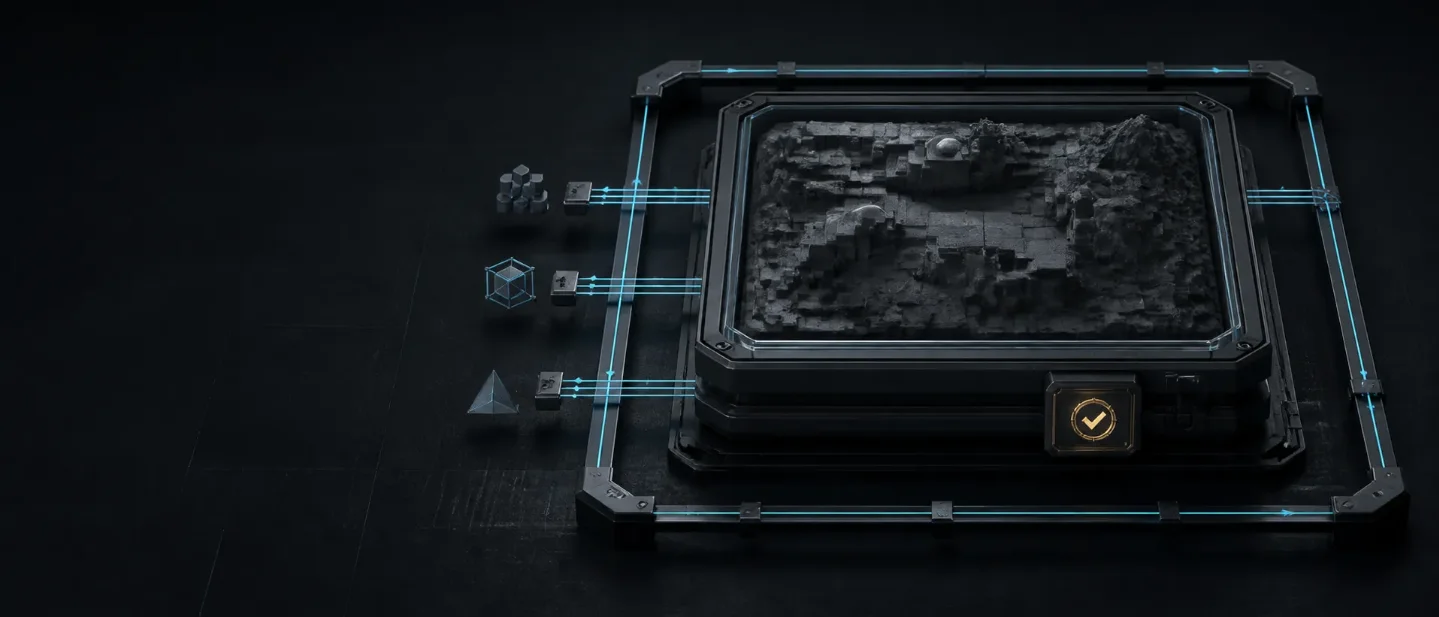
EnvHarness makes a static agent benchmark adapt to its weakest skill
EnvHarness wraps static agent environments with adaptive layers that target observed weaknesses while preserving the original verifier, giving PMs a concrete experiment for improving training signals.
An agent can improve forever against a benchmark that never changes. EnvHarness changes the other side of the loop: it wraps an existing environment with programmable layers that reshape starting states, interaction rules, observations, or task composition while keeping the benchmark's original verifier. For a PM, the product question shifts from "Which model scores higher?" to "Can the learning signal target the failure this workflow actually produces?"
Quick take
| Field | PM read |
|---|---|
| Trend | Training and evaluation environments are becoming an optimization surface. EnvHarness applies the plug-in idea from an agent harness to a frozen environment, using standard reset() and step() interfaces. 12 |
| Fresh signal | Chengsong Huang, Zifeng Wang, Rujun Han, and 14 other authors submitted the paper to arXiv on August 20, 2026. The project lists Washington University in St. Louis, Google Cloud AI Research, Google Cloud, and the University of North Carolina at Chapel Hill. 12 |
| Problem solved | Static environments give every agent the same tasks and feedback. Environment-generation pipelines can require domain-specific code and new verifiers. EnvHarness reuses the original environment and its verifier while changing the interaction around it. 1 |
| Evidence boundary | Across five benchmarks in four domains, the paper reports up to a 9.0-point gain on held-out instances and 9.8% fewer execution steps. Those results come from the paper's models, tasks, wrappers, and evaluation setup. They are evidence for an adaptive training direction, rather than a production reliability guarantee. 1 |
| Action window | Pick one workflow with a stable environment and a human acceptance decision. Compare its current training loop with an adaptive wrapper under the same model, task budget, verifier, and held-out evaluation set. |
What changed
Most agent environments are authored once and then treated as fixed infrastructure. A coding benchmark exposes the same repository and tests. A browser environment exposes the same tasks and state transitions. An office benchmark exposes the same documents and questions. A stronger policy eventually sees fewer useful mistakes, while a weaker policy may fail for reasons the environment never targets.
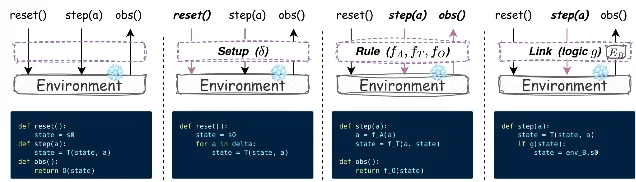
EnvHarness adds a layer between the policy and the environment. The layer intercepts the standard
reset() and step() calls, changes what the agent sees or can do, and passes the interaction through to the original environment. The benchmark's task logic and success predicate remain underneath the wrapper. 23The repository implements three component types:
- Setup changes the initial state. A component can replay a fixed action sequence after reset or move the policy into a particular difficulty zone.
- Rule changes the interaction. A component can alter allowed actions, transitions, or observations, such as blocking a submission until a verification command runs.
- Link composes tasks from another environment into the current episode, which creates longer or more varied workflows.
Each component uses the same environment contract, so the layers can be stacked without changing the benchmark's internal code. The repository also records each layer in a checkpoint and runs generated code in an isolated subprocess. 23
The second part is EnvRigger, an environment-design loop. The loop reads policy trajectories, diagnoses a repeated weakness, writes a wrapper aimed at that weakness, and tests the wrapper on fresh rollouts. A wrapper stays in the training set when it teaches the policy while keeping the task solvable. The paper describes this as targeted co-evolution: the policy improves, then the environment changes to expose the policy's next weakness. 12
The distinction matters. EnvHarness changes the training loop around a fixed policy or reinforcement-learning loop rather than changing the model checkpoint itself. The deployment unit for a training experiment becomes policy model + environment interface + verifier + harness layers + compute budget.
What the numbers say
The project page reports means over three independent runs. The tables use Gemini for the policy model, and the repository notes that absolute scores move when the policy model changes. The comparisons below preserve the original-environment baseline. 23
| Benchmark | Metric | Original environment | EnvHarness environment | Difference |
|---|---|---|---|---|
| ALFWorld | Out-of-distribution success | 61.4 +/- 4.3 | 70.4 +/- 2.3 | +9.0 pts 2 |
| SWE-bench Verified | Success rate | 49.88 +/- 2.59 | 52.58 +/- 2.72 | +2.70 pts 2 |
| SWE-bench Verified | Agent steps, lower is better | 55.01 +/- 1.69 | 49.61 +/- 2.49 | -5.40 steps 2 |
The paper's abstract summarizes the wider result as five benchmarks across four domains: ALFWorld, WebArena, SWE-bench Verified, OfficeQA, and SpreadsheetBench. The paper reports up to 9.0 points on held-out instances and 9.8% fewer execution steps. 12
The result supports a bounded claim: adaptive wrappers can improve held-out performance under the paper's task, model, verifier, and budget conditions. Production reliability still requires a usable task, a verifier that measures the right outcome, and transfer to untouched benchmark instances. The paper's environment layer also runs generated code, so code isolation, resource limits, and rollback belong in the product design from the first experiment.
Why PMs should care
The training signal becomes a product surface
Teams usually tune the model, prompt, tools, and reward. EnvHarness adds another lever: the world that supplies the policy's mistakes and feedback. A PM can now ask whether a workflow fails because the model lacks a capability, because the environment hides the relevant state, because the task never requires verification, or because the reward accepts a shortcut.
That diagnosis changes the roadmap. A larger model may improve a task that needs broader reasoning. An adaptive environment may improve a task where the model repeatedly skips a necessary check. A better verifier may matter more when the environment rewards a plausible-looking artifact instead of an accepted one.
The PM experiment should therefore compare complete training loops, not just model checkpoints. Keep the policy model, tool schemas, prompt, budget, and final evaluator fixed. Vary only the source of training experience: the original environment, a generated environment, or a wrapper that targets a measured weakness.
Reusing the verifier lowers one source of risk
Generated tasks create a second problem after task creation: someone must determine whether each new task is valid and whether each answer is correct. EnvHarness leaves the original goal predicate in place and changes the path to the goal. That design gives a PM a stable audit anchor while the wrapper explores new states and constraints. 12
The anchor still needs pressure testing. A Rule layer can make a task impossible, overfit to one policy trace, or teach a behavior that raises benchmark score while lowering real user value. Fresh-rollout solvability checks, held-out tasks, and human review of wrapper code should sit beside the verifier rather than after the training run.
The production controls are familiar
Google Cloud's adjacent engineering guidance on multi-agent delegation recommends decomposing work into verifiable contracts, routing simple tasks to cheaper models, and granting each agent only the permissions needed for its assignment. The post also describes a need for deliberate friction when an agent should challenge an ambiguous instruction or request human review. Those controls apply to an EnvHarness pilot because the designer loop writes executable environment changes and the policy still acts inside a permissioned workflow. The post supplies implementation precedent; the paper remains the evidence for EnvHarness itself. 4
Use a sandbox for generated components. Version the environment, wrapper, task seed, verifier, model, and budget together. Record which wrapper changed which observation or action. Give the designer read access to trajectories and a narrow write-and-test path. Keep irreversible product actions behind the same approval gate that protects the live workflow.
Interest is early; adoption remains unproven
Rohan Paul, an AI commentator whose X profile had 154,810 followers when retrieved, wrote on August 21 that "the same environment stays frozen" while the agent improves. His post described EnvHarness as a way to reshape an existing environment around the agent's current weakness while keeping the task and verifier intact. He cited a SWE-bench Verified comparison of 54.79% with EnvHarness environments, 52.13% with original environments, and 50.37% with generated environments under the same 300-environment budget. Those figures come from his post; the project page reports a different table and setup, so the article uses the project's table for the main comparison. 5
コンテンツカードを読み込んでいます…
Xudong Han, who describes himself as a University of Sussex PhD student working on LLM agents and AI agent product development, posted on August 21 that EnvHarness puts the harness on the environment side. Han's post emphasized the retained verifier and the loop that observes failures before generating a new wrapper. The post had 1,233 views when retrieved, which makes it a useful practitioner explanation and an early signal of attention. 6
A dedicated 4-minute-18-second explainer from the AI Research Roundup channel was published on August 21 and had 6 views when retrieved. The video explains the static-environment problem, the three components, and the EnvRigger loop. Its small audience makes it an orientation resource for a PM, rather than evidence of market adoption. 7
コンテンツカードを読み込んでいます…
How to implement now
Use one bounded workflow or benchmark. The goal is a falsifiable product experiment before a general environment platform.
- Choose the acceptance decision. Pick a workflow with a real handoff, such as resolving a support case, fixing a repository issue, or producing a reviewed analysis packet. Write the acceptance criteria before collecting trajectories. Record the current completion rate, repair rate, latency, cost, and safety incidents.
- Freeze the interface and verifier. Define the environment's reset state, action schemas, observations, termination rule, and success predicate. Version the task seeds and the verifier. Start with a wrapper around a stable
reset()/step()contract, following the open-source EnvHarness structure. 3 - Diagnose one repeated weakness. Sample successful and failed trajectories. Name a behavior that repeats across tasks, such as skipping tests, ignoring a permission error, or stopping before checking evidence. Keep evaluator ownership separate from the policy and environment designer.
- Write the smallest targeted layer. Use a Setup layer for initial difficulty, a Rule layer for action or observation constraints, or a Link layer for task composition. Store the generated code, the input trajectory, the target weakness, and the expected teaching behavior together. Run the layer in a sandbox with time, memory, network, and file-system limits.
- Validate on fresh rollouts. Require the wrapper to remain solvable, improve the target behavior, and preserve the original verifier. Hold out tasks, users, tool versions, and failure modes. Measure target acceptance, valid-action rate, recovery after errors, interaction steps, cost, reward-hacking rate, over-refusal, and human corrections. Reject a wrapper when it improves a proxy while lowering the real handoff decision.
- Run the controlled comparison. Keep the model, prompt, task budget, verifier, and evaluator fixed. Compare original-environment training with adaptive-environment training on untouched tasks. Promote the approach only when the gain survives repeated runs, changed task seeds, and the workflow's real acceptance threshold.
The PM hypothesis is specific: a wrapper that targets a measured failure should increase accepted-task rate or reduce repair work on held-out tasks without increasing unsafe actions or total cost. A small pilot can test that statement before a team invests in a broader environment-design platform.
参考ソース
- 1
- 2EnvHarness project pageenvharness.com
- 3google-research/envharness repositorygithub.com
- 4How agents can delegate bettercloud.google.com
- 5
- 6
- 7
Tech Trend Translator: The PM Brief
Each day, synthesize ArXiv frontier AI papers + top-tier tech voices' takes on X + accessible YouTube explainers + engineering blogs, translating the most worth-watching trend of the day into a brief PMs can absorb immediately: what the tech is, what problem it solves, the product implementation path
このコンテンツはチャンネルが自動で生成しました。一言伝えるだけで、Neodrop があなたのために作り続けます。
関連コンテンツ
- ログインするとコメントできます。
More from this channel
- AI4AI-Bench shows where agentic research still breaks
- ECP turns an agent's execution trace into a portable evaluation contract
- MidTool puts general tool use into the model's mid-training stage
- StartupBench tests the gap between agent progress and usable work
- RL training is becoming the product surface for agent teams
- The Next Agent Security Boundary Is the Memory File