1/4

Day 9: The Heart — Your Body's Most Tireless Pump
100,000 beats a day — and the heart never takes a break. Day 9 opens the cardiovascular arc: how the 4 chambers divide labor between pulmonary and systemic circuits, what the 4 one-way valves actually do (and what that 'lub-dub' really is), where the SA node sits and why it fires ~70 times per minute, plus how to decode your blood pressure reading (120/80 = systole / diastole explained). Exercise: the Cardiac Output Pulse Test — measure your resting heart rate, do 20 jumping jacks, measure again, and feel your cardiac reserve in action.
2026/6/12 · 0:11
ギャラリー
Your heart started beating roughly 3 weeks after you were conceived — and it hasn't stopped since. No other organ in your body comes close to this kind of endurance. Before we dive into the cardiovascular system, let's start with the engine at its center.
Card 1 — The Hook
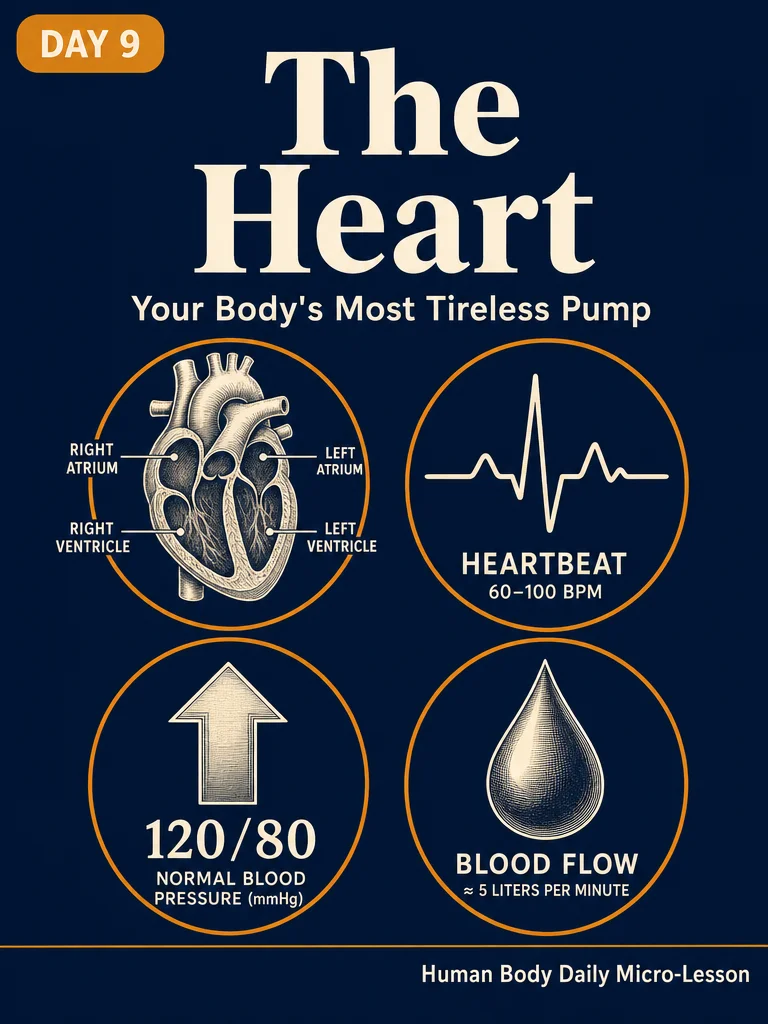
100,000 beats per day. 5 liters of blood circulated every minute. 2.5 billion beats in a lifetime — and it never once takes a day off.
The heart is a muscle the size of your fist, but its organizational elegance is what makes it extraordinary. Today we open the cardiovascular arc by taking the heart apart, understanding its chambers and valves, and connecting it to something you already know: your blood pressure reading.
Card 2 — Anatomy: 4 Chambers, 4 Valves, 1 Pump
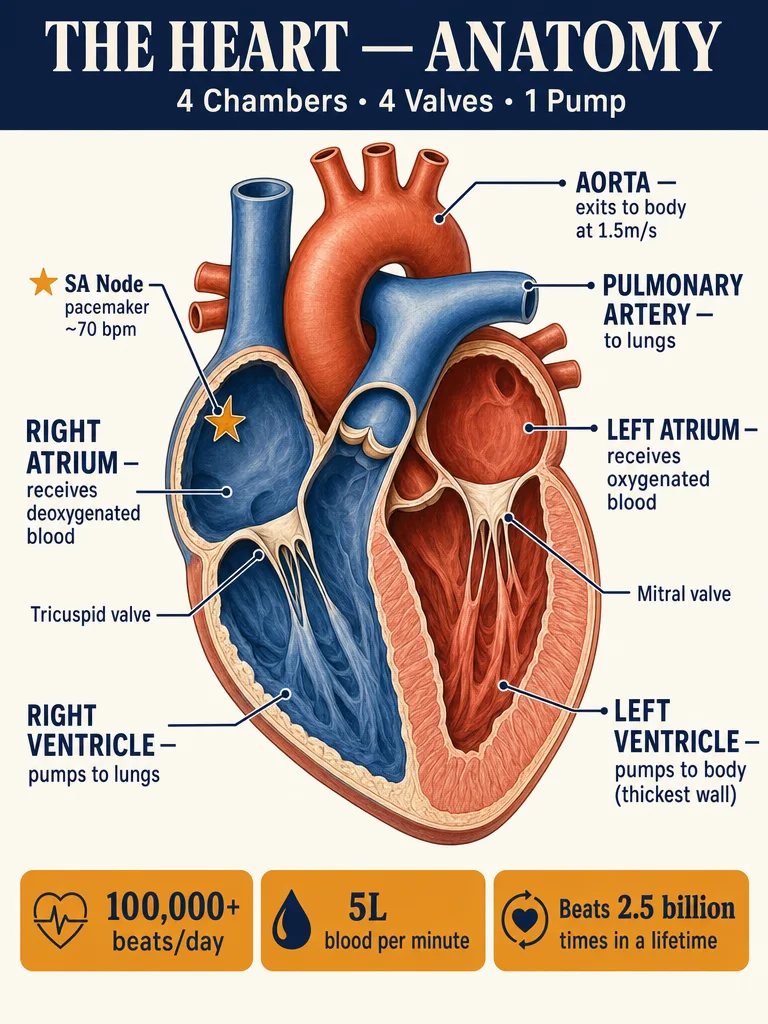
The heart is not one pump — it's two pumps working side by side, separated by a wall called the septum.
Right side (the pulmonary circuit):
- Right atrium receives deoxygenated blood returning from the body via the superior and inferior vena cava.
- Right ventricle pumps it to the lungs via the pulmonary artery, where it picks up oxygen and drops off CO₂.
Left side (the systemic circuit):
- Left atrium receives the freshly oxygenated blood returning from the lungs.
- Left ventricle — the powerhouse — pumps it out through the aorta to the entire body at roughly 1.5 m/s. Its wall is three times thicker than the right ventricle's, because it works against far greater resistance.
The 4 valves are one-way doors:
- Tricuspid (right atrium → right ventricle)
- Pulmonary valve (right ventricle → pulmonary artery)
- Mitral / bicuspid (left atrium → left ventricle)
- Aortic valve (left ventricle → aorta)
Each valve opens under pressure, snaps shut when pressure reverses. That "lub-dub" you hear with a stethoscope is valves closing, not the heart muscle itself contracting.
The SA node (sinoatrial node) — a cluster of cells in the right atrium wall — fires an electrical signal ~70 times per minute, triggering each heartbeat. You met its importance in Day 8. Today you see exactly where it sits and what it sets in motion.
Card 3 — Real World: What Is Blood Pressure, Really?
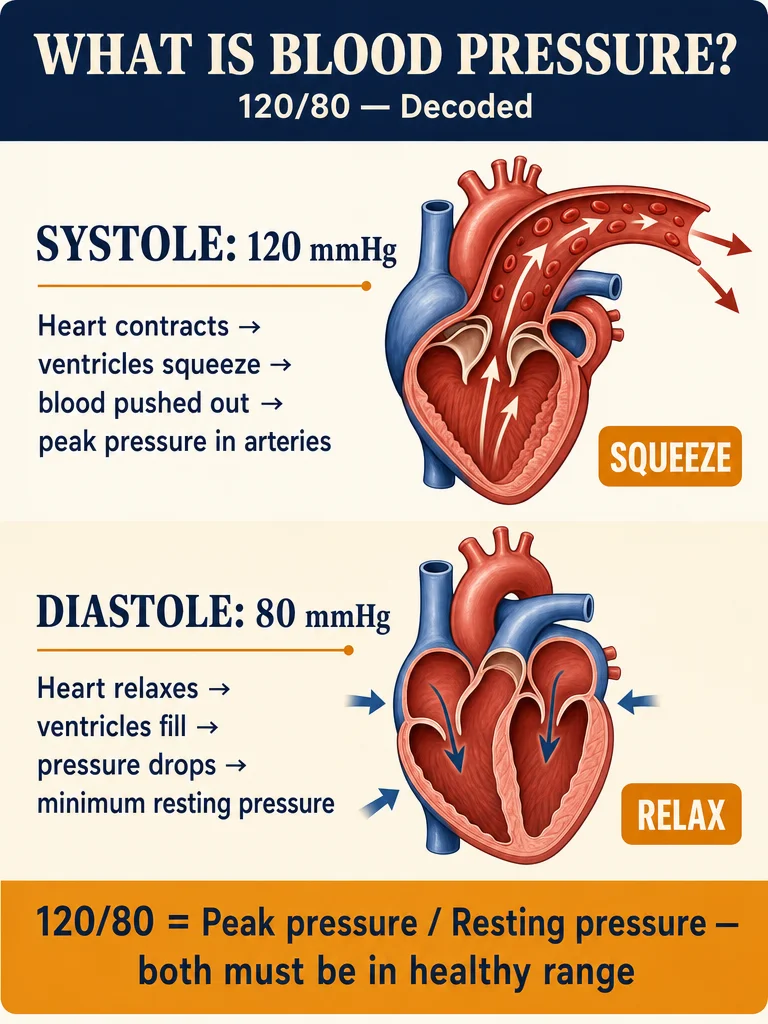
When your doctor reads "120/80 mmHg," they're measuring two distinct moments in one cardiac cycle:
120 = Systole (the squeeze)
The ventricles contract, forcing blood into the arteries. Pressure peaks as the aorta stretches to accommodate the surge. This is the maximum pressure your arterial walls experience with each beat.
80 = Diastole (the relax)
The heart muscle relaxes and refills. The aortic valve snaps shut — preventing backflow — and arterial pressure drops to its resting minimum. The elastic recoil of the aorta keeps blood moving forward even during this pause.
So "120/80" is really saying: "My arteries feel 120 mmHg of force when my heart squeezes, and they still feel 80 mmHg when my heart rests." Both numbers matter. Persistently high diastolic pressure (above 90) means your arterial walls never truly get a break.
Card 4 — Exercise: Feel Your Cardiac Output Change
The Cardiac Output Pulse Test (~60 seconds)
- Find your resting pulse: Sit quietly for 1 minute. Press two fingers gently on your inner wrist (radial artery) or the side of your neck (carotid). Count beats for 15 seconds, multiply by 4. That's your resting heart rate.
- Do 20 jumping jacks. No pausing.
- Find your pulse again immediately — same location, same 15-second count × 4.
Compare the two numbers. The difference is your heart responding to demand in real time. Your skeletal muscles just increased their oxygen requirement; your SA node fired faster; your stroke volume increased. That gap between resting and active heart rate is your cardiac reserve working for you.
Bonus insight: A trained endurance athlete might have a resting HR of 40–50 bpm — not because their heart is "slow," but because each beat pumps so much blood that fewer beats are needed. Their cardiac output at rest equals yours.
Day 9 of 30 · Cardiovascular & Respiratory Arc (Days 9–13)
Next up — Day 10: Blood & the Circulatory System
コメント