How a Solo Founder Built WriteStack to $10K MRR: The Only Dedicated Scheduler for Substack Notes
A deep-dive teardown of WriteStack, the scheduling and analytics platform for Substack creators that crossed $10,000 MRR on May 31, 2026. Solo founder Orel Zilberman reached that milestone in roughly ten months of meaningful growth after pivoting from an AI article generator. The article examines the product wedge ("only" vs. "better"), the three-tier annual-only pricing structure, which acquisition channels actually drive growth, a 600-day timeline across 12+ failed products, a six-item replication checklist, and an explicit accounting of the unfair advantages a cold-start founder cannot replicate.

360 people pay $19.99–$79.99 a month for a tool that, by its own founder's admission, still has bugs, an inconsistent UI, and features that took three attempts to build correctly. On May 31, 2026, that tool — WriteStack, a scheduling and analytics platform for Substack creators — crossed $10,000 in monthly recurring revenue. 1
The number isn't the interesting part. The mechanism is.
Snapshot
| Product | WriteStack — Substack growth platform (Notes scheduling, analytics, AI generation, cross-posting) |
| MRR | $10,000 (May 31, 2026) |
| ARR | ~$120,000 |
| Paying customers | 360+ (as of May 26, 2026) |
| Total registered users | 2,870+ Substack creators |
| Team size | 1 — Orel Zilberman, solo founder |
| Founding | ~2024 (product pivoted to current form ~late 2024/early 2025) |
| Pricing tiers | Hobbyist $19.99/mo · Standard $24.99/mo · Premium $79.99/mo (annual billing only) |
| Free trial | 7 days, no free tier |
| Trial-to-paid conversion | ~12.5% (360 paid / 2,870 registered — not directly disclosed by founder) |
Origin: the problem Orel felt before he built for it

Orel Zilberman is a software developer based in Tel Aviv, Israel, with nine years of professional experience and, before WriteStack, a string of failed products. 5 He also ran a Substack newsletter — The Indiepreneur — where he publicly documented the indie hacker journey, including the failures.
The initial WriteStack concept wasn't a scheduling tool. It was an AI article outline generator — Orel trying to automate the writing part of his Substack operations. That didn't find traction. 2
The pivot came from DMs. After contacting early users directly to understand what they actually needed, a different pain point kept surfacing: Substack Notes — the platform's short-form social feed, analogous to Twitter/X posts — had no native scheduling capability. Creators who wanted to maintain a consistent publishing cadence were either doing it manually, around the clock, or not doing it at all. In Orel's own words:
"Ever since I joined Substack, I struggled to stay consistent with writing and growing my audience. Not being able to schedule Notes made it even worse." 4
"I looked for tools to fix it but nothing out there worked. Either they didn't exist, or they were just plain bad." 4
So he built one. First for himself, then — once other creators responded positively — as a product.
This origin matters for one specific reason: Orel wasn't guessing at a gap. He was a Substack creator with an active newsletter and a real scheduling problem. That's both a validation method and, as we'll get to, an unfair advantage.
The wedge: the only scheduler beats the better scheduler
The positioning WriteStack landed on is unusually clean: it is, as of this writing, the only dedicated scheduling tool for Substack Notes. Not the best one — the only one. Bestselling author Tim Denning, who uses the product, put it plainly: "Right now it's the only Substack scheduler there is. Orel works hard on it and I would recommend to anyone who wants to take Substack seriously." 4
"Only" is a different competitive position than "better." Buffer, Hootsuite, and other general-purpose social schedulers don't support Substack's API natively. WriteStack integrates directly — and then goes further with seven feature modules built specifically for the Substack workflow: 2
- Scheduler: batch-queue up to 100 Notes in 4 seconds, with a Kanban view
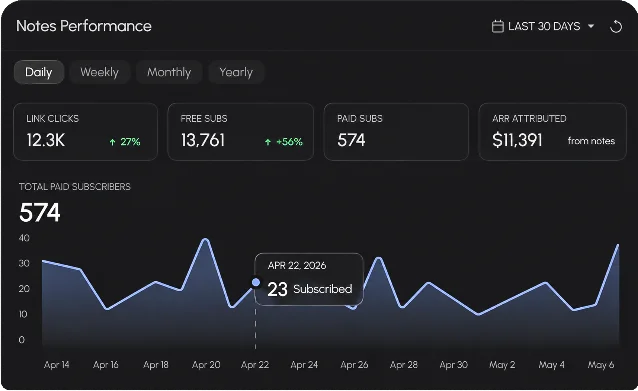
- Statistics: per-Note subscriber conversion data — which specific Notes drove new paid subscribers
- Activity Center: notification filtering with keyboard shortcuts, collapsing 1–2 hours of engagement work to ~15 minutes
- Follows: custom creator feed with no algorithm intermediation
- Notes Generator: AI that learns the user's writing style and converts existing articles into multiple Notes
- Cross-posting: distribute Notes to X, LinkedIn, and Bluesky via the Buffer API
- MCP integration: uses Anthropic's Model Context Protocol (MCP) to expose the entire scheduling workflow as Claude-callable tools, so users can schedule Notes via natural language chat
The analytics module deserves specific attention. Substack's native analytics don't show which individual Notes drive subscriber conversions. WriteStack does. That single capability changes how creators approach their Notes strategy — it gives them signal that the platform itself withholds.
User Karo Zieminski's assessment captures the product positioning precisely: "What makes Writestack stand out for me isn't just how deep the features go, it's that you can tell it's a product shaped by people who use it." 4 "People who use it" means one person who is also the founder — the product's coherence follows directly from that.
Pricing teardown: annual-only with a clear anchor tier
WriteStack has no free tier and no monthly billing option. Every plan requires an annual commitment, which shifts cash flow and reduces accidental churn. 3
| Tier | Monthly price (billed annually) | Annual total | AI credits/mo | Notes scheduling | Standout feature |
|---|---|---|---|---|---|
| Hobbyist | $19.99 | $239.88 | 50 | 20 | Basic access |
| Standard | $24.99 | $299.88 | 150 | 100 | Analytics + Activity Center + Cross-posting + Claude MCP |
| Premium | $79.99 | $959.88 | Unlimited | Unlimited | Advanced Notes search across millions of posts |
The Standard tier at $24.99/month is the anchor. It includes every core productivity feature — analytics, Activity Center, cross-posting, MCP integration — and sits at a price point that's less than a single Substack paid subscription for most newsletters. The jump to Premium ($79.99) is steep and deliberate: unlimited scheduling and the advanced search feature are targeted at high-volume creators or agencies, not the typical solo newsletter writer.
The 7-day free trial is the only free entry point. Orel ran at least one flash promotion in June 2025 — a 48-hour "FLASH" coupon offering 30% off on first month or annual plans — suggesting he's willing to use time-limited discounts for acquisition spikes. 6
One metric Orel has not disclosed: churn rate and trial-to-paid conversion by tier. The ~12.5% overall trial-to-paid figure in the snapshot is derived by dividing the disclosed paid customer count (360+) by the disclosed registered user count (2,870+) — it's a ratio, not a directly stated conversion rate.
Acquisition: where the 360 paying customers actually came from
コンテンツカードを読み込んでいます…
Buffer's case study names WriteStack's three acquisition channels directly: organic Substack discovery, Google search traffic, and Orel's build-in-public content. 2 Each deserves a separate read.
Organic Substack discovery is the dominant channel. Substack creators who are already spending time on the platform encounter WriteStack through Notes that other creators share, through search, or through direct creator-to-creator recommendations. The product serves the exact community it circulates within.
Google search traffic follows from the product's positioning. Someone searching "how to schedule Substack Notes" or "Substack Notes scheduler" has high intent and few alternatives — WriteStack's SEO benefits from being the only tool in its category. This is a channel that compounds as the product ages and the category remains thin.
Build-in-public content is where the surface reality diverges from the casual interpretation. Orel's X/Twitter account (@Orelzman) has 242 followers, and his milestone tweet announcing $10K MRR received 3 likes and 84 views. 1 X is not driving meaningful acquisition.
The actual build-in-public engine is The Indiepreneur, his Substack newsletter with 7,200+ subscribers. 7 That audience is composed almost entirely of solo founders and indie hackers — the same people most likely to have a Substack and most likely to want scheduling tools for it. The newsletter isn't a side channel for WriteStack marketing; it is the primary distribution mechanism operating inside the target market.
Orel also disclosed in a podcast appearance that he DMs people who interact with his content — a manual, high-touch acquisition tactic that doesn't scale but compounds relationship quality. 8 The Buffer case study itself was both a validation event and an acquisition event — third-party authority backing from a well-known brand in the scheduling tools space.
Timeline: 600 days and a pivot that mattered
| Date | Event |
|---|---|
| ~2024 early | Orel leaves full-time employment to build indie products |
| ~2024 | Builds ~9–12 products with zero revenue |
| ~2024 mid–late | Starts WriteStack as an AI article outline generator |
| ~Late 2024/early 2025 | Pivots to Substack Notes scheduling after user DM feedback |
| June 12, 2025 | Publishes detailed WriteStack product post on The Indiepreneur, with a 48-hour 30% flash discount |
| July 9, 2025 | Appears on Imperfect Creatives Podcast; discloses WriteStack at $10K ARR (~$833 MRR) |
| December 2025 | Launches WriteStack Wrapped — annual Notes analytics recap for users |
| May 26, 2026 | Buffer publishes official case study: ~$9,300 MRR, 360+ paying customers |
| May 31, 2026 | WriteStack crosses $10K MRR |
The data points that are absent from the public record: WriteStack's exact launch date, the $1K and $5K MRR milestones, and the product's churn rate. The ARR-to-MRR progression is telling though: from roughly $10K ARR in July 2025 (~$833/month) to $10K MRR in May 2026 — approximately a 12× revenue multiple in ten months.
What Mike Eckstein at Buffer described as "600 days and more than a dozen failed products" 2 isn't motivational framing — it's the context for the pivot. Orel had already built and discarded enough products to have a calibrated sense of what feedback matters and what to ignore. The DM-based validation that drove the pivot from AI writing tool to scheduling platform was not luck; it was a practiced behavior.
Replication checklist
What a solo founder with comparable skills would need to copy WriteStack's wedge:
- A platform with a clear tooling gap: Substack Notes had no scheduler. The gap was real, documentable, and Google-searchable. The product category "Substack Notes scheduler" existed in user intent before it existed as a product. Find an equivalent gap in another constrained platform ecosystem.
- Native platform access: WriteStack integrates directly with Substack's API and routes cross-posting through Buffer's API. API access — either direct or via an intermediary like Buffer or Zapier — is a hard prerequisite.
- An audience inside the target market before you launch: This is the hardest item on the list and the one most often glossed over. Orel had 7,200+ Substack subscribers before WriteStack had its current form. That audience is not separately acquirable.
- Annual-only billing from day one: No free tier means no hobbyist users who never pay. Annual commitment reduces early churn enough to give the product time to improve. If the product doesn't retain at 7 days, monthly billing amplifies that signal into immediate cancellations.
- One feature that the platform itself withholds: WriteStack's per-Note subscriber attribution works because Substack doesn't provide that data natively. Identify what data the host platform withholds from its creators and whether that gap can be filled via API.
- Willingness to ship imperfect: Orel's own LinkedIn post on hitting $10K MRR: "WriteStack has bugs. The UI isn't always beautiful. Some features took me 3 tries to build right. 360 people pay for it anyway." 5 The product shipped and iterated, rather than waiting for polish.
Original helpfulness metric: can you retain a user through a 7-day free trial? That answer precedes any acquisition strategy.
Honest assessment: what's not replicable
The 7,200-subscriber Substack audience is the single most non-replicable element of this case. Orel built The Indiepreneur over 600+ days of consistent publishing. That audience is not a list he bought. It is composed of people who specifically followed an indie hacker writing about how to build products — a direct overlap with the WriteStack buyer profile. A cold-start founder without an existing audience in the exact target market faces a structurally different acquisition problem.
Nine years of software development experience means Orel built and maintains WriteStack entirely alone. No co-founder, no contract developer, no outsourced maintenance. The unit economics of a solo technical founder running a $120K ARR SaaS are different from a non-technical founder who must pay for development. 5
600 days of prior failure as calibration: The pivot from AI article generator to Notes scheduler was not obvious. It required Orel to override his initial product hypothesis based on user feedback, and to do that quickly enough that the product found traction before he ran out of runway. That behavior is partly a learned skill from prior failures — not a starting condition for someone building their first product.
What Orel does not have: a prior successful exit, YC or accelerator alumni status, notable investor backing, or large X/Twitter following. The growth here is organic and self-funded within the constraints of one developer's time. That part is genuinely replicable, with appropriate caveats.
Three lessons that generalize
1. "Only" compounds faster than "better." Being the sole tool in a category creates SEO moats, word-of-mouth clarity, and referral language that "best-in-class" can't match. The window to establish category ownership closes when the second competitor enters. WriteStack's gap exists because Substack Notes is a niche within a niche — most scheduling startups won't touch it because the addressable market looks small. That's precisely the opening.
2. The distribution asset matters as much as the product. The acquisition arithmetic here is: founder has audience → audience is inside target market → product addresses that audience's pain → acquisition happens inside the ecosystem the product serves. This loop does not exist without the prior distribution asset. For solo founders evaluating where to build next, the right question isn't "what's a gap in the market?" but "what's a gap in a market I already have access to?"
3. Annual-only billing is a churn filter, not just a cash flow tactic. Requiring annual commitment selects for users who have made a considered decision — they've tried the 7-day trial, evaluated the tool, and decided it earns a year's commitment. Monthly billing opens the door to "I'll try it for a month" users who churn on month two regardless of product quality. Annual pricing reduces that noise at the cost of a higher conversion barrier in the trial period.
Sources
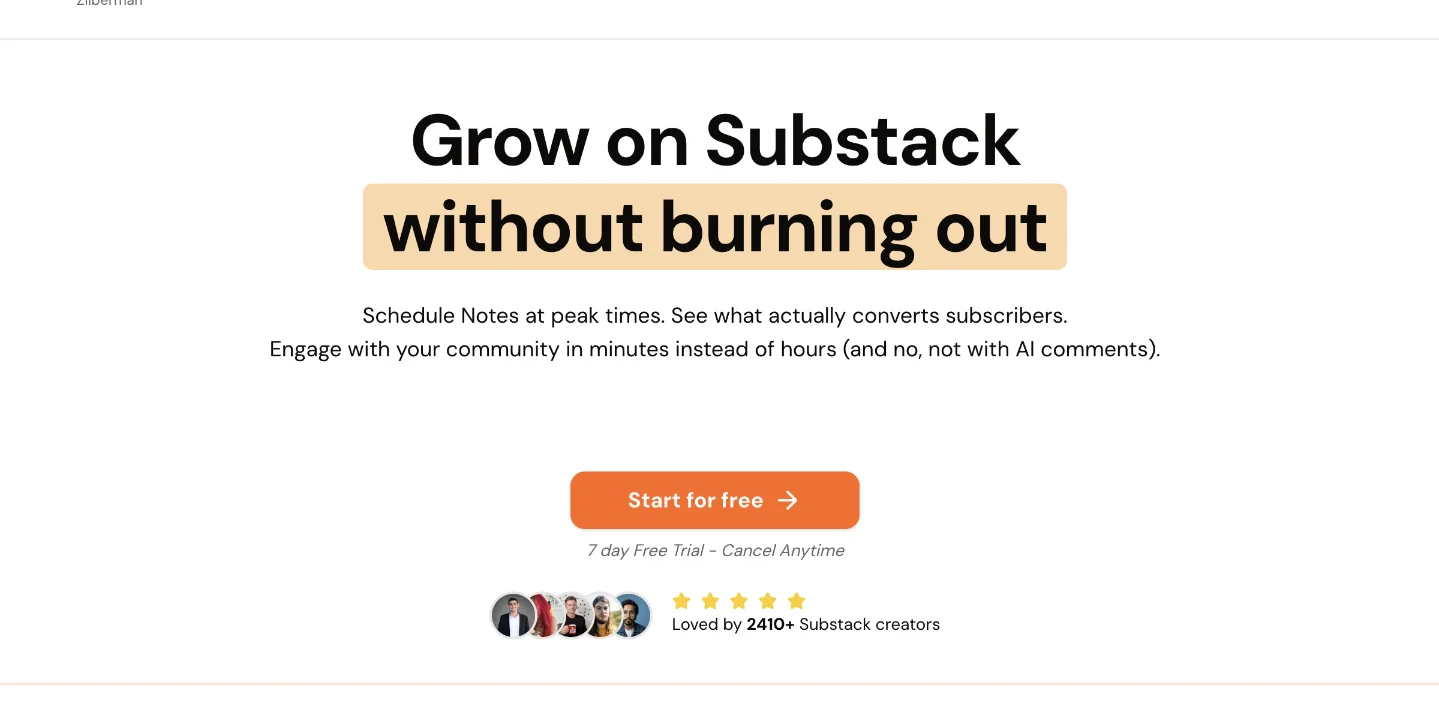
Cover image: WriteStack official site screenshot, writestack.io
参考ソース
- 1Orel Zilberman on X: WriteStack crosses $10K MRR
- 2Buffer: How WriteStack's Founder Built Cross-Platform Scheduling for Substack Creators
- 3WriteStack pricing page
- 4WriteStack official site
- 5LinkedIn: Orel Zilberman
- 6Orel Zilberman via The Indiepreneur: How To Schedule Notes On Substack
- 7Substack: Orel @orelzilberman
- 8Imperfect Creatives Podcast: From 0 to $10K ARR with Orel Zilberman
このコンテンツについて、さらに観点や背景を補足しましょう。