Ep 35/59 · Charadrius vociferus
Most shorebirds stay quiet and cryptic. The Killdeer named itself after its own alarm — a bird so loud it can be heard from a parking lot, a baseball diamond, or the middle of a suburban field.
Card 1 — Perched profile
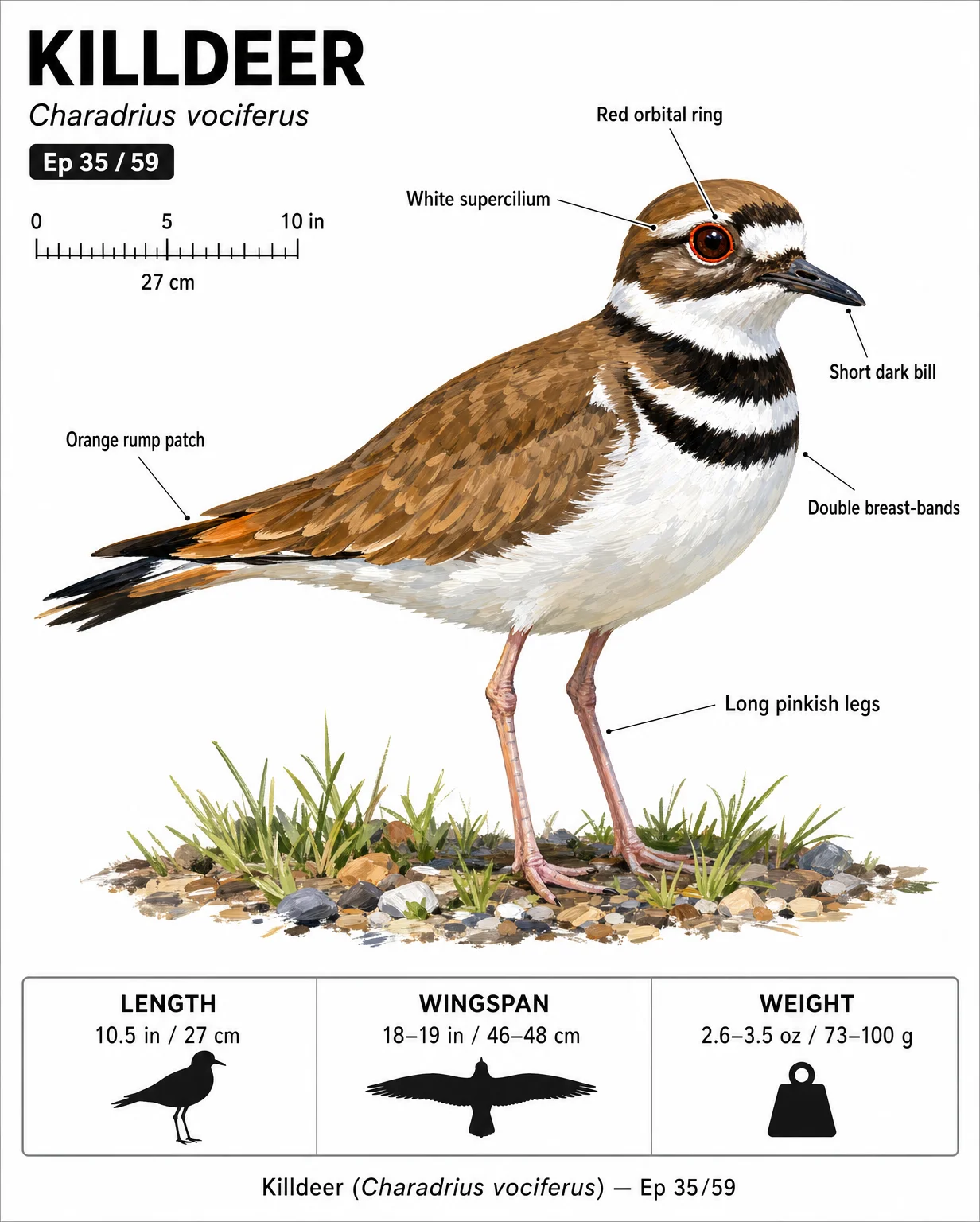
The double black breast-band is the one-glance ID. No other common plover in eastern North America has two of them. The vivid red-orange orbital ring around the eye looks almost painted on. At 10.5 in / 27 cm, it's the largest of the three look-alike species on Card 4 1.
Killdeer colonize open ground almost anywhere — gravel rooftops, mowed sports fields, parking lot edges, plowed farmland. Any flat, sparsely vegetated surface with sight lines will do.
Card 2 — Flight view
The flash of orange-rufous rump is the airborne giveaway. When a Killdeer flushes, that broad band of warm orange across the rump and uppertail blazes against the brown back — visible from a surprising distance 1.
In flight, look for:
- Brilliant orange rump patch — the #1 flight field mark
- Narrow white wing-stripe running along the secondaries
- Black subterminal tail band contrasting with white outer tail feathers
- Long, pointed wings that angle back — more falcon-shaped than typical plover
The ventral view reveals the breast-bands are visible in flight too, a useful double-check when the bird is banking.
Card 3 — Song & call
KILL-dee! KILL-dee! — the call is onomatopoeic enough that the bird named itself. Technically, the species name vociferus means "loud voice" in Latin, and that's generous understatement.
Three distinct vocalizations:
Primary song — the loud, repeated "kill-deer" cry used for territory and contact. Can go on for minutes without pause.
Alarm call — a rapid staccato dee-dee-dee when a predator (or a curious human) gets too close.
Broken-wing display call — the keening wail given while dragging one wing and stumbling away from the nest. This is performance: Killdeer lure threats away from ground nests with one of the most convincing injury acts in the bird world 1.
Card 4 — Look-alike comparison
Three brown-and-white plovers, but the band count tells them apart immediately:
Killdeer — two black breast-bands, orange rump, red orbital ring, 10.5 in. Widespread across North America year-round in the lower 48.
Semipalmated Plover (C. semipalmatus) — one black breast-band, orange-yellow legs and bill base, brown back similar to Killdeer but no orange rump, 7.5 in. Strictly a migrant through most of the US; breeds in the Arctic 1.
Piping Plover (C. melodus) — the palest of the three, with sandy-buff upperparts that blend into pale beach sand. Single breast-band that may be complete or broken. Orange-yellow legs and bill base, 7 in. Federally threatened/endangered; breeds on Atlantic and Great Lakes beaches 1.
The size difference matters in the field: Killdeer are noticeably larger than either look-alike. If you see a plover-type bird on a gravel roof in August, the Semipalmated is the most likely migrant candidate — Piping Plovers almost never leave their beach and lakeside habitat.
Quick ID summary
| Feature | Killdeer | Semi. Plover | Piping Plover |
|---|---|---|---|
| Breast bands | 2 | 1 | 1 (partial or full) |
| Back color | Brown | Brown | Sandy pale |
| Orange rump | ✓ | ✗ | ✗ |
| Size | 10.5 in | 7.5 in | 7 in |
| Status | Common, widespread | Migrant | Threatened/Endangered |
#Killdeer #BirdID #BackyardBirds #BirdWatching #Birding #PloverID #NorthAmericanBirds #FieldGuide #DailyBirdCard #Ep35of59
参考ソース
- 1Cornell Lab of Ornithology — All About Birdsallaboutbirds.org
コメント
ログインするとコメントできます。