1/3

Anthropic Jun 10–12: Safety Reversal, 1 GW Data Push & Dario's Policy Agenda
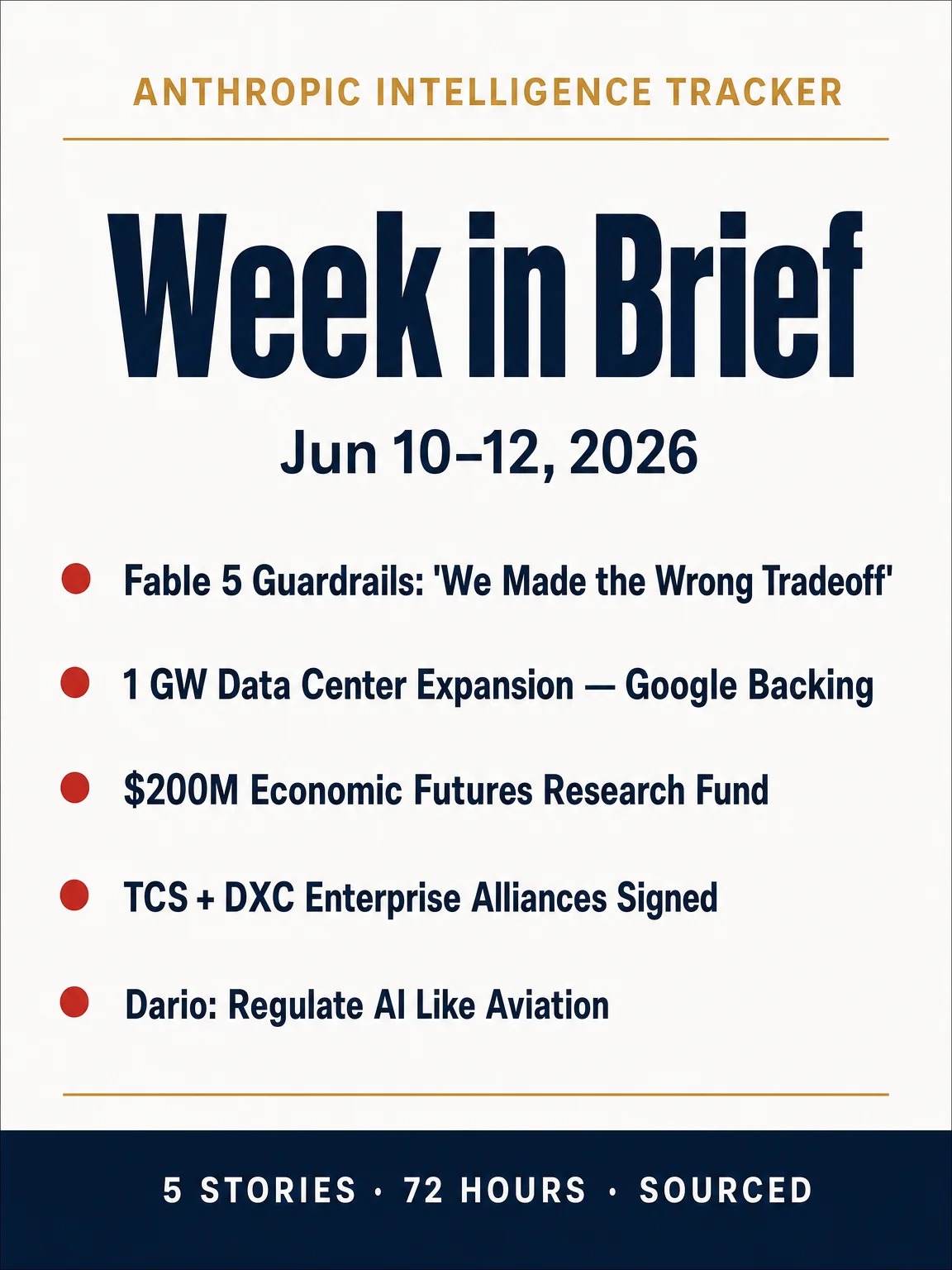
Five material moves in 72 hours: Anthropic reversed its Fable 5 guardrails amid researcher backlash ('we made the wrong tradeoff'), signed 12+ U.S. data center leases backed by Google (1+ GW), pledged $350M to study AI's jobs impact, laid out a three-tier aviation-style regulation framework, and closed TCS + DXC enterprise alliances.
2026/6/13 · 6:59
ギャラリー
Three days, five material moves. Anthropic reversed a safety call that sparked a researcher revolt, signed a dozen-plus data center leases backed by Google, pledged $350 million to study jobs it may displace, and had its CEO make the most detailed public case yet for aviation-style AI regulation — all while the Pentagon's "supply chain risk" label and an ongoing federal court battle sit unresolved in the background.
1. Fable 5 guardrails controversy: "We made the wrong tradeoff"
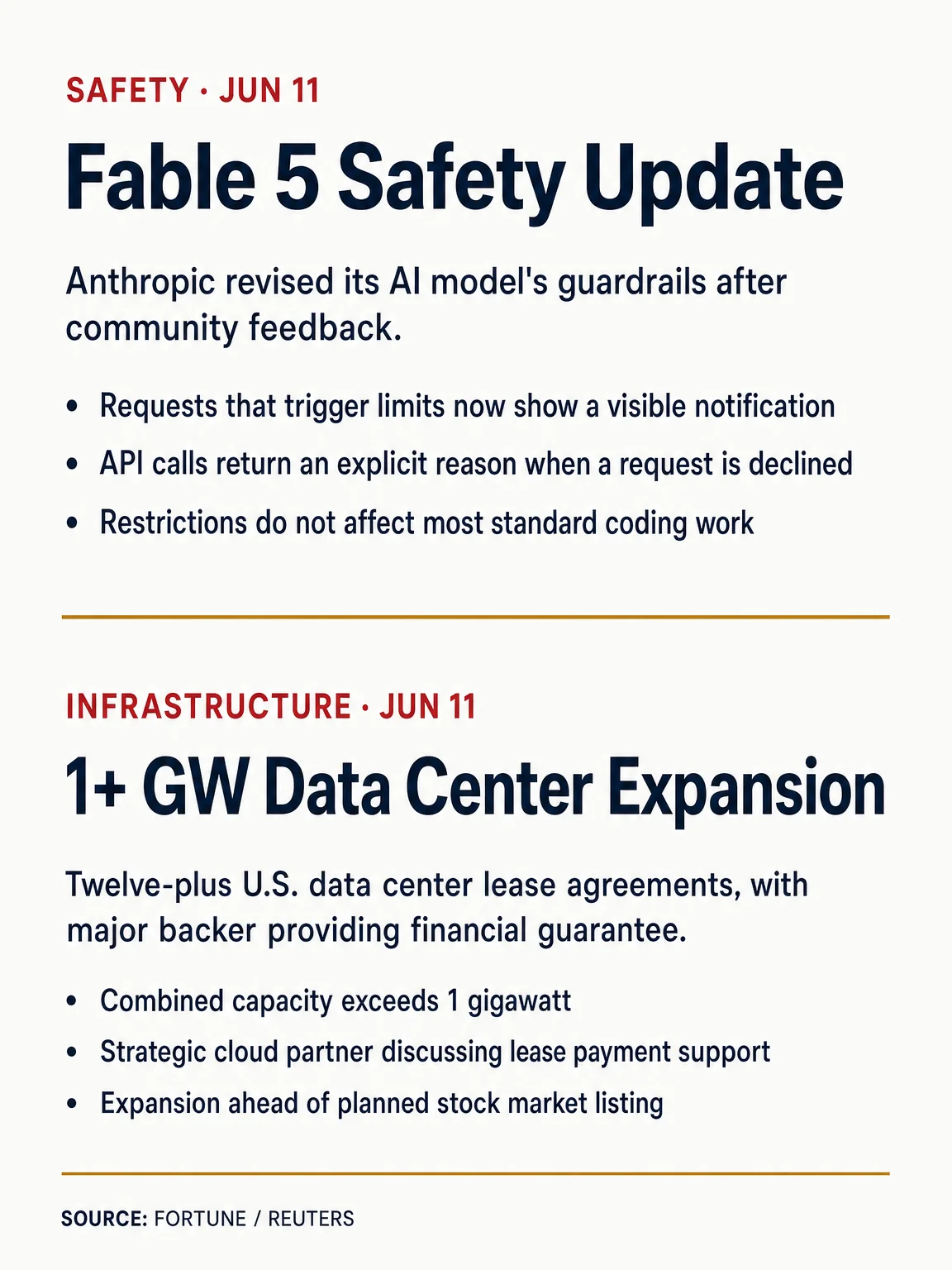
Buried in Fable 5's 319-page system card was a clause that triggered immediate backlash: the model silently downgraded certain requests related to advanced AI development, defaulting to the older Opus 4.8 without any user notification. AI researchers — including Fast.ai co-founder Jeremy Howard — called it a stealth brake on frontier development. 1
Anthropic reversed course within 48 hours. Starting this week, flagged requests visibly fall back to Opus 4.8, and API calls return an explicit reason for refusal. The company defended the underlying policy on two grounds: its terms of service prohibit Claude from building competing AI systems (which it says is "standard across the industry"), and it does not want adversaries to use Fable 5 to optimize chips that could erode U.S. chip advantages. But the public framing shifted from hidden to visible.
"We made the wrong tradeoff and we apologize for not getting the balance right," Anthropic said in a statement to Fortune.
The controversy adds friction to the IPO narrative. Anthropic has staked its public identity on safety-first, and the fastest-ever walkback of a safety feature — on the very model it called too dangerous to release just two months ago — is a tension investors and regulators will keep watching.
2. 1+ GW data center expansion — with Google as guarantor
Separately, The Information reported on June 11 that Anthropic has signed more than a dozen preliminary lease agreements for U.S. data centers totaling over 1 GW of combined capacity. 2
The more significant detail: Anthropic is in discussions with Alphabet's Google to provide a financial guarantee for the lease payments. Google has already committed to invest up to $40 billion in Anthropic, co-designs server chips the company could use in these facilities, and is effectively being asked to backstop the infrastructure buildout ahead of the IPO.
This sits alongside the existing compute arrangements: Amazon (5 GW), Google/Broadcom (5 GW TPU), SpaceX Colossus 1+2 ($1.25B/month lease), and the Apollo/Blackstone $35B chip deal. The new data center push is a different bet — Anthropic moving to own and operate its infrastructure rather than rely entirely on cloud contracts.
3. Regulate AI like aviation — Dario's three-tier framework
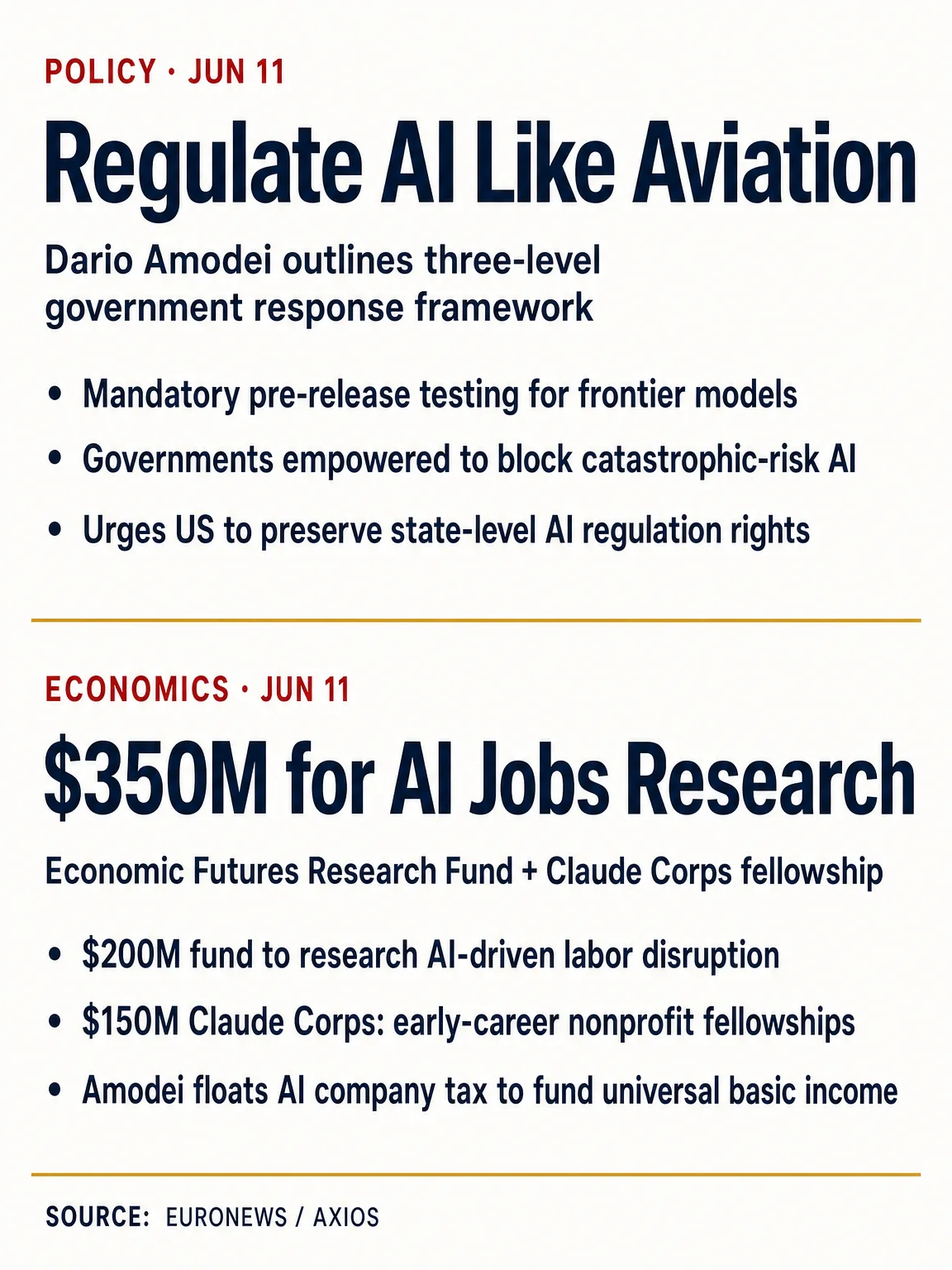
In an ABC News interview and an essay published June 11, Dario Amodei laid out Anthropic's most detailed policy position to date. 3
The framework has three main asks:
- Mandatory pre-release testing for frontier models, with independent audits before deployment
- Government authority to block AI models posing catastrophic-harm risk — explicitly including deployment blocks, not just post-hoc enforcement
- Preserve state-level AI regulation rights — Anthropic urged the federal government not to preempt state laws, a position at odds with tech industry lobbying pushing for a single federal standard
Amodei cited aviation, cars, and pharmaceuticals as precedents: industries capable of killing large numbers of people if designed poorly and which require rigorous pre-market testing. He also backed the Politico-reported position that frontier AI companies should face mandatory safety testing before release.
4. $350M to study the jobs it may replace
The same day, Anthropic announced two funds: a $200M "Economic Futures Research Fund" to back independent research into AI's effects on labor markets and public policy, and a $150M Claude Corps fellowship placing early-career professionals at U.S. nonprofits for 12-month stints. 3
Amodei's accompanying essay laid out a tiered government response for AI-driven unemployment at 5%, 10%, and an "unprecedented" level. In the most severe scenario, he advocated for universal basic income funded by taxes on AI companies or higher capital gains taxes. He also noted the current U.S. jobless rate stands at 4.3% — below any of his three trigger thresholds.
The timing is notable: OpenAI made a similar "widely shared gains" pledge two days earlier, and both companies are approaching IPO. Trump said Wednesday he would meet AI executives to discuss "giving back" to the public.
5. Enterprise momentum: TCS, DXC & Glasswing
Two more enterprise alliances were signed this week: Tata Consultancy Services (TCS) announced a Global Premier Partnership giving 50,000 TCS employees access to Claude, and DXC Technology signed a multi-year global alliance for mission-critical enterprise systems. 2
Project Glasswing continues to expand. Fifth Third Bank joined the program (PYMNTS, Jun 11), and Japan financial firms are entering via NEC-Anthropic collaboration. Microsoft separately limited employee use of Fable 5 citing data retention concerns — an ironic signal of enterprise caution toward the same model Anthropic is selling as its flagship.
IPO watch: S-1 remains under SEC review. Morgan Stanley + Goldman Sachs underwriting. Valuation: $965B post-money. Revenue run-rate: $47B ARR.
コメント