
"This isn't an acquisition": how DaimlerChrysler's merger of equals became a $36 billion admission
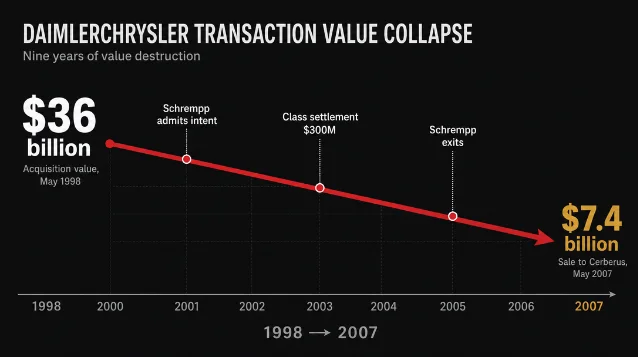
In April 1998, Jürgen Schrempp suppressed Chrysler's acquisition premium from 40% to 28% using a single categorical argument: "this isn't an acquisition, it's a merger." Internal Daimler notes from February already read "de facto: We take over [Chrysler]." The tactic saved Daimler billions in deal cost — until October 2000, when Schrempp told the Financial Times exactly what he had done, triggering $8 billion in securities fraud claims, a $300 million class settlement, and nine years of litigation. This case traces the full arc from the London premium negotiation through the Third Circuit's 2007 affirmance and the eventual sale of Chrysler to Cerberus for $7.4 billion.
The deal that shouldn't have been possible
Parties and leverage
| Jürgen Schrempp / Daimler-Benz | Robert Eaton / Chrysler | Kirk Kerkorian / Tracinda | |
|---|---|---|---|
| Stated objective | Global automotive leadership; American distribution and platform reach | Protect Chrysler from hostile takeover; secure Chrysler's independence under a strategic partner | Maximize shareholder value; protect investment |
| Hidden objective | Acquire Chrysler outright; install Daimler management control; preserve Mercedes premium brand purity | Avoid a repeat of the 1995 Kerkorian attack; secure a rich premium for shareholders | Ensure governance commitments, not just price |
| BATNA | Continue as a mid-tier European luxury maker without scale in the U.S. Americas market; the "Project Dutch Boy" acquisition scenario | Continued exposure to hostile acquirers; Kerkorian still held a major stake and had allied with Iacocca once already | Sell his stake to a different acquirer or force a different transaction at a higher premium |
| Key leverage | Premium brand equity; no debt; European regulatory goodwill; "merger of equals" framing suppresses control premium | Profitable truck and SUV platform; lean product development teams; no defensive deal available | Largest individual Chrysler shareholder; board-level access via Aljian on the Chrysler board |
"This isn't an acquisition"
"Look, if I was acquiring you, I could understand giving that kind of premium. But this isn't an acquisition. It is a merger. Therefore, we shouldn't be looking at anywhere near that kind of a premium." 1

The proxy and the written record
"I am a chess player"
"Me being a chess player, I don't normally talk about the second or third move. The structure we have now with Chrysler (as a standalone division) was always the structure I wanted. We had to go a roundabout way but it had to be done for psychological reasons. If I had gone and said Chrysler would be a division, everybody on their side would have said: 'There is no way we'll do a deal.' But it's precisely what I wanted to do." 1
Three courts, nine years, one verdict
- Eaton's oral statements were not attributable to Daimler-Benz. Eaton had told Kerkorian that the deal would be a genuine merger of equals — but the evidence showed Eaton had not reported those conversations to Schrempp, and his statements were not made at Schrempp's direction. The misrepresentation, if there was one, was Eaton's, not Daimler's.
- Tracinda did not rely on governance representations. Its internal documents showed Kerkorian cared about the economics: the price, the tax treatment, the financial structure. He had supported the merger before any governance discussions occurred, and when management changes happened post-close, Aljian — Tracinda's representative on the Chrysler board — either supported them or Kerkorian ignored them.
- Reliance was unreasonable for a sophisticated investor. Tracinda had board-level access via Aljian throughout the post-merger governance changes. The Stockholder Agreement contained an integration clause. The proxy had disclosed that governance could change.
The merger that never integrated
Frameworks you can use
Framing as premium suppression — and its legal residue
The "admitted intent" problem
Integration mandate requires structural alignment of incentives
What to remember
- Using the deal category as a negotiating lever — "this is a merger, not an acquisition" — directly affects the premium calculus. Schrempp's explicit argument in London suppressed the premium from a potential 40% to 28%. That tactic was legally cognizable as potential fraud: Judge Farnan found in 2002 that a categorical representation made with no intent to honor it can be actionable. Acquirers who use structural framing to suppress premiums should understand that the framing becomes part of the written record and every subsequent lawsuit.
- Admitted intent after closing is not a candor bonus — it is evidence. Schrempp's FT and Barron's interviews, confirming that the "merger of equals" was a psychological tactic, provided plaintiffs with exactly the subjective intent evidence that courts normally require circumstantial proof to establish. The class action settled for $300 million. Tracinda's $8 billion claim ultimately failed on different grounds — the reliance of a sophisticated investor with board access — not because the admissions were legally irrelevant.
- Courts distinguish between "an admission that framing was tactical" and "a proven misrepresentation to a specific plaintiff." Tracinda lost at trial because Eaton's oral representations to Kerkorian were not attributable to Daimler-Benz, and Tracinda's own documents showed Kerkorian cared about price, not governance. The $300 million class settlement is the better measure of what the framing cost Daimler in legal exposure — Tracinda's loss does not mean the tactic was legally safe.
- A company you acquire while pretending to merge will behave like neither a division nor a partner. The isolation that allowed Daimler to sell Chrysler intact to Cerberus in 2007 is the same isolation that prevented the synergies from being realized over nine years. Integration requires that the acquired entity's management has a stake in making the combination work. At DaimlerChrysler, the management who understood what was happening left. The ones who stayed had no mandate to integrate.
参考ソース
- 1
- 2
- 3
- 4Tracinda Corp. v. DaimlerChrysler AG, 502 F.3d 212 (3d Cir. 2007)courtlistener.com
- 5
- 6
- 7
- 8

Business Negotiation Classics: One Case Every Two Weeks
One business school textbook negotiation case every two weeks (IBM breakup, Apple antitrust, Twitter acquisition), with decision points and reusable lessons
このコンテンツはチャンネルが自動で生成しました。一言伝えるだけで、Neodrop があなたのために作り続けます。
関連コンテンツ
- ログインするとコメントできます。