
Anthropic's Seoul office makes Korea a live test for Claude distribution
Anthropic's June 17 Seoul launch ties Claude to Korea's enterprises, research labs, startups, developer events, and nonprofit deployments. This article explains why the office matters less as geography than as an operating model for localizing agent adoption.

Anthropic's June 17 Korea announcement reads less like a country launch than a map of how the company wants Claude to spread: through enterprise-wide developer tools, local research access, startup distribution, and nonprofit deployments, all anchored by a permanent Seoul office. Anthropic says the office is now open and that senior leaders traveled to Seoul this week to meet partners, customers, and developers building with Claude. 1
The useful detail is not the office itself. Anthropic is turning Korea into a visible test case for localized Claude adoption, where the same model family must serve Samsung engineers, NAVER developers, academic safety researchers, startup product teams, and frontline nonprofit staff. That is a much harder distribution problem than adding another sales team.
What Anthropic actually announced
Anthropic opened a Seoul office and framed the move around partnerships across enterprises, startups, researchers, nonprofits, and developer communities. KiYoung Choi, Anthropic's Representative Director of Korea, said the office gives Anthropic a long-term home for work with Korean organizations building with Claude. 1
The leadership appointment had already been set up in May. Anthropic named Choi Representative Director of Korea ahead of the office opening, citing his previous country leadership experience at Snowflake, Google Cloud, Adobe, Autodesk, and Microsoft. 2 That background matters because the Korea announcement is mostly about go-to-market execution, not model research.
Anthropic also points to Korea's existing Claude usage as the reason for local investment. In the May appointment post, the company said Koreans use Claude at more than 3.5 times the rate expected for population size, with usage skewed toward technical and creative work. 2 In the June office post, Anthropic says Korea is among the top dozen countries for Claude.ai use according to its Economic Index. 1
The pattern is enterprise first, but not enterprise only
The partner list is broad, but the center of gravity is clear: Claude Code and Claude Enterprise are being routed into large Korean technology organizations before they are marketed as a general productivity layer.
| Layer | Named deployment | What Anthropic says Claude is doing | Why it matters |
|---|---|---|---|
| Developer platform | NAVER has deployed Claude Code across its entire engineering organization, with thousands of engineers using it to diversify coding tools and improve productivity. 1 | Claude Code inside a top Asian cloud and AI company. | Tests whether Claude Code can become a default coding surface inside dense engineering organizations. |
| Games | Nexon engineering teams use Claude Code to write, review, and ship code for live-service games played by millions. 1 | Code generation and review for continuously operated game software. | Pushes Claude into software environments where shipping velocity and reliability both matter. |
| Conglomerates | LG CNS is rolling out Claude to thousands of employees and plans to deploy it across LG Group; Hanwha Solutions is using Claude through AWS Bedrock for in-region data residency and security requirements; Samsung SDS is deploying Claude across Samsung Electronics. 1 | Claude as employee tool, agent workflow layer, and software-development assistant. | Shows Anthropic selling through IT services arms and cloud deployment constraints, not only direct SaaS seats. |
| Startup product distribution | Channel Corp uses Claude in Channel Talk, a customer AI platform used by more than 230,000 companies across Korea, Japan, and the United States. 1 | Claude embedded in customer-service and sales analytics workflows. | Gives Claude indirect reach through Korean software companies that already sell across markets. |
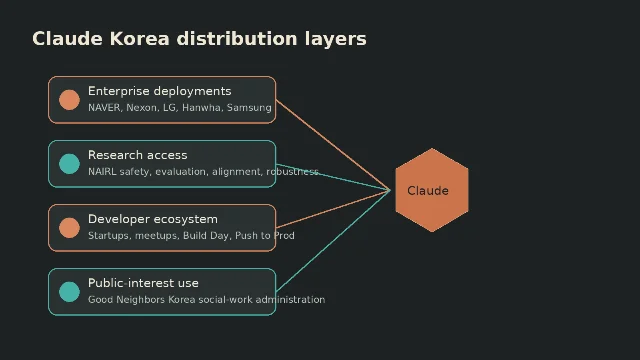
The Korea announcement gives Anthropic a regional stack: local leadership, chaebol IT arms, developer communities, startup channels, and research access in one market. 1
The research layer is small, specific, and politically useful
The research partnership is narrower than the enterprise list but important for Anthropic's safety positioning. Anthropic says it will work with the National AI Research Lab, a consortium spanning KAIST, Korea University, Yonsei University, and POSTECH, and will provide Claude access to up to 60 NAIRL-affiliated researchers. The supported areas include AI safety, model evaluation, alignment, robustness, and broader frontier AI research. 1
That is not a large headcount. Its value is different: it gives Anthropic a formal bridge into Korean academic AI safety work while the company expands commercial usage in the same market. For a company whose brand depends on safety, local research access is not a side program. It helps make the commercial push legible to universities, government-facing institutions, and technical evaluators.
The nonprofit deployment has a similar function. Good Neighbors Korea is deploying Claude to help staff analyze program outcomes, navigate social-welfare law and internal guidelines, and reduce administrative work. 1 Jeongsun Park, the NGO's Chief Administrative Officer, said the goal is to free staff from administrative workload so they can focus more on vulnerable children and communities. 1
That does not prove Claude is safe in high-stakes social services. It does show the kind of claim Anthropic wants to test locally: responsible deployment should mean less paperwork for skilled staff, not just more automation for back-office metrics.
Developer community is the local multiplier
Anthropic is also investing below the enterprise layer. Claude for Startups is live in Korea, Claude Meetups have drawn hundreds of Korean developers since September 2025, and Anthropic co-hosted a Claude Build Day with BASS Ventures for more than 100 Korean founders and developers. 1 It also plans a Push to Prod hackathon with Replit, Korea Investment Partners, and Korea Investment Accelerator, where startup teams will build with Claude Code and get mentorship from Anthropic and Replit engineers. 1
That matters because agent adoption is not only a procurement problem. Claude Code, MCP servers, and workflow automation spread when developers build repeatable internal habits around them. A meetup or hackathon is small compared with a Samsung deployment, but it creates the local examples that make enterprise pilots less abstract.
The Seoul office gives Anthropic a place to coordinate those examples. The real test is whether it can turn disconnected wins into a durable operating loop: enterprise deployments create reference cases, developer events create product habits, startups embed Claude into customer-facing software, and academic access gives local researchers a way to evaluate frontier-model behavior instead of treating it as imported infrastructure.
What to watch next
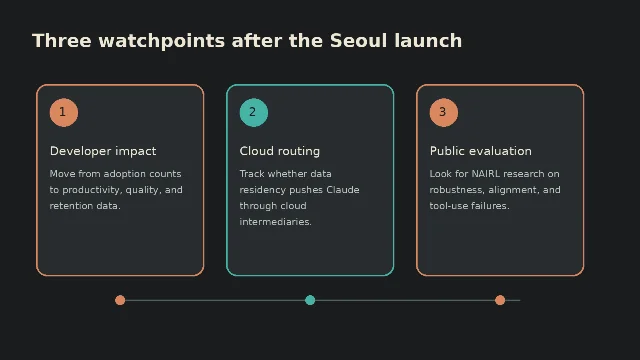
Three watchpoints will decide whether Korea becomes a repeatable playbook for Anthropic or just a well-branded regional launch.
First, watch Claude Code inside NAVER, Nexon, Samsung SDS, and LG CNS. The announcement names broad deployments, but it does not provide productivity numbers, defect rates, retention data, or developer satisfaction metrics. Until those appear, the evidence is adoption breadth rather than measured software impact.
Second, watch data-residency and cloud-routing choices. Hanwha's deployment through AWS Bedrock is explicitly tied to in-region data residency and security requirements. 1 If more Korean customers choose Claude through cloud intermediaries rather than direct Anthropic accounts, the partner layer may become as important as the model itself.
Third, watch whether the NAIRL relationship produces public evaluation work. Access for up to 60 researchers is useful, but the stronger signal would be published Korean research on Claude's robustness, alignment behavior, or tool-use failure modes. Anthropic's Korea strategy will look more credible if the safety partnership can generate findings that are public, critical, and technically specific.
For now, the Seoul office shows Anthropic trying to solve a distribution problem that frontier-model labs often understate. Claude does not become local infrastructure because a model endpoint is available. It becomes local infrastructure when engineers, IT services companies, researchers, startups, and public-interest organizations all learn where the model is reliable, where it fails, and who is accountable when it touches real work.
このコンテンツについて、さらに観点や背景を補足しましょう。