32 scuba divers pedaled a tricycle 116 miles underwater. Nobody paid them enough attention.

32 scuba divers pedaled a tricycle 116 miles underwater. Nobody paid them enough attention.

On June 16, 1988, 32 certified scuba divers in Santa Barbara pedaled a standard tricycle along the bottom of a pool for 75 hours and 20 minutes, covering 116.66 miles to set a Guinness World Record for underwater cycling — raising money for the MDA while leaving behind almost no photographic evidence or named participants.

Sports History Oddities On This Day
2026/6/15 · 21:27
購読 5 件 · コンテンツ 30 件
On June 16, 1988, a team of 32 certified scuba divers descended to the bottom of a pool at Diver's Den, a Santa Barbara dive shop, and started pedaling. They pedaled a standard, unmodified tricycle — the kind you'd find in a driveway — while breathing through scuba regulators, rotating shifts across three days and three nights. When they finally surfaced on June 19, they had covered 116.66 miles (approximately 127.3 km) in 75 hours and 20 minutes, setting a Guinness World Record for underwater tricycle distance. The money raised went to the Muscular Dystrophy Association. 1 2
You've probably never heard of it.
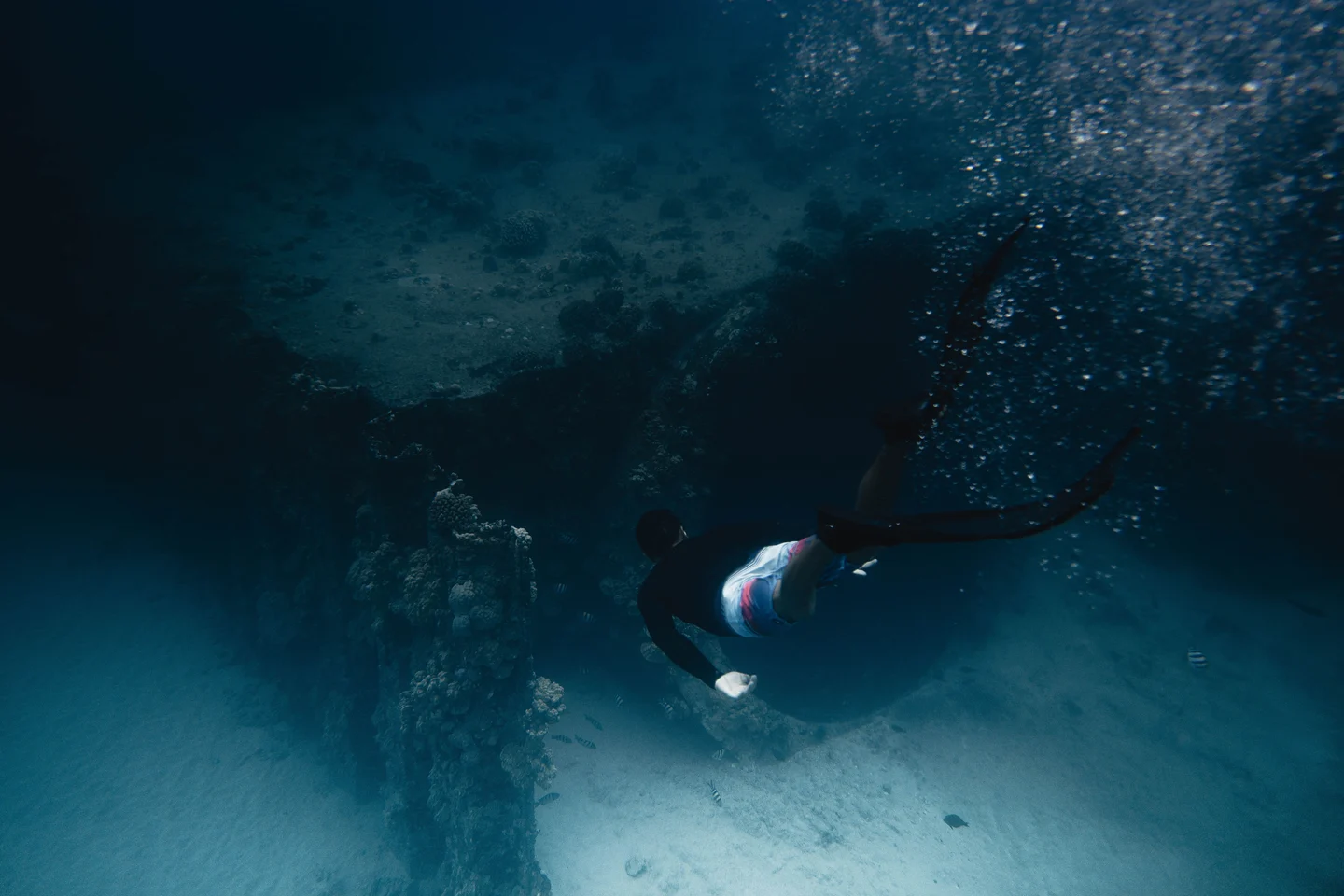
A scuba diver swimming through a vivid coral reef underwater
Underwater cycling looks nothing like this — but it starts the same way. 3

What even is underwater cycling

The Guinness Book had a category for it. In fact, the 1988 Santa Barbara team didn't invent the idea — they broke a record that already existed. Seven years earlier, on November 27, 1981, a different group of 32 certified divers rode what the official record calls a "submarine tricycle" for 64.96 miles in 60 hours, on the bottom of the Amphi High School swimming pool in Tucson, Arizona. That 1981 event appeared in the 1988 Guinness Book of World Records under the heading "Underwater Cycling." 4
The Santa Barbara team knew about that record and went after it. They nearly doubled the distance — 116.66 miles to the previous 64.96 — and extended the time from 60 hours to 75 hours and 20 minutes. They also upgraded from a submarine tricycle to a plain, standard one. Nobody seems to have noted that distinction in any surviving coverage, but it's there in the sources: a submarine tricycle versus a regular tricycle, submerged.
The setup at Diver's Den was relay-style. Thirty-two divers, rotating. You pedal, you surface, someone else goes down. For 75 hours. For charity.

The 1981 predecessor in Tucson

The record began in Tucson, at a high school pool, in November 1981. Thirty-two certified scuba divers. A submarine tricycle. Sixty hours. 64.96 miles. Recognized in the 1988 Guinness Book of World Records. 4
What's a "submarine tricycle"? The record doesn't explain, and no surviving source does either. The phrase suggests something purpose-built for underwater use, maybe weighted differently, maybe with different pedal resistance. The Santa Barbara team's choice to use a standard tricycle instead reads less like a downgrade and more like a statement: we're doing this with what you'd find in a garage.
Both events used exactly 32 divers. Whether that's coincidence, a Guinness category requirement, or evidence of some shared organizing tradition among Southwest dive clubs is unknown. No participant names from either event have surfaced in any accessible digital archive.
統計カードを読み込んでいます…

Diver's Den and the MDA connection

Diver's Den was a dive shop in Santa Barbara affiliated with the National Association of Scuba Diving Schools (NASDS), one of the major scuba certification bodies of the era. The shop was operating by at least 1977, issuing NASDS certifications through instructors on staff. 5
The 1988 event raised money for the Muscular Dystrophy Association, which throughout the 1980s was one of the most visible charity fundraising operations in the United States — largely due to Jerry Lewis's annual Labor Day telethon. A dive shop organizing a 75-hour underwater tricycle relay for MDA fits the era's fundraising culture exactly: local businesses staging increasingly elaborate stunts to reach national causes.
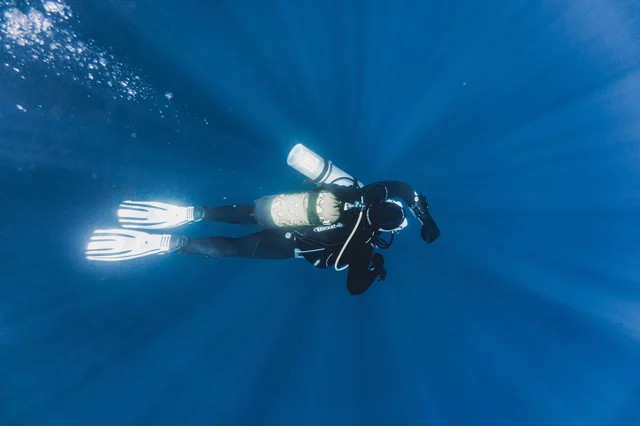
A scuba diver swimming underwater with an oxygen cylinder, viewed from above
Scuba relay endurance over 75 hours meant constant gear-switching and diver rotation. Photo: Pia B / Pexels
No named organizer has been identified in any accessible source. The event appears in a Singapore newspaper — the Straits Times, June 21, 1988 — with a brief wire report confirming the distance and time. 6 American newspaper coverage, if it existed, has not been digitized. The Santa Barbara News-Press archives, which would be the obvious primary source, are not publicly accessible online. The 75-hour event left almost no digital footprint outside trivia databases and the 1988 Guinness Book.

Why a tricycle specifically

Unicycles are harder to balance underwater. Bicycles wobble. Tricycles have three points of contact with the pool floor, stay put, and don't require the rider to think much about lateral balance while managing a scuba regulator and breathing from a tank. For an event that runs three days and requires dozens of rotation handoffs, simplicity is the engineering choice.
The "standard tricycle" specification also matters for the Guinness category. It ruled out purpose-built submarine equipment and made the record more reproducible — in theory, any group with dive gear and a hardware store could attempt it.
Whether anyone ever did attempt it afterward is a different question.

What happened to the record after 1988

The current Guinness record for "farthest distance cycling underwater" belongs to Jens Stotzner of Germany, who covered 6,708 meters (22,007.83 feet) in a solo non-stop effort at Bibert Bad Zirndorf, Germany, on September 8, 2013. He completed 78 laps of an 86-meter course. 7 A separate current record, "most people cycling underwater," is held by 22 divers at a competitive race in Guernsey in 2006. 8
Neither of these is the Santa Barbara category. Stotzner's record is individual and non-stop. The Guernsey record is a competitive race, not an endurance distance relay. The 1988 event's specific format — team relay, endurance distance, standard tricycle — appears to have been retired or superseded in Guinness's database without a direct successor.
This means the Santa Barbara team's 116.66 miles remains, in practical terms, unchallenged. Nobody has tried to beat that specific record in the 38 years since.
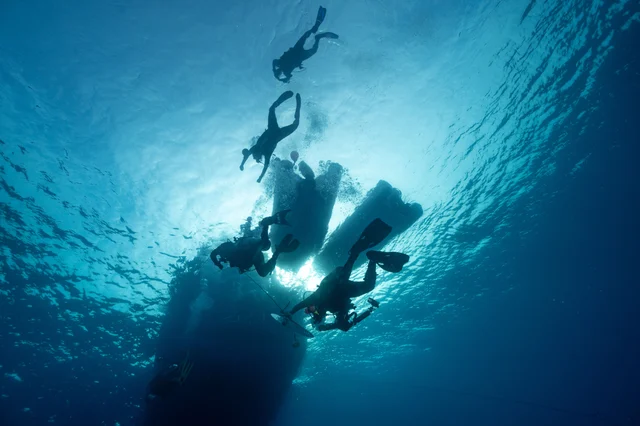
Silhouetted scuba divers swimming underwater beneath a yacht in clear blue water
The 1988 team rotated through three days of dives. Photo: Saad Alaiyadhi / Pexels

The anomaly

Here's what makes June 16, 1988 strange in retrospect. The event is confirmed by four independent sources, including a contemporaneous newspaper. 1 2 3 6 The numbers are precise and consistent across all sources: 116.66 miles, 75 hours and 20 minutes, 32 divers, June 16-19, Diver's Den, Santa Barbara, MDA charity. The Guinness category existed before the event and continued after it.
And yet: no photos. No named participants. No American newspaper coverage in any accessible archive. No follow-up story about what the team did next. No oral history from any of the 32 divers. The event sits in the record books like a parenthetical — a solved puzzle whose solvers left no names on the lid.
The 1981 Tucson event is similarly anonymous. Thirty-two divers, 64.96 miles, a high school pool, no names.
The Undercurrent diving newsletter mentioned the 1981 event in its July 1985 issue, confirming it was circulating in dive community memory four years later. 9 By 1988, someone in Santa Barbara read about it and decided to go further. That chain of decision — someone reading a record, deciding to try it, recruiting 31 other divers, arranging a pool, contacting MDA, pedaling for 75 hours — is entirely undocumented.
Which is itself a kind of answer. They did it, they got the record, they raised money for a good cause, and apparently that was enough. No publicity ambitions. No book deal. No reunion tour. Just the record, quietly sitting there, since 1988.
Cover photo: Diver swimming through coral reef. Photo by ArtHouse Studio / Pexels.

このコンテンツについて、さらに観点や背景を補足しましょう。

  • ログインするとコメントできます。