Anthropic ships Claude Fable 5, its first Mythos-class model for the public
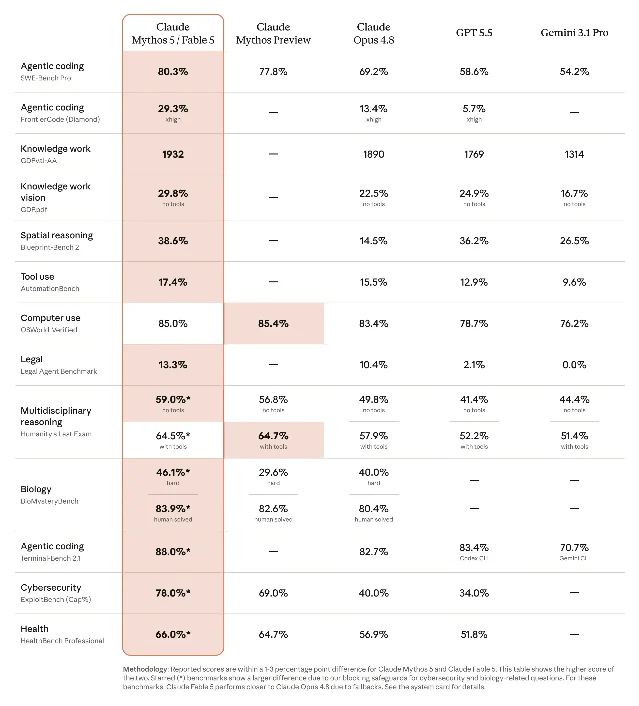
Anthropic released Claude Fable 5 on June 9, bringing Mythos-tier AI capabilities to the general public for the first time. The model tops benchmarks in software engineering, knowledge work, and scientific research, priced at $10/$50 per million tokens — less than half the cost of its predecessor.

Anthropic released Claude Fable 5 on June 9, making its first Mythos-class model available to the general public — and simultaneously announcing Claude Mythos 5, the unrestricted version of the same model, for a narrow set of government-vetted cybersecurity and life-sciences partners.1
What shipped
Fable 5 and Mythos 5 share the same underlying model. The distinction is guardrails: Fable 5 routes roughly 5% of sessions — those touching offensive cybersecurity, biology and chemistry queries, or suspected model-distillation attempts — to Claude Opus 4.8 instead of answering directly. Mythos 5 lifts those filters for authorized users.1
Both models are priced at $10 per million input tokens and $50 per million output tokens — less than half the cost of Claude Mythos Preview, the restricted research version Anthropic released in April through Project Glasswing. Developers can access Fable 5 today via the Claude API with the model ID
claude-fable-5.1For subscription users, Fable 5 is included on Pro, Max, Team, and seat-based Enterprise plans at no extra cost through June 22; after that, usage requires credits until Anthropic has enough capacity to restore it as a standard plan feature.1
Capabilities
Fable 5 is Anthropic's first generally available model to perform well on long-horizon agentic tasks. In early testing, Stripe reported that the model compressed a Ruby codebase migration — estimated at two months of work for a full team — into a single day across a 50-million-line codebase.1 GitHub said Fable 5 handled "complex, long-horizon coding tasks with a level of autonomy and reliability that exceeded previous benchmarks."1
In knowledge work, Hebbia's Finance Benchmark for senior-level analytical reasoning ranked Fable 5 highest of any model tested; IMC reported it matched near-perfect scores across trading-analysis tasks including factual lookup and expected-value analysis.1
Fable 5 also outperforms prior Claude versions significantly on long-context stability. When Anthropic tested the model on the deck-building game Slay the Spire with access to persistent file-based memory, performance improved three times more than it did for Opus 4.8 under the same conditions.1
The Mythos 5 variant adds autonomous scientific capabilities Anthropic is not yet releasing broadly. Internal protein design experiments showed Mythos 5 accelerating key steps in drug design by roughly ten times, matching or beating skilled human scientists on 9 of 14 protein targets. In a separate genomics project, Mythos 5 operated largely autonomously for over a week, training a custom machine learning model that outperformed a recently published Science paper model — at 100 times smaller size.1
The safety architecture
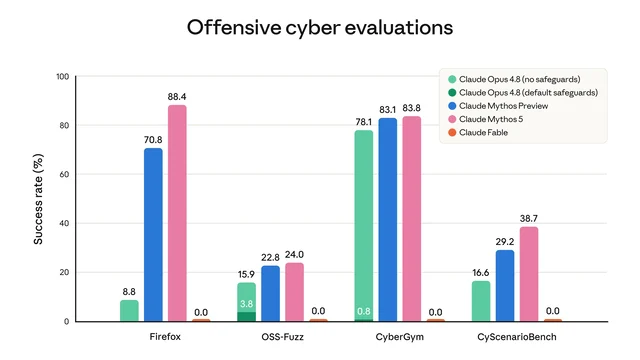
The release represents Anthropic's first public test of what it calls "capability-tier-specific safeguards" — classifiers that sit outside the main model and intercept queries before Fable 5 ever responds. The three classifier categories are cybersecurity (offensive tasks and exploit development), biology and chemistry (broadly defined, to cover dual-use research risks), and distillation (attempts to extract model weights to train competing systems).1
Anthropic ran an external bug bounty — over 1,000 hours of testing — that produced no universal jailbreaks. The UK AI Safety Institute found partial progress toward one in an initial window, which Anthropic disclosed. On single-turn offensive cyber requests, Fable 5 had a 0% compliance rate across 30 different public jailbreak techniques in third-party testing.1
Accompanying the safety classifiers, Anthropic introduced a 30-day data retention policy for all Mythos-class traffic: data is held for safety monitoring purposes, not used for training, and deleted after the window closes.1
Competitive context
The launch comes the same week Anthropic filed confidentially for a U.S. IPO and one day before OpenAI made its own public filing.2 Fable 5 is the first model at the Mythos capability tier — one step above Opus — to ship to general consumers; OpenAI and Google have not announced a comparable public release at this tier.
Read Anthropic's full announcement, including the system card and safety evaluations: Claude Fable 5 and Claude Mythos 5.
このコンテンツについて、さらに観点や背景を補足しましょう。